Hi, and welcome back to Line Sheet, where we’re big fans of fashion and fluoride. (We’re living in weird times, be good to yourself. R.I.P. Marianne Faithfull.) Today’s email, exclusive to Inner Circle members, is super, super fun. If you haven’t signed up yet, now is the time. You know I’m worth it!
Up front, I’ve got news on changes in the design ranks at Celine (no surprise, given Michael Rider is in that seat now), and the union walkout threat at New York magazine (no, ChatGPT didn’t write Cathy Horyn’s last review on The Cut). Plus, Matchesfashion is back… but don’t get too excited. I have details. Finally, I’m getting into all the changes at LVMH and what they portend for its future.
🚨🚨 Programming note: Tomorrow on Fashion People, my guest is Morgan Stewart McGraw—television personality, Instagram star, serial entrepreneur, and founder of Renggli, home of judiciously priced silk cashmere cardigans, adorable denim minis, and not-too-skinny jeans. We discuss her Beverly Hills youth, the troubled state of luxury retail, and why Angeleno fashion is so confusing these days. Enjoy our conversation on Spotify, Apple Podcasts, or whatever niche platform you use.
Mentioned in this issue: LVMH, Tiffany, Anthony Ledru, Louis Vuitton, Pharrell Williams, Stella McCartney, Maria Grazia Chiuri, Dior, Chanel, Schiaparelli, Lanvin, Jonathan Anderson, Fendi, Kim Jones, Phoebe Philo, Kering, Jack McCollough, Lazaro Hernandez, Loewe, Michael Burke, Sidney Toledano, Celine, Guillaume Henry, Alexandre Arnault, Christopher Kilaniotis, Cartier, and much, much more…
|
Three Things You Should Know…
|
- Hedi’s people continue to go with God: Michael Rider is settling in at Celine, where I hear he’s slated to show his first collection in June. Unsurprisingly, his arrival at the studio has come with some anticipated exits. This past Tuesday, men’s design director Alexander Häggblad (who was with former Celine creative director Hedi Slimane at Saint Laurent, too) had his leaving do at Montezuma, with all the Celine folk piling in gregariously enough for me to be texted about it. As for whether the Slimane diaspora will be reunited in the near future… you know as much as I do at this point.
- The Matchesfashion resurrection nobody wanted: Frasers Group, the company that bought beleaguered-but-beloved luxury retailer Matchesfashion.com for a song (and then made it insolvent and then shut it down), is looking to resurrect the business as a private shopping platform. In fact, a former buying manager from Matches has been reaching out to prestigious brands and showrooms to pitch this new concept. My understanding is that it’s similar to the U.S.-based startup In-Seam, which calls itself a private marketplace.
In-Seam gives personal shoppers and stylists a password-protected buying experience whereby they can more efficiently access inventory directly from brands—and giving the brands, for their part, access to another distribution channel and customer profile. (The platform is supposed to mirror the relationship that personal shoppers often have with managers at luxury boutiques, gaining early access to new styles and discounts.) Anyway, the brands approached by this zombie version of Matches have thus far had an “incredulous” reaction to the overtures, I’m told. After all, Frasers not only stiffed them out of money—not uncommon in multibrand retail—but also killed an industry-insider favorite in the process, too. A rep for Frasers Group declined to comment.
- A ‘New York’ story fit for ‘New York’: This afternoon, about 97 percent of New York magazine’s union said it would walk out unless “management agrees to a fair contract.” This is the first time that this union, which is separate from Vox Media’s union for reasons that neither you nor I should bother caring about, has threatened a work stoppage. It’s depressing and sad, but also evocative of broader media trends.Unlike most union shops I cover, New York staffers have been generally happy with Vox Media’s management—at least that’s the vibe I got yesterday, when I chatted with bargaining committee vice chair Reeves Wiedeman, an amiable guy, talented longtime features writer, and author of one of the WeWork books. The union members are proud to work at New York. This isn’t like Condé Nast, where everyone seems to resent or distrust one another. And since the union’s formation in 2018, it has been able to negotiate successfully with management. The last time they butted heads—over film and TV rights related to articles—an agreement was reached. This time, though, the union feels the future of the magazine is at stake, not to get too hyperbolic or anything.There are three big issues. First, union members feel they are underpaid compared to their peers at places like The New York Times, The Wall Street Journal, and The Atlantic, who they claim often earn salaries 20 to 40 percent higher. The union isn’t asking for that much, they feel. As of mid-January, the company was offering a 4.25 percent wage increase for people making between $78k to $105k, and 3.25 percent for anyone making above $105k. As of January 21, the union was asking for a 7.5 percent increase for those making less than $106k, a 7 percent increase for those between $106k and $149k, and a 6.5 percent increase for those making more than $149k.
“Journalism isn’t a viable career anymore. New York is a special place, and we want to keep this as an oasis and for Vox to understand our value,” writer and bargaining committee member Bridget Read told me. “The Times cannot be the only game in town.”
The other two open items are around health insurance and, of course, A.I. In May 2024, Vox brokered a content deal with OpenAI, feeding its articles into the chatbot in exchange for money. The terms of the deal weren’t disclosed, but OpenAI is paying Dotdash Meredith at least $16 million a year to license their content, so that’s probably a good comp.
Originally, the union demanded that each of its members receive individualized compensation for those licensing proceeds on a monthly basis—a nonstandard and cumbersome ask, which was eventually converted into a request for a pay raise. Still, they’re worried about A.I. replacing jobs. The union says that New York editor-in-chief David Haskell and others have promised them that this displacement will never happen, but Vox Media refuses to put such a clause in the contract… because, well, of course it is going to happen.
Anyway, Vox Media isn’t budging on that pay increase, presumably for a few reasons. First, Vox Media is not the Journal or the Times, which are operated by highly profitable public companies with billions in revenue. Nor is it The Atlantic, which is controlled by Laurene Powell Jobs, one of the wealthiest people in the world. Instead, Vox Media is a startup, albeit a highly mature one, that is trying to be profitable this year—and not just EBITDA positive. You may also recall that Vox Media isn’t Nvidia or Amazon: The company recently raised $100 million from Penske at a 50 percent markdown from its bubble-era $1 billion valuation peak in 2015, when it was touted as the Time Inc. for a new age. (The company has now raised more than $400 million.) Recall, too, that Time Inc. was stripped for parts soon thereafter.
When I asked a rep for Vox about the union situation, she told me that Vox Media is “in active negotiations on all of these issues, committed to continuing to bargain in good faith, and optimistic that we’ll reach a deal at the table. At a time of considerable challenges for the media industry, Vox Media has been committed to New York magazine and provided highly competitive compensation and benefits to our employees.”
New York’s union cites all kinds of brag stats signaling the importance of the magazine to Vox Media—The Strategist just had its biggest year, The Cut is gaining traction in the luxury advertising market (cue Haskell rolling up in Prada at Prada)—and they’re all valid. But New York is also a deeply challenged business inside of a large company with even larger priorities. In an age when media companies need either superscale, a B2B model, or superniche affinities, New York is somewhere in between—a confederation of powerful sub-brands, all bound together by print. That’s a tough business proposition.
The publication—still overseen by Pam Wasserstein, an heir to the family that owned the business before she sold it to Vox in an all-stock deal in 2019—has been spared from many rounds of layoffs. There’s a well-earned sentiment among Vox employees that the mag’s staff is considered special and elite, and given additional protections by Wasserstein, who is now vice chair of the parent company and has a material financial interest in its future.
So this is really one of those unfortunate situations where completely reasonable requests seem somehow impossible. The very nature of the squabble itself merely illuminates the size of the structural challenge. There are roughly 150 editors, writers, producers, and fact-checkers in the union, which obviously doesn’t account for so many other employees, like freelance writers and stylists and salespeople and marketers, plus management, etcetera. All for a business that is probably mired in the mid eight figures.
In the past, the brand has reduced its freelance budget and eliminated backfill roles in lean times. But perhaps both sides should be making some tough decisions in-house so the most valuable people are compensated properly. Otherwise, New York’s problems will only get worse.
|
|
|
|
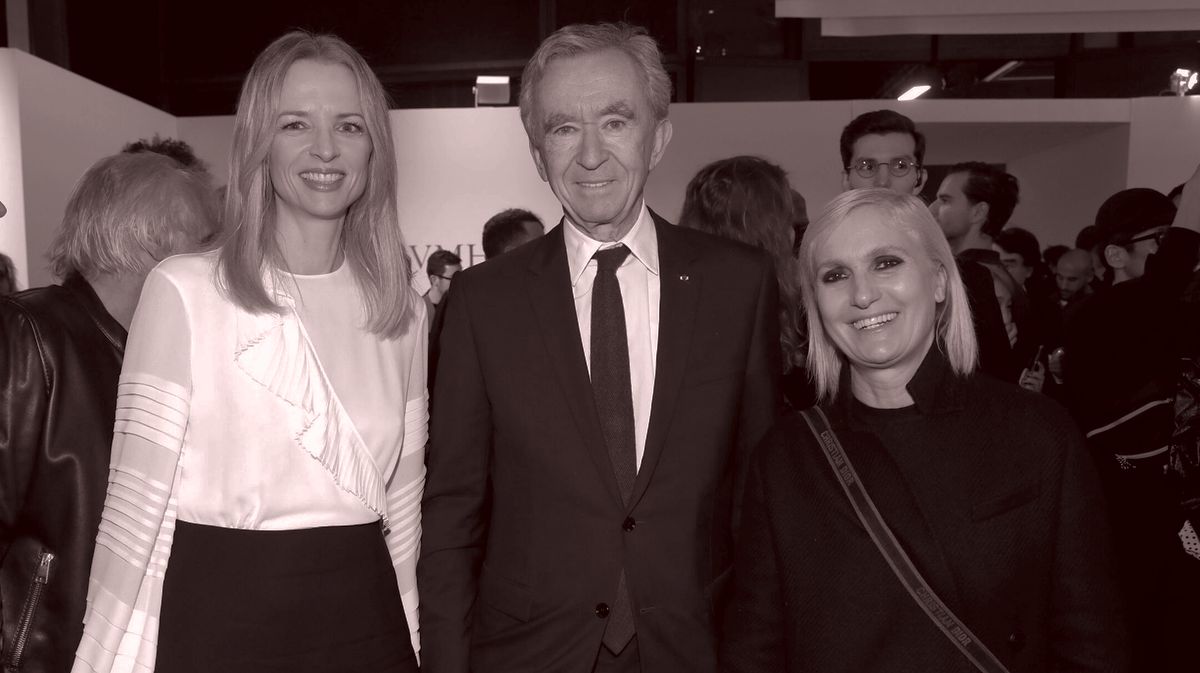
Despite being the largest company in Europe (depending on the oscillations of Ozempic), the chatter this week around LVMH, from the okay earnings to the Tiffany triumph, has been muted of late. It’s going to take a new creative direction—and return to an entrepreneurial attitude—for industry insiders (and investors) to get pumped once again.
|
|
|
This past week was all about LVMH, and yet not at all about LVMH. Yes, there were earnings—better than expected, but far from spectacular, which signaled to the market that luxury’s road to recovery may be longer than expected. (Shares were down 5 percent the day after the report was released.) Then there was the Bloomberg story about the new-guard-old-guard culture clash at Tiffany’s U.S. headquarters, and the brand’s star-studded dinner in Paris celebrating Pharrell Williams’s capsule collection. (I seemed to care more about these two events than anyone else.) And then, of course, came the announcement that the group was selling its stake in Stella McCartney back to the founder, who will exit her agreement from LVMH to run the business, which caused merely a blip in the news cycle.
More telling, perhaps, was the fact that Maria Grazia Chiuri’s Dior Couture show created zero conversation in my circles. Not good, not bad: nothing. Instead, people were talking about Chanel, Schiaparelli, Lanvin, et al., and not the LVMH brands. The threat of irrelevance is the real problem for the company, despite its $375 billion market cap, and one that the Arnaults are going to have to address during the next year if they want their other problems to go away.
The group put a Band-Aid on 2025 by relaunching the Louis Vuitton Murakami collaboration. As I mentioned on Tuesday, the partnership has already blown sales projections out of the water, and will carry Louis Vuitton—already the most stable house—through the quarter. But that’s a short-term tactic. Bringing Jonathan Anderson into Dior is the first longer-term strategic move. And while I’m slightly surprised that the company didn’t reveal his appointment during the investor call—what better way to ignite market enthusiasm?—I’m confident there will soon be a string of announcements that clarify the group’s fashion strategy.
After all, it seems so straightforward. First, Dior needs to gracefully exit its current designers. Grazia Chiuri may head to Fendi—or not—but she’s done enough that a simple retirement would be viewed as well deserved and admirable. Current menswear head Kim Jones is likely to take a beat; I heard he’s already entertaining brand consulting gigs outside of the fashion realm. I wonder whether LVMH would support a revival of Jones’s namesake line, if only to stow him away from competitors. (An insider reminded me that LVMH’s strategic investment in Phoebe Philo has the added benefit of keeping its namesake away from Chanel and Kering.) After Chiuri and Jones’s departures will come Anderson’s arrival, and after Anderson’s arrival will come Jack McCollough and Lazaro Hernandez’s Loewe announcement.
But I don’t think the transformation will conclude with only designer changes. I expect the long-awaited announcement of a new leader at the Fashion Group, along with other executive moves, in the same breath. (Interestingly, Michael Burke is still listed as a member of the executive committee, representing the Fashion Group, in the 2024 annual report. Sidney Toledano, who effectively retired at the top of the year but then returned to support the business when Burke stepped back, is not.)
That’s just the beginning of the work that needs to be done. The McCartney news was unsurprising on a number of levels, and not only because I mentioned it several months ago. McCartney has the means to operate her own shop, and her business was too small to matter inside LVMH. As I’ve reiterated time and again, LVMH has morphed into one of the two largest companies in Europe, and it can’t waste time betting on $100 million, $200 million, or $400 million brands that might, say, turn into $500 million or billion-dollar businesses. Instead, Arnault and his executive team must focus on businesses that can scale to $5 billion in revenue. And even when they are positioned to do so—like Loewe, Fendi, and Celine—$5 billion brands matter far less than Dior and Louis Vuitton. I expect that the Fashion Group will be pruned further, and know that the company is actively exploring various scenarios.
Look, there are buyers out there—including Tapestry—who would spend a lot of money to get their hands on Marc Jacobs, even though LVMH denied a Bloomberg report from last year that it was shopping the business. Then there’s Kenzo, a big fragrance business, and Moynat, a bag brand those of us in the U.S. simply do not understand. Patou, which the group acquired in 2018 as a way to access its bestselling perfume, Joy (now sold as a Dior beauty sub-brand), will likely continue on as a way to keep designer Guillaume Henry in the stable. When LVMH does dabble in smaller outfits over the next few years, they will be very small, like Patou, or its minority stakes in J.W. Anderson or Phoebe Philo. (A relaunch of Galliano fits into this mold as well.) The group’s recent year-ahead outlook did include a note about maintaining an “entrepreneurial spirit.”
|
And yet, we all know the truth. Loro Piana, Rimowa, Tiffany, and anything else of that size and stature are the future of LVMH. That’s one of the reasons I found this week’s Bloomberg story—in which 16 current and former Tiffany employees described a high-pressure, sort-of-crazy environment that made it difficult to enjoy their work—particularly interesting. My first reaction was that Tiffany C.E.O. Anthony Ledru—whose, um, challenging personality has been documented not only by me but also various others—was spared in the piece. As was former Tiffany product and comms head Alexandre Arnault, now off to fix Moët Hennessy, although that is perhaps less surprising given that the narrative was clearly driven by store employees.
The primary subject of vitriol, instead, was Americas head Christopher Kilaniotis, despite the fact that, as a regional executive, he was certainly following directives from Ledru. Of course, as the man on the ground, Kilaniotis is an easy target. LVMH insiders generally told me that the piece reflected the typical old guard versus new owner dynamic, and many suggested that the critical comments likely emanated from aggrieved ex-employees who didn’t like their severance packages. (The company cut the number of employees at the flagship Fifth Avenue store by about 40 percent last year, according to Bloomberg, reflecting LVMH’s penchant for efficiency.)
Tiffany is nowhere near category-leader Cartier in terms of prestige, sophistication, or customer service, but it’s creeping in that direction. And the 2024 record results at The Landmark, the Fifth Avenue store, suggest that LVMH can will it to become a top performer. Indeed, the company sells luxury goods, but its expertise is in ruthless, clear-eyed execution.
|
Kering is selling the famous Florence outlet mall, called The Mall—home of the even-more-famous Prada outlet—plus another luxury-off-price shopping center, to property developer Simon. The earnout is €350 million. To be honest, I had no idea Kering still owned this “non-core asset.” Congrats to everyone involved. [Inbox]
Wendy Mullin, the founder of Gen X relic Built By Wendy, is closing the business, and selling the trademark, website, and archives for $1.5 million. I really don’t think she should do that, but fine. [ Built By Wendy]
Here are two great pieces from New York magazine that I’d flagged long before I knew about this walkout business. One is about how being a Republican hasn’t been this trendy since the 1980s. The other is about how reading books hasn’t been this trendy since the 1980s. [ Brock Coylar and Matthew Schneier]
Dana Thomas wrote about vintage purveyor Didier Ludot, who is closing his store at the Palais-Royal, for The New York Times. I’m linking to the Substack version so that she gets some signups. [ The Style Files]
|
And finally… Kaitlin Phillips is funny.
Until tomorrow,
Lauren
P.S.: We are using affiliate links because we are a business. We may make a couple bucks off them.
|
|
|
|
Puck’s daily art market email, anchored by industry expert Marion Maneker, offers unparalleled access to the mega-auctions and galleries, elite buyers and sellers, and the power players who run this opaque world. Wall Power also features Julie Brener Davich, a veteran of Christie’s and Sotheby’s, who provides unique insights into how the business really works.
|
|
|
|
Puck founding partner Matt Belloni takes you inside the business of Hollywood, using exclusive reporting and insight to explain the backstories on everything from Marvel movies to the streaming wars.
|
|
|
Need help? Review our FAQ page or contact us for assistance. For brand partnerships, email ads@puck.news.
You received this email because you signed up to receive emails from Puck, or as part of your Puck account associated with . To stop receiving this newsletter and/or manage all your email preferences, click here.
|
|
Puck is published by Heat Media LLC. 107 Greenwich St, New York, NY 10006
|
|
|
|