{{ 'now' | timezone: 'America/New_York' | date: '%b %d, %Y' }} |
|
|
|
Hi, and welcome back to Line Sheet. Honestly, I’m so relieved for some reason that the Puig–Estée Lauder Cos.
merger is off. Rachel Strugatz will have more tomorrow.
Today is Inner Circle Day, and it’s a good one. Along with updates on Olivier Rousteing’s whereabouts, the cost of the Gucci show in New York, the surprising (in a good way) price of Matthieu Blazy’s first Métiers d’Art collection, and the scuttlebutt on Nicolas
Ghesquière’s future at Louis Vuitton, we’ve got a very special main event from Molly Rooyakkers, the data genius behind Style Analytics.
In extraordinary and entertaining detail, Molly explains why fashion brands need to be paying more attention to what people are saying about them on… quelle horreur… Reddit. Molly’s going to be
contributing to Line Sheet on a monthly basis, so feel free to send me any data requests and I’ll pass them along.
Tomorrow on Fashion People, my guests are Gabriela Hearst and Paul Smith, who designed a collection together that launched today. We talk about their lives, their work, their work together, and plenty more. You should pull up photos of both of their offices so you get a real visual sense of the episode before you start it. Listen here and here.
Also
mentioned in this issue: Phoebe Philo, Riccardo Tisci, Francesca Bellettini, Julien Dossena, the Niterói Contemporary Art Museum, Bryanboy, Dario Vitale, The Grand Budapest Hotel, Louis Pisano, Jonathan Anderson, Swatch, Delphine Arnault, Cecilie Bahnsen, Cathy Horyn, Ralph Lauren, Adèle Exarchopoulos, and more. |
Four Things You Should
Know…
|
-
Yes, Olivier Rousteing got a new job: According to the Paris-based publication Glitz, the former Balmain designer has been installed at a French “couture” house that is a “subsidiary of a major luxury conglomerate.” So… where could that be? Glitz is saying Puig-owned Rabanne, where the
mega-talented, if underutilized, Julien Dossena has been employed for 13 years. I’ve heard the same, but a rep for Rabanne had no comment. All I know for sure is that Dossena released a campaign this week and will present a Pre-Fall collection, which will be reviewed by the press, in June. Dossena, as mentioned, is a very good designer, and so perhaps he is simply ready to move on to a new project.
Does Rousteing make sense as a successor? No matter how this nets out, all
signs point to Puig or L’Oréal, where fragrances drive the majority of their fashion businesses. (I can’t see a world in which LVMH or Kering would hire him, especially if that involved firing someone else.) Rousteing had a loyal clientele at Mayhoola-owned Balmain, but the house was small and dwindling. His biggest selling point, other than being very nice by all accounts, is his extraordinary social media presence: 9.4 million Instagram followers alone, which makes him the perfect fit for a
fragrance-first house where making money off clothes and accessories is a nice-to-have secondary line of revenue. And his aesthetic dovetails with the heavy metal DNA of Rabanne. More soon.
|
|
|
|
A MESSAGE FROM OUR SPONSOR |
Agentic commerce isn’t a future concept. It’s already reshaping how people shop. Static storefronts are giving way to
guided, conversational experiences that don’t just surface products. They drive decisions and conversion in real time. Swap’s Agentic Commerce 101 breaks down what’s real and what it means for brands right now. Inside: |
• What agentic commerce is and why most AI tools don’t qualify • Why AI discovery platforms aren’t built to convert for your brand • Why owning your AI experience and your data is becoming non-negotiable |
|
|
|
-
Honestly, $10 million sounds low to me: In her review of the Gucci show in Times Square, Cathy Horyn revealed that Gucci C.E.O. Francesca Bellettini disclosed that the production cost around $10 million—a sum that instigated a minor internet freakout. To be clear, this
is a standard, if not modest, amount for such a production. Many off-calendar shows cost upward of $20 million to get off the ground. I was told by a hospitality industry source in Los Angeles that Dior spent $3 million just to rent the Chateau Marmont for its afterparty. (A rep for Dior had no comment.) Perhaps the Gucci Mansion on Madison Avenue was not included in Bellettini’s show calculation.
It was all surely worth it. These shows are important marketing moments. I’ll never
forget Nicolas Ghesquière’s Louis Vuitton Cruise show at the Niterói Contemporary Art Museum in Rio de Janeiro, which reportedly cost the company more than $20 million to produce—and that was a decade ago. After all, the house had to essentially subsidize the reopening of a truly extraordinary building; ensure there were zero mosquitoes (this was peak Zika era… were we ever so young!); and fly out the famous LVMH shaman to keep the rain away. - A
piece of Chanel for less than expected: Personal shoppers are passing around the finalized prices of Chanel’s Métiers d’Art collection, which is hitting stores in the coming weeks, and they’re even more reasonable than Matthieu Blazy’s first ready-to-wear drop. Many jackets are in the €6,000 range, and there are dresses for €5,000. As always, I’m not suggesting these prices are accessible, but they’re lower than many other luxury brands. It recalls the Hermès approach,
where the house claims to price items based on the costs of raw materials rather than responding solely to the market. If you need any advice, feel free to reach out to Bryanboy, who has, somehow, become the de facto customer service representative for people online who are considering buying something from Chanel.
- Yes, he’s still
there: Last night, Louis Vuitton staged a runway show at the gorgeous Frick museum in New York. I always thought Ghesquière’s Cruise collections were his best for LV, but this was not particularly good. At Versace, Dario Vitale did the early 1980s thing in an irresistible way. This collection, inspired by Ghesquière’s first trip to New York back then,
was as stiff as anything he’s created at Vuitton. The Keith Haring stuff was too generic; Uniqlo licenses the same images. (Remember, Louis Vuitton has Murakami and Richard Prince. These collaborations are meaningful.) The peanut gallery is wondering how much longer Ghesquière will be there. As I’ve said before, these things often drag out far longer than any of us think they are going to. However, it’s painful for everyone at this point.
Ghesquière is an incredibly talented designer, and it was simply never the right match.
|
|
|
|
Reddit, the platform that fashion brands have mostly ignored (and for good reason), is
becoming a key source for how we learn about them in the A.I. era. Unfortunately, there may be no way to control the trolls. |
|
|
|
Once a dingy bastion of snark pages, N.S.F.W. tags, and conspiracy theories, Reddit has somewhat surprisingly
become a genuinely important platform for fashion brands. Not necessarily because of the fan communities, per se, but due to the frequency with which Google and A.I. chatbots, like ChatGPT and Claude, scrape their collective wisdom. One recent study found that Reddit was the most cited source for A.I. responses on Gemini and Perplexity, and the second-most-cited source on
ChatGPT after Wikipedia.
The implication for brands is uncomfortable: A community they don’t manage, and presumably find largely appalling, has become a primary source for how A.I. bots describe their products. For example, when I Googled Matthieu Blazy’s appointment at Chanel, the sixth result was a Reddit discussion from r/Fauxmoi.
When I gave the same question to ChatGPT, its response was largely informed by a thread from r/chanel.
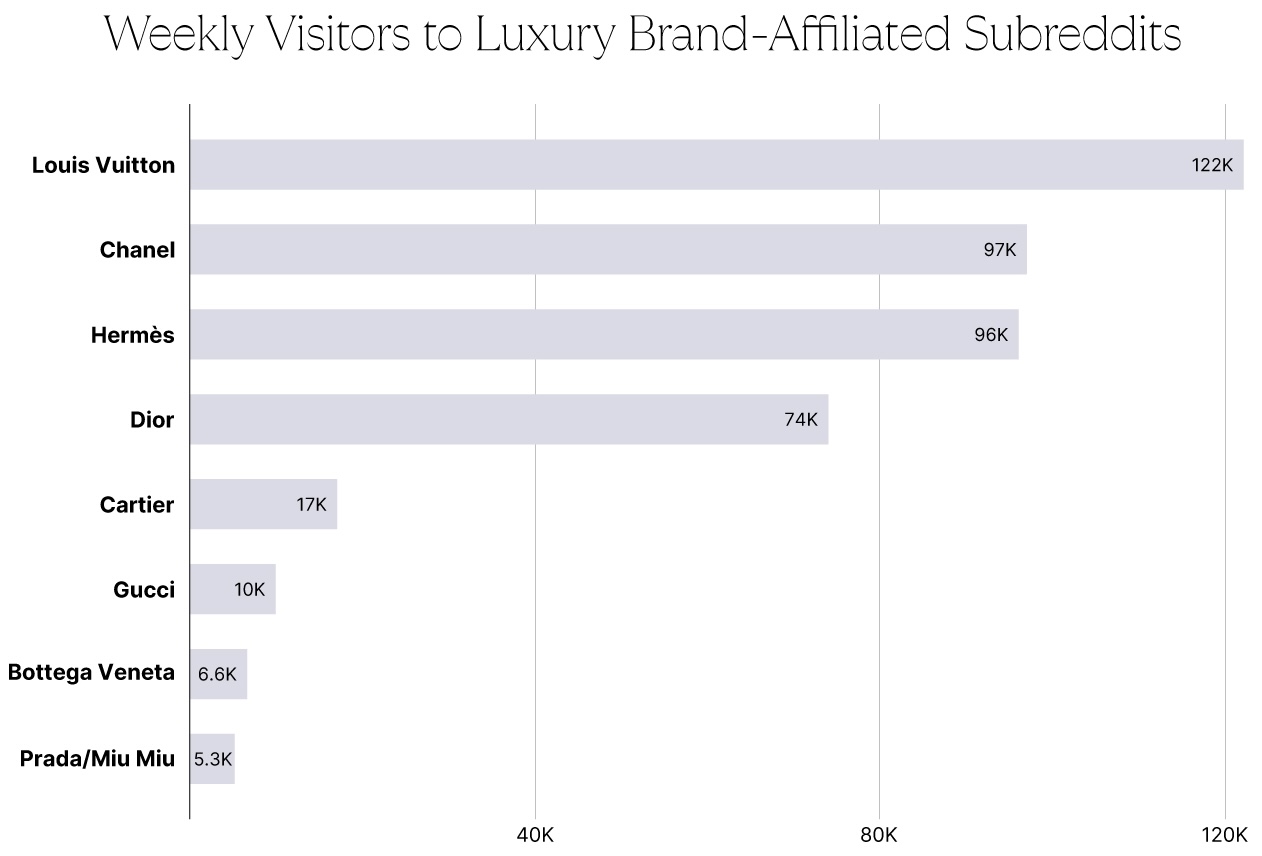
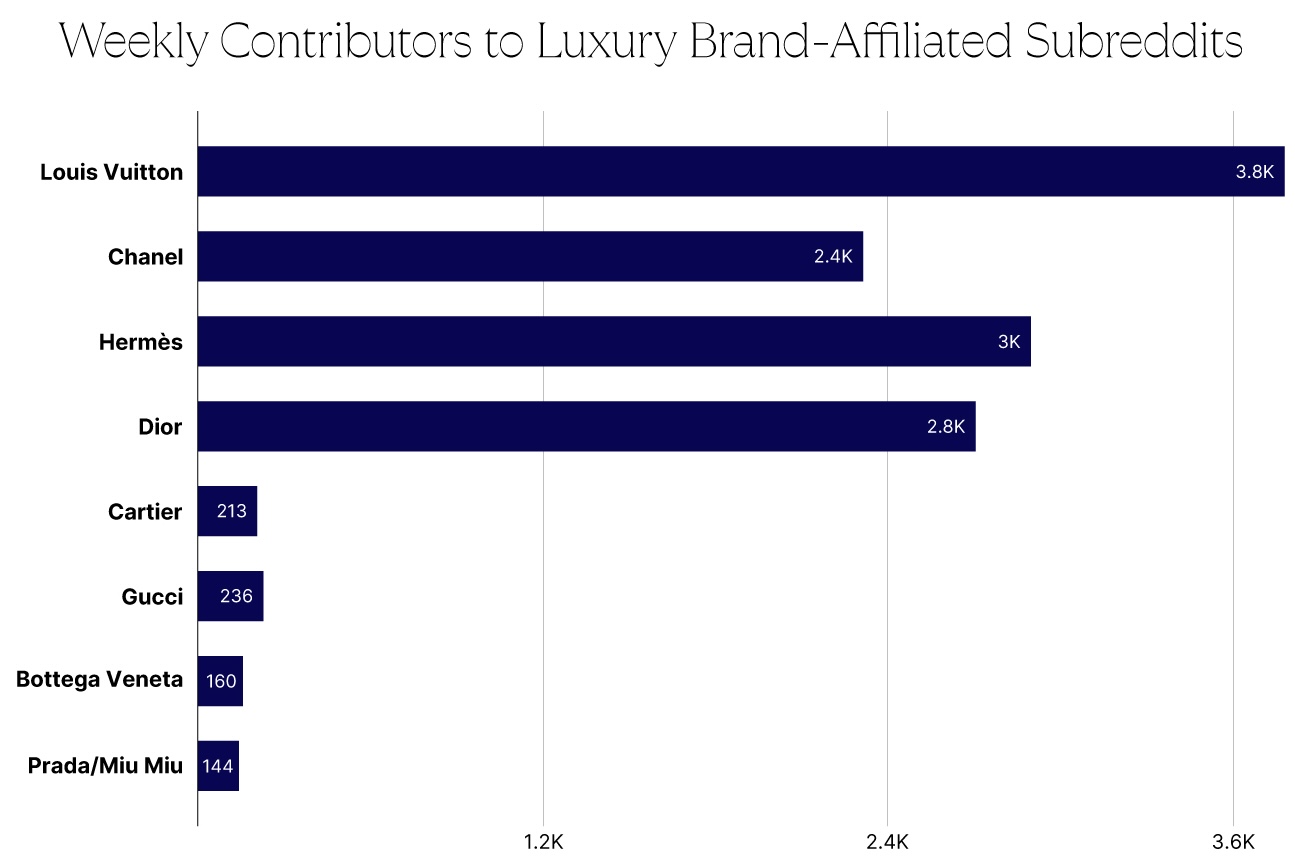
Chanel, Dior, and Louis Vuitton have obsessive communities ranging from 17,000 to 122,000 weekly visitors. These are spaces where people share their recent purchases, discuss the authenticity of secondhand finds, debate the value
of certain pieces, and sometimes weigh in on the internal politics of the brand—creative director appointments, C.E.O. departures, etcetera. Luxury brands are also frequently mentioned and discussed in forums about celebrity dressing (r/Fauxmoi, r/whatthefrockk), purchase decisions (r/femalefashionadvice, r/handbags), and niche communities within fashion (r/ThrowingFits, which I’ve previously
analyzed). |
|
|
|
A MESSAGE FROM OUR SPONSOR |
Agentic commerce isn’t a future concept. It’s already reshaping how people shop. Static storefronts are giving way to
guided, conversational experiences that don’t just surface products. They drive decisions and conversion in real time. Swap’s Agentic Commerce 101 breaks down what’s real and what it means for brands right now. Inside: |
• What agentic commerce is and why most AI tools don’t qualify • Why AI discovery platforms aren’t built to convert for your brand • Why owning your AI experience and your data is becoming non-negotiable |
|
|
|
To get a clearer picture of what Redditors are actually saying about brands, I scraped the 100 most recent
posts from subreddits dedicated to eight popular luxury houses using the platform’s public A.P.I. and analyzed the findings using R (a programming language) and a little bit of A.I. (thanks, Claude). This process captured the number of weekly visitors and contributors; the average number of comments on a post; the percentage of posts that are positive, negative, or neutral in sentiment; as well as the key topics being discussed for each brand. |
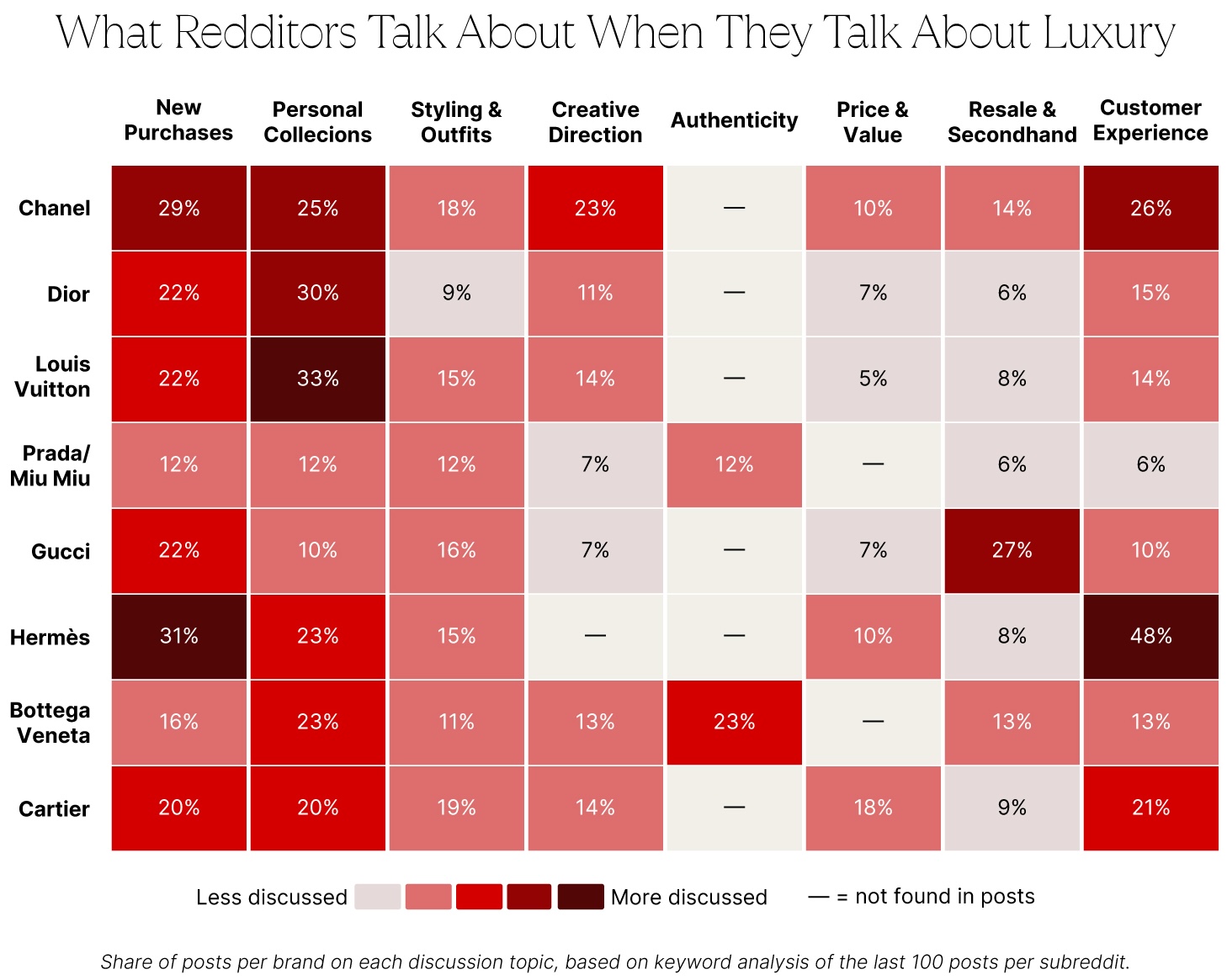
As you can see, most of the conversations skew heavily toward shopping and personal product affinities rather
than the businesses behind these brands. Across the dataset, the highest-engagement posts tended to be either people excitedly showing off a recent purchase or complaining about an in-store experience. Notably, Reddit luxury communities are also overwhelmingly positive: No brand scored less than 71 percent in terms of positive posts or comments, which makes the exceptions to this pattern potentially more meaningful. |
In r/TheHermesGames, the subreddit is organized almost entirely around “getting into Hermès.” The community
discusses pre-spend strategy, boutique relationships, and offer timing; the products are a secondary concern, and creative direction or management of the brand didn’t come up once in the dataset. Customer experience accounts for 48 percent of posts, and the most upvoted posts tend to be boutique experiences gone wrong—such as getting your Birkin request rejected.
Meanwhile, Chanel had the highest share of creative-direction discussion in the dataset, but the conversation was less consumed
with debating Blazy’s vision and more about tracking down his pieces. The community shares what they bought, where they found it, and how far they traveled to get it. Discussions about the brand’s business are largely absent, but excitement around purchasing the most recent release is palpable.
Gucci’s most popular post in this survey was about an inherited 1970s bag (never used), which was upvoted 909 times. This tracked with a broader theme in the subreddit, in which resale and
secondhand account for 27 percent of posts—the highest in the dataset—with “vintage” and “secondhand” dominating the keyword set. It’s probably not a great sign for the health of the brand when the community is more excited about the archive than discussing the current offerings. |
|
|
|
Dior’s community was almost exclusively focused on purchases—and, most recently, the Lady Dior and the
Cigale. Users in r/Dior also tended to be fixated on the brand’s tiered loyalty program: Members carefully track their spending to get to “platinum” status, compare gifts (La Maison du Chocolat chocolates, moon cakes, limited edition drops), and share their welcome packages for different membership tiers. The highest-scoring loyalty post in the dataset, simply titled “SO DONE,” was from a two-year platinum member whose limited-edition item was canceled while she watched influencers receive the
same product for free. |
While active subreddits give A.I. systems more material to work with, more content doesn’t
necessarily mean more positive representation. Yes, the majority of posts are positive in sentiment, but the ones that rise to the top with the most upvotes tend to be outliers: a defect complaint, a loyalty program betrayal, or a bad boutique experience. The result is that A.I. may actually be learning a disproportionately negative version of the brands. Similarly, brands without a dedicated subreddit presence—such as Fendi or Alaïa—have an adjacent vulnerability. A.I. systems are
forced to draw on more tangential references, like red carpet posts on r/whatthefrockk or the occasional thread on r/femalefashionadvice. The result is a thinner, less representative dataset, where the conversation is not controlled by fans of the brand.
The irony is obvious. Luxury brands want to control everything about how they show up, and yet their reputations are increasingly being influenced by unmanageable communities. Meanwhile, the fact that a few thousand highly
engaged buyers can quietly shape what a brand means to other consumers suggests that an organic community of advocates is a powerful asset—especially in an already difficult landscape for luxury, and at a time when A.I. is taking a larger role in how people discover and research what to buy.
For more, follow Molly’s data-driven fashion forecasting on Instagram at Style
Analytics. |
José Criales-Unzueta has an update on the Riccardo Tisci sexual assault
allegations via the independent reporter Louis Pisano: The Italian pop star Mahmood is being called to testify in court by Tisci’s legal team regarding what actually happened the night of the accusations. [Vanity Fair and
X]
I gave up on Wes Anderson movies after The Grand Budapest Hotel, but this notepad is still incredibly charming. [Astier de Villatte]
Adèle Exarchopoulos, in the running
for Hottest Woman Alive, wore Phoebe Philo in Cannes. [Red Carpet Fashion Awards]
Ralph Lauren beat expectations in the fourth quarter of its fiscal year. It’s truly winning, especially in China. Long live Polo!
[WSJ]
This interview with Jonathan Anderson and Delphine Arnault is worth watching. [Financial Times]
Uniqlo is collaborating with Cecilie
Bahnsen, which seems like a smart pairing. Many girls like to wear big skirts with sneakers. [New York]
On the collab beat, how lucky is Ambush that their Royal Oak dropped just days after the Swatch insanity? [Wallpaper]
Victoria’s Secret is changing its ticker to VSXY, a relief to all of us who remember the VSCO girls. [TradingView]
Estée Lauder ended merger talks with Puig.
[Reuters] |
Until tomorrow,
Lauren
P.S.: We use affiliate links because we are a business. We may make
a couple bucks off them. |
|
|
|
Puck’s daily art market email, anchored by industry expert Marion Maneker, offers unparalleled access to the mega-auctions and galleries,
elite buyers and sellers, and the power players who run this opaque world. |
|
|
|
Puck sports correspondent John Ourand and a rotating cast of industry insiders take you inside the executive suites and owners boxes where
the decisions that shape the entire sports business are made. You’ll hear interviews with players, network execs, and everyone in between. The Varsity is an extension of John’s private email for Puck by the same name. New episodes publish every Wednesday and Sunday. |
|
|
|
Need help? Review our FAQ page or contact us for assistance. For brand partnerships, email ads@puck.news. You received this email because you
signed up to receive emails from Puck, or as part of your Puck account associated with {{customer.email}}. To stop receiving this newsletter and/or manage all your email preferences, click here. |
Puck is published by Heat Media LLC. 107 Greenwich St., New York, NY 10006 |
|
|
|
|