{{ 'now' | timezone: 'America/New_York' | date: '%b %d, %Y' }} |
|
|
|
Welcome back to Wall Power’s Inner Circle. I’m Marion
Maneker.
It’s been a tough five years for the London salesrooms. Once the epicenter of the fine art and auction business—Sotheby’s, Christie’s, and Phillips were all founded in 18th century London—the city has struggled to define itself in the post-Brexit, post-Covid era. But the concerted efforts of London’s specialists produced very solid sales this season, with $550 million spent across a wide range of artists. Below, I’ll go deep on the sales metrics, using data from our
friends at ARTDAI.
On your way there: The Independent announced the exhibitors for its new location on the East Side, at the basketball pier; ARTnews ferreted out information regarding the planned Cy Twombly retrospective at the Met; and people are leaving the Fine Art Group.
Mentioned in this issue: Henry Moore, Francis Bacon, Wassily Kandinsky, Lucio Fontana, René
Magritte, Pablo Picasso, Gerhard Richter, Claude Monet, Lucian Freud, Jens Juel, Henri de Toulouse-Lautrec, Joel Ballin, Johan Laurentz Jensen, Bertha Wegmann, Leon Kossoff, and more…
Let’s do it… |
- Ken Citron exits Fine Art Group: Less than a year after assuming the role of chief executive officer at the Fine Art Group, and just over two years after joining as chief operating officer, Ken Citron, a veteran of both Sotheby’s and Christie’s in operational roles, has left the company. Several other senior staff have quietly left, too. Philip Hoffman confirmed with me that he is resuming his former position as C.E.O. and is “very
growth-focused and definitely not downsizing.”
- Cy Twombly needs a retrospective: When I raised some questions about the $40 million estimate for Agnes Gund’s Cy Twombly painting to be auctioned this May, someone bet me it would end up breaking the artist’s record for the highest price per square inch. Taking the advice of Sky Masterson’s father, I declined that “action.” But what I did say to many of those I spoke with was that there
was nothing wrong with the Cy Twombly market that a great museum show somewhere in the world could not fix. Turns out I was manifesting. ARTnews reported earlier this week that they had seen a job listing on NYFA, the lifeblood of the art industry, for a research associate to work on a Twombly retrospective at the Met, scheduled for March 2029. The Met has not confirmed the show, but the job listing remains active.
- The Independent’s spring fair revealed: Debuting on Pier 36 on New York’s Lower East Side, the Independent will run from May 14 to 17, with 76 galleries—almost half from outside the United States—representing more than 100 artists. A full 70 percent of the fair’s presentations will focus on a single artist, and three of the participating galleries will install large-scale sculptures
across the fair.
|
Now, let’s get to the data… |
|
|
|
The auction house results from the recent London sales show a healthy, steadily
improving market with more artists in the top tiers, vigorous bidding in the lower tiers, and a hammer ratio that everyone can be happy about. |
|
|
|
Following last week’s sales in London, every specialist I spoke with was in a buoyant mood.
Assembling the works they offered couldn’t have been easy. Where the New York sales are now focused on large art collections that have come to term—my friend George O’Dell’s neat euphemism for everything from death to estate planning—collectors in Europe and the United Kingdom have generally not been pressed to sell their works all at once. (One Belgian couple did, however, choose the right moment to sell.) That said, securing property for the sales is only half of the art
market equation; it only works, of course, if buyers also show up. And they certainly showed up in London. The result was the best sales cycle we’ve seen in five years.
The premium total for last week’s sales in London was a robust $551 million—a return to health for a market that has not seen that level of sales since the last peak in 2022, a year of extraordinary global liquidity and market demand. That year, the premium total from London sales at Phillips, Christie’s, and Sotheby’s
reached $718 million. Over the following years, sales declined by an astounding 66 percent, hitting $318 million in 2025—a painful slide for a city that remains a central pillar of the art trade. Last week’s sales were a strong rebound, representing a 76 percent bounce back from last year’s depressed returns.
Looking at the average lot price in these London sales over the last five years, we see that this season’s $670,000 still lags behind the recent peak of $1.1 million, in 2022, when
roughly 11 percent fewer lots were sold, including three that sold above $50 million. By 2025, the average price had fallen to $514,000, with no lot selling for more than $15 million. And while this year’s comeback is good, it doesn’t get London back above the $706,000 average from 2023.
The combined sell-through rate was within industry standards—83 percent, with 823 lots offered and 684 sold. Among the lots sold, 235 (34 percent) were bid above the estimate range; 264 (39 percent) sold
within the estimates; and 185 (27 percent) sold below the estimates.
The overall hammer ratio was good but not great, at 1.11. That number, along with the proportion of sold lots that achieved prices above, within, and below estimates, suggests a steadily advancing market with more buyers competing for works—but not an aggressive one, and that’s good news. For London to reclaim its role in the global market, its sales need to show steady, sustained growth rather than a volatile
snapback.
|
- Henry Moore, King and Queen (1952) $35.9M
- Francis Bacon, Self-Portrait (1972) $21.6M
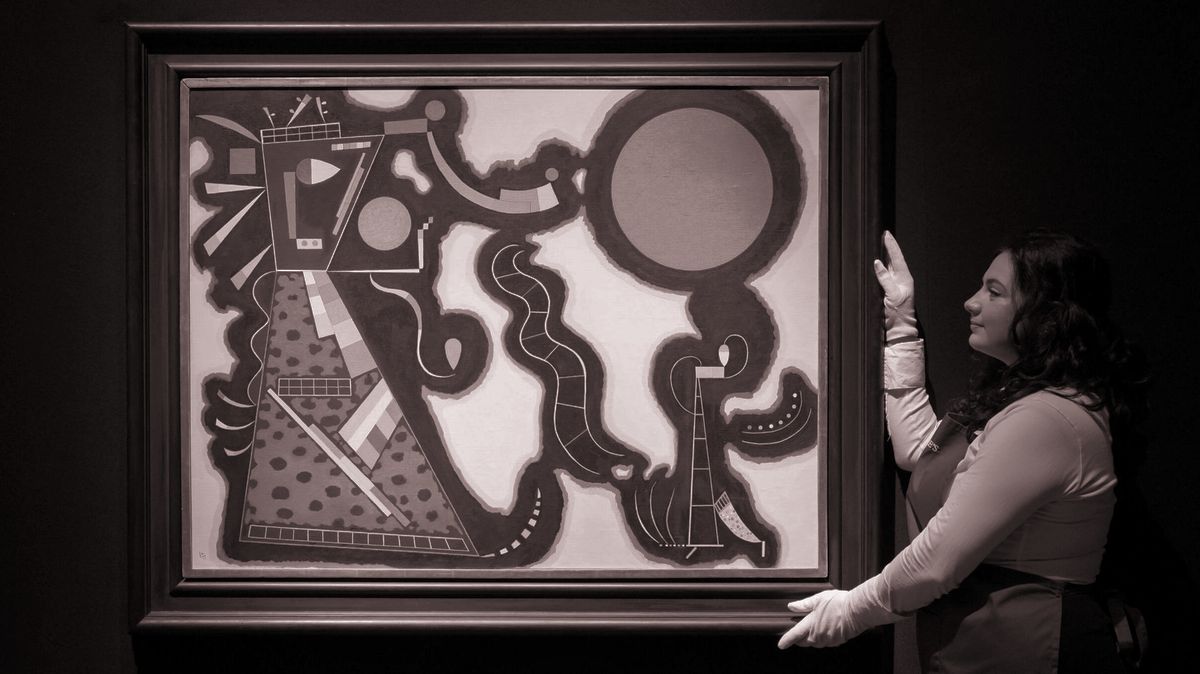
- Wassily Kandinsky, Le Rond Rouge (1939) $17M
-
Lucio Fontana, Concetto spaziale (1960) $13.3M
- René Magritte, Les grâces naturelles (1961) $11.6M
- Pablo Picasso, Le peintre et son modèle (1964) $11.6M
- Gerhard Richter, Schober (1984) $11.4M
- Claude
Monet, Maison de jardinier (1884) $11.1M
- Gerhard Richter, Abstraktes Bild (1991) $10.3M
- Lucian Freud, Blond Girl on a Bed (1987) $10M
|
The top two lots in the London sales exceeded their estimates by strong margins,
and were the only ones in the top 10 that saw dynamic bidding. Since both consignors were sophisticated art market players, I’ll assume they took advice from the auction houses and allowed the works to be offered with estimates below their own expectations. Notably, neither had the price protection of a third-party guarantor, but six of the top 10 lots did, which makes sense given the perceived risk of participating in these sales.
For instance, the third-highest-value lot,
Kandinsky’s abstract painting Le Rond Rouge, was also offered at a price significantly below what it had achieved in its most recent auction sale. That work had a third-party backer—presumably the buyer—who wound up paying around 17 percent less for it than the seller had paid. The fourth-most-valuable lot was a Fontana that sold for slightly below the estimate, again presumably to the third-party guarantor. The remaining six lots all sold within the
estimate range. Taken together, these numbers suggest a market in balance between supply and demand, with price expectations also at an equilibrium. |
- Jens Juel, Seated Chinese Man in Mandarin Dress: 11.5 ($202,307)
- Henri de Toulouse-Lautrec, Tête de cheval: 10.3 ($26,872)
- Joel Ballin, Study of a Model: 9.5
($68,849)
- Johan Laurentz Jensen, Basket with Roses: 8.0 ($35,184)
- Bertha Wegmann, Interior with a bunch of wildflowers: 7.6 ($334,247)
- Johan Laurentz Jensen, Poppies and Lilacs: 7.6 ($33,425)
- Leon
Kossoff, Children’s Swimming Pool: 7.0 ($7,036,371)
- Alice Bailly, Dans l’eau courante: 6.8 ($58,945)
- Man Ray, Purple Mask: 6.7 ($468,093)
- Johan Laurentz Jensen, Basket of Flowers and Fruits: 6.7 ($35,184)
|
The lots that saw the most aggressive bidding were all historical works, the most
recent being Leon Kossoff’s work from a seminal series of paintings that Sotheby’s was able to market well. Several works in the top 10 come from former ambassador John Loeb Jr.’s sale at Phillips, which featured his collection of Danish painters, including Jens Juel, Joel Ballin, Johan Laurentz Jensen, and Bertha Wegmann.
Notably, six of the top 10 works sold for five-figure prices,
indicating that bidders remain focused on lower-value lots. For example, the Toulouse-Lautrec drawing sold for a remarkable multiple of its very low $2,000 estimate, but it was not a major purchase, with a premium price of just under $27,000. Swiss dadaist Alice Bailly’s woolen work sold for nearly seven times the estimate, but only achieved a price of just under $60,000. Man Ray’s Purple Mask, meanwhile, had the kind of sale the market
would like to see more of: Estimated at £40,000, it sold for almost £343,000. In fact, the week in London was very strong for Man Ray. Five works were offered and sold, three of them for multiples of the estimates—including one that made more than six times the asking price.
For the past few seasons, third-party guarantees have been considered a sign of market confidence. Bidders, especially on high-value lots, have taken the guarantee to mean the estimate was reasonable, or perhaps even
underestimated the value of the work. (In other market climates, bidders have viewed third-party guarantees as a sign that the best price had already been achieved.) Looking through ARTDAI’s data for the London sales, it turns out only 22 of the 86 guaranteed lots saw bidding above the estimates. Of those 22 lots, 16 were David Hockney iPad drawings. That leaves just six guaranteed lots subjected to aggressive bidding. The sample is too small to extrapolate from, but it may be
another signal that the market is gathering momentum. |
- Henry Moore (7.9%) $43.4M
- René Magritte (5.7%) $31.5M
- Pablo Picasso (5.6%) $30.6M
- Lucian Freud (4.8%) $26.4M
- Lucio Fontana (4.7%) $25.7M
- Andy Warhol (4.4%) $24.1M
- Gerhard Richter (4.3%) $23.7M
- Francis Bacon (3.9%) $21.6M
- Claude Monet (3.7%) $20.3M
- Wassily
Kandinsky (3.2%) $17.4M
|
The market share numbers confirm what we’ve discussed several times in recent
months: The historical turn in the art market is now fully complete. Gerhard Richter is the only living artist on the top 10 market share list, and he has stopped making art. All of these artists are pillars of the market, and the fact that no single artist commands more than 10 percent of market share suggests the rebound is broad-based, and therefore healthy.
Looking at this list, which includes no women or people of non-European descent, it would be tempting to
conclude that the market has reversed its drive toward diversity. But 388 artists were represented in this year’s sales, up from 309 last year and 348 in 2022. That year, the top 10 artists accounted for 56 percent of the sale total. This year, the figure is 36 percent.
I won’t claim this is evidence that the art market is diverse, equitable, and inclusive. We’re a long way from that. But I would caution everyone to remember that the very nature of these markets is to reflect the patterns
and preferences of the individuals who participate in them. The slow progress we’re seeing is still progress. The art market remains dominated by dead European men—but a little less so, and it’s moving in the right direction, even in the midst of a revanchist backlash. |
That does it for today. Clare McAndrew’s art market report comes out early
tomorrow morning. I’ll take a closer look at it on Friday.
Let’s gather together then,
M |
|
|
|
Finally, a media podcast about what’s actually happening in the media—not the oversanitized,
legal-and-standards-approved version you read online. Join Dylan Byers, Puck’s veteran media reporter, and Julia Alexander, a longtime media analyst, as they sit down with TV personalities, moguls, pundits, and industry executives for raw, honest, sometimes salacious conversations about the business of media and its biggest egos. New episodes publish every Tuesday and Friday. |
|
|
|
Unique and privileged insight into the private conversations taking place inside boardrooms and corner offices up and
down Wall Street, relayed by best-selling author, journalist, and former M&A senior banker William D. Cohan. |
|
|
|
Need help? Review our
FAQ page or contact us for assistance. For brand partnerships, email ads@puck.news.
You received this email because you signed up to receive emails from Puck, or as part of your Puck account associated with {{customer.email}}. To stop receiving this newsletter and/or manage all your email preferences, click here. |
Puck is published by Heat Media LLC. 107 Greenwich St., New York, NY 10006 |
|
|
|
|