Welcome back to Dry Powder. I’m Bill Cohan.
Today, the latest
installment of my ongoing tête-à-têtes with beleaguered Apollo co-founder Leon Black, the formidable private equity pioneer whose seemingly inexplicable relationship with Jeffrey Epstein continues to shadow him. Last week, we sat down in his Park Avenue office, where Leon had much to say about Ron Wyden, the ranking Democrat on the Senate Finance Committee, whose ongoing investigation into the billionaire has
fueled an endless series of New York Times stories.
It’s been two years, almost to the day, since Leon first broke his silence with me to discuss Epstein—conversations for my upcoming book on Apollo that also formed the basis for two earlier stories in
Dry Powder. Our latest meeting constitutes the third installment in this series.
Mentioned in this issue: Leon Black, Jeffrey Epstein, Ron Wyden, Adam Wyden, Brad Karp, Susan Estrich, Joey Zwillinger, Joe Vernachio, Robert Schwartz, and many more…
But first… |
|
|
|

| Malique Morris
|
|
- R.I.P.
Allbirds: Allbirds, the maker of Silicon Valley’s once-favorite yet always-super-lame sneaker, announced on Monday that it was being acquired by licensing firm American Exchange Group for $39 million. The deal is expected to close in the second quarter, pending shareholder approval in April. It’s a spectacular fall for the erstwhile D.T.C. darling, once unavoidable on the soles of the 2010s-era founder set, that was valued at $4 billion at its 2021 I.P.O.
Then again, it’s been a
steady decline since those heights. In April 2024, Allbirds risked delisting after its share price fell below $1 following a failed attempt in the running market. The company never recovered. Co-founder Joey Zwillinger had left his C.E.O. post a month earlier, and operating chief and Nike veteran Joe Vernachio was promoted to the helm. Alas, the real lesson here was that Allbirds never created any sort of moat around its unattractive and sexless
sneakers. Nike, Adidas, et al. could just as easily create footwear for wannabe founders and I.T. guys. Much like BuzzFeed and other Web 2.0 businesses, Allbirds helped pioneer a behavior and distribution channel but was unable to keep up with its peers as material capital exploited the opportunity. The fact that it was ever valued at $4 billion is the sort of financial comedy that defined the unicorn era—you know, the time and place where WeWork was worth $50 billion.
American
Exchange Group, which owns cheap mall brands like Aerosoles and past-their-prime names like Ed Hardy, will probably take the company private and license it to smithereens. Such is the fate for an overcapitalized brand that probably wasn’t a good idea to begin with. Remember there will be another one of these very soon. There always is.
|
|
|
|

| Eriq Gardner
|
|
- A
watershed suit in the coming A.I. I.P. wars: Ironically, just as an L.A. jury was finding Meta and YouTube liable for design decisions that create real-world harms, the Supreme Court was moving in the opposite direction on copyright. In Cox v. Sony Music, the justices poured cold water on a billion-dollar verdict and reset the standard for contributory liability, raising the bar for holding companies responsible for users’ copyright violations. It’s no longer enough to show that a
service provider knew its users were infringing. Plaintiffs now have to show the company encouraged or intended that behavior. The publishers and labels were quick to downplay the decision as I.S.P.-specific, but that feels a bit like wishful thinking. The logic travels. If knowledge alone isn’t enough, then a lot of pending A.I. copyright cases just got harder. And we’re already seeing the ripple effects: A federal judge has ordered a briefing on Cox in the
authors’ class action against Nvidia, which is a pretty clear signal that courts see this as more than a niche ruling.
There’s more coming. This week, watch the case that Disney, NBCUniversal, and Warner Bros. Discovery filed against MiniMax, the Chinese A.I. video company that the studios accuse of “pirating and plundering” their I.P. at scale. MiniMax isn’t exactly ducking the fight, either. It has hired Quinn Emanuel’s Robert Schwartz, a veteran of the file-sharing
wars, and he’s signaled he’ll move to dismiss by April 10. Given what the Supreme Court just decided, I’m guessing he’ll argue that building a cutting-edge tool that’s merely capable of infringement is not the same as encouraging it.
|
|
|
|
The erstwhile Apollo executive has more to say about his entanglements with
Epstein, Ron Wyden, and his latest foe, The New York Times. |
|
|
|
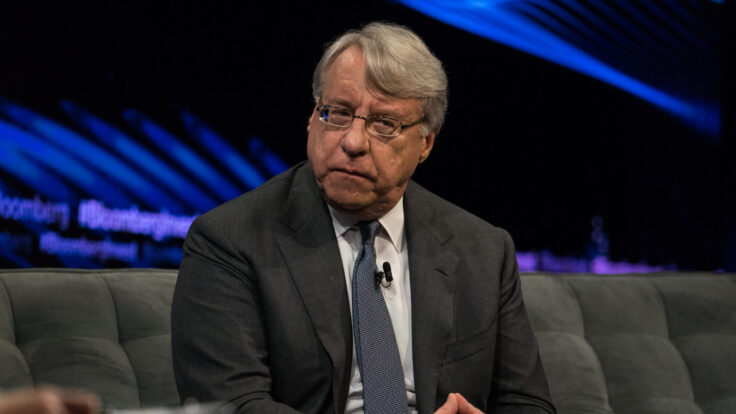
Last week, on March 25, I sat down again with Leon Black in his
spacious Park Avenue office, at the corner of 57th Street. He was stewing big-time. It was a few days after Ron Wyden, the ranking Democrat on the Senate Finance Committee, had publicly released his latest scathing letter about Black—the details of which found their way onto the front page of The
New York Times that very same day. Leon reiterated to me—just as he had during our memorable conversations a couple years ago, which formed the basis of the first two parts in this series—that he didn’t
know Jeffrey Epstein was a criminal pedophile. Yes, he was “a bit offbeat and counterculture and eccentric,” Leon once told me. And yes, he had pleaded guilty in 2008 to soliciting a minor, but “he was with a 17-year-old prostitute, got prosecuted for it, and got put away for a year,” he said. “I didn’t think this was the end of the world, frankly.”
When we reconnected last week, Leon insisted that the staggering $158 million he’d paid Epstein over the years—Wyden later
pegged the number at $170 million—amounted to a mere 5 percent commission on what Epstein had saved him on taxes and for other business-related advice. According to Leon, Epstein managed to devise a multibillion-dollar estate tax strategy that had eluded his previous lawyers at Weil Gotshal, Paul Weiss, and Sullivan & Cromwell. “All legal, very clever,” he had told me.
Alas, Black said the other day, his involvement with Epstein was simply too delicious a target for Senator Wyden, a
longtime crusader against esoteric tax loopholes, to leave a billionaire like him alone. And the new Wyden letter was indeed damning. For one, the senator reported that Black had paid Epstein, a non-lawyer, some 30 times more for legal advice than he’d paid Paul Weiss, the principal law firm that worked for both Black and Apollo Global Management, the private equity giant Leon co-founded in 1990. “Leon Black simply doesn’t have a good explanation” for how much he paid Epstein, Wyden
told me when I reached out to his office. It was “a preposterous amount of money to pay a notorious sex criminal. If anyone can find me another individual who paid this much for tax planning, without even a formal contract, I will investigate them too.”
In his public letter, the senator suggested that Epstein’s “exorbitant compensation” was likely a “pretext for other more nefarious tasks.” Wyden went on to accuse Black of everything from using Epstein as his “fixer” in order to funnel
millions of dollars to women “in exchange for their silence,” to arranging with Epstein and Brad Karp, the former senior partner and eventual chairman at Paul Weiss, to surveil Guzel Ganieva, a Russian model with whom Black had an affair. Wyden wrote that the Justice Department’s newly released files removed “any lingering doubt as to whether you were connected to women in Epstein’s network, and the evidence that Epstein and powerful associates
in the U.S. and abroad were surveilling and paying off women on your behalf is highly disturbing.” (Black and I previously discussed his yearslong relationship with Ganieva, who ultimately extorted Black for a roughly $21 million settlement in exchange for her silence and broke their nondisclosure agreement in March 2021.)
Wyden’s latest allegations against him, Black told me,
were, you know, total bullshit. He said he’d never been with an underage girl or abused a woman in his life. Nor, his lawyers told the Times explicitly, was he aware that Epstein had made payments to women on his behalf, as the paper asserted in its latest article. Yes, he has had extramarital affairs, but they were consensual. He conceded that he gave these women gifts, as he has to all sorts of people over the years, including his late sister, he said—and he has paid the required gift
taxes on all of them. Black said he would leave speaking on the record about Wyden to his attorney, Susan Estrich, who called the senator’s latest allegations “politically motivated” and “outrageous and false.” (“The financing of sex trafficking isn’t a red or blue issue,” Wyden told me. “I’m going to keep following the money.”)
Black also didn’t understand why the Times would make his consensual affairs and his financial support of various women out to be some
kind of crime. His lawyers told all this to the Times, too, before it published its latest tome. After all, Black said, Apollo had already commissioned a January 2021 report into his relationship with Epstein—at Black’s request—that seemingly validated his narrative. The so-called Dechert report, compiled by the law firm of the same name, “took more than four months, and they interviewed more than 20 people, including me more than once,” Black told me. “They reviewed more than 60,000
documents. They asked about everything. Nothing was off the table.” (“Shoddy work,” countered Wyden, who claims to have uncovered, without further explanation, an extra $12 million in payments that Dechert had not accounted for.)
All the investigation found, per Black, was that he’d paid Epstein for legitimate business purposes. “I understand that some people don’t like these conclusions, and are now saying the investigation was ‘not thorough’ and that the report was a ‘whitewash,’” Black
said. “That’s just flat-out wrong.” In any case, a year or so after the Dechert report, Wyden launched his own investigation into Black’s dealings with Epstein, looking into tax fraud and other matters. Since then, of course, the Department of Justice has released millions of pages of Epstein emails, providing Wyden and the media with a practically endless supply of new, highly flammable material. |
Leon continues to live the life of a billionaire, with all its ups and downs. He has lost about 35
pounds, thanks to a steady diet of Mounjaro. He’s hired security for the first time in his life, after receiving death threats. He’s been busy planning a trip to the Far East and spending time at the opera with his wife of 44 years. And he’s been tending to his multibillion-dollar art collection, with its masterpieces by Picasso,
Munch, van Gogh, and Cézanne. Naturally, his interest in smart investing continues.
And yet, Black has been unable to escape what he asserts is a direct pipeline from Wyden to the Times, which has reported on practically every microdevelopment in Wyden’s investigation. (Times spokesperson Danielle Rhoades Ha wrote in an emailed statement that “our reporting is based on interviews with dozens of people who have close knowledge of the Black-Epstein relationship,” along with Black’s financial records, documents in the Epstein files, public records, and materials “obtained from sources.”)
Black was particularly frustrated with the paper’s latest salvo because he felt he’d been dutifully cooperating with Wyden’s office. To Black, Wyden never cared
about his answers—only his own agenda. “I’ve paid billions of dollars in federal, state, and city taxes,” Black told me—a figure he’s never divulged publicly. “If and when I sell shares in Apollo, I will pay capital gains taxes. I’ve never had an issue with the I.R.S. I’ve had several audits through the years.”
Last week, under the guise of a major scoop, the Times
reiterated the themes Wyden had alleged in his letter by way of a four-byline story that quoted the senator. These included that Epstein served as Black’s “fixer” with a “yoga instructor” who was waiting on a $100,000 payment from Epstein, and that Epstein and Black once “brainstormed” how to “avoid taxes” on “$20 million paid to a dozen
women,” as well as the allegations of spying on Ganieva.
But the paper went further than Wyden’s letter, citing I.R.S. audits of both Black and Anastasiya Siro—a former model and art dealer with whom, according to the Times, Black was also having an affair. Epstein, the Times reported, helped Siro navigate the audit, and also advised Black to separate from his wife, Debra, “so he doesn’t have a heart attack,” as Epstein wrote in an email
to Karp. The paper also claimed Epstein once told Karp a rumor that Black was using cocaine. “Other than experimenting with drugs early in his life, Mr. Black has not used illegal substances in more than 40 years,” his lawyers told the paper, also noting that he never consulted Epstein about his marriage.
On March 19, a few days before publication, Black and his attorneys pushed back against Wyden in response to queries from the Times. Estrich wrote the paper that Wyden’s letter was designed to
“distract” from the fact that Wyden may have “violated federal law” by previously “leaking to the media confidential financial information”—a reference to SAR reports from Black’s Bank of America accounts that found their way to the media in December 2024. Estrich further claimed that the senator’s son, Adam Wyden, who founded his own hedge fund in 2011, had himself met with Epstein in 2016 at his East 71st Street townhouse to try to get him to invest in his hedge fund. (There
are indeed emails to that effect in the Epstein files.)
Another set of Black’s lawyers, at Kaiser Law, also lobbied the Times ahead of publication. “For more than five years, The New York Times has waged a vicious and specious campaign to destroy Leon Black’s reputation,” Black’s attorney at Kaiser wrote. “In all, the Times has written nearly 37,000 words filled with unsubstantiated allegations and speculation about Mr. Black, while allowing only roughly 1,100 words—often
paraphrased—for him to respond.” Kaiser reiterated Black’s denials of any inappropriate relationships with underage girls or that he paid Epstein for women or sexual activity, and called the idea of assaulting any woman “repulsive and reprehensible to him.”
Rhoades Ha called the paper’s coverage of the Epstein-Black relationship “groundbreaking, comprehensive, and fair,” writing in her statement that “Mr. Black and his representatives have been given every chance to fact-check, provide context and speak with our reporters to ensure his perspective is included.” She wrote that the paper’s coverage of Black, as “one of Mr. Epstein’s two largest financial benefactors,” helped show how Epstein continued to prosper after becoming a registered sex offender. “We are confident in the accuracy of our reporting,” she concluded. “Mr. Black and his representatives have not disputed the facts in our coverage.” |
I could tell Black was not happy that Wyden and the Times had struck again. After all,
the life Black had made for himself before it became publicly known that he was entangled with Epstein was arguably an enviable one even for a Wall Street Master of the Universe. Others have argued, less charitably, that he’s leveraged his billions to create the reality he wanted, giving himself free rein to conduct extramarital affairs, albeit with some consequences, and then deploying an army of lawyers to try to keep things quiet. It was only after he got involved with Epstein that many of
Leon’s secrets were exposed.
So when Black found himself again the subject of a damning front-page New York Times article, he seemed rather peeved. That’s probably why, for the first time in the three years that we’ve been visiting together—largely for my upcoming book on Apollo—he wasn’t fully on the record, in case his pique got the better of him. He’s scheduled to testify before the House Oversight Committee on May 13, and no doubt Wyden’s missives will help his counterparts
in the House come up with some pointed questions. “I’m looking forward to setting the record straight on my business relationship with Epstein when I meet with the congressional committee,” he said.
After that, perhaps, he may yet be able to reclaim some semblance of the life he enjoyed before the Epstein saga laid him low. He said his four children have been very supportive of him, as has his wife—although she understandably does not appreciate all the negative publicity. When we spoke
last week, they had just been to the opera together, and then back uptown for a burger at JG Melon. “I feel terrible for the victims of Epstein’s heinous activities,” Leon told me. “I also feel terrible for my wife and family, who have had to endure relentless and intrusive scrutiny. As I’ve said before, I regret ever having met Epstein and having him involved in my family office activities.” |
|
|
|
Join Puck’s chief political columnist, John Heilemann, as he roams the corridors of power and influence in America
on this twice-weekly interview show, taking you beyond the headlines with the people who shape our culture: icons and up-and-comers, incumbents and insurgents, moguls and machers in the overlapping worlds of politics, entertainment, tech, business, sports, media, and beyond. The conversations are rich and revealing, unrehearsed and unexpected… and reliably impolitic. A Puck-Audacy joint, new episodes drop every Wednesday and Friday. |
|
|
|
Puck’s daily political newsletter from Washington on what’s really happening in this town, from the White House to
the Pentagon to Capitol Hill, K Street, and the campaign trail. |
|
|
|
Need help? Review our
FAQ page or contact us for assistance. For brand partnerships, email ads@puck.news.
You received this email because you signed up to receive emails from Puck, or as part of your Puck account associated with {{customer.email}}. To stop receiving this newsletter and/or manage all your email preferences, click here. |
Puck is published by Heat Media LLC. 107 Greenwich St., New York, NY 10006 |
|
|
|
|