Welcome back to Wall Power’s Inner Circle. I’m Marion
Maneker.
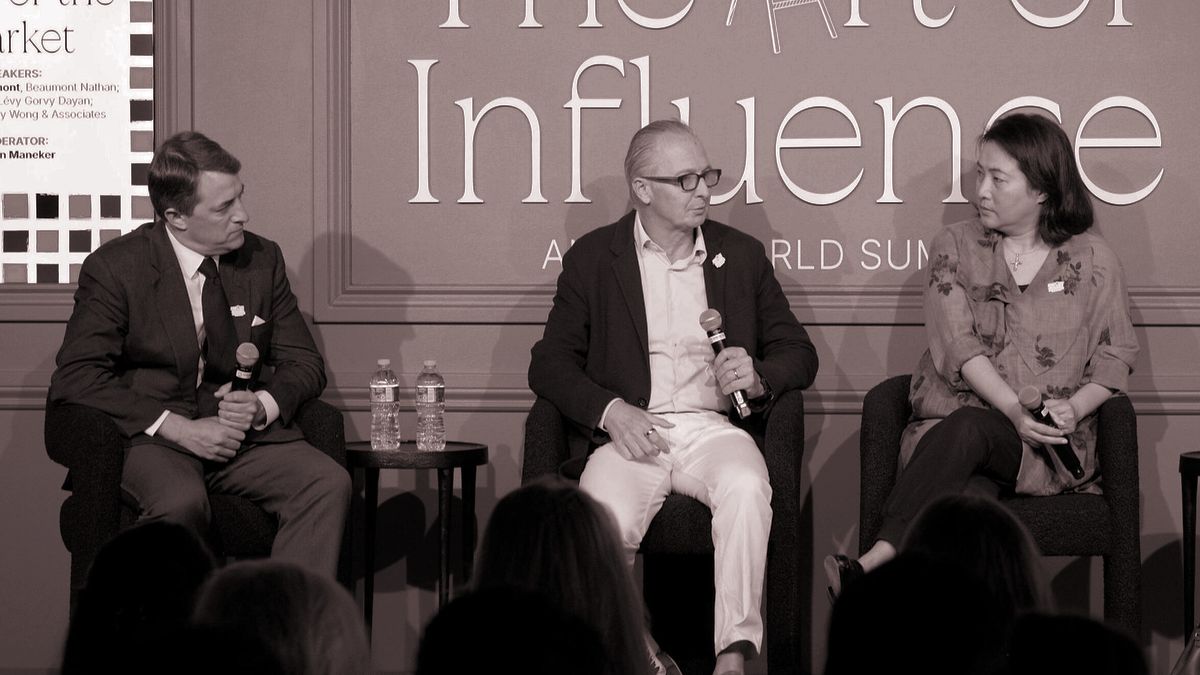
Tonight, we have a roundtable with global art advisors Patti Wong, Brett Gorvy, and Wentworth Beaumont, who were featured at the Art of Influence summit we hosted in September with our partners at the FLAG Art Foundation. All three operate at the very top of the market. In addition to their roles at their own companies, Patti and Brett are also partners with Ed Dolman in New Perspectives Art Partners, an
advisory firm for large estates and global collectors. Wentworth is the co-founder of Beaumont Nathan, a global advisory firm with offices in London, New York, and the Gulf. The conversation was a rare opportunity to get perspective from advisors to some of the world’s most accomplished collectors.
Mentioned in this issue: Patti Wong, Brett Gorvy, Wentworth Beaumont, Francis Ford Coppola, Robert M.
Olmstead, Jodi Pollack, François-Xavier Lalanne, Simon Shaw, and many more… |
|
|
A MESSAGE FROM OUR SPONSOR |
|
|
-
Watching the watches: Results are in from the watch sales at three major auction houses, wrapping up an undeniably strong season. Phillips’s Bacs & Russo watch auctioneers pulled in nearly $43.5 million, including the $10.8 million paid for Francis Ford Coppola’s F.P. Journe prototype. Sotheby’s pulled up to the bumper, selling just under $43 million—the highest-ever total for a watch auction there. I’m sure the house will give credit to its splashy new digs at the
Breuer Building. But that would be unfair to the watch department, which clearly pulled out the stops to secure property like the Robert M. Olmstead collection that accounted for $22.4 million of the sales. An Audemars Piguet pocket watch, Grosse Pièce No. 16869, sold for $7.7 million against a $500,000 estimate. Eight lots sold for more than $1 million. Christie’s came in third with a $9.3 million watch sale in which 96 percent of the lots sold, and 42 percent of the bidders and
buyers were new to the auction house.
- The Lalanne hippo sets a new record: Sotheby’s head of design Jodi Pollack predicted that the François-Xavier Lalanne hippopotamus bar would break the record for a Lalanne work, but she wasn’t bold enough to declare that the new record would be 50 percent higher. And yet, that’s exactly what happened this morning at Sotheby’s, as auctioneer Simon Shaw wrestled with
some recalcitrant bidders, accepting some split bids as the price crept up in $100,000 increments.
For a time, it looked like the hippo would only sell for a solid but not record-breaking price in the low-to-mid-teens. But once the bidding hit $14 million, two bidders got serious and took the final hammer price to $26.8 million—an astonishing number considering that the similar Rhinocretaire set the record at more than $19 million just two years ago. The hippo’s final selling price with
fees was $31.4 million. Has the Lalanne market stepped up to another level or just edged into bubble territory? It will take time to find out.
|
Now, let’s get to the main event… |
|
|
Art advisors are a fairly recent phenomenon, and no one is showing how
it’s done better than Patti Wong, Brett Gorvy, and Wentworth Beaumont. In this lively roundtable discussion, the three explain an advisor’s role in a murky market, how the back office operates, and why ambitious collectors need consultants now more than ever. |
|
|
Over the last few years, I’ve occasionally remarked—only half in jest—that advisors have become the main characters of the art world. Pioneered by just a few enterprising individuals, the advisory business has grown from a niche client service to a serious industry in its own right. Now we look to advisors not just for their insight on current market trends, but also their input on what collectors should be buying.
Even so, there are still only a handful of advisors operating in the eight- and nine-figure end of the market—where the
Klimts, Mondrians, and Picassos trade. And in many ways, the advisory business remains as mysterious to outsiders as the art economy itself. So for Puck’s Art of Influence summit, we curated a panel of three top advisors to discuss the current state of the market and their growing roles within it. Patti Wong of Patti Wong Associates, Brett Gorvy of the Lévy Gorvy Dayan gallery, and
Wentworth Beaumont of Beaumont Nathan told us how they each built their businesses, what clients look for in an art advisor, and why the industry needs to lower barriers to entry. The following interview, adapted from our conversation in September, has been lightly edited for length and clarity. |
Marion Maneker: Patti, from your perspective, how
are things going in the art market—what are the challenges and what are the positive changes?
Patti Wong: When I first started in London, and looking at the Asian market, it was very easy. [The market] just didn’t exist. While in Asia, we collected Chinese art in depth—ceramics and Chinese paintings. There was literally no one buying outside of that field. We had three clients, if we were lucky, who were occasional bidders, and they were experts living in Hong Kong. So
how did I go about building that market that was almost at zero? It was picture by picture, bit by bit. I sent out a lot of catalogues, and I marked up what I think [my clients] should buy, which made a difference. I realized [those clients] didn’t have access to this art. |
|
|
A MESSAGE FROM OUR SPONSOR |
|
|
Making the catalogue available and suggesting one or two pictures was where I
started. There was no email; I used a fax machine. What’s interesting is, I almost always got a response. People might come in and say, Well, I didn’t like what you suggested, but how about something else? That’s how I learned about people’s taste, and I would always pitch it a little bit higher the next time. So we grew it from three to 20 to a hundred to thousands of collectors. I’m very happy to have witnessed that.
Brett, tell us what’s going on in New
York.
Brett Gorvy: It’s very interesting hearing Patti’s perspective, because she’s talking about growing a market, but it’s also about individuals. There’s this idea that we’re dealing with a massive world and huge communities, but when it really comes down to it, it’s actually a very small number of participants who are affecting the market at the highest level.
Art always follows the money. One of the reasons I joined forces with Patti [to establish advisory
firm New Perspectives Art Partners] was to bring that knowledge and expose our collectors to as much knowledge as we can get. I also realize that in this market it’s about collaboration. Sharing ideas, and more importantly, sharing knowledge, is actually one of the most important things you can give to a collector today.
Wentworth, what’s your point of view?
Wentworth Beaumont: I think the fundamental challenge for this industry is how we encourage
meaningful new entrants. Obviously, there are many factors we have absolutely no control over; but I do think that there are some that we do. Relative to the proliferation of wealth over the past 10 years, I would say we’ve done an okay job—not an excellent job—at bringing new people in. And I think that’s one of the big fundamental questions facing this industry in its next iteration.
As advisors, do you view bringing people in as your role?
Wong:
Collectors come to us. You can’t force someone to do something until they’re interested, but no one wants to engage in a field where there aren’t any new entrants. The more people we have engaging, the better. There are a lot of young people now that are collecting, actually amassing a collection. Maybe it’s game-worn sneakers and whatnot that the traditional collectors haven’t previously collected. We should really be encouraging people to do whatever they like, whatever appeals to them and is
relevant to their time.
Gorvy: I think we’re all trying to encourage an audience. As a gallerist, you have an even greater need to bring people through the door. One of the biggest challenges we all faced after Covid was actually getting someone to physically come into a space and get rid of all the fear of being in a gallery. I think an auction house can be similarly [fear-inducing] to walk into. It’s about how we get a new generation and a younger generation
through.
Beaumont: Bringing new clients, and cultivating people from the outset to become the best collector they can be, is a big part of what we do and what we’ve done over the last 11 years. We break it down into three things: curatorial advice, commercial advice, and the experience of the collector. It’s probably that third pillar that we—the industry collectively—need to think a bit more about. We hear about the lack of transparency, about it being a sort of closed
environment. I don’t think there’s a magic answer to this, but at heart, this is a pursuit of passion, a pursuit of intellect, and an aesthetic pursuit. And we need to remember that it’s fun. We need to make sure it’s an aspirational place for new entrants to want to come into and stay. |
The Collector Force
Multiplier
|
Art advisors are a kind of force multiplier for collectors. You solve
problems, enhance access and opportunities. Do people come to you consciously realizing that, or do they have to discover that? |
|
|
Wong: Art advisory as a profession is very new in Asia. People are not
really understanding what it means, and [what it means is] actually access to information and access to great art. Having said that, the collecting journey is cumbersome. Managing your collection—the shipping, the insurance, etcetera—also needs solving. We take care of that for them and make it as painless as possible, so it’s purely about learning, acquiring knowledge, acquiring great art, and alleviating the headaches.
Do people come to advisors with the mindset of,
If I work with you over time, you’ll be able to help me define what I want, and where I go with the collection?
Gorvy: You’ve just described why someone would work with any one of us as an advisor. It’s both that access point and having someone along on their journey—someone who actually allows that person to develop their own taste and their own direction themselves, and not just have the input of a designer, ready-made
collection. To have an art advisor, ultimately, is giving them a degree of comfort and knowledge. It’s becoming more common.
Wenty, you’ve been spending some time in the Middle East. What do you think of the region’s potential to be the next big source of market growth?
Beaumont: I definitely think it’s got good potential. It’s also incumbent on us to bring along the collectors in the region, introduce them, and make sure it’s a very good experience for
them. I was interested in listening to Patti describe the mountain of back-office stuff that we have to deal with. For me, the absolute key to this is trust. Trust in the knowledge, trust in the intel they’re given, and trust in the numbers and valuations in what is a quite opaque world for newcomers to come into. Trust is the absolute essence of a successful relationship. |
Thanks to Curtis Rowser for sculpting a fast-paced post from a longer
conversation. That will do it for today. I’ll be back on Friday with more from the design auctions and a whirlwind tour of three related Manhattan museum and gallery shows. Let’s talk more then.
M |
|
|
The ultimate fashion industry bible, offering incisive reportage on all aspects of the business and its biggest
players. Anchored by preeminent fashion journalist Lauren Sherman, Line Sheet also features veteran reporter Rachel Strugatz, who delivers unparalleled intel on what’s happening in the beauty industry, and Sarah Shapiro, a longtime retail strategist who writes about e-commerce, brick-and-mortar, D.T.C., and more. |
|
|
Finally, a media podcast about what’s actually happening in the media—not the oversanitized,
legal-and-standards-approved version you read online. Join Dylan Byers, Puck’s veteran media reporter, and Julia Alexander, a longtime media analyst, as they sit down with TV personalities, moguls, pundits, and industry executives for raw, honest, sometimes salacious conversations about the business of media and its biggest egos. New episodes publish every Tuesday and Friday. |
|
|
Need help? Review our
FAQ page or contact us for assistance. For brand partnerships, email ads@puck.news.
You received this email because you signed up to receive emails from Puck, or as part of your Puck account associated with {{customer.email}}. To stop receiving this newsletter and/or manage all your email preferences, click here. |
Puck is published by Heat Media LLC. 107 Greenwich St., New York, NY 10006 |
|
|
|