 |
 |
|
Hello, and welcome back The Best & The Brightest, your Tuesday foreign policy edition.
Okay, so I lied. I’m not taking this week off, because when National Security Adviser Jake Sullivan wants to have a chat, you change your plans. (I’ll be off next week.) Our conversation is below, but first, the news from Abby Livingston on the Hill…
|
|
|
|
Tuesday marked yet another astonishing day on the Hill, with tempers flaring and schoolyard fights breaking out at both ends of the Capitol as Republicans embraced cartoonish name-calling and physical violence in their ranks.
- The spirit of Zell Miller lives on: House Oversight Chairman James Comer called Jared Moskowitz a smurf. Bernie Sanders broke up what was almost a fist fight between Markwayne Mullin and a testifying teamster during a Senate HELP hearing. And in front of an N.P.R. reporter, Kevin McCarthy elbowed Tim Burchett, who voted for him to be speaker six weeks ago. This is, increasingly, what we are beginning to call a regular Tuesday in Congress.
It’s not exactly news this year for members—mostly, but not exclusively, Republicans—to get aggressively rowdy (eyes on you, Derrick Van Orden, Ronny Jackson, Lauren Boebert, M.T.G., Jamaal Bowman). But the previous anti-social behavior was committed by junior members, most in their third term or less. Tuesday’s altercations involved leaders: a senator, a House chairman, and a former speaker. Rather than leaders setting the once-obligatory remember-where-we-all-work tone for the rank-and-file, it’s looking increasingly like party elders are taking their cues from the more rambunctious junior members.
- We Gotta Get Out of This Place: With so much escalating boorishness, it’s no wonder eight House members, plus Senator Joe Manchin, announced their retirements over the last month. With each passing day resembling a freakshow, retiring members like House Appropriations Chairwoman Kay Granger and once-aspiring House Energy and Commerce chairman Michael Burgess are beginning to resemble Leonardo DiCaprio and Brad Pitt in Once Upon a Time in Hollywood: Walking anachronisms who are watching the world as they know it collapse in the strangest ways imaginable.
- Theories abound…: The Mullin incident further supports a repeated theory that surfaces in conversations I’ve had with Hill and K Street Republicans: The Senate is not immune from the House crazy, and, in fact, becomes more like the House with each cycle. (Mullin is one of several House Republicans who make the jump to the Senate each cycle, replacing their more traditional, stodgy predecessors.)
The commentary coming out of Capitol Hill is that this behavior is a symptom of exhausted members following the worst fall in anyone’s memory. Recall, however, that these members were not physically and emotionally spent from a sweeping legislative push like the A.C.A., or responding to the 9/11 attacks. They’re exhausted from doing, well, nothing. This is what the G.O.P.-led House has gotten done since Labor Day: They ousted and replaced a speaker, filed a bunch of censure resolutions against each other, and led half-hearted impeachment movements against Joe Biden and Homeland Secretary Alejandro Mayorkas. Oh, and the government runs out of money on Friday.
|
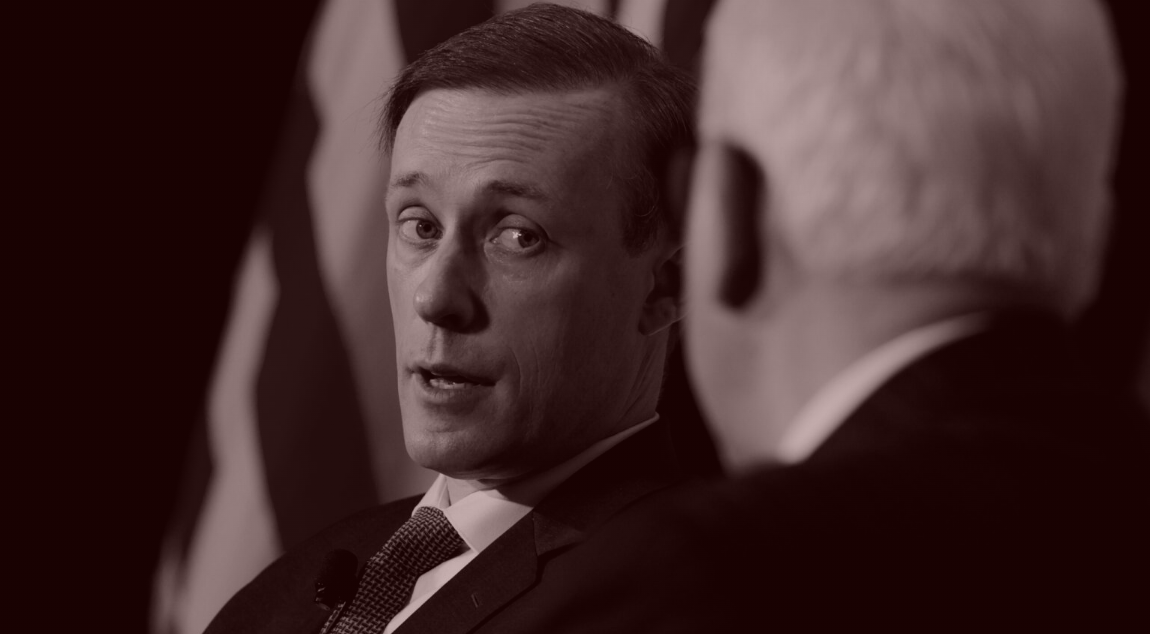 |
| Jake Sullivan on Israel & Ukraine |
| A very, very candid conversation with the national security adviser about the Israeli intelligence failure, Bibi-Biden, Ukraine, Xi, and much more. |
|
|
|
| Jake Sullivan, the president’s national security adviser, needs only the briefest of introductions. As his title implies, Jake is the primary adviser to Joe Biden on all matters of national security. He also runs the National Security Council, which provides guidance to the president, and directs the interagency process—that is, he coordinates between the various government departments that play a role in national security, like the departments of State, Defense, Energy, and Treasury, the Joint Chiefs, and Office of the Director of National Intelligence.
I’ve known Jake since he was Hillary Clinton’s right-hand man at the State Department and, later, the chief foreign policy adviser on her presidential campaign. Alas, the White House job would have to wait. While the Democrats wandered in the wilderness during the Trump years, Jake teamed up with former Obama adviser Ben Rhodes to form National Security Action, an advocacy group focused on counteracting (and counter-messaging) the occasionally insane foreign policy of the new president—who, as you’ll recall, wanted to purchase Greenland. The group was also a kind of administration in waiting, a who’s who of Democratic foreign policy hands including Wendy Sherman, Tony Blinken, Ned Price, Susan Rice, and Samantha Power—all of whom got senior jobs under Biden.
As national security advisor, one of Jake’s main roles is to explain the president’s policy decisions to the public. Often, as during the pullout from Afghanistan, that means being the president’s lightning rod. Known in Washington as a relentless pragmatist, Jake has taken flak from the parts of the Blob that are more hawkish on Ukraine, who want more armaments for the country—yesterday. These people often think that it is Jake that is the brake in this process, tempering Biden’s natural instincts to give Ukraine whatever it wants. (In fact, it’s usually the Pentagon, and this characterization is a sore spot for Jake.) His friends and allies argue that he cares passionately about Ukraine, and about other thorny national security issues—indeed, he got quite emotional when we spoke about the human toll of the war in Gaza. They also argue that no one in the U.S. government has done more for Ukraine, precisely because of his role coordinating all the various parts of the national security apparatus, squeezing it and working it for the ever-evolving needs of the Ukrainians.
Which is what Jake and I were going to talk about. In fact, we were going to talk sometime in early October, but we all know what happened. So our conversation, which has been very lightly edited for length and clarity, focused mostly on the Israel-Hamas war, but also covered Ukraine and China. I hope you find it as interesting as I did. |
|
A MESSAGE FROM OUR SPONSOR
|
| |
 |
| Blue Cross and Blue Shield companies are committed to affordable, high-quality health care. That’s why we’re working on solutions that rein in costs – like making hospital pricing more fair and reasonable.
Lower prices mean lower costs for consumers and taxpayers and could save more than $500 billion over 10 years.
Join us in working together with Congress to pass commonsense solutions for more affordable health care.
Learn more.
|
|
|
|
|
| Julia Ioffe: When you and I talked a little less than a year ago, you said that you were worried that the Russians were talking themselves into a place where nuclear Armageddon might be acceptable to them. What’s keeping you up at night now?
Jake Sullivan: Obviously, supporting Ukraine in its effort to achieve its objectives and thinking through the military elements, the diplomatic elements, the support for Ukraine’s economy, the protection of Ukraine’s civilian infrastructure, especially as we head into the winter. I lie awake at night thinking about how to protect Ukraine’s energy grid so that the country is not plunged into cold and darkness this winter under the onslaught of Russian missiles and Iranian drones. So all of that contributes to my insomnia.
Events in the Middle East are keeping me up, too. One of the things that I’m acutely focused on is trying to ensure that this conflict doesn’t expand into a wider regional war and that we maintain the capacity to deter and prevent that kind of escalation. I’m focused, day in, day out, on that task, even as we work all of the issues—the complex, difficult, often tragic issues—associated with the Israeli military campaign in Gaza, and the urgent need to increase and expand the level of humanitarian assistance that is getting to the Palestinian people.
Then, the other thing that keeps me up at night is the things that can happen that are unexpected. October 7th was an unexpected, unanticipated event in scope, magnitude, and the type of attack, as well as the consequences of it. So I began asking myself, my team, every day, every night: What could be the next one? How do we posture ourselves most effectively to be able to respond to it, even if we can’t fully predict it in advance?
That gets me to my next question: You’ve gotten a lot of shit for your Foreign Affairs article and what you said at the Atlantic Festival about the Middle East being “quieter than it has been in decades.” But it obviously wasn’t just you, right? It was the Israeli government. It was the broader American government. Why do you think the Biden administration was caught so unawares on October 7th? And did you really think that the Israeli-Palestinian issue was contained?
First, I don’t think it’s a fair characterization to say we thought that the Israeli-Palestinian situation was contained. When I was describing the state of the Middle East at the Atlantic Festival and in the Foreign Affairs article, I was talking about developments that followed two decades of massive military intervention: U.S. military intervention in Iraq, a civil war and a humanitarian crisis in Yemen, civil war and refugee crisis in Syria, a war between Israel and Lebanon, revolutions and counterrevolutions in Egypt and Tunisia, the rise of the so-called terrorist caliphate, a NATO military intervention in Libya, and much, much more. All of which unfolded in the course of the two decades leading up to the past couple of years, where most of those situations were not at the acute level they had been in the years before.
But I noted two challenges that remained, where progress was fragile. And, as I said at the Atlantic Festival, the emphasis had to be on “for now.” Things were quieter for now because that could all change fast. The two things I specifically called out were the Israeli-Palestinian situation and the threat from Iran, because as far as I was concerned, the Israeli-Palestinian situation remained a significant source of challenge and risk, something upon which we were highly focused. I personally went to both Israel and the West Bank earlier this year to meet with Israeli and Palestinian leaders. The president just hosted Prime Minister Netanyahu a couple of weeks before October 7th, and 90 percent of the conversation they had was actually on how to deal with the Palestinian situation in the context of the normalization talks with Saudi Arabia. This was a major area of focus, a huge initiative we were undertaking in part to try to address the underlying driver of this conflict, which was trying to generate a political and economic horizon for the Palestinian people that would be real and durable.
Now, why didn’t we see the type of attack that we saw on October 7th [coming]? The fact is, through multiple administrations over many years, Hamas and Gaza have been intelligence-collection priorities of the Israeli government and the Israeli intelligence community and the Israeli security establishment. They have not [been priorities] to the same extent for the United States because, of course, we have a close intelligence partnership with Israel, and they were the ones focused on this issue—and they obviously didn’t see it coming. I think that that answers the question about why we didn’t see it coming. To characterize it as a failure on the part of this administration or the U.S., or the U.S. intelligence community, is kind of missing the nature of the intelligence relationship and partnership between the United States and Israel.
As to why the Israelis didn’t see it, I think that’s a question that they are grappling with and will ultimately have to get to the bottom of. But that’s really, I think, where the focus should be on the question of what was missed here, because at a tactical operational warning level, this really sat with the relevant organs of the Israeli intelligence and security apparatus.
Given that it immediately involves the U.S. when something like this happens, is there going to be a change in our intelligence posture vis-à-vis the Israelis, Gaza, and the West Bank? Is the U.S. going to be doing more intelligence collection there now?
Any time a crisis happens, you examine what lessons you can learn from it, and how that applies with respect to intelligence posture. We’ll do that. But again, I think the nature of your question is not entirely on base. I don’t think that the main question here should be one about the U.S. intelligence community. |
|
|
| We now know that Hamas’s aim was to create a permanent state of war with Israel, have the Arab and Muslim governments on its side, and to unravel the Abraham Accords. What are you hearing now from the leadership of these Arab and Muslim countries? How do they see Hamas? What do they think should happen now—and are they willing to do something to make that happen?
I will not characterize their views. I would just say that for our part, we remain deeply committed to a long-term vision of regional integration, of normalization, and of a political horizon, including a two-state solution for Israelis and Palestinians. We are engaging deeply with the key leaders in the region on those issues. President Biden has spoken with most of the leaders of the region. I have spoken with my counterparts. A part of that conversation comes to, “What happens the day after in Gaza, and what are a set of principles and parameters we could all collectively agree on?” That’s a conversation that is getting underway.
Obviously, many of these leaders have called for a ceasefire. We’ve called for humanitarian pauses. There are some differences of opinion on the immediate tactical questions. But on a larger strategic perspective of what this region should look like long term, I think there remains a good deal of convergence among the key leaders of the region, President Biden, and the United States.
Right after the attacks, when President Biden traveled to Israel, he warned Israelis not to repeat the mistakes that the U.S. made after 9/11. Do you think they are repeating them now?
I have the opportunity essentially every day to talk directly to senior officials in the Israeli government, to share my views, to communicate President Biden’s views. He’s had the opportunity repeatedly to do the same thing directly with Prime Minister Netanyahu. I’ll continue to do that. I’m not going to be judge and jury and scorekeeper in on-the-record interviews. What I will say is that the United States has made very clear that we believe that a military operation aimed at the terrorist group Hamas—who slaughtered 1,400 Israelis on October 7th, the worst massacre of Jews since the Holocaust, in absolutely brutal and savage fashion—and going after their terrorist infrastructure, their terrorist leadership, that is Israel’s right, indeed its responsibility.
But it equally has a responsibility to protect civilians, to abide by the rules of war, and fundamentally, to ensure that humanitarian assistance, life-saving medicine, food, and water get to people in need, and that those people will also have shelter. We’re working on all of those things, and we’re deeply engaged with them. That’s the daily, indeed hourly work of the entire national security team.
Okay, but what do you do with an ally like Bibi, who doesn’t always listen to what you say and sometimes even publicly rejects your Secretary of State after he travels there to meet with him—despite all the aid coming from the U.S.?
The United States and Israel have been friends and partners since the founding of the state of Israel in 1948. As friends, we share a lot of similar perspectives. We share a lot of similar objectives. And we sometimes diverge on particular issues, on particular tactics, like all friends do. We speak honestly to one another about it. We deal with it, we work through it.
Sometimes those differences or disagreements actually disappear over time because one or the other party moves in terms of their position. President Biden went to Israel at a time when the publicly stated—quite emphatically publicly stated—position of the Israeli government was no humanitarian assistance could go to Gaza, none whatsoever.
Obviously, that’s evolved over time. So this is a dynamic conversation, it’s an evolving conversation, and part of diplomacy is keeping at it. That’s the spade work that we’re undertaking, not just to take a snapshot in time, a particular comment on a particular issue, but to work at this until we feel that between us—the U.S. and Israel—we’ve reached a common basis for how to conduct not just a military campaign, but a broad-spectrum campaign to protect Israel’s national security, its people, the state of Israel, and to do so in a way that is reflective of fundamental values. |
|
|
|
|
| The progressive left has been up in arms over this. It’s causing big fractures in the Democratic Party. Do you take the protests into account when you’re making policy at the N.S.C.?
I certainly take into account the arguments that people protesting are making, the feelings, the depth of feeling, particularly when it comes to the sanctity and dignity of every human life—Palestinian, Israeli, and otherwise; every innocent human life, every civilian, every person who is a noncombatant and who simply wants to live a life of freedom and equality and dignity. I think that is absolutely something that people should feel passionately about and speak passionately about.
I think about that every hour of every day that we work on this crisis. How do we deal with the issue of civilian casualties? How do we deal with the issue of humanitarian assistance? How do we deal with the reality that we have a terrorist organization, Hamas, that has such callous disregard for civilians that it actually hides among them, uses them as human shields, and creates a circumstance in which it is firing rockets at civilians in Israel from within civilian areas of Gaza? That places an added burden on the Israeli Defense Forces, but it does not lessen the Israeli Defense Forces’ responsibility to protect the lives of civilians to the maximum extent possible and to abide by international humanitarian law.
This is a difficult situation. You’ve got a situation where from Gaza emerged the bloodiest day since the Holocaust for the Jewish people, [perpetrated] by a terrorist group that is quoted as saying they want permanent war against Israel—that have said they’d like to repeat October 7th over and over again until Israel no longer exists. And so, Israel [is] going after those people who are posing that kind of threat and with that kind of murderous savagery, both in intent and in action. But it also has to deal with the overwhelming majority of the Palestinian people, who have nothing to do with Hamas, who are innocent, who deserve to have their lives protected, their lives dignified, who deserve to have rights and an aspiration to a state of their own.
That is the complexity of this. I see that complexity. I work that complexity every day. More importantly than that, the president does, and you hear it in his comments, and I see it day in, day out, in the way that he manages this crisis, in the direction that he gives all of us.
After the military phase, what is the diplomatic play? And after all the blood that’s been spilled on both sides, do you think a two-state solution is really possible—or even negotiations between the two?
I think a two-state solution is still possible. I think it’s possible in part because it is the only real solution. It is the just solution. It is the solution that can be achieved practically and must be achieved in practice. So we will work toward it.
Successive administrations have worked at this and have not succeeded. I’m not going to pretend it’s easy. I’m not going to pretend the road to get there is going to be straightforward. But we looked at this issue when we came in and we said, “Could we put Israelis and Palestinians now at the same table and get them to negotiate a two-state solution?” And we judged that the viability of that route—direct negotiations between the parties generating a two-state outcome—was low. It was not likely that that was going to achieve results. So we asked ourselves, is there another way to do this? And that is how we began to develop the strategy to work on Israel’s regional integration and its normalization process and to leverage that process to generate a political horizon for the Palestinian people.
That was the work that was underway and ongoing literally in the days leading up to October 7th. And it is work that we are not going to set aside. We are going to pick up and carry forward as best as we possibly can to try to get to an outcome in which Israel is at peace with its Arab neighbors and Israel and the Palestinian people have achieved a two state solution.
Part of the progressive part of the Democratic Party advocates for a one state solution, for Israelis, Palestinians living in one country, one vote per person, etcetera. Do you think that’s feasible or possible?
I think that the two state solution is the right outcome. It’s the one we’re going to be driving at. And that has been the president’s conviction since long before he was president. He has been assertive in continuing to advocate for that, even since this crisis has begun. That’s where our focus is going to be. |
|
|
| There was a story a little while ago that U.S. and E.U. officials are floating the idea of peace talks to Ukrainian leadership, especially after Gen. Zaluzhny’s comments that he thought the war was at a stalemate. Is that true? Is the administration pushing Ukraine to the negotiating table?
No.
What do you make of Zaluzhny’s comments? Where does Ukraine go from here? Can it still win?
There’s been a robust debate in Ukraine based on the general’s interview. I don’t want to get into the middle of all that. I’ll just give you our perspective, which is that we believe the battlefield remains dynamic, and we are going to continue to support Ukraine with the tools and resources and capabilities that it needs to continue to try to make progress on the battlefield. We do believe that, ultimately, when Ukraine determines it—because we feel passionately about the article of faith, “Nothing about Ukraine without Ukraine”—there will be a diplomatic phase to this. And our job is to put Ukraine in the best possible position on the battlefield so it’s in the best possible position at the negotiating table.
What is the latest with Evan Gershkovich and Alsu Kurmasheva, the two American journalists in jail in Russia right now?
I have to disappoint you yet again by saying I can’t say too much on this topic, I’m afraid, largely because we are pursuing a variety of efforts, starting at the highest levels of the U.S. government, to try to secure the release of these journalists, as well as Paul Whelan. And we will continue to do that. That involves a number of sensitive conversations and things that I just have to be very cautious about discussing publicly. But it is a paramount priority for the President, and we’re going to continue working until we succeed.
President Biden is meeting with Chairman Xi. I guess, you know, the world is burning. How does China see this, and is this chaos to their advantage? What do the two men even talk about right now, between Ukraine and Israel/Gaza?
Even in the midst of this unfolding crisis and the ongoing war in the Middle East and this ongoing war in Europe, since October 7th President Biden has hosted 10 Latin American leaders. He will be hosting all of the leaders of the Asia Pacific region in San Francisco. He will be advancing a number of critical diplomatic initiatives and economic initiatives in both the Americas and in the Indo-Pacific. He hosted the Australian prime minister for a state visit and moved the ball forward on AUKUS. The United States is capable of continuing to work on the full agenda of our foreign policy even while we deal with these crises.
And speaking of full agendas, that’s exactly what we will find in the meeting between President Biden and President Xi. They will discuss at a strategic level how to responsibly manage the competition between the United States and China, how to maintain open lines of communication, and how to find areas where the two countries can work together, where it’s in our mutual interests to do so. They will also obviously discuss ongoing events in both Ukraine and in Gaza, as well as in the broader Middle East.
In terms of the nature of their dialogue, it’s direct, straightforward, it’s detailed. And I expect that to be the case here, too. But it’s going to cover the waterfront: economics, technology, military-to-military ties, concerns that the United States has on issues associated with human rights or maritime matters or economic coercion, concerns China has about what the United States is doing in certain respects. We will talk about what we’re trying to achieve with our alliances and partnerships in the Indo-Pacific. Pretty much, you name it, it will be on the agenda, because that is the nature of the depth and breadth of the relationship between the U.S. and China. It is a challenging, complex, competitive relationship, but also one that we are working hard to manage in an effective and stable way. |
|
|
| That’s all from me, friends. Now I will finally take my week off—unless you’re a member of the administration and you want to chat. If so, I’m all ears. Otherwise, I’ll see you back here after Thanksgiving.
Julia |
|
|
|
| FOUR STORIES WE’RE TALKING ABOUT |
 |
|
 |
| Givenchy Goss |
| Inspecting the rumor mill surrounding Sarah Burton. |
| LAUREN SHERMAN |
|
 |
|
 |
|
|
|

|
 |
|
|
|
Need help? Review our FAQs
page or contact
us for assistance. For brand partnerships, email ads@puck.news.
|
|
You received this email because you signed up to receive emails from Puck, or as part of your Puck account associated with . To stop receiving this newsletter and/or manage all your email preferences, click here.
|
|
Puck is published by Heat Media LLC. 227 W 17th St New York, NY 10011.
|
|
|
|