Hi, and welcome back to Line Sheet. Happy U.S. government shutdown, day two. If you’re observing
Yom Kippur, may you have an easy fast. Finally, how badly do you want to know what Danielle Steel thought about Dior?
Alas, I don’t have the answer for you on that one, but today’s issue asks (and answers) the bigger questions about Jonathan Anderson’s women’s ready-to-wear debut: What did the Arnaults really think? Is this going to buoy the most challenged megabrand in the LVMH portfolio? And how much is that denim bowtie shirt
going to cost?
Up top, you’ll also find observations from recent shows—including Haider’s Tom Ford!—a Paris retail scooplet, and a couple of points on the Brunello Cucinelli earnings.
Programming note: Tomorrow on Fashion People, I’m joined by ultra-popular recurring guest Marisa Meltzer, this time to discuss her new book, It Girl: The Life
and Legacy of Jane Birkin. Preorder the book now, and listen to us here and here. The conversation is a great primer: No spoilers, just fun.
Mentioned in this issue: Jonathan Anderson, Dior, Luca
Guadagnino, Bernard Arnault, Adam Curtis, Greta Lee, Mikey Madison, J.Crew, Versace, Dario Vitale, Nicolas Di Felice, Courrèges, Haider Ackermann, Tom Ford, Nina Christen, Brunello Cucinelli, and many more… |
|
|
Three Things You Should Know…
|
- Let’s
stop talking about sex: I’m sick of the sexy clothes discourse. I never thought about it once when I looked at Dario Vitale’s Versace. Like heel heights and trouser lines, the way that clothes are cut to the body changes with the times, and after the puritanism of the mid-2010s, and the elastic waistband epidemic of the pandemic, we’ve entered a “remember bodies?” era of dressing—that’s all.
Over the past couple of days in Paris, there have been a few
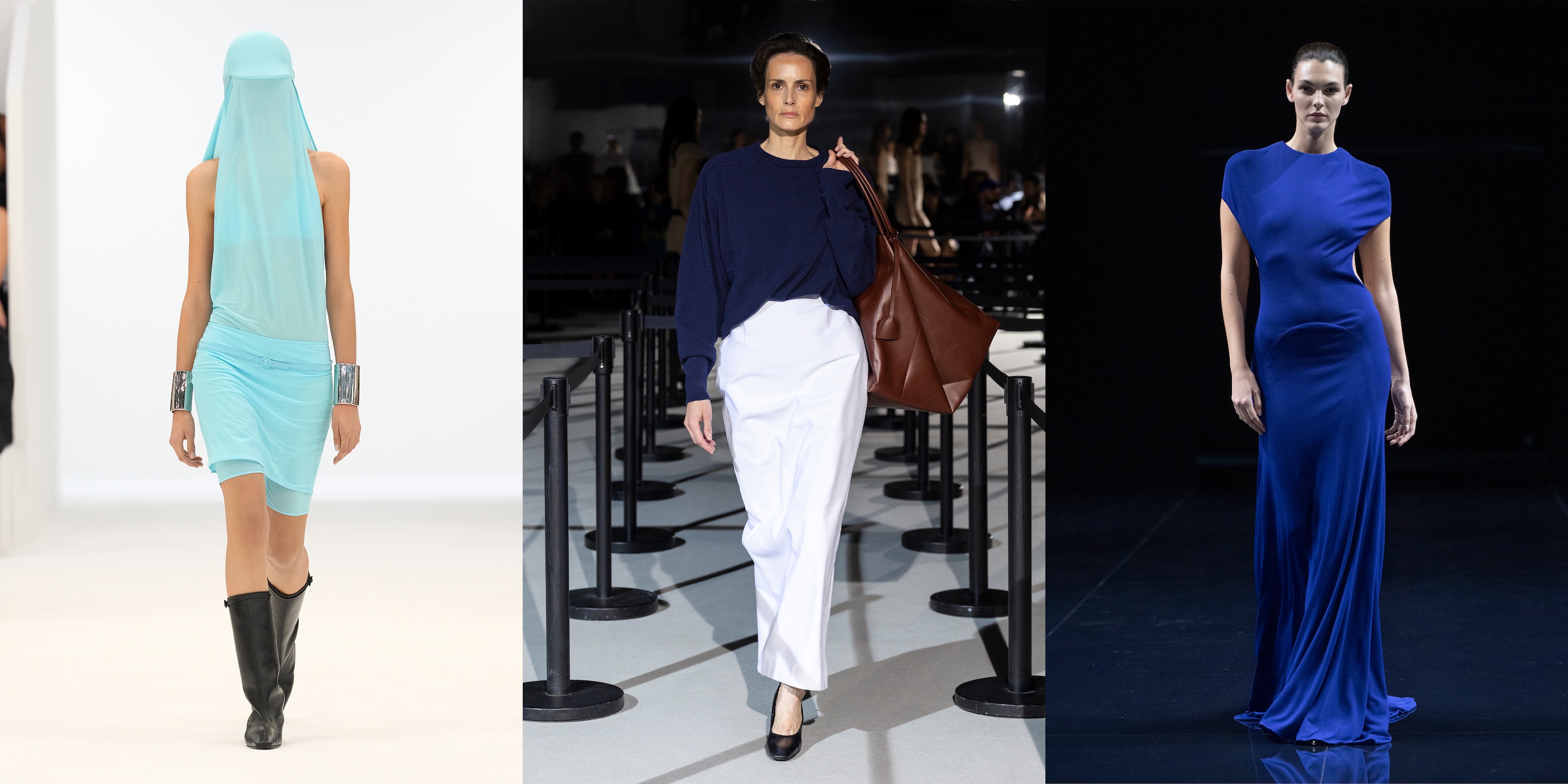
standouts that make consumers feel good, no matter how they frame the silhouette. I always like Nicolas Di Felice’s Courrèges. It’s a clear idea: all incredibly clean, lean lines. And while he is known for revealing the body, the provocative collection he showed on Tuesday was also about masking. (He showed face-covering sun caps, and some dresses had a sort of shield extending up over the chin.) The next morning, I paid a visit to Marie Adam-Leenaerdt, the
Belgian designer who became known for her subversive take on patrician classics. She lost me for a while with her tricks, but this season’s more straightforward, less think-y approach to the clothes—like a navy jumper worn with a narrow white skirt—lured me back in. I see her woman emerging.
|
From left to right: Looks from runways shows for Courrèges, Marie Adam-Leenaerdt, and Tom Ford. Photos:
Courtesy of Courrèges/Alessandro Garofalo/Courtesy of Marie Adam-Leenaerdt/Courtesy of Tom Ford |
- But the
highlight of the week, so far, has certainly been Haider Ackermann at Tom Ford. It was a truly elegant show, from the staging—models sauntering out in clusters to a slowed-down rendition of David Bowie’s “Heroes”—to the clothes themselves: perfect tailoring, elegantly draped dresses, all rendered in the rich, almost electric pastels that only Haider can do. The photos don’t do this collection justice: If you can go see it in person—at a resee, in a store—you
should. The clothes are expensive, but what Haider proposed here was worth the cost of admission. No wonder the business is on the up, and there were so many V.I.P. clients at this very, very small show.
|
- The
shoe designer of shoe designers: This is all over the French press, but did you know that Nina Christen is opening a store for her Christen brand right off the Place Vendôme? I walked by yesterday, the same day as the debut of Christen’s above-par designs for Dior, created in collaboration with Jonathan Anderson. As one of the most in-demand shoe designers in the world, Christen did the balloon heel for Loewe, but she also worked at Daniel
Lee’s Bottega Veneta and Phoebe Philo’s Céline (and The Row, although she doesn’t list that one on her Instagram profile). If you have any sense of how Christen is funding this endeavor, call me.
- Brunello’s Russian riddle: The Italian maker of tan-and-blue desirables did a smart thing and pulled up their Q3 earnings report to reassure the market and address reports of unsanctioned selling in Russia. Year-over-year sales were
up globally nearly 11 percent in the first nine months of 2025, to more than €1 billion. While some short-sellers are betting that Brunello is overly reliant on Russia sales and off-price channels, traditional analysts espouse the belief that the Russia business is both fractional and shrinking. (During the first nine months of 2025, it accounted for only 1.4 percent of sales, or €14.8 million, and the guidance is downward.) On Thursday, Bernstein upgraded the stock to
“outperform.”
Cucinelli did a lot of work to prove the company was in the clear, noting the more than 100 custom checks and a 52 percent decrease in the weight of shipments to Russia between 2021 and 2024. Meanwhile, questions abound. Will the company take legal action against Morpheus Research, the short-selling firm who put forth these claims last week? The bigger issue, to me, is Cucinelli’s depth of distribution in wholesale—they have more than 400 partners—amid an increasingly
precarious selling environment. The company has suggested that multibrand retailers help them figure out what’s cool, and what a broader range of customers wants. Maybe so, but these shorts have underscored that selling clothes isn’t easy, even when you have a great margin—and reputation.
|
And now on to the main event… |
|
|
LVMH has a lot riding on Jonathan Anderson’s women’s Dior debut on the Paris runway—did
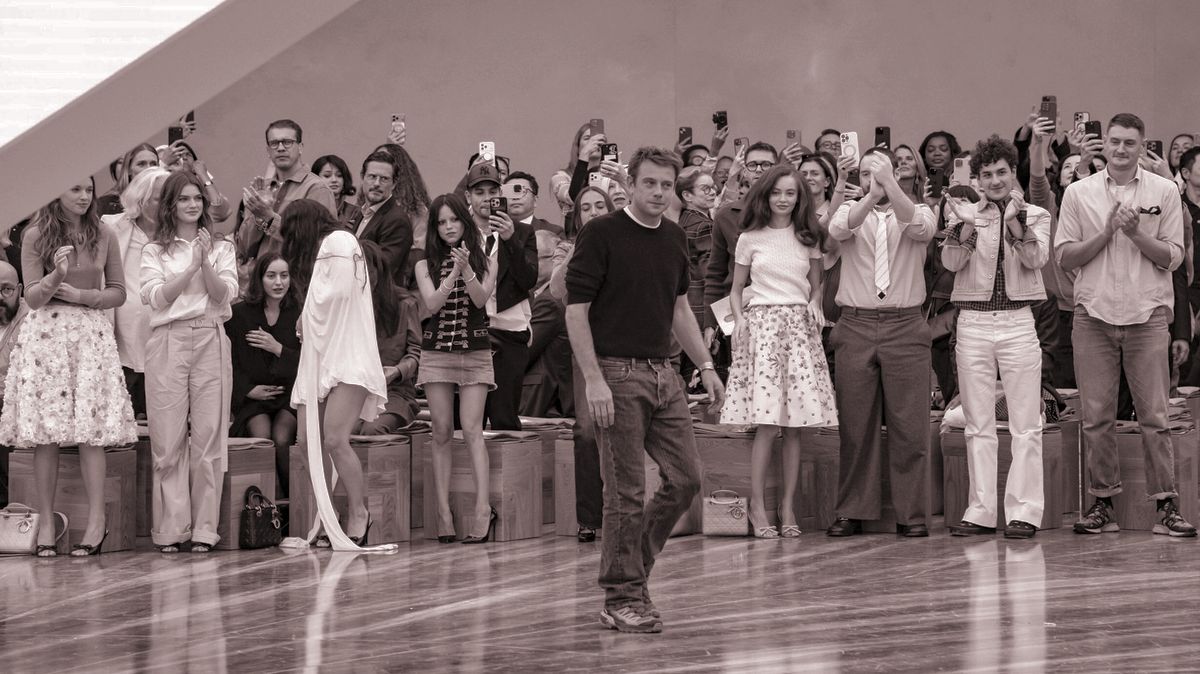
Bernard Arnault’s face say it all? |
|
|
Jonathan Anderson’s first women’s ready-to-wear Dior collection, which he debuted on
Wednesday, represented his vision—and his alone. There were no LVMH executives tinkering from the background on that Luca Guadagnino–designed set. In many ways, this represented the LVMH ideal. Bernard Arnault built his €265 billion empire on the notion that investing in creativity is more profitable when the suits don’t butt in at the end with fulsome notes. Arnault has scaled his company partly because he let John Galliano
and Marc Jacobs work freely at Dior and Louis Vuitton, respectively. He afforded Anderson the same freedom at Loewe, and now at Dior, too.
Of course, there are challenges inherent in this operating model. Dior makes €7 billion in annual sales (at least) and employs thousands of people. The business has also reported double-digit declines, up to 20 percent, during the past few quarters. Bernstein analyst Luca Solca has estimated a 10 percent sales decline
this year, and that could be optimistic. |
|
|
Anyway, there’s a lot riding on Anderson’s vision. Instead of letting the pressure get to him, Anderson
appeared to channel it through a collaboration with the documentarian Adam Curtis, a British institution of sorts (his docs run on the BBC) who most Americans associate with Can't Get You Out of My Head, his six-part series that explores the rise of individualism and its often destructive path. Enlisting—and convincing—Curtis to tell the story of an LVMH fashion house was a bold thing to do, and over this past week, Anderson made it clear in
conversations that he was indeed nervous about it.
The end result, which I watched via videos sent to me by attendees, and also on the livestream that flickered between the screen and the front row—populated by the likes of Bernard Arnault and his children Alexandre, Antoine, and Delphine—was one-part self aggrandizing, one-part horror movie; a history of Dior, LVMH, and consumer culture all rolled into one. “Do you dare enter the House
of Dior?” was the leading caption. |
Jonathan’s
Personal Touch
|
As for the collection itself, let’s start with the positives. Anderson is an undisputed genius when it comes
to advertising and communications. His swift rebranding of the house will be studied by marketers for decades, starting with Theo Wenner’s self-portraits for the menswear hard launch, leading into his funny, beautiful, bored-girls series starring Greta Lee, Mia Goth, and Mikey Madison—stars right at the intersection of critical acclaim and mass appeal. It’s the little details he gets right, from the social media rollout (DMing
folks) to the egg-plate invite. And of course, there’s the logo tweak, which did away with the harsh upper-case.
You could argue the clothes themselves are almost an afterthought, but they can’t be at Dior. The men’s collection received mixed reviews, but I loved it on the runway—it was a commentary both on the way people dress today and on Anderson’s very personal history. Did it look like J.Crew, with those cable-knit sweaters and khakis? Sometimes. But I loved the arrogance of
that gesture.
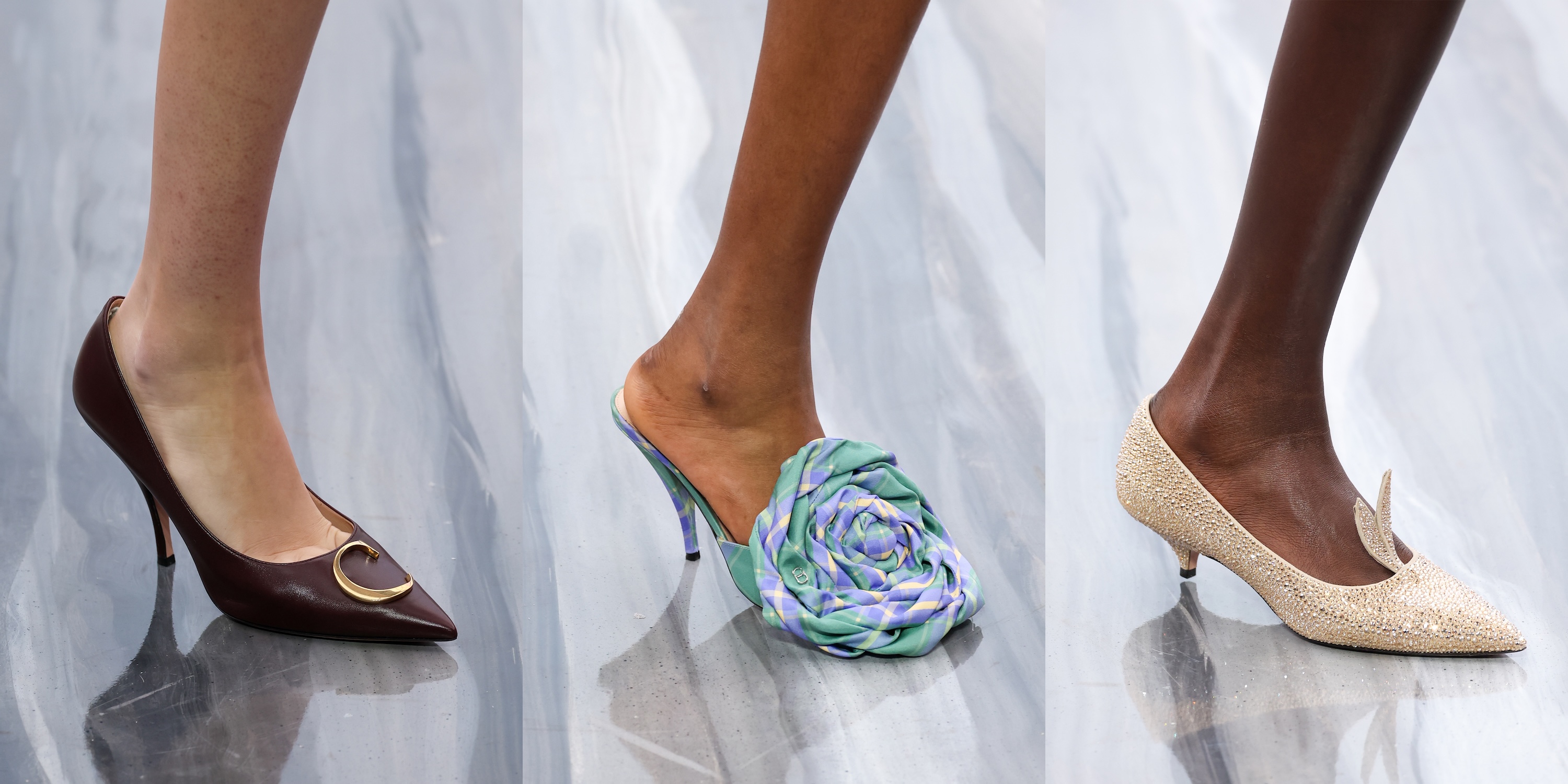
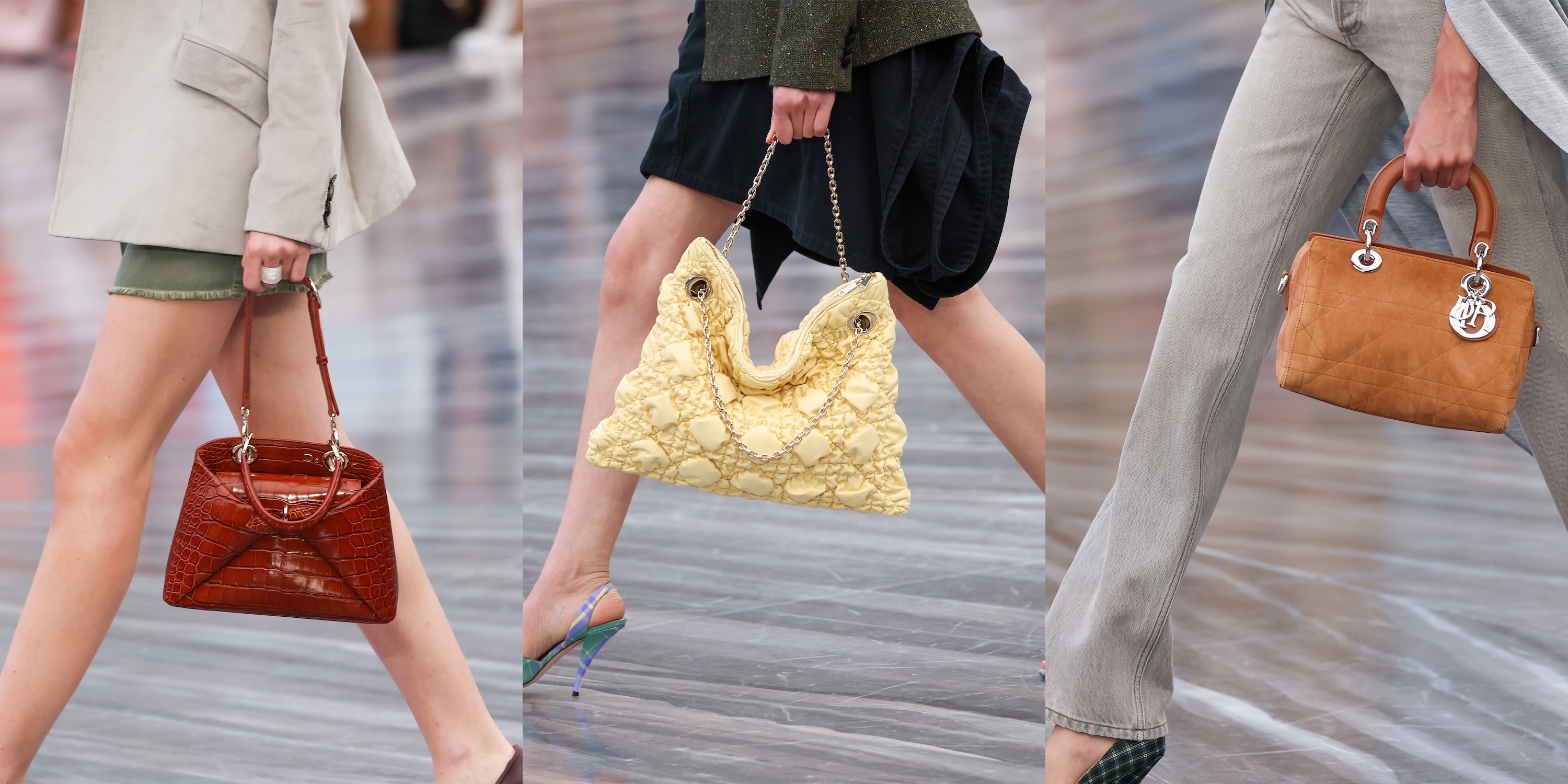
For women’s, the fashion was harder to get behind, and you could see it in the audience. Arnault père, who knows the difference between a good collection and a bad one, was depicted on the livestream, and his expression did not reflect confidence. I thought the most successful aspect were the shoes, which ranged from basic with a rude little flick on the throat (I will buy) to downright fantastical pumps fashioned from a satin rosette. The bags, too, showed promise:
It’s such a tricky category for Dior because the Lady silhouette, its hero style, is an uptight box. He’ll work his magic there, I’m certain. |
Photos: Peter White/Getty Images |
I wanted to love the clothes. But my favorite thing was worn off the runway, by guests: the rugby shirts.
Once again, Anderson was looking to interrogate the banal, but this time all I could think of was Jenna Lyons–era J.Crew, with its daywear sparkles and double denim. In fact, the amount of denim on the runway was shocking. The pricing was not. A line sheet revealed that the bowtie shirt, made of 100 percent cotton denim, will cost €1,700. The pink denim miniskirt will be €1,300. |
|
|
Some of the pieces shown, including a few of the jackets, were labeled haute couture, and therefore
had no price attached. But many ready-to-wear garments were in the five-figure range, as was the case with the men’s collection. (That opening white silk dress is €19,000. The red pleated blouse is €12,000.) Was this collection challenging? Yes. Did it show potential? Yes. Was it sensational? No. It was directional—but is this a direction we want to go in? (The return of steampunk is happening, and Anderson is leading the charge.) Unlike the menswear show, it did not feel optimistic. |
Photos: Peter White/Getty Images |
Anderson has earned the flexibility that the Arnaults have afforded him, and they have to put on a brave
face—particularly Delphine, who is under tremendous pressure to turn this thing around. Whether they liked it or not is beside the point. They chose Jonathan, and gave him this platform. This collection is incredibly consequential, and it will play a role in determining the future of the business. It may also answer some related questions about the impact that a mega-talent can have on a megabrand in a marketplace that’s evolved considerably since Galliano and Jacobs were in their heyday.
|
Antoine Arnault received the Legion of Honor in Paris on Wednesday, and the guest list was
fascinating. He’s clearly the person in the family trying to keep the peace. [La Lettre]
“There’s nothing I hate more than physical retail.” —Bob
Lefsetz on distribution being everything! [The Lefsetz Letter]
I love the v-neck discourse. I want to be incisive: A v-neck should be very high on the clavicle, or very low on the breastbone, but any v-neck works if you have a good sense of proportion in your outfit.
[New York Times]
I can’t begin to explain how famous and important Bernard Arnault is in France, where he’s held up as everything that’s right and wrong with his country. This week, lots of people have been discussing why he chose to speak out against this billionaire tax, which will ultimately be inconsequential to him and the economy. And yet
an Arnault supporter, the entrepreneur Jean-Philippe Cartier, also just said on French television that he wishes there were 50 more Bernard Arnaults. If that happens, hopefully they won’t all own fashion businesses—I have my hands full covering just the one! [BFM TV] |
Until tomorrow,
Lauren
P.S.: We use affiliate links because we are a business. We may make
a couple bucks off them. |
|
|
Puck’s daily art market email, anchored by industry expert Marion Maneker, offers unparalleled access to the mega-auctions and
galleries, elite buyers and sellers, and the power players who run this opaque world. Wall Power also features Julie Brener Davich, a veteran of Christie’s and Sotheby’s, who provides unique insights into how the business really works. |
|
|
Puck founding partner Matt Belloni takes you inside the business of Hollywood, using exclusive reporting and insight to explain
the backstories on everything from Marvel movies to the streaming wars. |
|
|
Need help? Review our FAQ page or contact us for assistance. For brand partnerships, email ads@puck.news. You received this email because you signed up to receive emails from Puck, or as part of your Puck account associated with {{customer.email}}. To stop receiving this newsletter and/or manage all your email preferences, click here. |
Puck is published by Heat Media LLC. 107 Greenwich St, New York, NY 10006 |
|
|
|