Hello, and welcome back to The Best & The Brightest, your daily political dispatch from Puck. It
is once again foreign policy Thursday—after TACO Tuesday—and I’m Julia Ioffe.
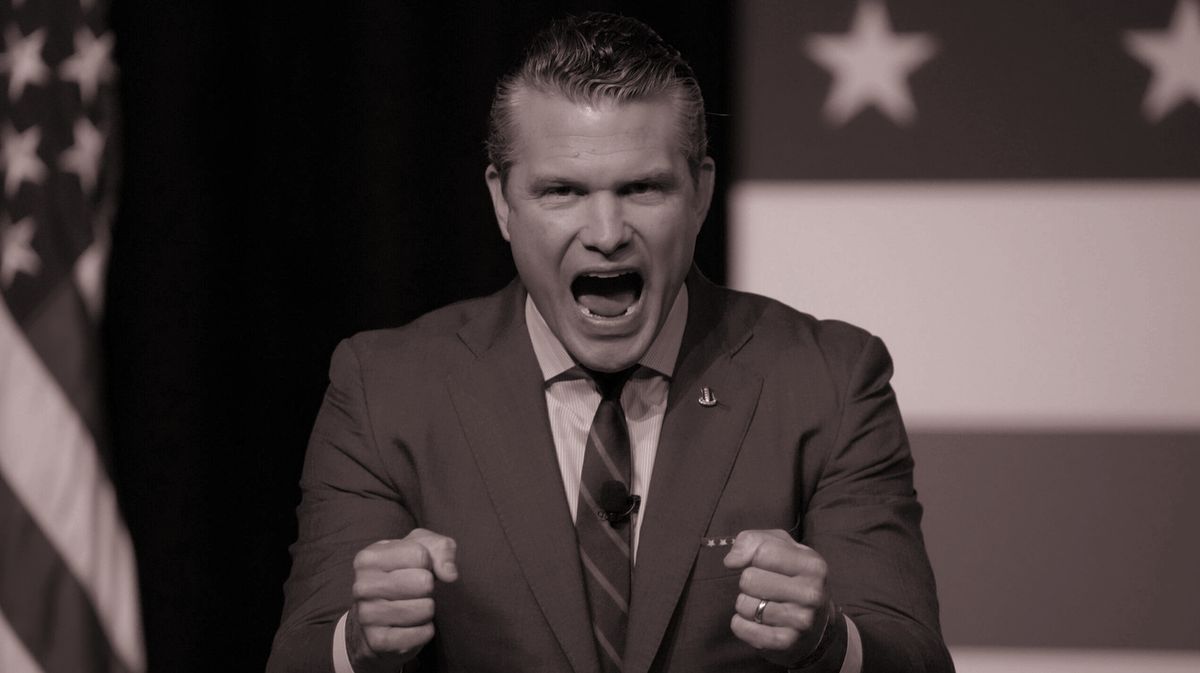
You may have missed it, what with a war raging in the Middle East, but last week, Pete Hegseth fired Randy George, the four-star general who was in charge of the U.S. Army, the American military’s largest uniformed service. Why would he do such a thing,
even as thousands of American soldiers, including from the Army’s 82nd Airborne, were on their way to the Gulf? “It seemed to have to do with lashing out at [Dan] Driscoll,” a Pentagon official told me.
Ah, Dan Driscoll, secretary of the Army, J.D. Vance’s friend from Yale Law, and Hegseth enemy number one—after wokeness, of course. As I wrote in November, Hegseth knew that Driscoll’s relationship with Vance made him unfireable. But is that changing? Is Hegseth prevailing in this D.O.D. drama? More on that below.
Also mentioned in this issue: Lloyd Austin, Mark Milley, C.Q. Brown, Lisa Franchetti, William Green Jr., David Hodne, Usha Vance, James Mingus,
Christopher LaNeve, Dave Butler, Susie Wiles, Kid Rock, Madison Cawthorn, and more… |
|
|
|
Claude, the AI for problem solvers AI helps most with the hardest work, not the simplest. Anthropic analyzed 2 million conversations and found Claude's biggest impact
is on complex, college-level tasks. The Economic Index tracks adoption across every state and occupation. See how your state uses AI. |
|
|
|
- J.D.
does Budapest: This week, while D.C. was sharing stories about how J.D. Vance was against the war in Iran and is trying
to mediate its end, the vice president was in Budapest, campaigning for MAGA darling Viktor Orbán. The Hungarian prime minister, whose authoritarianism has driven the country away from post-Soviet democracy and into poverty, is staring down an electoral drubbing for his party, Fidesz,
this Sunday. But the Trump administration, and specifically Vance, has been very vocal about the European parties that they support: Fidesz, the right-wing AfD in Germany, the right-wing National Rally in France. Support for these parties was a core message of his infamous Munich speech.
Ironically, while appearing at a university in Budapest, Vance lashed out at election meddling by… the Ukrainians. The very online vice president
repeated spurious, if not outright debunked, claims from the right-wing information ecosystem that it was Ukraine that is meddling in Hungarian elections more than Russia had in the 2016 U.S. presidential election. He said that the Ukrainians shut off an oil pipeline to
Hungary, though Kyiv claims that it was damaged by a Russian drone attack. He also said Ukraine and Russia were “haggling” over a few square miles of territory, something he derided as fundamentally silly and not worth it.
This isn’t new for Vance, who has an abiding distaste for Ukraine. During his Senate days, he consistently voted against aid for the country and
repeated the false claim that Volodymyr Zelensky had used U.S. funds to buy himself a luxury yacht. (That little tidbit was later shown to have originated in Russia.) And most
famously, the vice president lit into Zelensky in the Oval Office last February, lambasting him live on national TV, asking if he’d said “thank you.”
People who know Vance have told me over the years that his animosity toward Ukraine is real and deep-seated, and that he truly does believe the conspiracy theories that Ukraine had something to do with January 6, and that there really are Nazis there. “He takes an Orbán-esque view of a lot of things,” one Senate Democrat told me of
Vance a couple years ago. Or as a Republican who knew him in his Senate days put it, “Vance is very much a creature of the online MAGA world, and they’ve been against Ukraine from the beginning.” Zelensky may have reached some kind of uneasy peace with Trump, but Vance, it seems, has not let go.
|
And now, the main event... |
|
|
|
Under the cover of the Iran war, Pete Hegseth moved to oust Army chief Randy George, a
staunch ally of his archnemesis and untouchable Pentagon rival, Dan Driscoll. Was it a well-calculated plot, a sign of his juice, or maybe a signal that J.D. Vance has lost some of his foreign policy sway? |
|
|
|
Last week, while the United States was still very actively at war with Iran, Secretary of Defense
Pete Hegseth ousted the head of the U.S. Army, Gen. Randy George. Firing the head of the U.S. military’s largest branch in the middle of a war was a stunning move, but the real shocker to those in the know was that George lasted as long as he had. (The Pentagon declined to comment and referred me to spokesman
Sean Parnell’s tweet announcing the forced retirement and wishing George well.)
The four-star general was a seasoned soldier and well-liked in the Pentagon. But that isn’t the kind of qualification that matters in an administration obsessed with loyalty—even from the general officers, who have been trained from their first days in the service to be
fastidiously apolitical. And it has mattered even less under the micromanagement of Hegseth, who has been on a firing spree since he first arrived—purging, among others, anyone seen as aligned with his predecessor, Gen. Lloyd Austin, or former chairman of the joint chiefs Gen. Mark Milley. |
|
|
|
Claude, the AI for problem solvers AI helps most with the hardest work, not the simplest. Anthropic analyzed 2 million conversations and found Claude's biggest impact
is on complex, college-level tasks. The Economic Index tracks adoption across every state and occupation. See how your state uses AI. |
|
|
|
Especially vulnerable are those officers who don’t comport with Hegseth’s narrow view of “meritocracy”—that
is, those he perceives as getting promoted for “D.E.I.”-related reasons. The general consensus is that’s why Black joint chiefs chairman C.Q. Brown got the axe; Navy chief Adm. Lisa Franchetti was let go; and, in a highly unusual move last month, Hegseth personally removed four Army colonels—two Black officers and two female officers—from a promotion list. Fired alongside
Gen. George was the chief Army chaplain, Major General William Green Jr., who is Black. (Also purged in that round was Gen. David Hodne, whose ouster puzzled just about everyone, since he’s a white man with a reputation as a scholar-jock and a warfighter’s warfighter—exactly the kind of person who might appeal to the secretary. “It’s really mystifying,” one Defense official told me.)
George, another white man, had a target on his back for other reasons:
He had been nominated and confirmed in 2023, during the Biden administration, and was seen as someone from Austin’s camp. Far more fatefully, though, he was very close to current Secretary of the Army Dan Driscoll. |
Driscoll, as I’ve
reported, has been Hegseth’s enemy number one at the Pentagon for almost as long as he’s been in his role. In part, that’s because Driscoll became an early fixture in coverage of the administration—getting overwhelmingly positive press as the walking embodiment of affable competence. Between his boyish looks; his aw-shucks, nice-guy attitude; and his
headline-grabbing attempts to transform the Army into a futuristic force, it was easy to see why Driscoll was getting far kinder treatment than the ragey, abrasive Hegseth. (That, and his staff worked hard for it.) By the fall, much of Washington was abuzz with the rumor that Hegseth was not long for the top job and Driscoll would be taking his place.
This, of
course, is said to have infuriated Hegseth. But Driscoll had top cover that made him unfireable: He was a close friend of J.D. Vance, his pal from Yale Law. Usha Vance occasionally swung by the Pentagon for lunch with him. So Hegseth quickly learned how to make Driscoll’s life miserable without firing him outright: He would dismantle Driscoll’s inner circle and replace them with his own people.
One of the first to go was the vice chief of the Army, Gen.
James Mingus, who was replaced by Hegseth’s senior military advisor, Gen. Christopher LaNeve. When George and Driscoll tried to intercede for Mingus last fall, Hegseth delivered a curt warning: Even if he couldn’t fire Driscoll, he could still fire George. Less than six months later, Hegseth made good on the threat. |
|
|
|
Hegseth didn’t stop with Mingus. He also fired Col. Dave Butler, Milley’s former
spokesman, who had become George’s right-hand man and then Driscoll’s advisor. And, according to two sources familiar with the situation, Hegseth previously tried to fire George, too. That time, Driscoll successfully appealed to White House chief of staff Susie Wiles. The episode led people to believe that George would be fine as long as Driscoll was around.
A couple months ago, Vance convened a meeting with Driscoll and Hegseth in an attempt to make peace, according to
the two sources. (Vance’s spokesperson did not respond to questions in time for publication.) The message was that the fighting needed to stop, and the men needed to shift their focus to working together for the country’s sake. They were, after all, on the same team. The implication was clear, according to both sources: Hegseth wasn’t going anywhere, so Driscoll needed to figure out how to live with him. Before long, rumors began to circulate that Driscoll was planning to leave the job of his
own volition in the summer and return to North Carolina, perhaps to run for office again. (He’d made a bid for Congress in 2020 but came in sixth in a crowded Republican primary. Madison Cawthorn ultimately won the seat.)
Perhaps Hegseth decided to fire George last week because Driscoll had the smell of a lame duck about him. Or perhaps, as some speculate, he did it because Vance’s stock seems to have fallen with Trump. Vance was
reportedly the only person in Trump’s war cabinet to advise the president, however tepidly, not to go to war against Iran—and his very obvious failure to convince Trump has reinforced the widespread impression that he has lost every foreign policy fight of this administration. Either way, Vance may have been unwilling to keep spending his own finite political capital
to protect Driscoll.
It also didn’t help that George pushed back, first against Mingus’s firing, and then against Hegseth’s decision to cancel the promotion of the four officers to brigadier general. Reports have also linked
George’s firing to an Army investigation of two Apache helicopter crews that hovered outside Kid Rock’s home—a scene that quickly went viral. The inquiry, one retired Army general told me, was completely standard, but Hegseth quickly shut it down, reinstated the pilots, and then tweeted, “Carry on, patriots.”
Regardless, this time, Hegseth was successful. He
acted without warning, which robbed Driscoll of the opportunity to again lobby the White House on George’s behalf. The Pentagon immediately made the firing public, via Bari Weiss’s CBS News, essentially foreclosing any debate. (Sure, it wasn’t a great look to fire the chief of the Army in the middle of a war, but practically, Pentagon
insiders say, it doesn’t make much of a difference. And when have optics ever stopped Hegseth?) Driscoll was furious, but there was nothing he could do about it. Hegseth had already won. |
That’s all from me, friends. I’ll see you back here next week. Until then, good night. Tomorrow will be
worse.
Julia |
|
|
|
Join Emmy Award-winning journalist Peter Hamby, along with the team of expert journalists at Puck, as they let you in on the
conversations insiders are having across the four corners of power in America: Wall Street, Washington, Silicon Valley, and Hollywood. Presented in partnership with Audacy, new episodes publish daily, Monday through Friday. |
|
|
|
Unique and privileged insight into the private conversations taking place inside boardrooms and corner offices up and down Wall
Street, relayed by best-selling author, journalist, and former M&A senior banker William D. Cohan. |
|
|
|
Need help? Review our
FAQ page or contact us for assistance. For brand partnerships, email ads@puck.news.
You received this email because you signed up to receive emails from Puck, or as part of your Puck account associated with {{customer.email}}. To stop receiving this newsletter and/or manage all your email preferences, click here.
|
Puck is published by Heat Media LLC. 107 Greenwich St., New York, NY 10006 |
|
|
|
|