{{ 'now' | timezone: 'America/New_York' | date: '%b %d, %Y' }} |
|
|
|
Hello, and welcome back to The Best & The Brightest, your daily politics dispatch from Puck. It’s
foreign policy Thursday, and I’m Julia Ioffe.
I’m old enough to remember when Republican GWOT vets like J.D. Vance and Pete Hegseth railed against anything that smelled remotely of getting the U.S. sucked into another war, especially in the Middle East. The wars they had fought in, after all, were expensive, deadly, and stupid. All that money would’ve been better spent back home, they argued, building roads and factories. In
fact, if you’re reading this newsletter, you’re old enough to remember it too, because this was all of two years ago. But, as I wrote last week, no one in Washington cares about hypocrisy. Evolving policy positions are just how this town works.
But while Republican GWOT alumni are in the headlines, Donald Trump’s open-ended,
shoddily planned war on Iran—now in its third week—is fueling many of their fellow veterans on the other side of the aisle. I talked to one of them, Colorado’s Jason Crow, about what it’s like to watch the country slide toward another “forever war” in the Middle East.
Also mentioned in this issue: Joe Kent, Thomas Massie, Joe Biden, Ruben Gallego, Dan Driscoll, Brian
Mast, Don Bacon, Tammy Duckworth, Warren Davidson, Eugene Vindman, Mike Waltz, Seth Moulton, Dan Crenshaw, Tom Cotton, Ruben Gallego, A.O.C., Mikie Sherrill, Adam Kinzinger, and more… |
|
|
|

| Abby Livingston
|
|
- Underwhelming heirs: The
failure of Jesse Jackson Jr.’s campaign to return to Congress underscores the limits of outside spending even on high-name-recognition candidates. Jackson, of course, benefited from sharing a name with his father, the late civil rights icon, but he was also weighed down by scandal, having served time in federal prison for spending $750,000 in campaign funds on personal expenses. In the end, the crypto-backed group Fairshake spent more than $800,000 attacking one of Jackson’s
rivals, while the pro-A.I. group Leading the Future invested $1.4 million on Jackson’s behalf. It still wasn’t enough.
Jackson’s baggage was sui generis, but this cycle will provide a broader test of dynastic family brands and their resilience amid heavy outside spending and growing anti-establishment rage. Literal next-gen Democratic candidates will face the voters in Maine on June 9, when former state House Speaker Hannah Pingree (daughter of Rep.
Chellie Pingree) and Angus King III (son of independent Sen. Angus King Jr.) will be among those vying for the gubernatorial nomination. On June 23, Jack Schlossberg (J.F.K.’s grandson) will be one of several Democratic primary contenders in New York’s 12th district. And Beau Bayh (son of former Sen. Evan Bayh and grandson of the late Sen. Birch Bayh) will be on
Indiana’s May 5 primary ballot as he seeks the Democratic nomination for secretary of state. If he succeeds, we’ll find out in November whether a younger Bayh can win in a reliably red state.
|
|
|
|
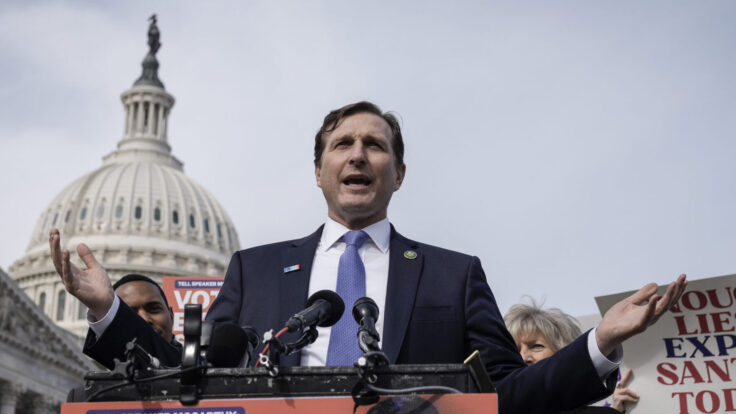
Republican veterans of Iraq and Afghanistan used to be among the most vocal critics of new
military adventures in the Middle East. Democratic Rep. Jason Crow, a veteran himself, wonders where they all went. |
|
|
|
There’s a dark irony in the fact that the U.S. war on Iran is being waged under the auspices of the same
generation that served in Iraq and Afghanistan. Hundreds of thousands of soldiers returned battle-scarred and cynical about American intervention, especially in the Middle East. And over the last two decades, scores of them ran for—and won—federal political offices, including Tammy Duckworth, Ron DeSantis, Seth Moulton, Dan Crenshaw, Tom Cotton, Eugene Vindman, Ruben Gallego,
Mikie Sherrill, Adam Kinzinger, and many others.
For Democrats, the soldier-politician was the perfect rebuke to Bush-era criticisms that the party was weak on national security. But the Republican Party was also transformed. A molten core of Millennial and Gen X conservatives who had served in the Global War on Terror—people like Dan Driscoll, Brian Mast, Eli Crane, Jim
Banks, and Mike Waltz—came away deeply embittered and vociferously antagonistic toward foreign intervention. |
|
|
|
A MESSAGE FROM OUR SPONSOR |
Across the country, harmful corporate insurer practices are driving up costs and delaying care for patients and
families. Prior authorization requirements, AI-driven coverage denials, and excessive red tape shift medical decisions away from doctors and into corporate offices. These barriers can postpone critical treatment, increase out-of-pocket costs, and add stress during already difficult moments. Hospitals are focused on delivering timely, appropriate care, but insurer interference too often stands in the way. It’s time to
prioritize patients over paperwork and ensure access to affordable, reliable healthcare. Learn more about how these practices are impacting care and what can be done. |
|
|
|
Many ultimately supported Donald Trump, who campaigned on the notion that America should
never again be duped by the promise of regime change in the Middle East. “The basic feeling is, we were all sold a bill of lies,” a senior Republican Senate staffer told me. “The U.S. government wasted billions of dollars, the lives of all our friends, and my mental health—and what did we get out of it? Imagine what we could’ve had if we’d minded our own business and invested that money at home. In its essence, it’s a reaction to Afghanistan and Iraq.”
Now, of course, many of those angry
young men who joined the second Trump administration—chief among them Pete Hegseth and J.D. Vance—have become the very politicians leading young men back into war. The U.S. suddenly finds itself in precisely the kind of Middle East quagmire they’d dreaded. Yet many of these men, along with their G.O.P. compatriots in Congress, have been conspicuously silent—or, as in Hegseth’s case, have become its most aggressive cheerleaders.
With that in mind, I
reached out to Rep. Jason Crow, a Democrat and a decorated Army Ranger who founded the For Country Caucus, a bipartisan veterans’ group in the House. He had been close with some of the Republican veterans in Congress who have since gone to ground. He’s also spent the past year-plus recruiting and fundraising ahead of the midterms, trying to get the
Democratic Party back on its footing after the November 2024 walloping. A national security wonk from a working-class, Trump-supporting family, he has also been trying to help Democrats speak about foreign policy in terms that make sense to voters outside the Beltway.
We discussed all of that, as well as the upcoming midterms, the war in Iran, and why his Republican colleagues have suddenly changed their tune on Middle East wars. The following conversation has been edited for clarity and
length. |
Julia Ioffe: I was thinking of all the Millennial and Gen X men who served
in Iraq and Afghanistan and came out disillusioned. Some of them turned hard-right and isolationist, and some are now serving in this administration. Others, like you and Ruben Gallego, are criticizing the administration. What is your perspective, as a veteran of past American Middle East wars, on what the U.S. is doing right now in Iran?
Jason Crow: A lot of Global War on Terror veterans are disillusioned because we understand that we
got screwed by president after president and Congress after Congress. We were sent off to fight wars over and over again. The justifications changed, and we were told by the generals and admirals that we could win with just one more troop surge, one more new strategy, one more new slogan. And 20 years crept by: We spent $5 trillion–$8 trillion; 7,000 of our brothers and sisters died; and American working-class folks, the people I grew up with, did the fighting and dying and the financing of it,
and the elites who perpetuated the wars got wealthier and more prominent. We’re pretty angry about it.
This unified some people on the right and the left, but you don’t hear much criticism of the new Middle East war from the Republican GWOT vets. They’ve been pretty lockstep with the president publicly. Are you hearing anything behind closed doors?
I used to hear more behind closed doors than I hear now. The level of capitulation
among a lot of congressional Republicans has been pretty stunning. But there are profiles of people sticking up and doing the right thing. It would take us a long time to run through all of the things that I disagree with Joe Kent on, for example, but the guy stuck with his principles on this war, was clear that there is no imminent threat—which there isn’t—and called them out. That is a rare exception to what seems to be the rule of Republicans in this town now, which is to
just do what their leader says and move out, no questions asked.
There should be some solidarity that transcends partisanship and party, and there actually used to be. I’m one of the founding members of the bipartisan veterans’ caucus, which came together in 2018. I was pretty critical of a number of things that the Biden administration did, whether it’s Afghanistan or slow-rolling Ukraine or not dealing with Israel and Gaza the right way. I had no trepidation
standing up and calling out what I thought were failures and missteps. I was hoping there would be reciprocity by my colleagues with this administration, but I just haven’t seen it.
What about people like Dan Crenshaw, who lost his primary? He could, theoretically, pull a Thom Tillis and speak out. Have you heard anything from him?
Yeah, not much. I mean, that’s the problem. The folks on the right side of the aisle who have stuck
their heads out, they’ve had them chopped off. At the beginning of this Congress, I had my legislative team create a list of my top 10 Republican co-leads and partners in Congress, people I’ve legislated with, because I’ve been one of the most legislatively bipartisan members of the House. Seventy-five percent of the bills I introduced had Republican co-leads. So they created that list, and all but two of those folks are now gone. They either retired or were beaten in primaries, and one of the
last two—Don Bacon—has announced his retirement.
There used to be a larger group of folks who were interested in recapturing congressional war powers, ending endless conflict, and reining in the Authorization for Use of Military Force. That has dwindled to a small handful of people who actually still believe in that principle—your Thomas Massies, your Warren Davidsons, and a few others. That number used to be bigger until Donald Trump
captured the party and threatened their careers. It turns out that people are willing to do almost anything to save their job. It’s not good for the country. It’s not good for the institution of Congress, either. |
|
|
|
A MESSAGE FROM OUR SPONSOR |
Harmful corporate insurer practices are increasing healthcare costs and creating unnecessary barriers to care. Prior authorization delays,
coverage denials, and excessive administrative requirements slow treatment and drive-up expenses for patients and families. Reform is needed to ensure medical decisions are guided by doctors, not corporate red tape. Learn why curbing these practices is essential to lowering costs and protecting timely access to care. |
|
|
|
You mentioned you come from a working-class family. From what I understand, they’re pro-Trump. How is
this war going down with them?
Almost all of my immediate family members are Trump supporters. I think folks are willing to make a lot of excuses for Trump, but I see cracks starting to appear as the costs for this war go up, and as gas prices go up—they’re up over 60 cents a gallon on average in Colorado. Americans are paying about $300 million a day more in gas, and we’re spending close to $2 billion a day just on defense costs for this war.
That’s more than $20 billion to date on a war nobody asked for, and which remains overwhelmingly unpopular and with no clear off-ramp. Joe Kent is an illustration of [cracks] in the MAGA base.
But what do you hear from your family? Do they support the war because they support Trump or are they becoming skeptical?
I’m not going to go into my conversations with my parents and my brother right now.
That’s fair. What
about in your district?
I can tell you that people who have supported Trump are very concerned about us being pulled into a war with no off-ramp, and they’re very concerned about the military costs and energy costs. This administration is about to propose to Congress a $1.5 trillion defense budget—a 50 percent increase that, again, is overwhelmingly unpopular and actually won’t make us any safer. We are spending and losing hundreds of billions of
dollars on defense items that our military and our service members aren’t even asking for.
I’m unwilling to give the Pentagon a windfall when it’s run by a clown and they can’t even pass an audit, and they’re actually asking for items that have been pushed on them by the defense industrial complex. The face of warfare has drastically changed in the last 10 years—the Ukraine war has completely changed warfare—and our military is sitting here geared to fight a war from 20 years ago. I’m not
going to just throw money at a situation unless I have confidence that the Pentagon and this administration are willing to make radical changes and the reform necessary to spend it in the right way. |
You’ve been working to recruit people to run, to fundraise. One key problem for Democrats after 2024
was coming up with a message other than “We hate Trump.” On foreign policy and national security, what’s the message beyond returning to the status quo?
We need a foreign policy that will be directly beneficial to working-class Americans, and that includes trade, our economy and industrialization, and how we view conflict, military spending, and engagement with our alliances. The litmus test should be that every member of Congress is able to go
home to his or her district and stand in front of a crowd in a high-school auditorium and explain why defense spending or national security spending is going to make their community safer, healthier, and wealthier. If they can’t do that, then we should really be asking ourselves why we’re spending money and taking the actions we’re taking. |
|
|
|
It can’t just be anti-Trump. Trump is a symptom of that resentment and anger that’s taken 20-plus years to
boil over. And Donald Trump actually recognized the way Americans felt before many other people did, and that’s why he made the campaign promises he made. He campaigned on ending conflict, on government reform, on lowering prices. Of course, he got into office and has done the exact opposite on all of those fronts, and has also turned the government into a piggy bank for himself and his family.
Okay, but what is the proposal? In Munich, you talked about a foreign policy for the
working class, but it was overshadowed by A.O.C.’s stumbles. You’re in a gym in, let’s say, Aurora, Colorado. What are the five points of your “foreign policy for the working class”?
One of the problems with Democrats is that we love our five-point plans. People have tuned us out because we start with policy
prescriptions, and what we’re not doing is starting conversations in the way that everyone else does—with values and a sense of shared vision and where we want to go as a country. So we’re saying we know it’s a corrupt, rigged system, that working-class Americans have been getting screwed, and we’re going to end the cycle of conflict, we’re going to reform government and make it work. We’re embarking on a nationwide tour to engage with Americans in every corner of this country, and we’re
listening to folks, trying to understand what struggles they’re dealing with and what government they want to deliver for their families. It’s that process that’s going to create the path forward for us.
What do you think the war in Iran has done for your party’s prospects in the midterms?
Donald Trump continues to do the opposite of what he campaigned on and cause damage and inflict harm on Americans across the country, and we’re
taking that message everywhere. I’m the co-chair of battleground [recruitment] for House Democrats, and I’ve been in Wisconsin, Michigan, New Hampshire, New Jersey, Arizona. And what I can tell you is folks who voted for Donald Trump are pretty fed up, and they’re looking for an alternative and a new path forward. So it’s actually our responsibility now, as a party and as candidates, to engage with those folks, to listen to them, to understand what they’re looking for and what kind of government
and leadership they want, and then work with them to re-earn their trust. People don’t trust us right now, because they don’t think we’ve listened to them and understand and respect their way of life. So before we actually get to a policy discussion, we have to re-earn that trust. You can’t lose 90 percent of U.S. counties like we did in November 2024 and say that we have a coalition—because we don’t.
This isn’t a one-term problem. It took us decades to dig a hole with working-class
voters in America, and it’s going to take more than one cycle to get out of it. So that process is starting. I’m helping to lead it, and we’re going to re-earn people’s trust, but it’s going to take some time. |
That’s all from me, friends. I’ll see you back here next week. Until then, good night. Tomorrow will be
worse.
Julia |
|
|
|
Join Emmy Award-winning journalist Peter Hamby, along with the team of expert journalists at Puck, as they let you in on the
conversations insiders are having across the four corners of power in America: Wall Street, Washington, Silicon Valley, and Hollywood. Presented in partnership with Audacy, new episodes publish daily, Monday through Friday. |
|
|
|
Need help? Review our
FAQ page or contact us for assistance. For brand partnerships, email ads@puck.news.
You received this email because you signed up to receive emails from Puck, or as part of your Puck account associated with {{customer.email}}. To stop receiving this newsletter and/or manage all your email preferences, click here.
|
Puck is published by Heat Media LLC. 107 Greenwich St., New York, NY 10006 |
|
|
|
|