{{ 'now' | timezone: 'America/New_York' | date: '%b %d, %Y' }} |
|
|
Welcome back to Dry Powder. I’m Bill Cohan. A quick shout-out to two of my
colleagues: Julia Ioffe, for her new book, Motherland: A Feminist History of Modern Russia, from Revolution to Autocracy, which is a finalist for the coveted National Book Award; and John Ourand, for pulling off Puck’s first sports media conference, In the Arena, held in Hudson Yards last week and featuring a power lineup that included Adam
Silver, Josh Harris, Gerry Cardinale, Michael Rubin, Eric Shanks, Jay Marine, and others. Kudos to you both!
In other news, Wall Street’s biggest banks are minting money again—JPMorgan Chase, Goldman Sachs, Morgan Stanley, and others all reported double-digit profit gains in the third quarter, with JPMorgan Chase on pace for a record $60 billion in annual earnings. But beneath the jubilation,
Jamie Dimon is calling for caution: The bankruptcies of First Brands and subprime auto lender Tricolor Holdings may be early cracks in an overstressed credit cycle. I’ll get into all that below, plus the quiet rise of “continuation debt funds,” which roll often-troubled private-credit loans into new funds to delay the moment of reckoning.
But first… |
- Verizon’s
$100 million C.E.O.: Verizon has finally revealed its compensation package for new C.E.O. Dan Schulman, once the top executive at PayPal. Last week, for unexplained reasons, the telecommunications behemoth quite abruptly removed longtime C.E.O. Hans Vestberg and replaced him with Schulman, who had been Verizon’s lead independent director. It goes without saying that succession at big public companies is usually much more
orderly—and rarely involves promoting someone from the board to be C.E.O., let alone the lead independent director. (Vestberg is sticking around as an advisor.)
The change was sudden, enigmatic, and drastic. Notably, Verizon appointed Schulman without nailing down his compensation first, which gave him a lot of leverage to extract a maximum pay package. According to a new 8-K filing, it looks like Schulman hit the jackpot, with compensation that could stretch past $100 million if
he hits various performance and stock-related thresholds. According to the filing, Schulman, who will be employed as C.E.O. until (at least) the end of 2027, will make an annual salary of $1.5 million in cash and be eligible for a cash bonus of as much as $3.75 million.
Then there are the stock grants: $9.5 million worth of shares that vest at the end of 2026, to replace the compensation Schulman had bargained for at Valor Capital Group, the private equity firm where he was working
before taking the Verizon gig; and another $20 million that vests at the end of 2027, assuming he’s still in the job. There’s another $30 million of “performance stock units” also contingent upon his continued employment—and don’t forget the final “performance stock units” grant of 222,222 Verizon shares—which can ratchet up in value if Schulman can get the stock, now at $40 a share, up into the $75-a-share region.
In other words, if Schulman delivers for Verizon
shareholders, his compensation could easily reach $100 million, and possibly as much as $130 million if he really hits it out of the park. No wonder he took the job at 67 years old.
|
And now, on to the main event… |
|
|
The coffers are bursting again at JPMorgan Chase, Goldman, Morgan Stanley, Citigroup, and
Bank of America, but Jamie Dimon and others sense the private-credit markets may signal trouble ahead. The P.E. firms have another idea. |
|
|
As third-quarter earnings suggest, the animal spirits have once again been unleashed on Wall Street, and big
banks are making money hand over fist. JPMorgan Chase, with a market capitalization these days of around $820 billion, is on track to make $60 billion of net income in 2025 after registering $14.4 billion in the third quarter—up 12 percent over the same period a year ago. This would obviously be the bank’s best year ever. No wonder Jamie Dimon looked so dapper and relaxed at Andrew Ross
Sorkin’s book party at the renovated Waldorf Astoria on Monday night. He’s broken the champagne bottle on his new, $3 billion, Norman Foster–designed headquarters on Park Avenue, his bank is killing it, and he’s got no near-term plans to retire. JPM’s stock is up 25 percent in 2025.
Goldman is kicking it, too. The bank generated $4.1 billion in net income in the third quarter and $12.5 billion so far in 2025. Its $2.7 billion worth of
investment banking fees were up 42 percent over the same quarter last year. Meanwhile, Goldman’s $1.4 billion in M&A advisory fees were up 60 percent year over year and 20 percent quarter over quarter. Goldman now has a market cap of $227 billion, up 31 percent so far in 2025. Even Citigroup, with net income up 16 percent, is starting to return to the form that once made it the powerhouse on Wall Street. Rounding out the list, Morgan Stanley’s net income was up 45 percent compared to
the third quarter of 2024, while Bank of America earned $8.5 billion in the third quarter, up 23 percent year over year.
But there were some alarm bells ringing amidst the general euphoria. Jamie mentioned a few of them during JPM’s Tuesday morning earnings call—in particular, the spectacular bankruptcies of First Brands, the auto-parts manufacturer, and subprime auto lender Tricolor Holdings. The latter resulted in a $170 million hit to the JPMorgan Chase P&L—chump change in the grand
scheme of things, but enough to get Jamie’s attention. (JPM was one of five lenders who collectively provided some $1 billion of financing to Tricolor before it went belly-up last month.)
On the earnings call, Jamie mused about whether the long bull market in credit, particularly private credit, might be reaching a denouement of sorts. “We’ve had a credit bull market for the best part of 14 years, and these are early signs there may be some excess out there because of it,” he said,
noting that his “antenna goes up” regarding potential warning signs in the credit markets because “when you see one cockroach, there’s probably more.” (He was probably cribbing from Warren Buffett, who once said, “There’s never just one cockroach in the kitchen when you start looking around.”)
“It is not our finest moment,” Jamie said of the Tricolor situation. “And when something like that happens, … we scour every issue, every universe, everything about how that can be
taking place to make sure it doesn’t take place from here. You can never completely avoid these things, but the discipline is to look at it in cold light and go through every single little thing, which you can imagine we’ve already done. … And we will tell you more about that down the road.” |
Despite Jamie’s concern, there’s a lot of activity in the credit markets these days—the result of a highly
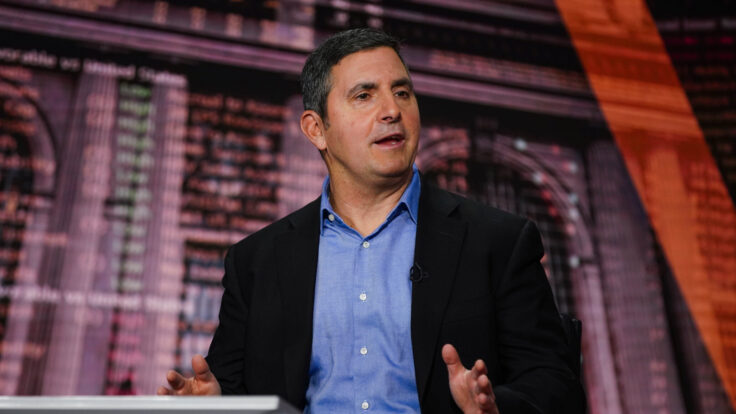
successful idea run wild—so there are bound to be some mistakes, too. “It does not surprise me that we are seeing late-cycle accidents,” said Marc Rowan, the C.E.O. of Apollo and the godfather of private credit, who was one of several leading billionaire moguls to address the bankruptcies of Tricolor and First Brands at a recent Financial Times conference in London. “I think it’s a desire to win in a competitive market that sometimes leads to … a willingness to cut
corners.”
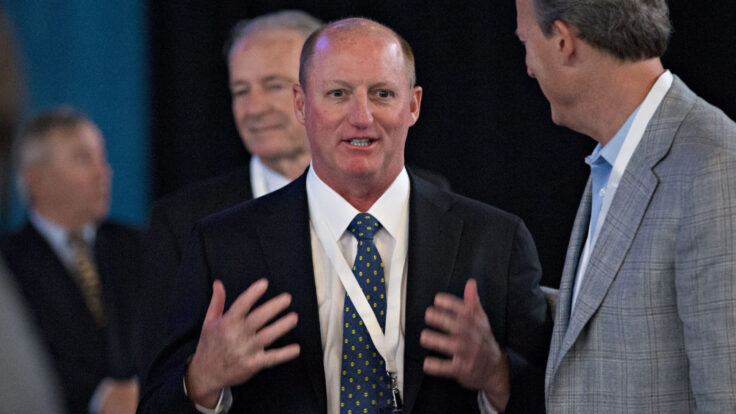
Rowan wasn’t the only one to kick some dirt in Jamie’s direction. Jon Gray, the president of Blackstone, also noted that both Tricolor and First Brands “were bank-led processes.” Of course, there has long been a rivalry over the issuance of credit between the alternative-asset managers, such as Blackstone, Apollo, and KKR, and the big Wall Street banks. Gray told the conference he rejected “100 percent” the “idea that this was a canary in the coal mine” for
private credit.
Indeed, the big P.E. firms remain as bullish as ever on the market. I’ve noticed the emergence in the second and third quarters of something called a “continuation debt fund”—Wall Street speak for a fund composed of private loans that were previously stuck in a debt fund that had reached the end of its natural life (say, seven years). But instead of selling the loans or liquidating them, the debt fund sponsors create a new fund that contains some, if not all, of the old
loans in the original fund.
This instrument extends the life of the assets and avoids marking them to market—which can be valuable if an outright sale or disposal of the loans would have resulted in a loss. It also gives the original investors an opportunity to cash out, usually at a discount, while the fund sponsors—and any of the initial investors who choose to roll the dice—buy more time to achieve the best outcome for the assets rolled into the new fund.
This kind of structure
has been ubiquitous in the private equity world for years, but continuation debt funds appear to be a more recent phenomenon. In August, TPG and Coller Capital, one of the largest private-market investors in secondary stakes in both private equity and private credit funds, closed a $3 billion credit-focused continuation fund that acquired a diversified series of loans made by TPG’s Twin Brook Capital Partners, a middle-market direct lending platform, in 2016 and 2018. The Twin
Brook continuation fund gave existing investors “an attractive liquidity option” while offering new investors “access to a diversified and high-quality pool of private credit assets alongside a long-tenured manager,” according to the TPG press release. (Disclosure: TPG is an investor in Puck.) In September, meanwhile, Coller Capital also teamed up with Benefit Street Partners, an alternative-asset manager with nearly $80 billion under management—and a wholly owned subsidiary of Franklin
Templeton—to create a new $2.3 billion credit continuation fund that purchased a diversified portfolio of middle-market loans from Benefit Street’s 2016 “vintage flagship direct lending fund,” according to a press release about the deal.
In June, Antares Capital, another major provider of private credit, teamed up with Ares Management Corp., a huge provider of private credit with a $50 billion market cap, to create Antares’s first continuation fund, which has more than $1.2 billion of
commitments. The new fund will give existing Antares investors and new investors, including Ares, access to a diversified pool of some 100 loans that had been originated by Antares. Naturally, everyone involved is optimistic. “Building upon our multidecade relationship with Antares, we are proud to lead this transaction, which represents Ares’ largest credit secondary investment to date,” said Dave Schwartz, head of credit secondaries at Ares. “This investment underscores our
team’s differentiated experience in private credit and secondaries and our ability to deploy scaled capital.” |
Of course, to be fair, there are positive aspects to continuation funds. But just as with the private equity
version, a debt continuation fund can serve as an admission that things did not turn out as rosy as originally hoped. As Jim Chanos, the longtime short seller and markets Cassandra, warned earlier this month in an interview with the Financial Times, private credit is not the “magical machine” that its proponents often claim.
As one longtime Wall Street hand told me this week, a private credit continuation fund is evidence that “you can’t exit the [original] fund because you can’t repay it, and you can’t refinance it, and you don’t want to take the hickey, right? … I need to kick the can down the road, but if I kick the can down the road, I’m coming up against the life cycle of my fund.”
Left in the original debt fund might be some loans with uncertain payments, or warrants in the underlying company, or a PIK preferred—and that is what gets rolled over into the continuation fund. “We’ll pay out the people who want to exit, because they think we’re
full of shit,” he continued. “[The problems is these funds] are like cockroaches, my friend. Once you see three, there’s more coming. The market is wildly efficient when you make money, and then it’s, of course, inefficient when you lose money.”
So… is there a dead canary in the coal mine after all? On Tuesday, the International Monetary Fund noted in its semiannual report that European and American banks have made $4.5 trillion of loans to hedge funds, private equity and private
credit funds, and alternative asset managers, who pretty much specialize in risk-taking in order to outperform the wider debt and equity markets. “Beneath the calm surface,” the IMF warned, “the ground is shifting in several parts of the financial system, giving rise to vulnerabilities.” |
|
|
Join Puck’s chief political columnist, John Heilemann, as he roams the corridors of power and influence in America on this
twice-weekly interview show, taking you beyond the headlines with the people who shape our culture: icons and up-and-comers, incumbents and insurgents, moguls and machers in the overlapping worlds of politics, entertainment, tech, business, sports, media, and beyond. The conversations are rich and revealing, unrehearsed and unexpected… and reliably impolitic. A Puck-Audacy joint, new episodes drop every Wednesday and Friday. |
|
|
Puck’s daily political newsletter from Washington on what’s really happening in this town, from the White House to the Pentagon
to Capitol Hill, K Street, and the campaign trail. |
|
|
Need help? Review our FAQ page or contact us for assistance. For brand partnerships, email ads@puck.news. You received this email because you signed up to receive emails from Puck, or as part of your Puck account associated with {{customer.email}}. To stop receiving this newsletter and/or manage all your email preferences, click here. |
Puck is published by Heat Media LLC. 107 Greenwich St, New York, NY 10006 |
|
|
|