• Washington
  • Wall Street
  • A.I.
  • Hollywood
  • Media
  • Fashion
  • Sports
  • Art
  • Join Puck Newsletters What is puck? Authors Podcasts Gift Puck Careers Events
  • Join Puck

    Directly Supporting Authors

    A new economic model in which writers are also partners in the business.

    Personalized Subscriptions

    Customize your settings to receive the newsletters you want from the authors you follow.

    Stay in the Know

    Connect directly with Puck talent through email and exclusive events.

  • What is puck? Newsletters Authors Podcasts Events Gift Puck Careers
Hello, and welcome back to The Best & The Brightest. I told you I’d see you here rain or shine, and I was not shitting you: If you’re in the D.M.V. right now, it feels like monsoon season, wintry mix edition. But writing to you warms my heart and my hands, so here I am. Before we get to the meat of the matter today—South Africa’s application at The Hague accusing Israel of genocide—here’s Abby Livingston with news from the Hill.
 ‌ ‌ ‌ ‌ ‌ ‌ ‌ ‌ ‌ ‌ ‌ ‌ ‌ ‌ ‌ ‌ ‌ ‌ ‌  ‌ ‌ ‌ ‌ ‌ ‌ ‌ ‌ ‌ ‌ ‌ ‌ ‌ ‌ ‌ ‌ ‌ ‌ ‌  ‌ ‌ ‌ ‌ ‌ ‌ ‌ ‌ ‌ ‌ ‌ ‌ ‌ ‌ ‌ ‌ ‌ ‌ ‌  ‌ ‌ ‌ ‌ ‌ ‌ ‌ ‌ ‌ ‌ ‌ ‌ ‌ ‌ ‌ ‌ ‌ ‌ ‌  ‌ ‌ ‌ ‌ ‌ ‌ ‌ ‌ ‌ ‌ ‌ ‌ ‌ ‌ ‌ ‌ ‌ ‌ ‌  ‌ ‌ ‌ ‌ ‌ ‌ ‌ ‌ ‌ ‌ ‌ ‌ ‌ ‌ ‌ ‌ ‌ ‌ ‌  ‌ ‌ ‌ ‌ ‌ ‌ ‌ ‌ ‌ ‌ ‌ ‌ ‌ ‌ ‌ ‌ ‌ ‌ ‌  ‌ ‌ ‌ ‌ ‌ ‌ ‌ ‌ ‌ ‌ ‌ ‌ ‌ ‌ ‌ ‌ ‌ ‌ ‌  ‌ ‌ ‌ ‌ ‌ ‌ ‌ ‌ ‌ ‌ ‌ ‌ ‌ ‌ ‌ ‌ ‌ ‌ ‌  ‌ ‌ ‌ ‌ ‌ ‌ ‌ ‌ ‌ ‌ ‌ ‌ ‌ ‌ ‌ ‌ ‌ ‌ ‌ 
The Best & Brightest

Hello, and welcome back to The Best & The Brightest. I told you I’d see you here rain or shine, and I was not shitting you: If you’re in the D.M.V. right now, it feels like monsoon season, wintry mix edition. But writing to you warms my heart and my hands, so here I am.

Before we get to the meat of the matter today—South Africa’s application at The Hague accusing Israel of genocide—here’s Abby Livingston with news from the Hill…

A Surprise Trump Ring Kiss & Schiff’s Amazing Haul
Members are trickling back into D.C. as both chambers gavel in after the holiday break. The next few weeks are expected to be brutal, especially given the simmering angst within the House G.O.P. conference about the leadership of Mike Johnson, who heads into a hellacious negotiating season with an eventual one-vote margin. (This instability will escalate tensions around the Hill for the next few weeks.) But come February, Congress will be obsessed with the outcome of New York’s Feb. 13 House special election, after which primary season will consume the attention of members and staffers. In fact, it’s already starting. Here’s what’s going around today:

  • Rogers’ Surprise Supplication: Michigan’s Mike Rogers (not to be confused with Alabama’s Mike Rogers) endorsed Donald Trump on Tuesday, just days before the Iowa caucuses. While this may seem like the price of admission for any Republican Senate candidate—Rogers is a viable general election challenger to Democratic phenom Elissa Slotkin for Debbie Stabenow’s Michigan seat—this nod is yet another reminder that the Republican Party is never, ever going back to its pre-Trump worldview.

    In his heyday as House Intel chairman, Rogers was one of the most respected Republicans across the political spectrum. He also served for five years in the F.B.I., an institution Trump has been at war with since the earliest days of his presidency. Only 14 months ago, The Washington Post’s David Ignatius described Rogers as a potential Republican presidential candidate, writing, “The bet that Rogers and a long list of other prospective candidates are weighing is that Republicans don’t want to be the party of crazy anymore.” But, alas, politics is the art of the practical, and Rogers knows that if he wants to run for Senate as a member of “the party of crazy,” he needs to kiss the ring.

  • Fundraising Intrigue: Fascinating F.E.C. fundraising numbers are dribbling out, including the intriguing tidbit that Arizona Republican Senate candidate Kari Lake raised $2.1 million, which lagged far behind Democratic challenger Ruben Gallego’s $3.3 million in the same period. (Incumbent Kyrsten Sinema has yet to release her figures… or even announce whether she’s running for reelection.)

    Last year, Lake took forever to launch her campaign. Everyone knew she was running, but she waited until the beginning of the fourth quarter fundraising period to officially announce. The logic is that early-quarter announcements give the candidate as much time as possible to post impressive numbers. Moreover, a candidate’s launch quarter is often one of their best fundraising windows because the low-hanging-fruit donors are not yet tapped out. It’s remarkable that Gallego has been in the race for a year and has still outpaced Lake’s first stab holding the bag.

    In other fundraising news, New Jersey first lady Tammy Murphy outraised Andy Kim in their battle for the Democratic nomination for the Garden State Senate seat currently occupied by Robert Menendez. Murphy raised $3.2 million against the third-term congressman’s $1.75 million in the same period. New Jersey, of course, has one of the most powerful state governments in the country, and donors flock to state officials (or, in this case, a spouse) with cash in hand. Menendez has yet to announce his next move, but took to the Senate floor Tuesday for a defiant speech after picking up his third indictment since September.

    By juxtaposition, both of these contests illustrate the extraordinary success of Adam Schiff’s fundraising effort. The fourth quarter marked the second reporting period during which he raised more than $6 million. Who gets the credit? His California political godmother, Nancy Pelosi? Maybe. But mostly, Schiff should be writing thank-you notes to the House Republicans conference, whose censure of him last summer infuriated progressives and marked an inflection point in his campaign.

“Blood Libel?”: On the Question of Genocide in Gaza
Assessing South Africa’s accusations with David Scheffer, a founding father of the International Criminal Court.
JULIA IOFFE JULIA IOFFE
On Thursday, the International Court of Justice, the U.N.’s top court, located in The Hague, will hear arguments in response to South Africa’s petition accusing Israel of violating the 1948 Genocide Convention. It is asking the court to order an end to all Israeli military action in Gaza. The Israeli government has denounced the case, slamming it as “blood libel” and reportedly pushing other governments to pile on, too.

Their response, as a state created in response to the very calamity that gave rise to the Genocide Convention, is understandable. The Jewish community worldwide has, at times, had a very territorial relationship to the word. But so, too, has the petitioner to the court, South Africa, which coined the term “apartheid” and which has had increasingly bitter relations with Jerusalem since the apartheid system was dismantled in the early 1990s. Israel, after all, had a cozy Cold War relationship with the apartheid regime, despite its leaders’ ties to the Nazis. But any remaining good will between Pretoria and Jerusalem has completely evaporated during this war as both South Africa and Israel have pulled their ambassadors from the other’s capital.

Last fall, when the October 7 attack was still fresh and the war between Hamas and Israel had just kicked off, I interviewed David Scheffer, a lawyer and professor who had been named by Bill Clinton to be his ambassador-at-large for war crimes. Scheffer, who worked closely with Madeleine Albright, first when she was ambassador to the U.N. and then secretary of state, is a pioneer in international human rights law. He helped set up war crimes tribunals for Rwanda, the former Yugoslavia, Sierra Leone, and the Khmer Rouge. He is also a founding father of the International Criminal Court, having negotiated its creation and signed the Rome Statute on behalf of the United States government in 1998.

David and I were on the same fellowship this fall, and as the information war intensified around the actual war, I often found myself asking him for clarity and sanity. Without fail, David was able to cut through the bullshit and explain where things stood from the point of view of international law, which is so frequently invoked on social media these days. Unsurprisingly, it was usually not what either side of the debate was screaming at us.

Now, with the I.C.J. hearing scheduled for Thursday, I decided to give David a call and pick his brain about what’s in the complaint, what we can expect from the court, and what we talk about when we talk about genocide. I hope you find our conversation, which has been edited for clarity and length, as fascinating and illuminating as I did.

Julia Ioffe: What exactly does South Africa allege?

David Scheffer: South Africa is alleging the entire corpus of the Genocide Convention and its application, namely that Israel has failed to prevent genocide against Gaza and that it is committing genocide against Gaza. It is a very fulsome application. South Africa is not asking the I.C.J. to make a finding of a failure to prevent, or a commission of, genocide. They are asking the I.C.J. to direct Israel through what are called provisional measures to do what is necessary to prevent and not commit genocide in Gaza, to take those measures while the I.C.J., over a much longer period of time, considers the merits of South Africa’s allegations. For a commission of genocide, one needs to establish that both the genocidal act has occurred and that it has occurred with the specific intent to destroy all or part of a national, racial, religious, or ethnic group. The dolus specialis, we call it—the specific intent to do that. That’s why, particularly on a merits stage, it takes time to put those two together: the genocidal acts, and the mens rea of the specific intent.

So, South Africa is asking not for a finding of genocide, but for an injunction to stop Israeli military action in Gaza?

Yes. “Provisional measures” is their way of saying injunction.

Why South Africa?

South Africa is a state party of the Genocide Convention. Israel is a state party of the Genocide Convention, and the Genocide Convention is a human rights convention which recognizes what we call erga omnes, which just means that, when you are a party to the Genocide Convention, you owe obligations to all parties of the Genocide Convention. And if you violate your obligations under the convention, then any party in the treaty has standing to call you out on it and to bring an application before the I.C.J.

South Africa is a logical candidate for this, in part because I think, politically, South Africa has had its apartheid experience, and it actually alleges in the application that there is a context between Israel and the Palestinians that feeds into the genocidal acts and intent. Part of that context is what South Africa alleges is the commission of apartheid against the Palestinians for decades. And that feeds into how you establish specific intent to commit genocide, because, as they’re alleging, Israel has treated the Palestinians under apartheid in such a discriminatory manner.

Also, I think South Africa would like to be seen as a real leader in the Global South. But furthermore, in terms of strategy, they would prefer to see a non-Arab state take the lead in a case like this. And of course, South Africa is also joined in this application by other parties: Bangladesh, Bolivia, the Comoro Islands, and Djibouti, none of which are Arab states. It’s an interesting combination, and you see that there’s some strategy there.

A lot of the things that the applicants are alleging aren’t really in dispute. Thousands and thousands of Palestinians have been killed. Hundreds of thousands of homes have been destroyed. Pretty much the entire population of Gaza has been displaced. We know all this, but how is that genocide rather than a horrific way of waging war? And where does one tip into the other?

The application disgorges an enormous amount of publicly available information about what has happened in Gaza. We all know that it’s a humanitarian catastrophe of some dimension in Gaza right now. I don’t want to diminish the importance of that. But nowhere in South Africa’s application is there any recognition that there is a war taking place. This is not a genocide like Rwanda or of the Rohingya or the Yazidis in recent times, where these were just authoritarian regimes that went after populations that were not attacking them. These were just slaughters.

But this is a war. There is an act of self-defense by Israel. Now, that does not mean that Israel has clean hands on absolutely everything it’s done, absolutely not. As I said from the beginning, target by target, day by day, you have to meet a legal standard. But it is astonishing to me how the application by South Africa tends to ignore almost the entire context of this, which is that these deaths, injuries, and destruction and humanitarian situations are erupting in the context of a war.

And there is no recognition in the application that Israel has any justification for responding to the October 7th atrocities at all. There’s no reality check in this application about the fact that everything needs to be gauged against the laws of war, not just human rights principles, not just even international humanitarian law. It has to be seen in the context of war.

There’s also no recognition in the application that Israel has any right of self-defense. It’s never stated. It’s a major principle of international law that Israel has the right of self-defense. The question is: How is Israel exercising that right? Yes, the Genocide Convention applies during wartime, but you cannot isolate the war from the genocide. You have to examine both at the same time.

To be fair, there is a kind of pro forma box-ticking, where they mention the attacks of October 7th in the application and then say that they are against hostage-taking and the targeting of civilians and that bombs are continuously going out from Gaza into Israel.

The acknowledgment of October 7th and of the hostage taking and of Hamas missiles still being fired into Israel—those acknowledgments are so, well, perfunctory. They are presented without any analysis or any recognition that this is part of what has to be analyzed as well in terms of the Genocide Convention, because it’s the right of self-defense which triggers a combat situation. And nowhere in the document—or nowhere that I can find—is there even any suggestion that the total number of Palestinian casualties includes a certain percentage of Hamas militants. There’s no breakdown at all, as if the Israeli attack on Hamas and the militants is irrelevant to the entire equation.

Does this complicate things at all??

The International Court of Justice is only to a certain degree a fact-finding court. It does not really have the capacity to independently investigate a huge amount of data and of evidence. Typically, its cases require some evidence, but not of the character associated with a massive war and humanitarian situation, as we find in Israel and Gaza. So therefore to ask the I.C.J. to render a finding that genocide is occurring or has occurred is a very heavy lift for the I.C.J. Contrast it to a criminal court such as the I.C.C., which requires the production in the courtroom of an enormous amount of verified evidence, all of which has to be verified by the court: witness statements, depositions, documents, all sorts of evidence. And since this is a criminal issue—the Genocide Convention—this would be difficult for the I.C.J. to do as as they would do in a criminal court with a single defendant. Here we have an entire state, the state of Israel.

The precedents in the I.C.J. bear out the following: the I.C.J. is very reluctant to reach a finding of genocide unless it can point to a criminal conviction of a leader of that state who has been convicted of the crime of genocide.

How do you think this hearing will shake out? What do you predict the I.C.J. will do?

In this situation, the determination of the facts, particularly given that here we have the context of a war being waged between Israel and Hamas, as well as the enormous amount of clarification that would be required for all of the evidence produced in the public realm—you know, courts don’t just convict on the basis of news articles—all of that has to be reviewed and taken into account.

So I think that what the court may end up doing here is, they can issue provisional measures, but they will not go to the merits at all. It will not conclude that Israel is conducting genocide—it just will not go there—but it may issue a provisional measure that says that Israel should not take any steps that would violate the Genocide Convention. I mean, all of us are not supposed to take any steps that violate the Genocide Convention. And they’ll probably say that Israel has to preserve all the evidence on everything that it’s done in terms of targeting. I think they might say something like that.

So let’s say the court issues these provisional measures. Are they enforceable?

Only the Security Council could enforce them through a Chapter VII resolution. And even then, Israel could or could not comply with the Security Council resolution under Chapter VII.

Let’s say the I.C.J. issues provisional measures saying, “Stop this military action because it’s killing all these civilians, which is tantamount to genocide,” and then the U.N. Security Council votes on a resolution saying, “Israel, you have to abide by this.” Then what happens?

Possibly nothing. I mean, Israel has not complied with many Security Council resolutions or General Assembly resolutions.

I doubt that the court will simply say, “Stop fighting,” because that would deny Israel the right of self-defense. And you have to be positive that Israel will make that argument on Thursday. They have the right of self-defense, and the court cannot instruct them to literally stop exercising the right of self-defense, which does, in Israel’s mind, require a certain amount of military force. The question is: How much force and in what manner and character, etcetera? In other words, will the court be the messenger for the ceasefire crowd? I don’t think so.

What do you think Israel will argue in its defense?

They could use a legal principle called “unclean hands” as an affirmative defense—namely, that South Africa is de facto presenting this as a surrogate for the state of Palestine. The problem is the state of Palestine has unclean hands because Hamas, which is part of the state of Palestine, committed the atrocities of October 7th, and, in law, if you yourself are the perpetrator of, in this case, literally the same crime that you’re accusing the other party of committing in your application, your suit is greatly weakened.

And while South Africa is not the perpetrator of genocide by any means, it’s the de facto representation of the interests of the state of Palestine in bringing this case to the I.C.J. Israel could say, “You don’t even recognize it in the application other than to say October 7th happened. You never identify October 7th as possibly even falling within the realm of genocide? You don’t even put that in writing in your application? And yet it’s obvious that it does!”

I would not be surprised if some judges on the I.C.J. ponder the imbalance in this application and the failure to recognize the character of what happened on October 7th as if not genocide, then possibly genocide. South Africa could have helped its case by first recognizing the significance of October 7th, not just as a throwaway comment, and then move from there to its concerns about Israeli conduct in Gaza.

Also notice, by the way, that the Israelis did not select an American to represent them in front of the court. And I think probably for good reason. The United States is so deeply tied to Israel in this entire conflict, in so many ways. It might be misleading to have an American literally representing Israel in front of the I.C.J. It’s much safer to have a barrister like Sir Malcolm Shaw, who is held in high respect by all the judges on the bench at the I.C.J.

You said Hamas may have committed genocide on October 7th. Do you think a terrorist attack like that can constitute genocide or an attempt at genocide?

Yes, I think it can. Now, that doesn’t mean that if I’m presented with all the facts and everything, I would conclude as a judge that genocide occurred on October 7th. That’s what makes a discussion about “Is it or is it not genocide?” so difficult, because it is a fact-based judicial decision where you have to bring together the acts with a specific intent to destroy all or a substantial part of a population.

I do think that there is a strong case that Hamas was seeking to destroy a rather sizable proportion of the Israeli population on October 7th. They seem to have had an agenda that even went beyond the kibbutzim to move into other parts of Israel, and there seems to be documentary evidence of that.

I’m comfortable with using the word “genocide” for October 7th, recognizing that—and I’m sorry to say this—I’m the one who created the word “atrocity crimes” in 2002 in order to liberate us a little bit from having to rush to these kinds of determinations [of genocide]. It’s a little easier just to say “atrocity crimes,” but saying “atrocity crimes” is enough to get me moving.

You hear the word “genocide” thrown around so much these days when people might mean “war crimes” or “ethnic cleansing,” like in some of these recent statements about the “voluntary” immigration of Gazans, which is insane. Are people confusing the terms?

There is a considerable amount of sloppiness in how people describe this crime. That said, we do not want to hamstring people from describing what is awful as being awful and illegal, right? I don’t think we can impose strict discipline on everyone to use the proper term legally. Because at the end of the day, it would be a court that would make that determination. Or a government could make that determination based upon a great deal of investigation. For example, the U.S. government determined that genocide was happening in Darfur. South Africa has the right to call it genocide if that’s what it believes is taking place and then presents a lot of information that it believes supports that allegation. But at the end of the day, that does not mean that Israel is literally committing genocide. It will have to be a court that would make that final determination, just as the International Criminal Court, the I.C.C., has yet to make a determination on genocide in Darfur because [Omar] al-Bashir has not been arrested and transferred to The Hague yet to stand trial on that charge.

Why use the term “genocide” when “atrocity crime” will do?

I think genocide is a very powerful word. You get everyone’s attention. South Africa could just as easily say, “We clearly think atrocity crimes are occurring now in Gaza. We’re not prepared yet to say whether it’s genocide or not.” But they did make a determination: They want to call it genocide. And they’re free to do so. I don’t blame them.

But in the court of law as well as in the court of public opinion, I think it’s very important that we not embrace that word in this particular conflict until there’s a better understanding of what is occurring in terms of warfare and of the humanitarian plight of the Palestinian people.

At the same time, as I have pointed out, Hamas could stop it all tomorrow by surrendering. Hamas has the power to prevent genocide. It has had the power to prevent genocide even after it, itself, probably committed genocide on October 7th. It had the power, after October 7th, to subject none of the Palestinian population to what South Africa describes as genocide. Hamas had the power and it did not use that power. Hamas has no right to fight on. It has no right of self-defense. And furthermore, by virtue of the fact that it continues to fight, it brings an enormous amount of suffering and destruction upon the Palestinian people, all of which it could stop by simply surrendering.

There are those who say that “resistance is justified” and that Palestinians have the right to liberate themselves “by any means necessary.” From the point of view of international law, is that true?

The right of self-determination is a steadfast, peremptory norm of international law. It’s what we call jus cogens. No one’s denying the right to advocate for self-determination. But we’re no longer in a world where the achievement of self-determination can be legitimately undertaken by violating human rights law or the U.N. charter. The classic example would be the Scottish National Party. They want self-determination for Scotland. Do they have the right to raise an army and invade England for that purpose? No. International law would never embrace that.

Certainly during the colonial period, there was some acceptance of using force in order to free nations from colonial power. But international law has advanced since then, and customary international law strictly prohibits using those kinds of illegal steps—i.e., violating conventions like the Genocide Convention, the Geneva Conventions—in order to achieve that objective. Now, I’m sure that there’ll be a scholar or two that will come back and say, “Oh, no, no, actually, technically, I don’t see that, that that’s actually prohibited under international law.” But that’s a sort of an explanation that defies all rational interpretation of international law in the year 2024. Otherwise, one is inviting an enormous amount of violence on planet Earth.

Last question. Israel, as you say, has ignored so much coming out of the U.N. Their response to this kind of stuff tends to be, “Okay, another day, another war crimes accusation from antisemites.” Why do you think Israel is actually responding to this application and sending someone to argue on its behalf?

I think Israel has undermined its argument somewhat by not being clear throughout this war about why it is striking the way it is striking, why it is targeting the way it is targeting. It issues a very general statement to the effect of, “We are always cognizant of international humanitarian law. We want to distinguish between civilians and combatants. And we’ll come back and say the same thing tomorrow.” What they should be doing is providing far greater clarity as to why the force that they have used was necessary for military purposes. If they drop a 2,000-pound bomb, why was it necessary to drop a 2,000-pound bomb? Well, Israel might say it was in order to destroy a tunnel. Okay, but did you realize that 300 civilians were in the building on top of that tunnel? You have to explain yourself.

They have not been doing that, which is somewhat arrogant. It is also ill-conceived because the world is watching. It wants to understand what Israel is doing when there is such a huge humanitarian impact to what they’re doing. Israel also needs to understand that the world is looking at the totality of this. Even if they could claim individual strikes are legal because they’ve gone through this analysis, strike by strike, when you have a total result that appears to be what we see in Gaza, they need to explain to the world far better than they have.

I think one of the interesting things about the Israel-Hamas war is that it demonstrates that the world is not only watching, but the world knows enough now about atrocity crimes and what has happened in the last 30 years to understand that individuals can be held accountable under international criminal law and that these crimes cannot be committed secretly. They are being committed publicly because the world watches them, and the world understands more now than it did 30 years ago about the character of these crimes. The Israeli Defense Forces, while having the right of self-defense, always need to bear that in mind.

That’s all from me, friends. I’ll see you back here next week. Until then, good night. Tomorrow will be worse.

Julia

FOUR STORIES WE’RE TALKING ABOUT
The Times vs. OpenAI
Dissecting a potentially watershed lawsuit.
ERIQ GARDNER
Iowa in Absentia
Iowa in Absentia
As it turns out, all races are not built the same.
PETER HAMBY
As I Lay Designing
As I Lay Designing
Notes on the return of Anna Wintour’s favorite (print) designer.
LAUREN SHERMAN
Ackman’s Revenge
Ackman’s Revenge
On Bill Ackman’s P.R. battle royale, ESPN’s megadeal, and more.
WILLIAM D. COHAN
swash divider
Puck
Facebook Twitter Instagram LinkedIn

Need help? Review our FAQs
page
or contact
us
for assistance. For brand partnerships, email ads@puck.news.

You received this email because you signed up to receive emails from Puck, or as part of your Puck account associated with . To stop receiving this newsletter and/or manage all your email preferences, click here.

Puck is published by Heat Media LLC. 227 W 17th St New York, NY 10011.

SEE THE ARCHIVES

SHARE
Try Puck for free

Sign up today to join the inside conversation at the nexus of Wall Street, Washington, A.I., Hollywood, and more.

Already a member? Log In


  • Daily articles and breaking news
  • Personal emails directly from our authors
  • Gift subscriber-only stories to friends & family
  • Unlimited access to archives

  • Exclusive bonus days of select newsletters
  • Exclusive access to Puck merch
  • Early bird access to new editorial and product features
  • Invitations to private conference calls with Puck authors

Exclusive to Inner Circle only


Latest Articles from Washington

Donald Trump
Julia Ioffe • January 10, 2024
The Greenland Mile
After claiming the “framework of a deal” to expand America’s presence on the world’s largest island, Trump has dropped his threats to invade Greenland. Thank God, because a direct assault on Greenland wasn’t going to be a cakewalk.
Donald Trump
Leigh Ann Caldwell • January 10, 2024
Trump’s G.O.P. Greenlanditis
With his Davos speech, the president reassured jittery Republicans that invading Greenland is, for now, off the table. But conversations on the Hill have escalated, as even Trump’s G.O.P. allies warn that any move that blows up NATO could end his midterm hopes—and lead to impeachment, too.
ICE protest
Peter Hamby • January 10, 2024
Inside the Democratic ICE Storm
A remarkably candid conversation with Adam Jentleson, the founder and president of the Searchlight Institute, about the rhetorical fight over abolishing ICE that’s raging inside the Democratic Party.


Amy Klobuchar
Abby Livingston • January 10, 2024
Klobuchar’s Minnesota Succession Mess
Two days before the killing of Renee Good, news leaked that Senator Klobuchar was weighing a bid to succeed Tim Walz as governor of Minnesota. But while the chatter about Klobuchar has receded from the headlines, Democrats are quietly discussing the political impact of a second open Senate seat in 2026.
Kristi Noem
Leigh Ann Caldwell • January 10, 2024
Will Democrats Impeach Kristi Noem?
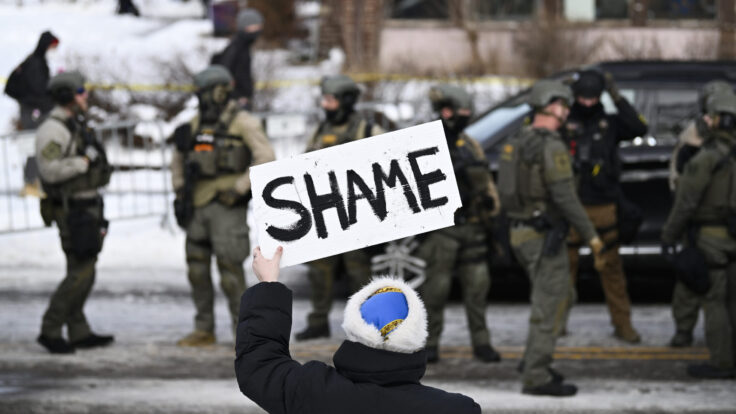
While House Democrats are divided over how to challenge Trump, leadership is quietly building a case against the Homeland Security secretary—beginning with potential shadow hearings, outside the official committee structure, that would gather the evidence against her.
Tulsi Gabbard
Julia Ioffe • January 10, 2024
The Havana Hangover
After years of denials, Washington is finally reckoning with new reporting that would seem to confirm the existence of the alleged Russian directed-energy weapon that causes Havana syndrome—or what the U.S. government now calls “anomalous health incidents.” But will Tulsi Gabbard be allowed to release the O.D.N.I.’s own findings?


Donald Trump, John Thune
Leigh Ann Caldwell • January 10, 2024
John Thune Has the Hardest Job in Washington
Can the Senate leader preserve his majority, manage his members’ competing agendas, and protect his institution—all while placating the president?


Get access to this story

Enter your email for a free preview of Puck’s full offering, including exclusive articles, private emails from authors, and more.

Verify your email and sign in by clicking the link we just sent.

Already a member? Log In


Start 14 Day Free Trial for Unlimited Access Instead →


Latest Articles from Washington

minneapolis ice shooting protests
Peter Hamby • January 10, 2024
Support for ICE Is Collapsing
Outside the right-wing echo chamber, polls tell the true story of an unprecedented drop in support for Trump’s immigration agency, which has swung 30 points in 12 months.
Nancy Pelosi
Abby Livingston • January 10, 2024
Pelosi Succession Chatter & Gavin-mander Aftershocks
Nancy Pelosi’s retirement in San Francisco, an Obama alum’s generational challenge in L.A., and a redrawn Orange County could end careers and launch new California stars.
Rand Paul, Lindsey Graham
Leigh Ann Caldwell • January 10, 2024
The Ballad of Rand & Lindsey
The changing definition of “America First” has exploded tensions between two senators at opposite ends of the conservative foreign policy spectrum: the libertarian Rand Paul and the interventionist Lindsey Graham. If Paul won the ideological battle in the first term, Graham seems to have Trump’s ear in the second.


Nancy Pelosi, Hakeem Jeffries
Abby Livingston • January 10, 2024
The Wolves of First Street
The once quixotic, bipartisan crusade to ban congressional stock trading is gaining real momentum—but in the least productive Congress in history, getting Washington’s best-informed traders to give up their Robinhood accounts may be a long shot.
Lew Olowski
Julia Ioffe • January 10, 2024
The Big Olowski Has Left the Building
Lew Olowski, the State Department’s wacky, polarizing head of H.R., is said to have imploded at his farewell party when he learned that he wasn’t getting a coveted assignment.
Donald Trump
Leigh Ann Caldwell • January 10, 2024
Trump’s Mile-High Revenge Tour
The president’s bizarre decision to wage a retaliatory political war on Colorado—including the MAGA stronghold that elected Lauren Boebert—could wind up costing him the House.


trump supporters gen z young men voters
Peter Hamby • January 10, 2024
Manospheres of Influence
The disaffected young men who helped elect Trump are fed up with high prices, worried about A.I., and frustrated by the president’s neocon turn. And, according to exclusive new polling data, they’re souring on Trump just as they turned on Joe Biden.
Get access to this story

Enter your email to get access to one article and free previews of our private emails from Puck authors and editors.

OR

Already a Member? Sign in


Latest Articles from Washington

Donald Trump
Julia Ioffe • January 10, 2024
Neocon Don
Trump’s largely consequence-free projection of military power in Iran and elsewhere laid the groundwork for last weekend’s shocking action in Venezuela—and validated a new framework for MAGA-style interventionism. But what happens when Xi starts playing by the same rules?
Mike Johnson chuck schumer Hakeem Jeffries
Leigh Ann Caldwell • January 10, 2024
The Four Horsemen of Capitol Hill’s Apocalypse
A close look at the challenges, opportunities, and curveballs awaiting the Big Four congressional leaders in the new year: the M.T.G. mutiny, G.O.P. majority shrinkage, another shutdown, A.C.A. headaches, and Trump.
Ezra Klein
John Heilemann • January 10, 2024
The World According to Ezra
The Times columnist, podcast impresario, and would-be Democratic Party uber-reformer recaps the past year in politics—and explains why, despite his ongoing sense of alarm, he’s closing out 2025 feeling moderately hopeful.


april McClain Delaney
Abby Livingston • January 10, 2024
The Real House Members of Potomac
Ready or not, the midterm primary season is just days away. And, as analyst Jacob Rubashkin explains, just about anything can happen… including a congressional surprise in Texas and a Senate upset in Michigan.
Republicans
Leigh Ann Caldwell • January 10, 2024
The G.O.P.’s Midterm Polling Paradox
A few months ago, Republicans thought they had the country on autopilot. Now the party is stuck with a souring economy, beholden to Trump for turnout—whether they like it or not—and staring down an increasingly unpredictable midterm map.
Jim McDonnell
Peter Hamby • January 10, 2024
The ICE Storm
A candid conversation with L.A. police chief Jim McDonnell about the complicated reality of ICE raids, hyperbolic crime narratives, and preparing for the World Cup and 2028 Olympics in the second Trump era.


Dan Goldman
Abby Livingston • January 10, 2024
“The Mini Mamdanis Are Coming”
Dan Goldman, the popular resistance-lib congressman repping downtown Manhattan and much of brownstone Brooklyn, was a star on MSNBC. But in a year in which his rival was just endorsed by Mayor-elect Zohran Mamdani, Democrats fear he could be among the biggest names to fall in a Tea Party–style reckoning.


  • Terms
  • Privacy
  • Contact
  • FAQ
  • Careers
© 2026 Heat Media All rights reserved.
Create an account

Already a member? Log In

CREATE AN ACCOUNT with Google
OR YOUR EMAIL

OR

Use Email & Password Instead

USE EMAIL & PASSWORD
Password strength:

OR

Use Another Sign-Up Method

Become a member

All of the insider knowledge from our top tier authors, in your inbox.

Create an account

Already a member? Log In

Verify your email!

You should receive a link to log in at .

I DID NOT RECEIVE A LINK

Didn't get an email? Check your spam folder and confirm the spelling of your email, and try again. If you continue to have trouble, reach out to fritz@puck.news.

CREATE AN ACCOUNT with Google
CREATE AN ACCOUNT with Apple
OR USE EMAIL & PASSWORD
Password strength:

OR
Log In

Not a member yet? Sign up today

Log in with Google
Log in with Google
Log in with Apple
Log in with Apple
OR USE EMAIL & PASSWORD
Don't have a password or need to reset it?

OR
Verify Account

Verify your email!

You should receive a link to log in at .

I DID NOT RECEIVE A LINK

Didn't get an email? Check your spam folder and confirm the spelling of your email, and try again. If you continue to have trouble, reach out to fritz@puck.news.

YOUR EMAIL

Use a different sign in option instead

Member Exclusive

Get access to this story

Create a free account to preview Puck’s full offering, including exclusive articles, private emails from authors, and more.

Already a member? Sign in

Free article unlocked!

You are logged into a free account as unknown@example.com

ENJOY 1 FREE ARTICLE EACH MONTH

Subscribe today to join the inside conversation at the nexus of Wall Street, Washington, A.I., Hollywood, and more.

START 14-DAY FREE TRIAL

  • Daily articles and breaking news
  • Personal emails directly from our authors
  • Gift subscriber-only stories to friends & family
  • Unlimited access to archives
  • Bookmark articles to create a Reading List
  • Quarterly calls with industry experts from the power corners we cover