|

|
|
Hello, and welcome back to The Best & The Brightest. I’m Peter Hamby, hitting your inbox a day late on account of last night’s voting.
The Iowa caucuses are finally in the rearview, and the sprint to the G.O.P. nomination has begun. But as I look at the upcoming primary calendar, all I see is an ugly road ahead for Ron DeSantis and Nikki Haley, who are looking more and more like zombie candidates as Donald Trump further tightens his grip on the Republican electorate. More on that, below the fold.
But first, the latest from Abby Livingston on the Hill….
|
|
A MESSAGE FROM OUR SPONSOR
|
|
|

|
Protect patients against PBM abuses. Across the country, policymakers, regulators, patients, doctors, pharmacists, and others agree on the solution to lower drug costs. It’s time for Congress to pass strong PBM reforms.
Learn More.
|
|
|
|
|
- Fresh shutdown fears: Even as Washington enjoys a snow day, there is no rest for the weary. The weather scrambled members’ schedules, but the government is still set to shut down on Friday. And while some hardliners have been planning for a two-week protest shutdown, as my partner Tina Nguyen reported, there are growing worries on the Hill about the impact of a genuine shutdown, as opposed to past mini-shutdowns. Reversing course, negotiating a resolution, and getting the lights back on again could be more difficult than some members anticipate. And that’s not the only problem facing this inexperienced speaker…
- Redistricting drama: Meanwhile, Mike Johnson is also waging political battle on a second front. The House speaker has taken on his home state governor, Jeff Landry, over a proposed congressional map that would almost certainly jettison Louisiana Rep. Garret Graves. (Graves was in Kevin McCarthy’s inner circle and frequently surfaced as a pivotal player during the October power scramble after McCarthy’s ouster.)
A court-ordered redraw mandated that state lawmakers create an opportunity district for likely African American representation. They responded with a map that prioritized protecting the only Republican woman in the delegation, Julia Letlow, per multiple reports. Johnson called for the state to keep fighting in court before considering “legally compliant” alternatives.
There are many reasons for the speaker’s interest here. This is his home delegation, of course, and Johnson and Graves both use the same Louisiana-based consulting firm, The Political Firm (which was acquired by Jeff Roe’s Axiom Strategies after the 2020 cycle). Graves is also a loyal member-donor to Republican House and Senate incumbents and candidates—he gave almost $60,000 to various campaigns last cycle, per the Center for Responsive Politics. He’s making the same kind of donations this cycle, plus $22,000 in dues to the N.R.C.C.
Obviously, the new Louisiana map will not affect the current House margin. But looking ahead to the fall election, control of the House is expected to be a district-by-district knife fight across the country. It makes sense that Johnson is concerned about Democrats picking up an easy, safe seat in November.
- Finally, on Iowa…: Dave Weigel smartly noted a significant turnout dropoff in Polk County, home to Des Moines, where there are “more Romney-Biden voters who’ve left for good than Dems who wanted to do game theory for Haley.” It’s hard to draw conclusions given the massive winter storm that hit Iowa last week, but it’s worth watching whether that same dynamic—depressed Republican turnout in large cities with suburbs—repeats in forthcoming primaries. After all, control for the House runs through suburban/urban regions like Orange County in California and the New York metro. Beyond the presidential primaries, it’s also worth watching New York’s February special election to see if this looks like an actual trend.
|
| And now back to the main event… |
|
|
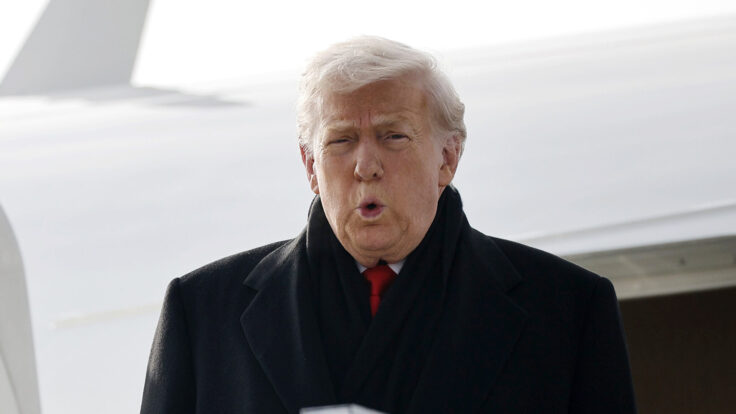
| For all the inside baseball talk about frigid weather and turnout operations and which Republican candidate “needed” a second-place finish, there’s really only one lesson to take away from the Iowa caucuses last night: This is Donald Trump’s Republican Party.
While I was stuck watching caucus results on a holiday, my brother Michael was happily watching the NFL playoffs. At one point, he sent me a vintage clip we both love: legendary Atlanta Falcons quarterback Michael Vick scrambling for an overtime touchdown in a late-season game against the Minnesota Vikings in 2002. It’s a spectacular play. Vick is so powerful and so fast that he sprints through a gap between two Vikings defensive backs chasing him downfield. Both are dialing in for the tackle, eager to save the day, but neither of them sees the other. Vick accelerates just as both Vikings players jump for him and miss. Embarrassingly, they collide with each other and collapse to the turf as Vick skates into the end zone.
Watching those defenders, I couldn’t help but compare them to Haley and DeSantis, left behind in a hapless tangle, while the crowd is mesmerized by the superstar taking what’s rightfully his. I don’t need to tell you who Trump is in this analogy.
Trump’s smashing Iowa victory was built on almost every Republican demographic—at least among the mostly white, conservative, election-denying G.O.P. electorate that showed up to caucus on Tuesday. He won evangelicals, older voters, and both the cohorts that self-identified as “very conservative” and “somewhat conservative.” Strikingly, almost two-thirds of caucus-goers said they had made up their minds about whom to vote for before this month, and 64 percent of those went for Trump. In other words, the Iowa outcome was baked in well before Christmas.
Winning the nomination just got much, much harder for both DeSantis and Haley, both of whom need something close to a miracle—and a lot of money—to survive beyond the primary contests of February. Monday was supposed to bring some clarity to the race, validating one or the other as Trump’s main opponent. Instead, their finishes—an underwhelming second for DeSantis, an expectations-missing third for Haley—guaranteed only stasis.
I’m covering my fifth presidential election, and I’ve never seen a primary race this lopsided in my career. Having watched these contests before, I have a few thoughts on what went down last night—and how the next few weeks might play out as the race moves to New Hampshire, Nevada, South Carolina, and Michigan. |
|
A MESSAGE FROM OUR SPONSOR
|
|
|
|
Protect patients against PBM abuses. Across the country, policymakers, regulators, patients, doctors, pharmacists, and others agree on the solution to lower drug costs. It’s time for Congress to pass strong PBM reforms.
Learn More.
|
|
|
| I. Beware the Iowa Narrative |
|
| Yes, I just cited entrance poll results to showcase the power of Trump’s win. But I was pretty skeptical of one data point that quickly started to shape the narrative on Monday night, at least among the pundits I was watching on CNN and MSNBC. Entrance polls showed that 51 percent of the Iowa caucus electorate was college-educated, and Trump won those voters over both DeSantis and Haley. That’s a surprise, given how education polarization has defined American politics in the Trump years.
Trump’s coalition, we know, is built on non-college voters. College-educated voters, meanwhile, have drifted toward the Democrats. Haley, in particular, has been climbing in the polls based on support from college-educated voters, who have been recoiling from Trump since 2015. Still, a notion quickly took hold on the cable news panels: A resurgent Trump was suddenly winning back college-educated voters, yet another threat to Joe Biden’s re-election chances in November.
Slow down, gang. Here’s what really happened: Trump narrowly won a plurality of college-educated voters (36 percent to Haley’s 30 percent) among the 110,000 self-selecting, very conservative people who braved the cold to caucus for their culture-war daddy. Call me crazy, but I have a feeling these Republican primary voters aren’t in play for Biden come November. What’s more, it’s important to take entrance polls, like exit polls, with a big grain of salt. It’s very unlikely that half of Republican caucus-goers were college-educated. According to Census data, only 30 percent of Iowans actually have a college degree.
All of this is to say that we need more states to vote—in actual elections, not caucuses—before we can make any sweeping assessments about the nature of the G.O.P. electorate. The New Hampshire primary, for instance, will likely see more than double, if not triple, the amount of voters that showed up to caucus in Iowa on Monday. After that, we’ll have a much clearer sense of this season’s Republican voter. |
| II. Nikki Haley Needs a Win |
|
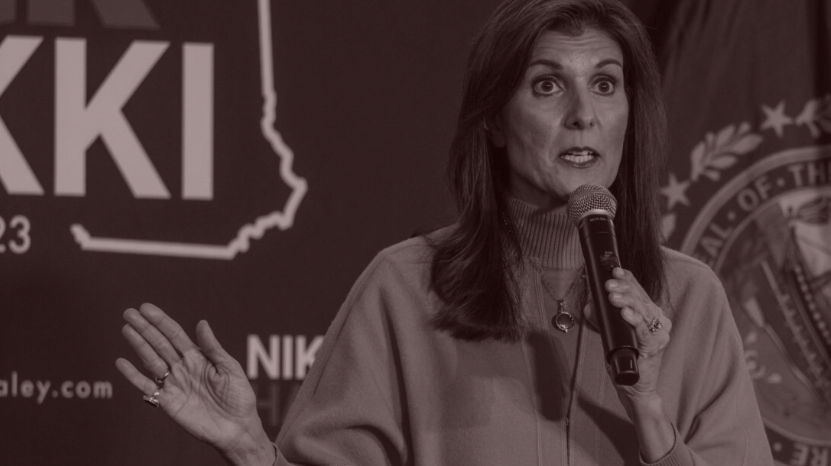
| Unlike DeSantis, who put all his chips in in Iowa, Haley has been running a multistate primary campaign. She’s close to Trump in New Hampshire, according to the polling average, and she could even be within 10 points of the frontrunner now that Chris Christie ended his New Hampshire-focused campaign (although we can also assume Vivek Ramaswamy’s voters move to Trump). Haley is also polling in double digits in her home state of South Carolina, though she’s still trailing Trump by 30 points according to polls. DeSantis, meanwhile, is only an afterthought in both states. That dynamic is why Haley made such a brazen boast in her Iowa concession speech on Monday: “When you look at how we're doing in New Hampshire, in South Carolina, and beyond, I can safely say tonight, Iowa made this Republican primary a two-person race.”
For months, Haley has been counting on an upset win or a close second in New Hampshire’s open primary, which allows for Democrats and undeclared voters. An unexpected second-place finish in Iowa, effectively eliminating DeSantis, would have been a key momentum booster heading into the more moderate New Hampshire. No, Iowa wasn’t essential for Haley—but she wanted it, and made a late play for it. Her expectations were heightened by the vaunted Des Moines Register poll, which actually missed the final Iowa result for the second caucus cycle in a row, despite the poll’s cult-like following within the press corps. The Register’s final survey showed DeSantis fading into third and Haley taking second place. The opposite happened.
Now, if any candidate has momentum moving to New Hampshire, it’s Trump. And remember: Trump crushed his opponents in New Hampshire in 2016 by 20 points. Now that Haley has positioned herself as Trump’s singular rival, she needs to find a way to beat him outright. A third-place finish in Iowa and a second-place finish in New Hampshire won’t be enough to derail Trump because the primary calendar only gets more expensive, and more conservative, from there. Haley has support among independents and moderate Republicans, but her unfavorables are shooting up among base Republicans. It’s just very hard to see where Haley gets a win after New Hampshire. |
|
|
| III. South Carolina Is Everything |
|
| Yes, I’m biased when it comes to South Carolina, where I lived when I covered the 2008 primaries for CNN. But in my mind, no primary contest is more relevant for Republicans. The press lavishes attention on Iowa and New Hampshire because of their quaint traditions and first-in-the-nation status, but both states have a mixed record when it comes to picking the eventual G.O.P. nominee. Since it began in 1980, South Carolina has picked every eventual Republican nominee, missing only in 2012—when Newt Gingrich won the primary over Mitt Romney. Katon Dawson, the former South Carolina G.O.P. chairman who is now working for Haley’s super PAC, has a favorite saying: “Iowa picks corn, New Hampshire picks pockets, South Carolina picks presidents.”
Unlike the states that precede it on the primary calendar (including Nevada), South Carolina is home to pretty much every stripe of Republican voter. There are military families, church people, farmers, business owners, snowbird retirees, young families, anti-abortion activists, country clubbers, and old-timey racists. It’s urban, suburban, exurban, and rural. You can buy fried chicken at Whole Foods, Lizard’s Thicket, and your favorite highway gas station. It’s more populous than Iowa and New Hampshire, but still small enough to drive across in a single day. Very simply, it’s the state where Republican candidates must prove they can win voters beyond whatever narrow coalition they bring to the table. If you can’t win South Carolina, you’re basically toast. In 2016, it’s where Trump effectively killed off Jeb Bush and Marco Rubio.
Haley has decided not to compete for delegates in Nevada in early February, by filing to run in that state’s primary rather than the MAGA-run G.O.P. caucus. So, after New Hampshire, she’ll likely decamp to her home state, which votes on Feb. 24. That’s a full month of trying to remind South Carolina voters why they liked her in the first place, all while enduring a likely barrage of negative attacks from Trump. Haley likes to brag that she’s never lost a campaign, but the truth is that she hasn’t faced a competitive race in almost 14 years. She was a Tea Party darling when she won South Carolina’s G.O.P. gubernatorial primary back in 2010. But now she’s old news, and the state’s Republican voters are fully in Trump’s grip. This is why Haley must win New Hampshire to have any kind of chance. Only an adrenaline shot of that size could give her the kind of momentum she would need to remain competitive with Trump down south. |
| IV. DeSantis Is a Zombie Candidate |
|
| DeSantis technically punched his top-three ticket out of Iowa, but what does he do now? Monday’s outcome was pretty much the worst-case scenario for him. A strong second-place finish in Iowa would have given him the rationale to soldier on. Third place would have been a clear message to get out of the race. Instead, his lukewarm finish has him stuck—vowing to move on even though he has nowhere to go. As one major DeSantis donor put it to me Tuesday morning, “He’s in purgatory.” As of today, he is no one’s first choice, and some people’s second choice. That is obviously not a path toward the nomination.
DeSantis has depleted his financial resources and can’t point to any real constituency in a state beyond Iowa. He has vowed to carry on in conservative South Carolina, stressing that the primary race is about collecting delegates, not headlines. But those are correlated, and I’m having a hard time finding any state on the primary map where DeSantis can resuscitate his flagging campaign by winning even a single news cycle. On top of that, DeSantis has to somehow convince his skeptical donors to keep cutting checks. He will run out of money.
DeSantis has entered what I call zombie candidate territory. He wants to put on a brave face after giving a year of his life to the campaign trail. He had his moment, but he lost where it mattered—and now he’s running on fumes with no finish line in sight, but too proud to drop out. I’ve seen this in past primaries. John Kasich, Newt Gingrich, Rick Santorum, Ron Paul—they all became zombie candidates after their campaigns had obviously died. Why do they hang around? Maybe they like the national attention, maybe they’re collecting delegates so they can have a say at the convention, maybe they just don’t want to go home. At some point though, they either come to Jesus, or Jesus comes to them.
The DeSantis campaign is saying he will stay in the race at least through the South Carolina primary. But again, that’s more than a month away. Instead, I have a hunch DeSantis will do what zombie candidates Jon Huntsman and Rick Perry did back in 2012, after they underwhelmed in Iowa and New Hampshire: He’ll campaign half-heartedly for a few more days in South Carolina, then take a long look in the mirror, huddle with his family and friends, and decide to drop out and finally do the obvious: Endorse Donald Trump. |
|
|
|
| FOUR STORIES WE’RE TALKING ABOUT |
 |
|
 |
|
 |
|
 |
| A.I. & Its Times |
| On OpenAI eating the internet & a blueprint for a media-Silicon Valley detente. |
| BARATUNDE THURSTON |
|
|
|

|
 |
|
|
|
Need help? Review our FAQs
page or contact
us for assistance. For brand partnerships, email ads@puck.news.
|
|
You received this email because you signed up to receive emails from Puck, or as part of your Puck account associated with . To stop receiving this newsletter and/or manage all your email preferences, click here.
|
|
Puck is published by Heat Media LLC. 227 W 17th St New York, NY 10011.
|
|
|
|