{{ 'now' | timezone: 'America/New_York' | date: '%b %d, %Y' }} |
|
|
Welcome back to Dry Powder. I’m Bill Cohan.
If the United States
is still a free market economy, it’s increasingly practicing something like capitalism with Trumpian characteristics. Over the past few weeks, the president has converted Intel’s $9 billion “free money” CHIPS Act grant into a cut-rate government equity stake, then cheered while Softbank and Nvidia piled in, sending the stock soaring like a memecoin.
I’ll dig into all that below, and explore what lies ahead for Intel—a company that, as one analyst put it, still has “no customers,” no
competitive chips, and no quick fix.
But first… |
-
Oaktree’s choppy seas: As Fearless Leader likes to boast, stocks are at an all-time high. But there are plenty of companies struggling amid the soaring financial markets. Take the Ritz-Carlton Yacht Collection, an operator of luxury cruise ships that charges something like $16,600 per person per week. After the company told its bondholders in June that it would likely be unprofitable until 2027, according to Bloomberg, the price of the $300 million of 11.875 percent bonds issued in July
2024 dropped 16 points, into distressed territory.
Ritz-Carlton Yacht is 55 percent owned by Oaktree, the famous distressed-investment firm founded by Howard Marks and Bruce Karsh. Oaktree itself is about 61 percent owned by Brookfield Asset Management, the alternative-asset behemoth. Other investors in Ritz-Carlton Yacht include the government of Singapore, which owns 15 percent, and Mohari Hospitality, which owns 35 percent. The company has three ships
in the fleet: Evrima, Ilma, and, most recently, Luminara, which can carry some 452 passengers. Occupancy rates have been an issue, which really should not be all that surprising given the high cost. For the first quarter of 2025, average occupancy has reportedly been around 50 percent. (The company had been hoping for more like 80 percent.) At least if the company needs a debt restructuring, Marks and Karsh will know how to go about it.
Meanwhile, Brookfield, along with the Carlyle Group,
is facing another troubling financial situation, according to Teri Buhl at IJGlobal, an energy and infrastructure market intelligence company. Brookfield and Carlyle are among the big lenders to Pine Gate Development LLC, an Asheville business that owns, finances, and develops solar and energy-storage projects, with more than 100 solar facilities generating some 2 gigawatts of power. In March, Brookfield provided a $300 million loan to Pine Gate. Carlyle is owed $150 million.
But now Brookfield and Carlyle have hired legal counsel to advise on providing debtor-in-possession financing to Pine Gate, according to Buhl, signaling the company may be heading for a Chapter 11 filing.
Buhl reported that another creditor, Fundamental Advisors, has hired Sidley Austin to advise on pre-bankruptcy negotiations. Pine Gate has hired both Lazard and Latham & Watkins to help restructure its debt. The company also has a $288 million preferred stock investment from Blackstone,
which it received in 2024. Other investors in Pine Gate include Generate Capital, Healthcare of Ontario Pension Plan, and HESTA, the Health Employees Superannuation Trust Australia.
|
And now a quick word from my partner Dylan Byers on Kimmelgate… |
|
|

| Dylan Byers
|
|
- Kimmelgate and its
discontents: As you may have noticed, Disney’s decision to preempt Jimmy Kimmel’s show amid F.C.C. pressure has touched a national nerve and heightened anxieties about Trump’s overt, Orban-esque crackdown against the media. The blowback to this latest move has been broad and, reassuringly, bipartisan. Beyond the obvious implications for the health of American democracy, the whole fiasco is unquestionably what Bob
Iger would call “a brand withdrawal”—for both himself and the company.
As of Friday, Kimmel remained at odds with Iger and Dana Walden over how he should address the controversy on his show. As my partner Matt Belloni has reported, Kimmel wanted to clarify that he never meant to suggest Charlie
Kirk’s killer was pro-Trump, while also criticizing Fox News and others on the right for mischaracterizing his comments. Disney wanted something closer to a straightforward and unconditional apology. Underlying all of this was the leadership’s longstanding frustration over how much Kimmel has politicized the late-night show. Sure, it’s their network, and they can do what they want about that. But it probably would have been smart to address that before kowtowing to the
White House. (As if the criticism from Barack Obama weren’t enough, even Iger’s predecessor Michael Eisner came out of the woodwork to hit him over the move—a real thrill for veteran Magic Kingdom kremlinologists.)
In a stark contrast to Disney’s prostration, the New York Times leadership has been defiant in its fight against
Trump’s $15 billion defamation lawsuit. At a Financial Times event here in L.A. last week, C.E.O. Meredith Kopit Levien said the Times would “not be cowed” by the president’s “anti-press playbook.” At an Axios event in New York, executive editor Joe Kahn said Trump was “wrong on the facts” and “wrong on the law,” and pledged victory in court. On Friday, Judge Steven Merryday dismissed Trump’s suit for being “decidedly improper
and impermissible” in its length, “vituperation,” and “invective.” (A lawsuit, Merryday noted, is “not a protected platform to rage against an adversary.”) The Times commended him for seeing “that the complaint was a political document rather than a serious legal filing.”
Of course, the Times and Disney play in two different sandboxes, with distinct ownership structures and business models, and different levels of exposure to government pressure. Nevertheless, it is at
least somewhat reassuring to see the Sulzbergers—and, indeed, even the Murdochs—stand up against Trump’s meritless lawsuits in the wake of Iger and Shari Redstone’s capitulations. Recall that Iger, who is now enduring another turn in the barrel, was the one who started us down this path when he settled Trump’s lawsuit against George Stephanopoulos. Obviously, this did nothing to get the monkey off his back.
|
|
|
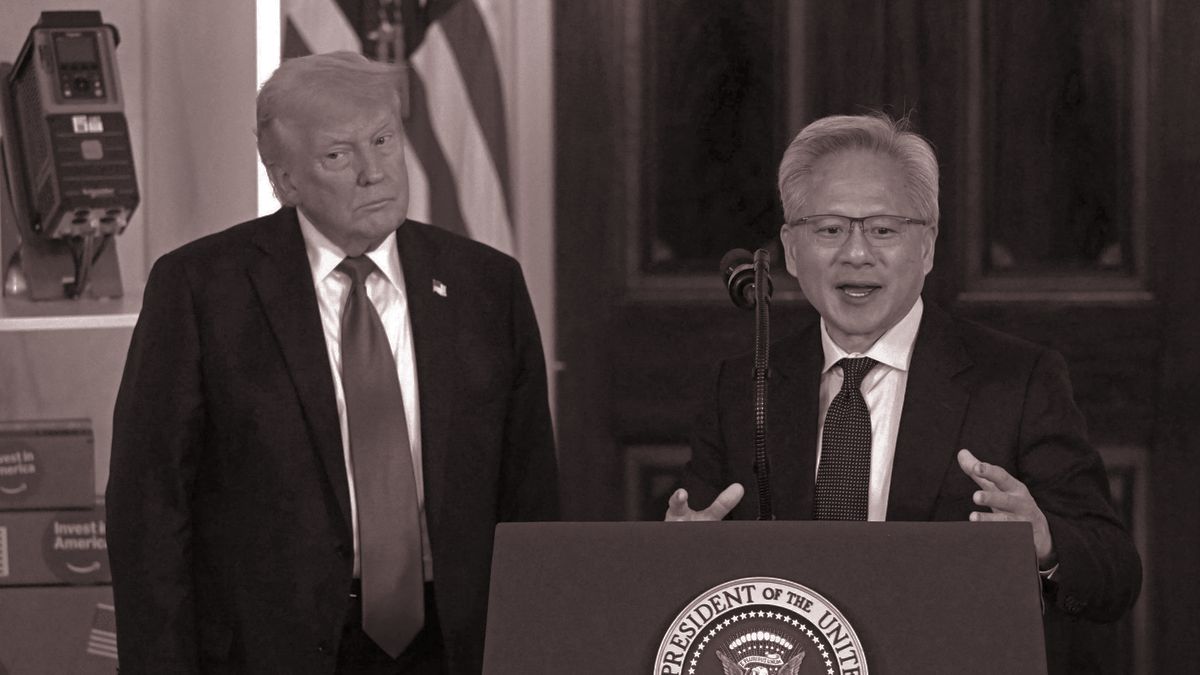
By directing the government to take an equity stake in Intel, followed immediately
by SoftBank and Nvidia, Trump was able to boost the company’s market value by $26 billion. But the leading U.S. producer of semiconductors is still way behind on A.I., and notably short of customers. |
|
|
It seemed like any other day in the Trump administration. On August 7, the president was
once again inserting himself into the affairs of a private company. This time, Trump was going after Lip-Bu Tan, the C.E.O. of Intel, the largest U.S. manufacturer of semiconductors. Posting on Truth Social, Trump wrote that Tan “must resign, immediately” because he was “highly CONFLICTED,” adding that there was “no other solution to this problem.”
Tan—who is a U.S. citizen—had ostensibly drawn Trump’s attention a few days earlier, when Sen. Tom
Cotton wrote a letter to Frank Yeary, the chairman of the Intel board of directors and former head of M&A at Citigroup, expressing concern that Tan’s investments in Chinese semiconductor firms, some of which have ties to the Chinese Communist Party, could pose a “national security risk,” especially given the supply chains that Intel relies on. Cotton wanted to make sure Tan had divested himself of these interests and asked the Intel board to review the C.E.O.’s
investments in light of the $9 billion or so in grants that Intel was in the process of receiving from Joe Biden’s CHIPS Act.
But as it turned out, there was another solution. On August 11, Tan met Trump at the White House, along with Treasury Secretary Scott Bessent and Commerce Secretary Howard Lutnick. Suddenly, Trump changed his tune about Tan. He praised Tan’s “success and rise” and his “amazing story” and described the
meeting as “very interesting.”
Then things started getting weirder. A week later, Trump’s pal Masayoshi Son, the C.E.O. of SoftBank, announced that SoftBank was investing $2 billion in Intel, at $23 a share, for 87 million shares and a 1.8 percent stake in the company, making SoftBank its sixth-largest investor. Then on August 22, a mere two weeks after his Truth Social broadside, Trump announced that the U.S. government would be taking an 8.8 percent stake in
Intel—making it the largest shareholder in the company—by converting that $9 billion CHIPS Act grant, which was supposed to be no-strings-attached money, into 433 million shares of the company, at a price of $20.47 a share, a 17 percent discount to the closing price the previous day. Then, just last week, Nvidia announced a $5 billion equity investment in the company, good for a roughly 4 percent stake.
Intel’s stock shot up 23 percent on the news, a $26 billion increase in
market value, to $138 billion. Nvidia’s market value increased some 3.5 percent, or $147 billion, yet another boost to its $4.3 trillion valuation. (I mean, it’s a great company and all, but $4.3 trillion?) |
There was a time when Intel didn’t need help from anyone. The “Intel Inside” marketing campaign,
launched in 1991, was genius. It encouraged consumers who were buying branded P.C.s—Dell, HP, IBM—to demand their computers also have the fastest central processing units (or C.P.U.s) in them. And those C.P.U.s were made by Intel. If you bought into “Moore’s law,” which essentially predicts that computing power should double every two years, Intel seemed unstoppable.
Moore’s law was named for Gordon Moore, the co-founder of Intel and its C.E.O. from 1979 to 1987. Alas,
the leaders who followed Moore and the legendary Andy Grove, including Paul Otellini, Brian Krzanich, Bob Swan, and Pat Gelsinger were never really up to the task, leading to years of market misjudgments, leadership snafus, and general arrogance.
Lip-Bu Tan was supposed to be better. Born in Malaysia and raised in Singapore before eventually moving to California, Tan is the founder of
venture capital firm Walden International, which has numerous investments across Asia, including in SMIC, or Semiconductor Manufacturing International Corporation, the Chinese rival to TSMC—which, of course, is in Taiwan. From 2009 to 2021, Tan was C.E.O. of Cadence Design Systems, a leader in the semiconductor software design industry. In March, he was appointed C.E.O. of Intel, where his performance will now be judged, for a while at least, based on the recent, strange turn of events and his
ability to manage, and satisfy, this interesting collection of new shareholders.
To get an understanding of precisely how Intel had become almost an afterthought in the semiconductor industry, and what the new $16 billion infusion will mean for the company, I rang up Stacy Rasgon, a managing director and senior analyst at Bernstein Research. Rasgon, who covers the semiconductor industry, has a Ph.D. in chemical engineering from MIT and has been on Extel’s (f.k.a.
Institutional Investor) All-America Research Team every year since 2010, with several appearances as the top-ranked research analyst.
“Intel has been a total disaster,” he told me. During the heyday of the P.C., Intel had “legitimate, monopoly-sized economics,” but then it got “fat” and “dumb.” For example, around 2014, Intel’s biggest competitor was AMD, which had a 0.1 percent share of the chip market; Intel had a 99.9 percent share. Intel management was dismissive of AMD, Rasgon said,
“and they got lazy.” |
Alas, Moore’s law didn’t hold as the chips got smaller and smaller, and Intel whiffed on a bunch of
new market opportunities, Rasgon told me, including chips for mobile devices. Management didn’t think the volumes would be sufficient to overcome Intel’s high-cost model, Rasgon said. But as it turned out, the volume of smartphone sales would be 100x Intel’s projections.
When the company tried to catch up in the mobile market, it lost billions along the way. “I never thought it would get this bad,” Rasgon said, noting that at least Tan wasn’t “delusionally optimistic” like at least one of
his predecessors. Tragically, Intel also downplayed the G.P.U. (graphics processing unit) opportunity that Nvidia capitalized on for A.I. “They were dismissive, I think, at first of the [A.I.] trend,” Rasgon said. “And then when they realized it was going to be a real problem, they decided to try to acquire [the capacity to make A.I. chips].”
But Intel’s M&A track record “is absolutely horrendous,” Rasgon noted, citing flops such as deals for Altera ($16.7 billion); Mobileye
(another $15 billion); DSP (“sold for peanuts” and a $300 million loss); McAfee (“To this day I don’t know why they bought that”); and an A.I. startup called Nervana Systems, which Intel “eventually wound up shutting it down.”
Regarding the Trump administration’s conversion of the $9 billion CHIPS grant into Intel equity last month, Rasgon wrote in an August 25 note to investors that “the valuation seems very low” in exchange for money the company was supposed to get for free.
Nevertheless, he wrote, “Fans of the CHIPS-for-equity deal have pointed out that governmental support is nothing new in semis, and have deemed it welcome to have Trump as an engaged stakeholder, while dissidents have decried the idea of governmental meddling in the free market (up to and including making allusions to communism).” As for Nvidia’s $5 billion investment, he concluded that it “seems like money well spent at this point,” with considerable understatement, pointing out that its stake
in Intel had increased in value by $1 billion on the news alone. |
But Rasgon has still been left scratching his head. Intel now has some $16 billion of new cash,
but, as he told me, it really doesn’t need it. While the money could help Intel expand its manufacturing capacity, what the company really needs is more people buying its products. “They’ve got no customers,” he said. “And so there’s been a lot of speculation that, hey, the next thing the government will do is force customers to use them. Personally, I think that is ridiculous. I don’t think you can. I don’t think you need to. If Intel could prove that they can make products in
high volume that meet spec—and which have a good cost structure and are available on time—they will have customers lined up around the block.”
Semiconductors are “the most complicated things that humanity has ever built,” Rasgon told me, and over the years, Intel has lost the capability to deliver what customers want on a sustained basis. “To get customers,” he said, “you have to prove you can deliver. And can they deliver? Who knows? Call me in three years.”
Even with the
new money, the seeming votes of confidence from SoftBank and Nvidia—and the boost, or whatever it is, from Trump—Intel remains “fundamentally in a rough spot,” Rasgon said. But he wants Intel to succeed. “I do think it’s strategically important to have a successful [domestic] leading-edge semiconductor company,” he said, “but they’ve got to do it themselves.” There is no “secret sauce” that Nvidia’s Jensen Huang can share, despite the $5 billion investment. “It’s thousands
and thousands of engineers working long, long hours for years.”
All the new cash from, in part, two fairly sophisticated investors, has driven Intel’s stock up in the near term, which is nice, I suppose, but it’s unlikely to solve a problem more than a decade in the making. “Trump’s not going to be down in the fucking lab trying to improve the yields on the chips,” Rasgon said.
As far as any recommendation for investors about whether to start loading up on Intel, Rasgon told me
he’d short the stock if it weren’t so volatile and now that it’s become a bit of a meme stock. “You get a headline like this and it goes up 30 percent in your face,” he said. “How can you short it?” (As always, this is not investment advice.) But Rasgon doesn’t want to own the stock, either. “I’ve been preaching avoidance,” he said. “It’s an event stock. But you don’t know what the event is.” |
|
|
Join Puck’s chief political columnist, John Heilemann, as he roams the corridors of power and influence in America on
this twice-weekly interview show, taking you beyond the headlines with the people who shape our culture: icons and up-and-comers, incumbents and insurgents, moguls and machers in the overlapping worlds of politics, entertainment, tech, business, sports, media, and beyond. The conversations are rich and revealing, unrehearsed and unexpected… and reliably impolitic. A Puck-Audacy joint, new episodes drop every Wednesday and Friday. |
|
|
Puck’s daily political newsletter from Washington on what’s really happening in this town, from the White House to
the Pentagon to Capitol Hill, K Street, and the campaign trail. |
|
|
|
|
MATTHEW BELLONI & KIM MASTERS |
|
|
Need help? Review our FAQ page or contact us for assistance. For brand partnerships, email ads@puck.news. You received this email because you signed up to receive emails from Puck, or as part of your Puck account associated with {{customer.email}}. To stop receiving this newsletter and/or manage all your email preferences, click here. |
Puck is published by Heat Media LLC. 107 Greenwich St, New York, NY 10006 |
|
|
|