 |
 |
|
Happy Wednesday, and welcome back to Dry Powder.
|
|
What to make of the potentially gaping hole—namely, $136 billion in unrealized losses—on Bank of America’s balance sheet? In today’s issue, I take a close look at the risks facing the nation’s third largest bank, and consider whether BofA’s true headache lies elsewhere.
But first…
|
| What Is Hulu Really Worth? |
|
|
Starting today, November 1, Comcast and Disney can both trigger the option to commence the sale process of Comcast’s one-third stake in Hulu. The floor valuation for Hulu and its 48.3 million subscribers, as set in 2019, is $27.5 billion. I know it’s been a tough year or so for the streamers, but I tend to agree with Brian Roberts, the C.E.O. of Comcast, that Hulu is “way more valuable today than it was” back then.
How much more valuable will be determined by the work of the two investment banks hired so far: JPMorgan Chase for Disney and Morgan Stanley for Comcast. It’s interesting to me that Comcast didn’t hire Paul Taubman, one of Roberts’ longtime bankers, who used to be at Morgan Stanley and now runs his own eponymous publicly traded firm, PJT Partners. But maybe Paul is busy working on something even bigger for Brian, like the NBCU/WBD merger. (Call me, Paul.)
The way this boxing match will go down is as follows: If the banks’ valuations of Hulu are within 10 percent of each other, then the value of Hulu will be determined by the arithmetic average of their valuations. If the values are not within 10 percent, then it really becomes fun, and a third investment bank will be hired to make yet another valuation of Hulu. At that point, the third bank’s valuation would be averaged with the closest valuation.
No matter how you slice it, this is a plum assignment for Morgan Stanley and JPMorgan Chase (and possibly that third bank). First of all, the deal is going to happen. So the work the banks put in will yield a payday. Not all deals pay off, of course, and oftentimes a ton of work goes into deals that never materialize. That’s always frustrating for bankers (not that anyone has, or should have, any sympathy). But this one will happen because Comcast wants to sell, and Disney, bless its little heart, wants to buy.
Another plus for the banks is that their valuations matter—there are real financial implications for these valuations. That’s somewhat unusual, too. After all, Disney wants to pay as little as it can for Comcast’s one-third stake in Hulu and Comcast wants Disney to pay as much as possible. In any event, what’s paid will be determined by these two banks (and maybe a third), not by shareholders, not by the market, not by arbitrageurs. That makes the assignment both important and interesting.
I haven’t yet seen the engagement letters, but I wouldn’t be surprised to learn that each bank got a fee of $25 million for its trouble. How great will that be, especially this close to bonus season? After all, 2023 hasn’t been a great year for M&A on Wall Street. As best as I can tell there have been only two other deals this year greater than $30 billion: Broadcom’s $69 billion acquisition of VMware and Pfizer’s $43 billion acquisition of Seagen.
In the end, my prediction is that Morgan Stanley and JPMorgan Chase will be within 10 percent of each other and the winning number will be a round one: $30 billion, giving Brian a $10 billion windfall. Then the question for Bob Iger will be how to pay the $10 billion purchase price. If it were me, and it’s not, I’d use ESPN as my currency and begin the process of moving that asset off Disney’s balance sheet and onto Comcast’s. (Are you working on that, Paul?) But that’s probably not going to happen, as we all know.
|
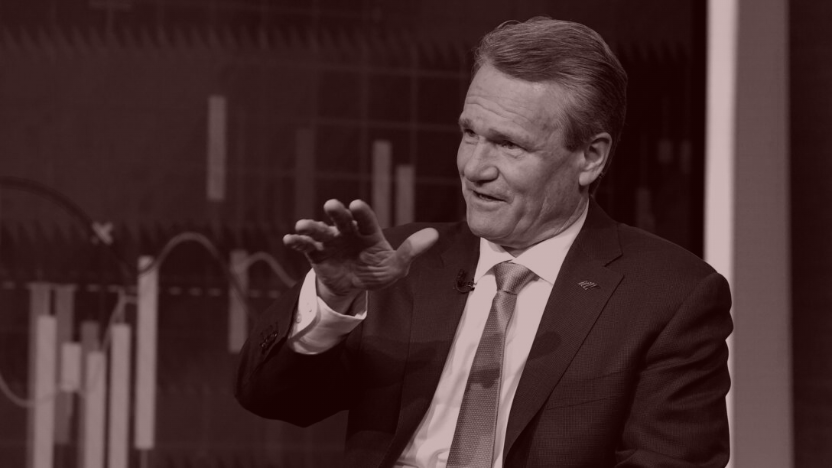 |
| The BofA $136B Dynamite Stick |
| Bank of America has what appears to be $136 billion of unrealized losses on its balance sheet. Is this a material nightmare, or simply an explanation for why its market cap is half of the Bank of Dimon? |
|
|
|
| A concern wafting through some corners of Wall Street, which has recently reached me, centers on Bank of America, our second largest bank, with some $3.5 trillion in assets—and in particular, what appears to be $136 billion of unrealized losses on its balance sheet. Those unrealized losses, which show up on the bank’s third-quarter 2023 financial statements, dated September 30, and filed with the Securities and Exchange Commission, represent more than 70 percent of the bank’s tangible book value and derive mostly—$132 billion of the $136 billion, to be precise—from potential losses in the bank’s portfolio of what it calls “held-to-maturity debt securities.”
These are assets that Bank of America holds on its balance sheet without any intention of selling. Rather, the bank just hopes to continue to get the quarterly interest payments and the payoff of the debt at maturity. These assets include more than $474 billion of mortgage-backed securities issued by federal agencies and some $121 billion of U.S. Treasuries and other government agency debt. According to the Bank of America calculations, its trove of mortgage-backed securities is only worth $367 billion these days, or 77 cents on the dollar, while its $121 billion of Treasuries and other U.S. government debt is only worth $98 billion, or 81 cents on the dollar.
These discounts are, hopefully, much less about credit risk than changes in the interest rate environment. Bank of America likely loaded up on these bonds when interest rates were much lower; so if they had to sell them, these are the kinds of losses the bank would face on the portfolio. The key words here, of course, are if they had to sell them.
At the moment, it seems, Bank of America has no reason to sell the bonds; that is why they are kept on the bank’s balance sheet as being held-to-maturity. As a result, according to depository bank accounting rules, Bank of America doesn’t have to mark these securities to market. But it’s nice of them to share with us what would be the result if they did: There would probably be a massive hole in the bank’s equity account. But could there ever be a proverbial “run on the bank” at Bank of America, as there was at SVB earlier this year?
Sure, in a fractional banking system anything is possible, since not even close to 100 percent of deposits are at the bank if waves of depositors decide all at once that they want their money back. Even an institution as large as Bank of America could not withstand that kind of onslaught, although it thinks it can. But is that likely to happen, even with a $136 billion mark-to-market hole in its balance sheet? Very few seem particularly worried about it. Not surprisingly, Bank of America isn’t the slightest bit concerned about the revelations about its hold-to-maturity portfolio. It’s happy knowing it has more than $1.9 trillion of deposits and some $3.5 trillion in assets. And, it has said, it has $859 billion in what it calls “global excess liquidity,” including $352 billion of cash and some $100 billion of hedged, shorter-dated Treasuries ready to be sold, if necessary. It also has access to the Federal Reserve’s discount window—a variety of solutions that SVB did not have when the shit hit the fan. Good for Bank of America. But it does get me thinking, once again, about the similarities between our fractional banking system and a good old-fashioned confidence game. |
|
A MESSAGE FROM OUR SPONSOR
|
 |
| Access A New Era of U.S. Industrial Productivity
U.S. legislation is funneling billions in federal spending toward revitalizing physical infrastructure like roads and bridges, ports and waterways, and public transit, as well as key areas of the clean transition like renewable energy, modernized water utilities, and digital infrastructure.
Explore an ETF poised to capitalize on the growth of U.S. infrastructure development.
|
|
|
|
|
| Few seem particularly concerned about this potential gaping hole in Bank of America’s balance sheet because few people think that the institution will suffer a run on the bank the way SVB, Signature Bank, and First Republic did earlier this year. Instead, the Wall Street executives I chat with regularly seem more concerned about the equity of Bank of America. Its stock is down 28 percent in the last year and its market value is now $206 billion. By contrast, JPMorgan Chase is up 10 percent in the last year, and its market value is $403 billion. So, at least equity investors are differentiating between the two banks.
Jack Farley, a 2019 graduate of Brown University who is the host of the Forward Guidance podcast at Blockworks, first alerted me to the depth of Bank of America’s unrealized losses. Farley told me that he views the unrealized losses as an indicator of part of the reason Bank of America’s equity has been trading so poorly for a year, rather than as an existential threat. But, he also told me, he recognizes the risks faced by all the banks that bought bonds when interest rates were at absurdly low levels, between 2009 and 2022, thanks to the Federal Reserve’s Zero Interest Rate Policy and to Quantitative Easing.
Farley conceded that there are “a lot of underwater bonds in the banking system and that can pose financial stability risks because banks are leveraged institutions. If it’s levered 10 to 1 and you have a 10 percent loss, all the equity is gone.” Which, of course, is exactly what happened to Bear Stearns, which at times was levered 50 to 1, meaning that a 2 percent change in the value of its assets wiped out its equity. (Which, presumably is why, once upon a time Lloyd Blankfein, the former C.E.O. of Goldman Sachs, told me that he spends 98 percent of his time worrying about things with a 2 percent probability of happening.) In sum, according to this potential wunderkind, BofA’s profit spreads are narrowing.
To check Farley’s logic, I turned to my friend Mike Mayo, the Wells Fargo research analyst who has long been the Wall Street “ax” on financial stocks, including for Bank of America. He told me that when it comes to banks and their balance sheets, there are three ways of looking at them: the real way, the sentimental way, and the fantastical way.
For Mayo, the real concern about Bank of America’s unrealized losses is that it limits the stock buybacks that the bank can engage in, which affects its stock price and probably explains why its stock has underperformed JPMorgan Chase so materially in the last year. The sentimental concern is simply, he said, “Can the losses go higher? And could that depress earnings a bit more?” The fantastical risk is that the unrealized losses could affect the balance sheet and prove existential. “In reality,” Mayo said, “these are held-to-maturity government securities that are money good. It’s not like C.D.O.s during the financial crisis. You also have full transparency, so you know exactly what you’re dealing with. They have plenty of liquidity. The regulators aren’t going to force them to sell.”
Mayo said he’s been talking to the Financial Accounting Standards Board and “they aren’t going to change 40 years of rules right now. So the reality is they don’t have to sell.” He made another good point, one that Farley also made to me: if, in theory, Bank of America had to mark-to-market its portfolio of assets and take the $136 billion hit—a big if—the bank should also be able to mark-to-market the value of the $1 trillion of deposits (that it only pays 1 percent on, or if that) in an environment where money market rates are in the vicinity of 5-plus percent. Those liabilities are quite valuable since Bank of America’s cost of capital is still nearly free when other companies have to pay some 5 times more for that same raw material. (Marcus, a Goldman Sachs savings account, pays 4.4 percent interest a year, or some 220 times more than JPMorgan Chase pays me for my savings..) “What’s the unrealized value there,” Mayo asked rhetorically. “A lot.”
It’s a point that Bank of America’s C.F.O. Alastair Borthwick, made back in April, during the bank’s first-quarter earnings presentation. “As rates began to rise quickly throughout 2022, the value of our deposits rose,” he said. “And at the same time, the disclosed market value of the hold-to-maturity securities has declined, resulting in a negative market valuation on those bonds. That negative market valuation peaked in the third quarter [of 2022], came down in the fourth quarter [of 2022], and it has come down another $10 billion in the first quarter [of 2023].” |
|
|
|
|
| Mayo is not existentially worried about Bank of America. He’s worried that they won’t be able to buy back stock in the near term and so has taken them “out of his starting rotation” among bank stocks he recommends. And he thinks there is a real opportunity cost to the bank because of all the long-term securities it owns that can’t be sold and reinvested at the higher rights now available in the market. And, he said, Bank of America still has the Warren Buffett “seal of approval” because he remains a large investor in the company. “But I don’t have a catalyst to get them out of this funk,” he said, while also predicting the bank’s “spread revenue” would increase over the next few quarters and that it’s “way under-earning” its potential. (As always, I am not offering investment advice.)
As for me, I recall that, back in the day, no one could have imagined the failures of Bear Stearns, Lehman Brothers, Merrill Lynch or even Silicon Valley Bank. BofA probably won’t fail, of course, and it would probably be bailed out anyway, given that it’s a Systemically Important Financial Institution, or SIFI. But if for some reason those $136 billion in unrealized losses became real, or even partially real, a whole slew of Bank of America stakeholders—depositors, customers, clients, counterparties—could lose confidence in the bank. And we all know what happens when people lose confidence in a financial institution. Let this be a reminder: Impossible is nothing. |
|
|
|
| FOUR STORIES WE’RE TALKING ABOUT |
 |
|
 |
|
 |
| Sam I Am |
| Front-row observations from S.B.F.’s last stand. |
| TEDDY SCHLEIFER & ERIQ GARDNER |
|
 |
|
|
|
|
|
 |
|
|
|
Need help? Review our FAQs
page or contact
us for assistance. For brand partnerships, email ads@puck.news.
|
|
You received this email because you signed up to receive emails from Puck, or as part of your Puck account associated with . To stop receiving this newsletter and/or manage all your email preferences, click here.
|
|
Puck is published by Heat Media LLC. 227 W 17th St New York, NY 10011.
|
|
|
|