 |
|
Hi you,
This week, I’m excited to try something different. I have been thinking a lot about the information environment in this high-stakes, record-setting, global election year. Yes, Democracy is on the ropes. Yes, authoritarianism is on the rise. I feel the fatigue of people being asked to step up yet again to “do our civic duty,” and I feel there is a lack of acknowledgment that the arena itself is toxic. What do we need to know about the information landscape to successfully navigate this year? What questions should we be asking about the discourse we encounter online that can help us feel a little less crazy about all the noise we are all already encountering?
I don’t have answers to all these questions, but I found someone who can help, and I’m excited to share my conversation with her. If you’re feeling exhausted and overwhelmed already, know that you are not alone, and that there are people and institutions who want you to feel that way so that you’ve got nothing left to give to our common project of trying to live together. Knowing that doesn’t make it go away, but it does help.
Take care.
|
 |
| How to Survive the ’24 Info Wars |
| An illuminating and often terrifying conversation with Jiore Craig, a misinformation specialist, about the unexpected ramifications of a TikTok ban, how bad actors prey on anxious populations, and how we can protect ourselves from manipulation. |
|
|
|
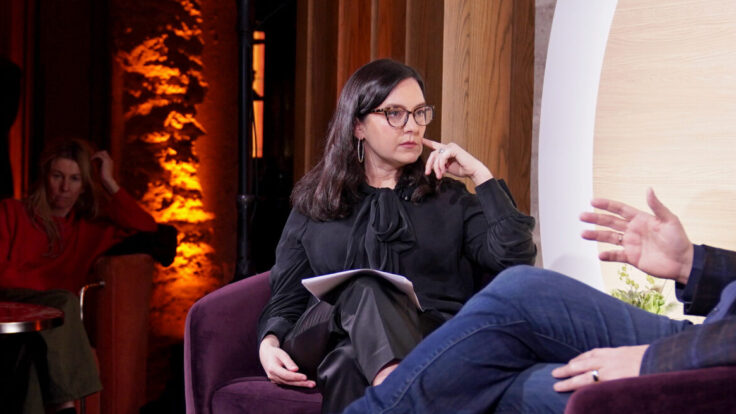
| I first encountered Jiore Craig, a senior fellow of digital integrity at the Institute for Strategic Dialogue, through my friend and pro-democracy colleague Jon Alexander, a U.K.-based writer I met during Covid. At the time, Jon, my partner Elizabeth, and I were beginning to explore more ways in which “citizen” can function as a verb, and how we can better understand “democracy” as a practice and not just an idea. Of course, these questions are now inextricably linked to our lives online, and the ways in which mis- and dis-information spread through the digital landscape. When I was introduced to Craig’s work, it felt like I had discovered a missing piece in the tapestry of our intellectual inquiry.
In her own telling, Craig’s field was born in 2015, and became hypercharged following the 2016 election. She studies how information is manipulated online—from the ways in which tech C.E.O.s put their thumbs on the scale in the battle for our eyeballs, to how our collective trust in one another has eroded as a result of the attention economy. Naturally, her work coalesces around how these dynamics impact elections and public opinion, which is why she was recently called before the House’s subcommittee on elections to discuss “foreign and domestic sources of disinformation.” Trust me, it’s worth watching in full.
In this election year, which is starting to feel like the final showdown in the battle for democracy, Craig’s work can help illuminate the manipulation online that we so often cannot see. When my wife recently met her in person, she suggested I interview her. I’m sure you’ll find her insights as fascinating, and genuinely vital, as I did. Our conversation has been edited and shortened for clarity. |
|
|
| In many ways, it feels like bad actors are free-riding on an already informationally manipulated environment. How does that show up in the elections you’re monitoring?
In 2018, when people were focused on Russia and fake news, I would say, “If you want to know how to get your content to where you want it to go, follow beauty influencers. They will give you tips on how to game the platform.” That can be something like multiple accounts, strategically organized, posting at the same time with the same hashtag. All of that coordination is signaling to the algorithm. If you really want to get sophisticated, which bad actors do, you make sure those accounts aren’t in community with each other so it looks like lots of people from different communities are now engaging with this content. That all is sending a signal to the algorithms that it should move in front of more people.
To counter this, the Meta-owned platforms have all these announcements about how they’re not going to automatically boost political content, but what we will see is that the bad actors will learn whatever is getting them suppressed, and they won’t use those words. They’ll use nonpolitical words. They’ll find ways to move their content, and make sure that it isn’t triggering whatever that policy is. We saw this in the pandemic with people finding creative ways to move Covid misinformation, disinformation, and really inaccurate, out of context studies, without having it fall under the policies that were designed around medical disinformation.
In recent years, the platforms have really cut off data access and have removed a lot of the transparency that we used to have around online activity. I used to be able to see on any Facebook page where they were located; I can’t see it anymore, not always. I used to be able to see all the ads that anyone had ever run in the past. I used to be able to see all the name changes a page had gone through. Those were all signals that we use to understand how to attribute certain activity, and a lot of it’s disappearing and it’s not reliable. So researchers are in a real bind because it was already easy to hide what you were doing online, and with the removal of transparency mechanisms, it’s even easier.
What are your thoughts on the community notes feature that Elon added to X? Has it helped or had any effect that you can see?
I’m never really going to be on the side of more context not being helpful, but in terms of the quality of that context, we’ve not really seen any system in place to verify where those comments are coming from. I think that in general, the gutting of trust and safety teams at Twitter, and the way Elon Musk has set up who can have paid access and verification, has created a lot more confusion and decreased the quality of information on that platform. I don’t think it’s done anything for protecting free speech or representing free speech. I like crowdsourced efforts when there is a component or policy around how to verify the contributors to those crowdsourced efforts. I like Wikipedia. They have a system.
What can official or “legitimate” news outlets do to provide quality information and counter disinformation in this environment?
Right now there’s a big conversation about generative A.I. and there are a lot of people looking to design solutions and P.S.A.s just to warn people about the introduction of generative A.I. The problem is that we don’t have a good method, or central repository of information that we’re able to direct people to. The information landscape is so fractured.
Over the past 10 years as we were investing in local newsrooms and short-form digital content, we could have been doing a lot of trust building to restore our ability to reach people when we do want to deliver information, and some newsrooms have done that. They’ve hired from their own communities, they’re producing news, and they’re in the community covering stories relevant to the community, but I don’t think that happened enough, and one thing I’m trying to do is revive the conversation about diverting some resources into that trust rebuild. I just don’t see a world where, unless you’re an absolute communication heavyweight, you can reach people at scale in any timely manner that would respond to some of those threats we’re facing.
So if you’re a media company, or the government, how do you counter that phenomenon? Ride the digital attention wave, hack the algorithm, be a counterweight to the information noise?
They need to get with the program and realize what information environment we’re in or they need to understand they’ve lost the trust of their audience. The Biden campaign put out a statement before the State of the Union where they acknowledged that in today’s information environment, a lot of people aren’t going to hear the State of the Union in the format in which they’re delivering it, and so they’re going to have to work extra hard to get that message in front of people. That’s the first time I’ve really seen that kind of acknowledgment, and the administration has started working more with influencers to go to where people are at.
But I would argue that the solution is not just about gaming it the way others are, but also taking the offline steps to make up for some of where our attention has gone. This is especially important since the pandemic, when we didn’t have much of a choice in diverting our attention to screens. I don’t know that our behavior has corrected since then. This information environment explains a lot of the way we’re feeling, which is then preyed on by bad actors. If I’m feeling stressed and anxious and lonely and depressed, which many people in the country are, then I’m a really easy target for some sort of narrative that’s going to give me something to believe in.
But it’s also the way people are consuming information. They’re on their phones, on the subway, on the bus, watching their kids’ soccer game, they’re busy. And if you’re not really respecting that reality, and your job is to try to get information consumed by people, there’s a pretty large disconnect that I can’t really see past, and a majority of the people I work with are focused on correcting that behavior.
So almost literally meeting people where they are in terms of their information availability.
Yeah, and that’s a really positive way to frame it. |
| TikTok Paradox & The ’24 Race |
|
| How do you define misinformation and disinformation?
Misinformation is false or misleading information that is shared without any intent to harm or deceive, and disinformation would be the same, but there’s an intent to harm or deceive, and there’s a lot of misinformation, a lot of accidental sharing. When I’m talking about disinformation, I have to say I avoid using that word.
What do you say instead?
It depends. I usually say information integrity or the quality of information.
Is the decline of information integrity a new thing?
I think that there has been an overuse of “fake news” and “disinformation,” and it’s unfortunate because there’s a lot of disinformation. You have an entire news channel that is pushing a large majority of content that is disinformation, and it’s been in place for years and years and years. I think that we got a little bit confused, and what we were actually talking about was all the information moving online and social media. There’s AM radio stations owned by conservative media. There’s Epoch Times. What we were actually having a reaction to was the new information ecosystem, largely because of the introduction and dominance of social media platforms, and that is the problem. That is why it was chaotic, that’s why it was different from before.
People have been lying forever. Alexander the Great was the first big propagandist. People are fudging the story to sell us shoes, to sell us ideas. People used to understand that, but they knew who to trust and who could credibly keep up and give them the information they needed. We have seemingly given up on the fact that there is even a system that anyone’s following that we can really rely on.
Before 2016, I’d only worked internationally, and that election was a big moment where everybody had been on the record and wrong. All the people who had been giving advice before were, in a grand way, wrong. I was 25, and I had colleagues on the domestic side of my firm who were like, “Do we have a Russia problem?” And I would be like, “No, but you do have an information movement problem and you do have a communication problem and a lot of your opponents are really trouncing you in how effective they are.”
What are your thoughts on the legislation that would either force ByteDance to divest TikTok, or ban the app?
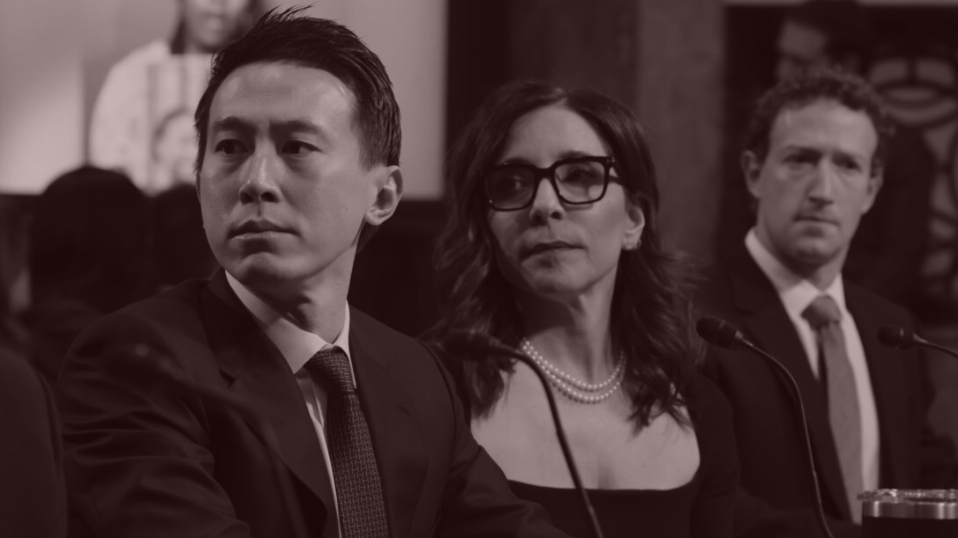
I don’t think a ban is a good idea. I also think that much of the conversation is unfortunately misguided and it’s bipartisan in terms of support and votes. It’s not bipartisan in terms of what we’re all agreeing to agree on. You have one group really focused on the alleged foreign ownership of the company, and that conversation comes with quite a bit of xenophobia. Where you do have bipartisan agreement is that a majority of Americans want to see tech reined in because of the effect it is having on American children.
That has bipartisan support, and part of that sentiment is being used to justify this bill. Now, I like a lot of what’s happening in this conversation, which is also happening in the Senate judiciary hearing on child safety and four other bills that have a lot of support in the Senate to better address this problem, and better address the systems across tech companies. This TikTok bill has kind of put legislators in a position where they want to be responsive to the concerns that are true about TikTok and true about other platforms, and it’s been proposed in this way, so they’re kind of in a bind. I think that better legislation addresses the sector as a whole and looks at their business practices as a whole—practices used by TikTok, Meta, Snapchat, and YouTube.
So, I personally don’t think a ban is the right move. I can’t say that I have an opinion on this specific bill other than I think it’s a distraction trying to solve for some of the things that I do think are a problem, and in some ways trying to advance a political agenda to the forefront of a conversation in an election year.
We’re a few months away from the November election and the ratcheting up of content that’s going to make us crazy, built on a system that already makes us crazy. What should we be fighting for and organizing for?
In the short term, we need to have some collective acknowledgement of being overwhelmed by the information environment, about how we’re all feeling in relation to our devices and information. From there, I would say something like, “Given this mad world we’re existing in, we can expect that there’s going to be some chaos that’s going to be deployed to try to make us think certain things, vote a certain way, and it’s important to know that, yes, while political parties have tried to win votes for a long time, this information ecosystem has some new types of threats that are particularly tricky and we don’t have exact solutions for them yet.”
Then, you have to remind people that there is accurate information out there that we rely on all the time, because what we don’t want is everybody to be skeptical of everything. We need to remind people of all the things we do rely on. I give silly examples like, “If you are going on a date, you rely on the recipe you’re making not being so spicy that it messes up the rest of the date.” You’re still getting information that is reliable and we all do have a sense of when information is filtered, or when something’s not quite right.
I tell people to slow down and be intentional about what kind of information is driving your decisions and behavior, and to remember that there are people who really want your decisions and behavior to benefit them. Make them earn it. Make them show you what you need to see to buy into that information. I encourage leaders to talk about why they trust the sources they trust. There are processes in place at mainstream outlets that don’t exist at disinformation outlets. And at a minimum, I’d be asking for transparency wherever I can get it. So, I’d want to know who shared that, why, and who’s paying them… and if I even just stop myself to ask that, I would be in a better place. |
|
|
| What should trustworthy information sources, whether official media outlets or just parties with influence and reach, do when they come across something they’ve confirmed is untrue?
A lot of the sector will publish a fact check and stop there. The fact check should be step one, and then there should be at least five more steps. Here’s an example of what I mean. In 2020 a far right super PAC known to produce disinformation was behind an organization called Protect Our Vote that used an image of LeBron James to promote election disinformation online. I took this research to the Washington Post and said “I have this research, and I’ll let you publish it if you agree to do what you can to get ESPN to cover it with the hope that ESPN would do a push notification” through its mobile app.
They did, and President Obama and LeBron shared the information, and we took another step, which was to create a set of talking points for Black pastors to use. That is a complete response. That is doing the work to get the message to where it needs to go. If it had just stopped at the Washington Post article, it may not have reached the people who were being targeted with the campaign, who were being told mail-in voting wasn’t safe, and who very well still may think that.
How do you talk about this with regular people?
The vibe of the message has to be: There’s a lot coming for us, but they’re not going to stop me from engaging in this election. They’re not going to stop me from making my voice heard and casting my vote. I’m not going to let them keep me home. I’m not going to get so tired that I let them benefit from me not engaging. They’re making us tired so that we can be controlled, and that’s scary and that’s universal, and no one wants that.
To your point about the centralization of these platforms, what are some of the things we should be demanding of them?
Transparency. They’re not transparent. They haven’t had to be and they need to be. The E.U. has passed legislation that’s going to require them to start being transparent on a few different things. Right now though, they’re using the excuse of data privacy, but it can’t just be a default setting for the platforms to be like, “Well, we can’t be transparent because we don’t want to give you anybody’s private information.” So we need to call for transparency with researchers, independent auditors, and users really. There’s a lot that doesn’t require sharing user data, like making it really easy for me as a user to understand how every action I take on your platform is making you money, and how you determine what shows up in my feed.
I also want to know who it’s being shared with, and if someone ended up in my feed, how did they get there and who are they? If you think about pieces of content online, we never get to see how many people chose not to engage with a piece of content. We only get to see the people who did engage, and that’s really misleading in a lot of cases.
We need to develop safety standards, the way all other industries that have this much impact on human behavior in life are held to. In Europe the way that’s happening is there has to be risk assessments between platforms and independent auditors, determining what risk their platform is posing, and that hopefully will be the basis for the development of safety standards that they have to adhere to.
So how do we get there?
I really do think that what’s happening to young minds under 25 is really concerning and negative, and I’m worried about the impact of this time on their lives. That is the quickest road to having any accountability for this sector. I would love for a mom to ask some of these C.E.O.s, “If my kid has a problem and maybe they go away to rehab and then they come back, will their phone know that they’ve gone to rehab and stop giving them the content suggestions, and how hard would I have to work as a parent to get to that?” These are the conversations I want to be having about what’s going on with our time online. And hopefully in having those conversations, there would just be an increase in awareness of all the other information moving online.
I often tell people, “I am not immune to this. This affects me, too.” The number of times I grab my phone, the number of times I’m opening some apps, it’s not normal, and I think about where I would be directing attention otherwise.
I’m glad to hear you acknowledge that you’re not immune from this. That makes me think it’s not my fault for not being more individually diligent.
The platforms want you to think it is your fault. They do message testing, and you’re going to start seeing more messaging from them like: “We want to help you be in control of your own time.” This implies that they’re not in control of your time, but they are. You should hear these parents blame themselves for what their kids are experiencing. You should hear kids blame themselves for not having the willpower to do their homework and say, “I wish that I was more disciplined.” It’s much like other industries who try to get us to take individual action instead of collective action that focuses on the much smaller, centralized target of the problem. |
|
|
|
| FOUR STORIES WE’RE TALKING ABOUT |
 |
| Shari’s Choice |
| A captivating twist in Apollo’s offer for Paramount. |
| MATTHEW BELLONI |
|
 |
| Ronna Maddow |
| Diving into Ronna McDaniel’s post-R.N.C. reality. |
| DYLAN BYERS |
|
 |
|
 |
| DustinBucks |
| On the Facebook co-founder’s renewed interest in money-bombing D.C. |
| TEDDY SCHLEIFER |
|
|
|
|
|
 |
|
|
|
Need help? Review our FAQs
page or contact
us for assistance. For brand partnerships, email ads@puck.news.
|
|
You received this email because you signed up to receive emails from Puck, or as part of your Puck account associated with . To stop receiving this newsletter and/or manage all your email preferences, click here.
|
|
Puck is published by Heat Media LLC. 227 W 17th St New York, NY 10011.
|
|
|
|