{{ 'now' | timezone: 'America/New_York' | date: '%b %d, %Y' }} |
|
|
Welcome back to Wall Power’s Inner Circle. I’m Marion
Maneker.
Tonight, I speak to Steve Ivy, one of the founders of Heritage Auctions, the Dallas-based company that grew out of Steve’s rare-coin business—and has become, perhaps unexpectedly, the third-largest auction house in the world by sales volume. It’s not far behind Christie’s and Sotheby’s, with more than $2 billion in sales. Steve has a lot more to say below the fold about how he and his partner, comics collector Jim
Halperin, came to dominate the collectibles market.
As always, if you’re not yet a Puck subscriber, you can sign up here. It’s a lot easier than bugging someone to forward you the newsletter. And if something I’ve written gets your nose out
of joint, you can take a poke at me at +1.917.825.1391 on SMS, Signal, and WhatsApp. Or just hit reply to this newsletter.
Mentioned in this issue: Steve Ivy, Jim Halperin, Roland Augustine, Lawrence Luhring, Lauren Wittels, Donald Johnson Montenegro,
Jensen Huang, Hendrick ter Brugghen, Gian Enzo Sperone, Alex Nussbacher, and more.
Let’s get started… |
- Vanderbilt takes over San Francisco’s California College of the Arts: After pouring $123 million into the expansion of its San Francisco campus in 2024, the California College of the Arts announced yesterday that Vanderbilt University will take over the property, according to The San Francisco Standard. The school had faced accumulated debt and declining
enrollment, and last year raised $45 million in emergency funds, half of which came from Nvidia’s Jensen Huang. (The school had been developing the “C.C.A.–Nvidia Incubator for Creative Intelligence” in response.) But Huang’s gift clearly wasn’t enough, and the school will not be accepting new students next year. In its own release, Vanderbilt
stated that it will begin programs at its new Bay Area campus in 2027 and relaunch C.C.A., including the college’s Wattis Institute of Contemporary Arts, as part of the university. Vanderbilt, which is based in Nashville, has expanded its footprint in recent years, with new campuses planned in Manhattan and West Palm
Beach.
- Roland Augustine departs Luhring Augustine: Roland Augustine announced in ARTnews this morning that he will no longer be a partner in the gallery he founded with Lawrence Luhring in 1985. Luhring will continue to operate from the gallery’s two locations in Chelsea and Tribeca, with Lauren Wittels and Donald Johnson Montenegro, two longtime
directors, becoming equity partners.
- Is Gian Enzo Sperone selling an Old Masters painting?: This morning, a very savvy European collector pointed out to me that Sotheby’s is selling a Hendrick ter Brugghen painting, Jovial Violinist Holding a Glass of Wine, from around 1626-27, with an estimate of $300,000. The provenance and literature citations suggest the painting is owned by Gian Enzo Sperone, the Italian
co-owner of Sperone Westwater gallery, which is currently being wound down contentiously. You can get a sense of Sperone’s collecting from a profile of his Swiss home that appeared in The New York Times last fall.
|
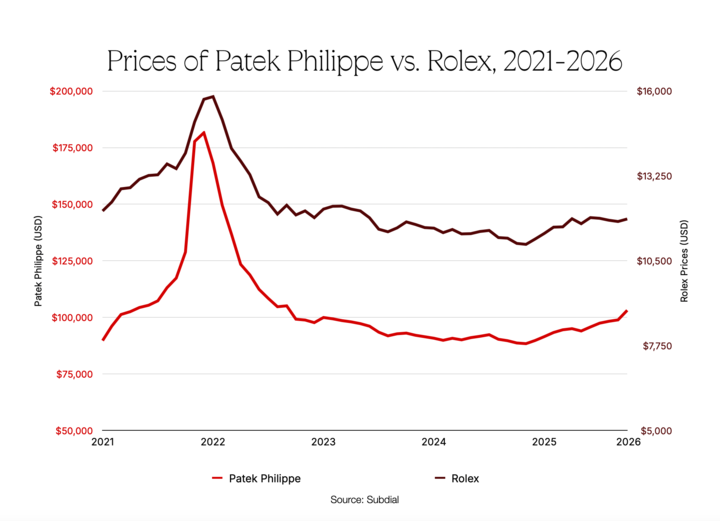
Going forward, I’d like to present more data about art and collectibles—with commentary from those
who did the research. Herewith is a secondary price index for Rolex and Patek Philippe watches over the past five years, compiled by Alex Nussbacher at Subdial, a watch-trading platform that collects extensive data on the watch market. Each index is a weighted average of the secondary sales of the 25 most popular reference numbers for each brand. (A watch model is tracked by the
maker’s reference number.)
The chart offers two different, equally interesting insights. The first concerns the shape of the watch market since 2021, when many new buyers came into the secondary market and speculation ran rampant following the pandemic. You can see that the price index for both brands spiked sharply at the beginning of 2022. According to Nussbacher, the reasons for this were probably a combination of factors, including lockdown hobbies, government stimuli, and crypto
wealth. In the watch market, Nussbacher told me via WhatsApp from London, everyone was making money quickly and thought the gravy train would continue. That, of course, proved unrealistic as the market corrected over the next three years. We can see a fairly clear bottom at the end of 2024 and growing momentum for both brands since then.
The second insight revealed in the chart is that the percentage growth of the bubble was quite different for Rolex and Patek Philippe. While Rolex prices
rose 33 percent between 2021 and 2022, from around $12,000 to $16,000, Patek prices doubled, rising from roughly $90,000 to $180,000 in the same period. Nussbacher explained that some of the differential comes from the way each company updates their watch lines—tastes change as the watchmaker markets different reference numbers—and from the sheer volume of watches made by each company.
Of course, Rolex and Patek Philippe are not the only watches that are traded on the secondary market.
But they act as a reliable bellwether because they both have a continuous ownership history and make up a large portion of that market.
Now, let’s get to the main event… |
|
|
An eye-opening conversation with the auction house founder (and
lifelong numismatist) on the explosion of the collectibles market, Heritage’s $2 billion year, and his middle-school obsession with coins. |
|
|
How do you get from a fifth-grade coin collection to a $2 billion collectibles giant? Heritage
Auctions C.E.O. and co-founder Steve Ivy made a business out of a childhood obsession. He’d been dealing in rare coins when he partnered with James Halperin—another coin-dealing college dropout, who also happened to collect comics—in 1982. Their business grew through the 1990s with the advent of the web, and the timing was fortuitous: As fine art grew more valuable and contemporary began to soar, Christie’s and Sotheby’s ultimately exited
furniture, antiques, rugs, and other categories to concentrate on secondary sales in luxury items. In the process, they ceded much of the collectibles market to Heritage.
Heritage’s sales have been accelerating at a rapid clip lately—the house broke the billion-dollar barrier only a few years ago, and doubled that last year. It’s now in the process of expanding its Dallas warehouse to 270,000 square feet. I spoke to Steve recently about the early days of Heritage; its innovations, from
its early website to pre-bidding; and much more. As always, this interview has been edited for clarity and length. |
“Collecting
Is a Genetic Disorder”
|
Marion Maneker: You started as a numismatics company.
You and Jim Halperin had separate companies, and you put them together. How did the coin business start before it expanded into these other categories?
Steve Ivy: People always ask me what I did before I got in the coin business, and my standard response is, I was in the fifth grade. A huge percentage of the people in the coin business these days are people my age [76]. We all started out when you could still find coins in
circulation; it essentially became a treasure hunt. We would go through change, find coins, and put together sets. I’ve always said, Collecting is a genetic disorder. It literally is a compulsive thing. Either you have that gene or you don’t.
I went to the University of Texas, and after about two and a half years, I called my dad and said, I’m gonna drop out of school and come to Dallas and open up an office. So in January 1970, I did that, and that’s when I incorporated
Heritage. That’s really when I started as a, quote-unquote, official business.
How did it grow from those early days?
My first business was me in a single office, in a shared office pool. After about six months, I added a single employee, who happened to be my cousin. And over the next few years, I hired one person after another, and pretty soon we were up to around 20 people. So we moved to bigger offices and it just sort of grew
from there. People ask me what my grand plan was at the time and I always say, I never had a plan. It was just, Let’s try to make some money this month and do the same thing the following month. Now we’ve got a little less than 1,000 people across 17 offices. Jim and I became partners in 1982 and changed the name from Steve Ivy Rare Coin Company to Heritage, and we did the same thing then as we do now, sans 49 other categories. We were essentially “the coin company” up until
the mid-to-late ’90s.
Of course, the mid-1990s is when the World Wide Web became a consumer-facing part of the internet. You didn’t sleep on creating a website, and that seemed to fuel your expansion.
We were early adapters to the internet and had a pretty robust website in 1997 based on the standards of that time. Then Jim, who collected comics as well, came to me with the idea of having a comics sale. Lo and behold, it did
phenomenally. And the next comics sale we had, six months later, was bigger than any comics sale that Sotheby’s or Christie’s had ever had. For the next 15 years or so, we would add two or three categories a year.
We found out that if you collect one thing, you likely collect something else or will in the future. So the networking effect was that all these people who had been buying coins would start buying something else. All of a sudden we had several hundreds of thousands of people on
our list, all of whom collected something else. During this time, Sotheby’s and Christie’s were discarding their collectibles, and essentially ceded that marketplace to us. What you’re seeing now are the results of that. |
Breaking
the Billions Barrier
|
Your annual numbers just came out, and for the first time you’ve broken $2 billion in
sales. It wasn’t long ago—maybe five or six years—that you first hit $1 billion in sales. Things are moving fast for Heritage, and now, very significantly, you’re third place behind Sotheby’s and Christie’s. What’s the context to all of that?
Our actual auction sales, as opposed to the private treaty sales, were about $1.1 billion, spread over 50 different categories—some very small, some quite large. That’s the part of our business we’re most
excited about. We started out in the other categories [comics and comic art, memorabilia, sports, and fine art] 20-plus years ago, and had no advantage over anybody else. Obviously that wasn’t true of numismatics, but it was true of everything else.
The website is a key part of what you built, and you also introduced innovations that others are now trying to emulate: pre-bidding, using under-bidders, and being able to circle back to buyers far more efficiently. I think the other
houses are still operating in much more old-fashioned ways.
There’s an interesting dichotomy in our categories: We have shopper categories and collectible categories. The shopper categories are for people who want to collect handbags or jewelry, for example, and are just looking around and aren’t going to read a whole bunch of instructions on how to get really robust information. Whereas a collector is highly motivated. They read
instructions, they learn how to work on our website, and they stay once they get there because we have a lot of information that these other houses don’t provide. We get close to 100,000 unique visitors to our website every day, and they stay on it for twice as long as the other competitive websites.
One of the other things you’ve done—which was unique to coins when you originally did it—is drive the rise of grading agencies so that these objects can be assessed for quality and
condition, and also authenticated and preserved.
That’s been huge because it’s brought in a whole new group of people and allowed them to justify spending a lot more money on a product. We’ve lowered the friction, which has not only brought in a bunch more people, but it’s driven the price and value up. We give out a huge amount of third-party information because that makes people feel more confident. And we try to make it efficient for people so
they’re not wasting their time.
Can you speak to the two different grading services that got their start with you guys? Your volume allowed the graders to grow by working with you, and your investment gave them the opportunity to grade so many of these objects, which also helped your business.
PCGS [Professional Coin Grading Service] has now evolved into PSA [Professional Sports Authenticator]. And there’s NGC [Numismatic Guaranty
Company]. We were early users of both of those services. We used our market power, if you will, and owned a part of PCGS, which we sold in the early ’90s. Then we turned around and bought NGC, and that company was recently sold to Blackstone. |
PSA has since exploded into a huge business. The sports collectible business seems to be
growing in lockstep with their ability to grade things.
Yeah, the numbers are just crazy. Sports cards, in particular, continue to go through the roof. They were doing 2 million cards a month for a while. I think it’s down a little bit, but, as you know, the business sold for $800 million, and now they’ve had some secondary sales that value the company at $4 billion.
Sports cards are a considerable business and growing,
right?
Absolutely. Comics and comic art, sports cards and sports memorabilia, and now entertainment—they collectively do more than numismatics, and they’re probably growing at an even faster rate.
Generally, logistics are hidden in the entire art and auction business—but in your case, it’s one of the competitive advantages.
It’s huge. We sell 500,000 units a year, and I think
Sotheby’s and Christie’s do about a tenth of that. Obviously their average value is much higher, but we can afford to sell $200 items in quantity. We’re essentially a factory in that regard. We’re actually adding robotics to the equation, too.
I do think collectibles are on an upward trend, and that’ll continue. They don’t have the sort of natural inhibitors that fine art has. But I will say, in fine art, we’re having tremendous success in multiples. They lend themselves to the same kind
of aspects that help coins. Grading will probably come into play at some point with those. |
I want to thank Curtis Rowser for his help editing this interview and Maya
Tribbitt for her help with the Subdial data. Wall Power runs smoothly on their able efforts.
That’s all for today. Let’s speak again on Friday.
M |
|
|
Puck founding partner Matt Belloni takes you inside the business of Hollywood, using exclusive reporting and insight
to explain the backstories on everything from Marvel movies to the streaming wars. |
|
|
The ultimate fashion industry bible, offering incisive reportage on all aspects of the business and its biggest
players. Anchored by preeminent fashion journalist Lauren Sherman, Line Sheet also features veteran reporter Rachel Strugatz, who delivers unparalleled intel on what’s happening in the beauty industry, and Sarah Shapiro, a longtime retail strategist who writes about e-commerce, brick-and-mortar, D.T.C., and more. |
|
|
Need help? Review our
FAQ page or contact us for assistance. For brand partnerships, email ads@puck.news.
You received this email because you signed up to receive emails from Puck, or as part of your Puck account associated with {{customer.email}}. To stop receiving this newsletter and/or manage all your email preferences, click here. |
Puck is published by Heat Media LLC. 107 Greenwich St., New York, NY 10006 |
|
|
|