Hi, and welcome back to Line Sheet, live from Milan, where Sabato De Sarno wants you to know he is not slinking away. The former Gucci designer was out and about this week as anticipation builds about the impending announcement of his replacement, which is expected sooner than soon.
In today’s Inner Circle issue, I explore why the search for Sabato’s successor is so consequential to the future of Gucci and parentco Kering, but not in the way you might think. Up top, I have a near-instant report from the Prada show and notes on the Silvia Venturini Fendi rally—and, for a special treat, Sarah Shapiro explains how Nuuly used its second-mover advantage to make the clothing rental business model work.
By the time you read this, I’ll be heading home from a dinner in the Portrait Milano with retailer Antonia Giacinti and Khaite designer Catherine Holstein. (Khaite did a takeover of the Antonia store across the way.) My pre-Oscars party FOMO is growing, though. Tonight in West Hollywood, UTA’s Dan Constable and Future Publishing’s Hillary Kerr are hosting a dinner at Marvin for the fashion people stuck (?) on the West Coast this weekend. (They’re calling it “carbs before the carpet.”) I’m especially sad to miss it, given that the event was partly inspired by my plea to the Academy to consult Dan next time they’re picking a date for the Oscars. (We missed him at Prada today.) I expect a full report from those in attendance!
🚨🚨 Programming note: Tomorrow on Fashion People, I’m joined by P.R. extraordinaire Lucien Pagès, who sold his business late last year to The Independents, a marketing, events, and comms conglomerate in the making. We talk about his exit, interning at Yves Saint Laurent in the 1990s, fashion in America versus Europe, being nice, and plenty more. Listen here and here.
🛍️ 🛍️ For those of you with the Shoppies: This is a very un-Euro shopping rec during a week when I’m contemplating Phoebe Philo suiting and Jermyn
Street Scottish cashmere, but it feels urgent: Jessica Taft Langdon, the shoe designer and friend of Line Sheet, recently posted a gorgeous vintage handbag from… Liz Claiborne. I have a deep appreciation for these bags, which were popular in the ’80s. (My parents bought me a knockoff version at Kids “R” Us.) The bags, of course, were a riff on the European luxury monograms of the time—designed for a mass, American audience—but Claiborne did an ingenious thing and created an original pyramid pattern that feels special now. Buy one here, here, or here.
Mentioned in this issue: Gucci, Sabato De Sarno, Kering, Francesca Bellettini, Silvia Venturini Fendi, Daniel Lee, Burberry, Prada, Saint Laurent, Raf Simons, Miuccia Prada, LVMH, Pierre-Emmanuel Angeloglou, Sarah Jessica Parker, Anna Wintour, Nuuly, Rent the Runway, Luke and Lucie Meier, Jil Sander, Parker Posey, and many more…
|
Three Things You Should Know…
|
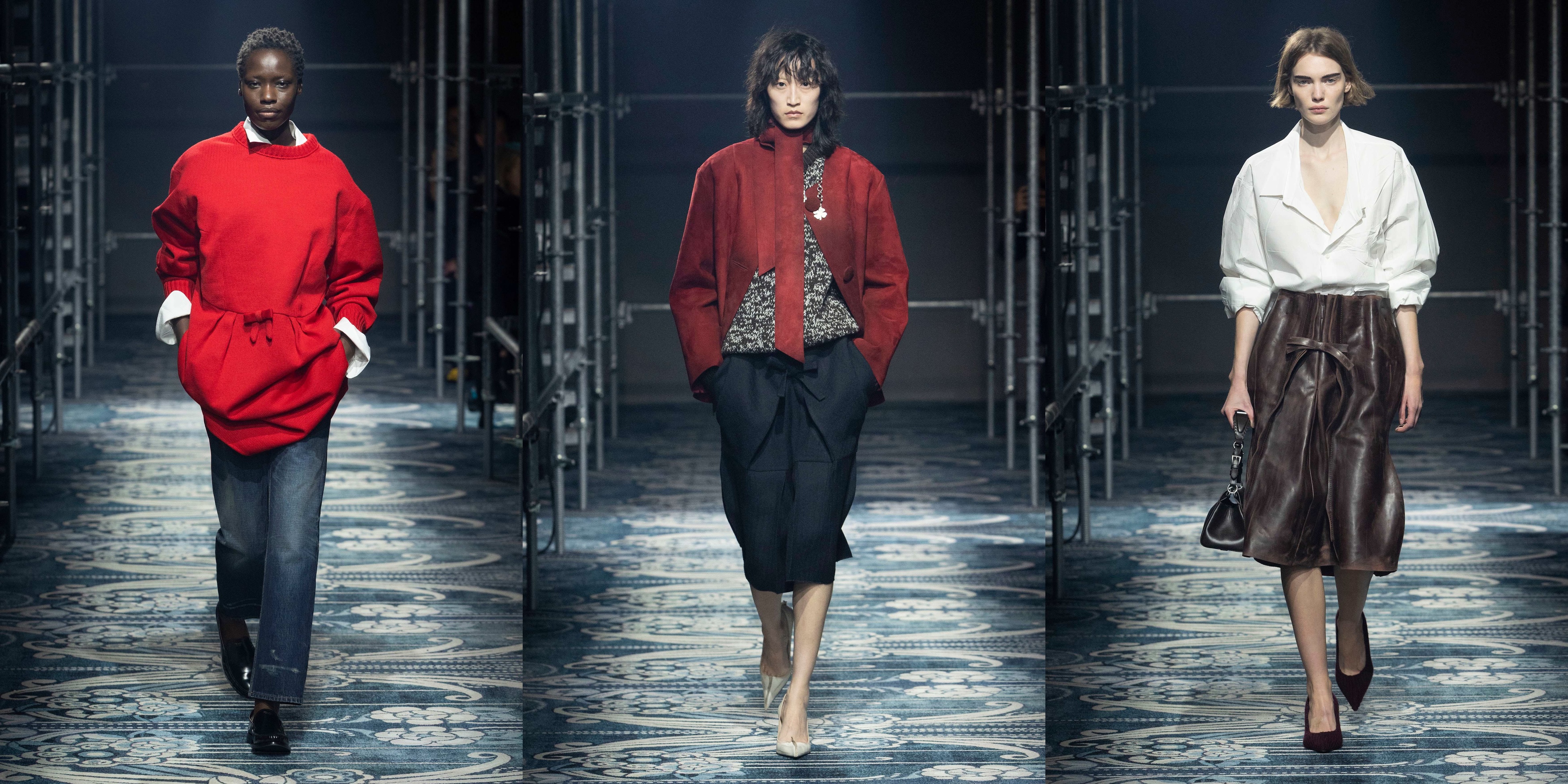
- Prada’s black moment: Backstage at the Prada show, Raf Simons accidentally wrote the headline for plenty of reviews: “Prada’s Anti-Quiet Luxury.” Yep, the Raf Simons uttered the dreaded empty phrase. “I know I’m not allowed to say it, but I said it,” he added. “We read what you write, and you all write about it!”
I believe Simons was trying to say that he and co-creative director, Miuccia Prada, are opposed to that kind of unimaginative minimalism. (Praise be.) “We thought a lot about reduction,” Simons continued. “Clichés that we find beautiful, essential, feminine.” Indeed, their essentials included knit dresses that were cinched with a drawstring at the waist but still sort of stood off the body, and pencil skirts that did the same (in conversation with skirts that Marc Jacobs, a Prada acolyte, has been showing), along with chubby-and-short jackets and marled jumpers. No evening. Severe pumps. Several little black dresses, almost sack-like. “We’re in a very black moment,” Prada said, quickly adding, “It’s not our role to protest. I don’t want to be political.”
|
|
Photos: Courtesy of Prada
|
- Sure, but that’s a difficult proposition at a time when everything feels political. After all, the biggest star in the front row this season was trans actress Hunter Schafer, whose recent video revealing that the gender on her passport had been changed from female to male—a directive from the Trump administration—went viral.Anyway, I felt unsettled watching the show, which was exactly the point: The tension between Simons and Prada is what makes this iteration of the brand work so well. When a journalist asked whether they were aiming to show a lot of the construction, Prada said, “Absolutely.” But, simultaneously, Simons responded, “I would almost say we have rejected a lot of construction. “He thinks more about the future, I think more present,” Prada said. “The present is enough.”
|
- Silvia gets her Fendi flowers: The chatter in Milan these past 24 hours took an unexpected turn. Everyone—and I mean everyone—was raving about the Fendi centenary show, designed by heir and longtime menswear head Silvia Venturini Fendi. This is the second time that Venturini Fendi, whose future at the business post-100th-anniversary has long been in question, has designed womenswear. She also served in the interregnum between Karl Lagerfeld and Kim Jones, who left last fall. Give it all to Silvia was the refrain.
Fendi—which, as we all know, began as a furrier—is very lady. And Venturini Fendi and the team delivered just that: elegant clothes that poster child Sarah Jessica Parker would want to wear. (By the way, now that cancel culture is fading away, fur is back alongside so many other formerly verboten trends.) At the re-see this afternoon, there were some great looking pieces (including, yes, a pieced-together fur decorated with red dots). But the flat-front satin pants, tiered lace dresses, and puzzle-piece bags were near-universally appealing. (Honestly, it felt like what Sabato was trying to achieve at Gucci, but never managed.) “The quality of the product was on display, finally,” was how one insider put it, adding that “that Pierre guy should stay here.” This person was referring, of course, to Fendi C.E.O. Pierre-Emmanuel Angeloglou, a rising star in the LVMH universe, who was rumored in recent weeks to be moving elsewhere.Indeed, Fendi presents a unique opportunity. It’s big, but could be far bigger. It already has a robust handbag business, and there’s so much history. Venturini Fendi is in her mid-sixties, which is practically middle-aged for a fashion designer these days, and perhaps she has another decade in her. Whatever is happening there, the team in place is on to something.
- Sarah on the surprise success of Nuuly: Pre-pandemic, it felt like Rent the Runway founder Jenn Hyman was going to get the last laugh. Monthly subscriptions for clothing rental services were exploding, and Hyman’s argument that closets had become portfolios of short-term rental and long-term rental (a.k.a. resale) assets seemed prescient. Of course, her business was decimated during the pandemic. Nuuly, however, seized the second-mover advantage—not only doubling R.T.R.’s subscriber numbers, but also achieving the financial performance that eluded its predecessors. The company earned $13 million in profit last year on $378 million in revenue. Moreover, it’s supercharging the acquisition funnel for parentco Urban Outfitters and its portfolio of brands—many of which can be rented on Nuuly, including special in-house brands like Nuuly x Rachel Antonoff and Nuuly Vintage offerings.Nuuly’s big advantage was the built-in inventory, yes, but also the fact that the business, run by David Hayne, son of Urban Outfitters C.E.O. and co-founder Richard Hayne, had the infrastructure in place to see Rent the Runway’s mistakes and circumnavigate them… at least to a point. As they scale beyond 300,000 subscribers, the challenge will be maintaining operational efficiency and managing the industry’s notorious inventory and shipping costs, while ensuring that their economics don’t come back from the cleaners shrunk beyond recognition. —Sarah Shapiro
|
|
And now on to the main event…
|
|
|
|
Even as Gucci prepares to announce a new creative director, the industry is reorienting away from star designers and runway buzz toward more sustainable strategies that put brands front and center.
|
|
|
The biggest surprise this week so far was not that Luke and Lucie Meier, the designers of Jil Sander since 2017, were leaving the brand. That news, delivered less than an hour after the press release for their final collection dropped, had been widely reported weeks earlier. Reps for the fashion house’s parent company, which is eyeing an I.P.O. next year, made it clear that this was a conscious uncoupling: no hard feelings, everyone was ready to move on, etcetera. Nor was I surprised by the Meiers’ final collection, which leaned into the ladylike side of their familiar repertoire. (I liked the oversize, feminized satin chore jacket.)
No, the real surprise of the week came on Monday night, when Burberry’s Daniel Lee draped a hall at Tate Britain in scenic tapestry. Anna Wintour loved the collection—perhaps because the paillette-covered knit dress, tall boots, and jumbo chenille-esque scarf looked like they were designed for her—but really, so did everyone. (“Burberry Brings the Magic Back to London Fashion Week” was the Financial Times headline.) To me, it felt as if Lee had finally been given a brief by still-new C.E.O. Joshua Schulman regarding what he was supposed to deliver, and he followed it. This was, in my view, as good as any Christopher Bailey show—or nearly as good.
Burberry, of course, has been vexed by deteriorating sales and plunging profits, fueling speculation that Lee would be departing. Does this mean he’s sticking around? I honestly have no idea at this point, but as I wrote on Monday, I’m also not sure it matters. Burberry will succeed if they make desirable coats and scarves, and a decent amount of clothing and accessories. The situation there helps to explain why the greater fashion industry is in crisis.
Prior to Schulman joining, it seemed as though Lee had been given the keys to the tartan kingdom, despite the fact that he was largely unproven as a creative director. His stint at Kering-owned Bottega Veneta made him a star, but that was a fleeting moment (which ended unceremoniously by all accounts). Unlike his take on Bottega Veneta, which was clear from the start, his vision for Burberry was blurry. It was difficult to imagine that the same person designed both lines—which is, to say, Lee is no Tom Ford.
Indeed, when you look back on the past three or four decades in fashion, there are two models that have worked. The first is the designer-as-omnipotent-narrator strategy, where success on the runway dictates sales. Exemplars include Ford, of course, but also Alessandro Michele at Gucci, Demna at Balenciaga, and Hedi Slimane at Saint Laurent and Celine. (You might add Jonathan Anderson at Loewe and Phoebe Philo at Céline, too.) It’s the most intoxicating way of operating, because consumers become obsessed.
Increasingly, however, that model feels dangerous, especially for brands like Burberry, which are not rooted in runway fashion. Completely overhauling a brand every time a new designer is installed requires spending millions of dollars on store redesigns, operational changes, and product marketing. When it hits, the results are spectacular. But these transitions present inherent business challenges and amplify the key man risk that has undergirded the business for so long. Going all in on a singular artistic vision seems increasingly economically perilous in an era when the top brands are doing more than $5 billion a year in sales.
|
|
The megabrand model, of course, relies less on the designer’s runway proposition and more on the annual recurring revenue that comes from its core offerings. At Louis Vuitton, Hermès, and Chanel, for instance, the runway is just one layer of a much grander plan. So perhaps it’s no surprise that Kering deputy C.E.O. Francesca Bellettini made clear on a recent earnings call that she is staying the course at Gucci, where the focus is on improving quality, refining designs, and diversifying leather goods. Like Virginie Viard at Chanel, Sabato De Sarno may have not been the right fit, but Bellettini is adamant that the underlying strategy will, in the end, prove to be right. Of course, the difference between Chanel and Gucci is that Chanel was still selling despite Viard’s poor reviews.
Even at Dior, where Anderson is slated to assume control of a larger part of the vision than any designer has since Christian Dior himself, there will be guardrails put in place. Dior will continue to be about the Lady bag and the Bar jacket long after Anderson leaves the building. The same goes at Louis Vuitton, which doesn’t need Nicolas Ghesquière to sell Neverfulls, and at Chanel, which is still selling 2.55s and tweed jackets long after Karl Lagerfeld. Sure, the powers that be at Chanel are betting that Matthieu Blazy will attract a new customer base, but they need to continue satisfying their current customers, too.
That’s why the next creative director of Gucci, who is expected to be appointed in the coming weeks—maybe even days—will be so critical for the future of the brand and for Kering. It will be a test of Bellettini’s vision, too. At Saint Laurent, she made a genius move by replacing Slimane with Anthony Vaccarello, whose runway vision is stronger with every season, but never dictatorial. (At the beginning, Bellettini’s motto was “evolution, not revolution.”) She was steadfast that Saint Laurent should focus on wardrobe essentials—the building blocks of the original Yves Saint Laurent business—and so it remains.
But at Gucci, Bellettini and C.E.O. Stefano Cantino need to make a sharper reset. And yet, even if the messaging in the coming weeks is all about the person, the business needs to be about horsebit loafers, top-handle bags, and interlocking Gs. So while, yes, I would love to be able to tell you their name today, it’s the underlying strategy that will ultimately determine Gucci’s fate.
|
The Neiman Marcus downtown Dallas store closure is also a disaster. The TL;DR is that people in the city rallied to get the lease dispute resolved. Saks Global is still closing the store. (Obviously.) I’m sure there’s an explanation, but the reality is that Stanley Marcus knew that retail was moving to the suburbs and opened the first upscale luxury store in the suburbs in the 1950s—in what is now NorthPark—and it would have been possible to spin this closure into something Marcus predicted a long time ago. [ Local News]
I’m sorry, I really want to like the Gap- Parker Posey advertisement because I love her and I love trench coats, but I’m not into it. [ Adweek]
Whatever color it was, it was ugly! [ X]
|
|
And finally… One more day ’til Bally!
Until tomorrow,
Lauren
P.S.: We are using affiliate links because we are a business. We may make a couple bucks off them.
|
|
|
|
Puck founding partner Matt Belloni takes you inside the business of Hollywood, using exclusive reporting and insight to explain the
backstories on everything from Marvel movies to the streaming wars.
|
|
|
|
Puck’s daily art market email, anchored by industry expert Marion Maneker, offers unparalleled access to the mega-auctions and galleries, elite buyers and sellers, and the power players who run this opaque world. Wall Power also features Julie Brener Davich, a veteran of Christie’s and Sotheby’s, who provides unique insights into how the business really works.
|
|
|
Need help? Review our FAQ page or contact us for assistance. For brand partnerships, email ads@puck.news.
You received this email because you signed up to receive emails from Puck, or as part of your Puck account associated with . To stop receiving this newsletter and/or manage all your email preferences, click here.
|
|
Puck is published by Heat Media LLC. 107 Greenwich St, New York, NY 10006
|
|
|
|