Welcome to The Hidden Layer. I’m Ian Krietzberg. Happy GPT-5 Day.
Yes, the
rumors were true: After two years of waiting, OpenAI’s latest model was released into the wild today. In today’s issue, I’ll break down whether it’s actually a game-changer—or falls short of its astronomical expectations.
As a reader recently pointed out, GPT-5 arrives almost exactly 1,000 days after the launch of the original ChatGPT—a milestone that begs for some reflection. What’s the most significant positive impact that generative A.I. has unleashed on society since
2022? Let me know what you think by replying to this email, and I’ll share the best answers later this month.
Mentioned in this issue: Sam Altman, Elon Musk, OpenAI, Anthropic, Google, Michael Rigas, Lisa Su, AMD, Super Micro, John Licato, Nvidia, and many more…
Okay, let’s get into it… |
Deal of the Week: The
Nvidia Exemption
|
On Wednesday, President Trump said he would be imposing a whopping 100 percent tariff on
semiconductors and computer chips—except, of course, for companies that are “building in the United States.” That’s a loophole large enough to drive a container ship of Nvidia chips through.
The final rule is still being drafted, and other elements of the supply chain could still be at risk. But this looks like a big win for the incumbents, who know how to play Trump. Intel already manufactures many of its chips in the U.S.; TSMC, the large Taiwanese semiconductor manufacturer, has
recently begun limited production in Arizona. AMD also plans to manufacture at least some of its chips through TSMC’s facilities. Tim Cook, for his part, delivered his tribute directly to the White House, where he announced that Apple will begin using chips from Samsung’s plant in Texas, and gifted the president a 24-karat gold plaque. Subtle. |
Two Things You Should
Know…
|
-
Action Plan in play: Less than two weeks after Trump unveiled America’s A.I. Action Plan, his administration is already making good on one of the industry’s wishlist items: integrating A.I. into federal agencies. On Tuesday, the General Services Administration made OpenAI, Anthropic, and Google services available to
purchase for federal, state, and local governments at discounted prices. Michael Rigas, the agency’s acting administrator, suggested in a statement that these tools will “streamline back-office processes,” “revolutionize employee and citizen experiences,” and “reimagine how we deliver mission-critical services.” (OpenAI
announced it’s offering ChatGPT Enterprise to federal agencies for $1 per agency for the first year.)
As part of the rollout, Trump signed an executive order banning the use of what he has called “woke” A.I. models in the federal government, which is why the adoption efforts will, according
to Federal Acquisition Service Commissioner Josh Gruenbaum, focus on “models that prioritize truthfulness, accuracy, transparency, and freedom from ideological bias.” The G.S.A. did not return a request for comment about how this will be measured or enforced. It’s also unclear whether OpenAI, Google, or Anthropic introduced specific model guardrails to ensure their systems are somehow free of whatever the administration might deem “ideological bias.” None of the labs responded
to requests for comment, either.
|
|
|
As AI adoption accelerates, power has become the defining constraint—and opportunity—for data center growth. Our
latest 2025 Mid-Year Power Report reveals a dramatic shift in how industry leaders are planning for the future. Read the report. |
|
|
-
A.I. earnings season: Not everyone can be Nvidia, as evidenced by this week’s earnings reports from AMD and Super Micro. The chip business, obviously, has been on a tear: Nvidia, whose data center revenue increased from less than $4 billion in Q2 2022 to nearly $40 billion three years later, is now the most valuable company in the world. (Nvidia reports its earnings later this month.) But rival companies are struggling to ride its tailwinds.
Over the last three quarters,
AMD has seen its data center revenue fall from $3.9 billion to $3.7 billion to now $3.2 billion—it’s still a 14 percent gain from the same period last year, but it’s hardly what Wall Street analysts wanted. Combined with a slight earnings miss, the stock dropped nearly 7 percent on Wednesday. C.E.O. Lisa Su blamed U.S. export restrictions that “effectively eliminated MI308 sales to China.”
Super Micro also missed expectations for this most recent quarter, and issued
softer-than-expected guidance for the current quarter, sending the stock plummeting nearly 20 percent. The company’s efforts to meet demand and stay price-competitive have been remarkably costly, with its margins falling below 10 percent for the quarter. Maybe if their C.E.O. got a cool leather jacket, sentiment would change…
|
Quote of the Week:
Time Machine Edition
|
“The most successful founders do not set out to create companies. They are on a mission to create something
closer to a religion, and at some point it turns out that forming a company is the easiest way to do so.” —Sam Altman, the C.E.O. of OpenAI, waxing poetic 12 years ago.
Which leads us to the main event… |
|
|
Silicon Valley is adjusting its expectations yet again, after OpenAI’s latest model turned
out to be more of an upgrade than a great leap forward. “It’s not a disappointment in the sense that it won’t actually be better,” said one A.I. researcher. “But a disappointment relative to what people were expecting.” |
|
|
For all the feverish excitement surrounding today’s release of GPT-5, the latest and most advanced OpenAI
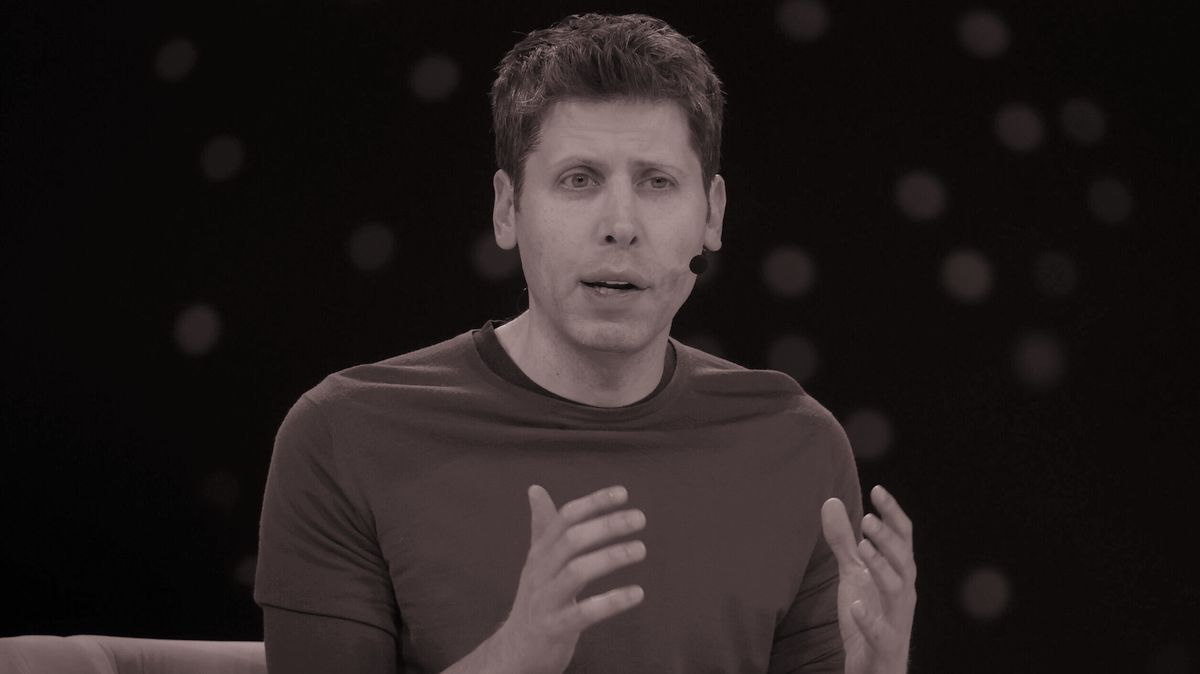
model seems to represent more of an incremental update than a paradigm-shifting breakthrough. At a press briefing, C.E.O. Sam Altman called GPT-5 a “major upgrade” that serves as a “significant step along the path to A.G.I.,” or artificial general intelligence, an entirely hypothetical technology. At another point he referred to it as “very A.G.I.-like.” Obviously, we’re not quite there—and it’s not clear that we ever will be.
Nevertheless, GPT-5, which comes in
pro, standard, “mini,” and “nano” flavors, is a pretty impressive upgrade—particularly to the folks who got to test it out before the release. The system offers better coding and software development capabilities than previous models—it scored a 74.9 percent on SWE-bench, the popular software engineering benchmark—which could make it more competitive with
Anthropic models. According to Altman, GPT-5 can “instantaneously create an entire piece of computer software … on demand.” In a demo at the briefing, an OpenAI researcher created a seemingly functional web app with a two-paragraph prompt in less than a minute. It’s also on par with the competition on a series of other benchmarks, although it’s not a knockout; on ARC-AGI-2, for instance, Elon Musk’s Grok 4 maintains
a significant lead.
But what most distinguishes GPT-5 from past iterations is its two-model architecture, which combines a “high-throughput model” to handle ordinary questions with a “reasoning” model to answer thornier ones. A “real-time router” decides which of the two models to use based on each prompt. “This idea that we can use more compute, higher-quality data, better
environments, whatever, to make smarter and smarter models, we see orders of magnitude more gains in front of us,” Altman said, with the addendum, of course, that he’ll have to invest in the compute side “at an eye-watering rate” to get there (surely good news for Nvidia, whose stock hit a new 52-week high today). |
|
|
AI growth is outpacing power infrastructure, making energy strategy a board-level concern. The
2025 Mid-Year Power Report highlights grid delays, rising onsite generation, and the strategic importance of power access. Get the report. |
|
|
GPT-5 also hallucinates less than previous OpenAI models, at least according to the company’s own internal
evaluations. The improvements point to the possibility of new or hybrid architectures (or lots of engineering scaffolding), which OpenAI didn’t clarify when I asked about it. In the demo, Altman hinted that OpenAI is “discovering new paradigms,” but it’s unclear what those are, or whether they are in some way present in GPT-5. Meanwhile, the model’s context window—which refers to the amount of text, in tokens, that a model can “remember” at one time—is 400,000 tokens (in the A.P.I.),
significantly less than the million-token-strong context window of GPT-4.1.
Perhaps most notably for the average user, OpenAI says that GPT-5 just “feels more human”—although what that means is anyone’s guess. “In which ways is it more human than it was before?” asked Dr. David Bader, the director of the Institute for Data Science at the New Jersey Institute of Technology, when I asked for his first impression. “Does it talk in one’s vernacular? Does it make more
mistakes, since to err is human?” As even Altman conceded, we’re not quite through the looking glass yet. |
The road to GPT-5 has been longer than originally anticipated. Many thought it
would launch last year, about a year after Altman debuted GPT-4 in March 2023. Instead, OpenAI released a series of incremental updates and new models: 4o and 4o-mini, o1, o3, and GPT-4.5 (which
was later scrapped) and 4.1, none of which were apparently worthy of the lofty GPT-5 title.
In fact, a downshift in the pace of innovation from giant leaps to incremental gains has become a defining feature of the A.I. industry. That’s not to say that many of these new products aren’t impressive. It’s
just getting harder to achieve something that could be considered legitimately groundbreaking. In the meantime, increased competition between A.I. companies has pushed them to release smaller upgrades—on an accelerated time frame, no less—in order to stay one step ahead of their rivals. Earlier this week, Anthropic released Claude Opus 4.1, which is supposedly better at coding than
Opus 4 (funny timing, OpenAI), and Google debuted DeepMind’s Genie 3, a “world model” with enhanced memory. OpenAI also released its long-awaited GPT-oss series, a handful of smallish, partially open models.
According to Dr. John Licato, the director
of the Advancing Machine and Human Reasoning Lab at the University of South Florida, this is just how science works. “There’s this kind of popular misconception of scientific advancement where it’s a lone genius in a room who creates something and it emerges from their mind fully baked,” he told me. “That’s not really how it works. Everybody keeps building off of each other, and they make a minor change, then when you’ve had enough of those minor changes, you call it a major release. This is no
different.”
Even at this incremental pace, Licato and Bader explained, genuine model improvements are becoming more difficult to squeeze out. Several reports have detailed OpenAI’s hard journey to GPT-5, and asserted that the leap between GPT-4 and GPT-5 is significantly smaller than the leap between GPT-3 and GPT-4.
“The improvements are slowing down,” Bader told me. “They’re not as dramatic as those first couple of releases.”
Bader wasn’t really surprised by anything in the GPT-5 release, and called the coding improvements “low-hanging fruit”—especially since Anthropic’s Claude has generally been considered a much better coding assistant than anything OpenAI has been able to produce thus far. And when it comes to OpenAI’s claim that GPT-5 will feature less user deception, less hallucination, and
instantaneous software generation, he’ll believe it when he sees it. “I tend to discount statements like that as potentially more marketing- or publicity-related,” Bader said, noting that prerelease testing rarely captures the full breadth of a model’s performance; it takes millions of real-world users to find their actual limits. (Also, as with pretty much every A.I. model release since 2022, non-peer-reviewed demos always look fantastic—but the reality tends to be a little less
rosy.)
For Licato, who was expecting to see a significant hardware integration, or leveled-up video processing, a model that’s merely “better” probably won’t meet most people’s expectations. “It’s not a disappointment in the sense that it won’t actually be better,” he told me. “But a disappointment relative to what people are expecting, given that it’s the big version number.” The model, he later added, shouldn’t even be called GPT-5. “This is GPT-4.2. Absolutely nothing groundbreaking
here, and honestly, even the presenters seemed underprepared,” he said. “They let Google and Anthropic dictate their release schedule, and it shows.”
Indeed, many of the most impactful advances going forward will likely revolve around more prosaic concerns: product-market fit, user interface, customer experience, etcetera. (GPT-5 allows users to select a personality and choose different colors for their chats.) As Licato told me, for the big players, it’s all about “that
attention-economy win.”
Bader agreed that “we need to distinguish between genuine advances and marketing narratives designed to attract talent and investment.” Technically, he noted, we’ve seen plenty of impressive model advancements over the last few years, including enhanced planning, reasoning, and multimodal understanding. OpenAI, in particular, has pioneered key innovations in chain-of-thought reasoning, reinforcement learning, and improved tokenization strategies, but it’s not a
significant step toward A.G.I., or manna from heaven for some of the A.I. pseudo-religions that have permeated across Silicon Valley.
“When companies suggest they’re on the verge of achieving artificial general intelligence, it creates unrealistic expectations and potentially diverts attention from more immediate A.I. challenges around bias, reliability, and
transparency,” Bader said. He added that we should recognize OpenAI’s technical, incremental advancements as “engineering achievements within the current paradigm—not evidence of an imminent leap to A.G.I.” |
In a newish essay, “The End of Understanding,” neuroscientist Grace Huckins argues
that big data and A.I. tools are ushering in a true scientific revolution: For the first time in human history, we are innovating and inventing without understanding why an innovation works, and without understanding any more about ourselves or the universe. [The Nine Dots Prize]
Eleanor Drage is tired of tech billionaires and costly
technological solutions. Instead, she proposes the rise of “frugal tech”—on-site, problem-oriented technological solutions intended to help people do more with less, rather than enrich the wealthy. [The Guardian]
Hugging Face researchers Dr. Sasha Luccioni and Yacine Jernite detail the recent
rise of electricity bills across the eastern part of the country, and how A.I. data centers—and utility companies eager to serve them—are to blame. [Tech Policy Press] |
That’s all for today. I’ll see you next week.
Ian |
|
|
Join Emmy Award-winning journalist Peter Hamby, along with the team of expert journalists at Puck, as they let you in on the
conversations insiders are having across the four corners of power in America: Wall Street, Washington, Silicon Valley, and Hollywood. Presented in partnership with Audacy, new episodes publish daily, Monday through Friday. |
|
|
A professional-grade rundown on the business of sports from John Ourand, the industry’s preeminent journalist, covering the
leagues, players, agencies, media deals, and the egos fueling it all. |
|
|
Need help? Review our FAQ page or contact us for assistance. For brand partnerships, email ads@puck.news. You received this email because you signed up to receive emails from Puck, or as part of your Puck account associated with {{customer.email}}. To stop receiving this newsletter and/or manage all your email preferences, click here. |
Puck is published by Heat Media LLC. 107 Greenwich St, New York, NY 10006 |
|
|
|