 |
|
Welcome back to Dry Powder. I’m Bill Cohan.
|
|
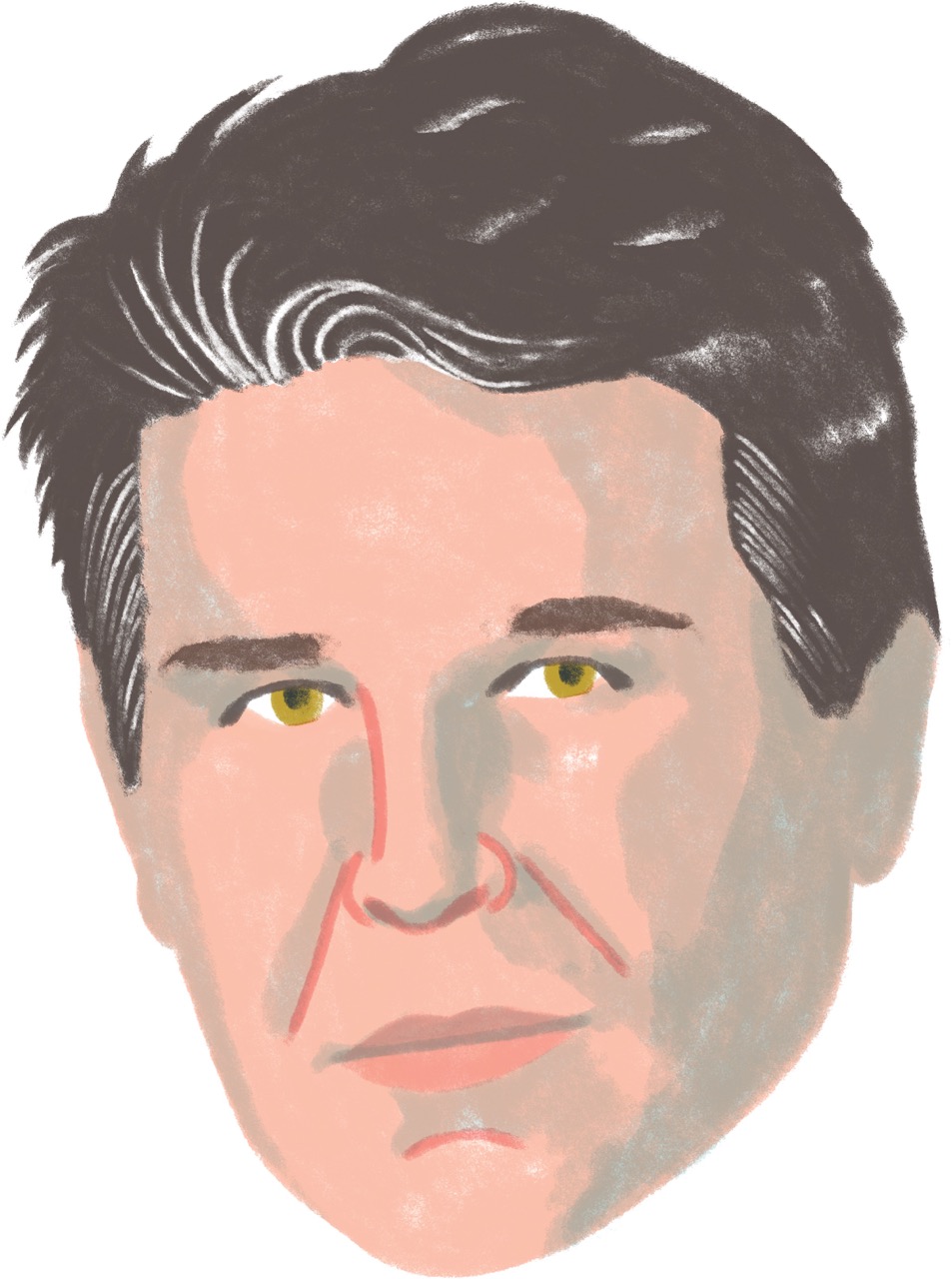
When rich and powerful families get into a sticky situation with their family businesses, they tend to call Byron Trott. It’s not for nothing that Warren Buffett has called him his “favorite Wall Street investment banker.” So it should come as no surprise that Trott is advising Shari Redstone on the sale of NAI, her family holding company (Trott is also a creditor of NAI, to the tune of $125 million preferred, an interesting wrinkle). In today’s issue, how Trott could influence the Paramount Global sweepstakes.
But first…
- The Wall Street C-Suite Revolving Door: There were a few notable personnel changes this week, one coming and one going. In what is being portrayed as a surprise announcement at Goldman Sachs, Jim Esposito, one of the three co-heads of Goldman’s combined investment banking and trading business, is retiring from the firm after nearly 30 years to become a senior adviser. Apparently, he told his clients, he’s lost the fire in the belly, at least for the moment.
I’m not exactly sure what a semi-retired senior adviser at Goldman does these days, but it’s probably akin to what a limited partner used to do at Goldman when it was still a private partnership: retain an office in the Goldman building on a separate floor and accrue some other benefits, such as healthcare, and probably a nice salary and a healthy expense account for full engagement in the restaurant arts. Anyway, good luck to Espo, as he is known at the firm. He’ll probably be scooped up soon enough by some other worthy financial institution, where his fire will get reignited.
But this wasn’t really a surprise, after all, given that C.E.O. David Solomon is not going anywhere anytime soon, having just shored up his support on the board of directors by naming David Viniar, a former Goldman C.F.O., as the board’s lead independent director, and Tom Montag, a former Goldman banker and former head of Merrill Lynch, as the head of the board’s risk committee. So with Solomon in place and his number two, John Waldron, still well positioned to succeed him at some point, there was bound to be some attrition among the leadership ranks. The good news for Goldman is that, as always, the bench is very deep, and there are always a bunch of alpha males and females eager to grab the reins. But, for now anyway, the three-headed monster atop banking and trading will be two-headed, with Dan Dees and Ashok Varadhan remaining as co-heads. Espo is 56 years old, so he still has some tread on the tires.
- Nides Takes His Talents to Blackstone: The other interesting news on the personnel front was the recent announcement that my longtime friend Tom Nides—we shared a rental house together on Nantucket back in the day—is returning to Wall Street as vice chairman of strategy and client relations for the august Blackstone Group. I’m not sure what that means, either. But I do know that hiring Tom, who is 62, is a smart move for Steve Schwarzman, also a Nantucket guy these days, and Jon Gray. Nides most recently was Biden’s ambassador to Israel. After he returned from Jerusalem last year, Nides (very) briefly served in an executive role at Wells Fargo. But after the Hamas massacre in southern Israel, on October 7, Nides decided to leave Wells Fargo and return to providing advice to the Biden administration and the new ambassador to Israel, Jack Lew, the former secretary of the treasury.
Now, with the Mideast war hopefully moving toward some sort of diplomatic resolution, Nides is also moving on, to Blackstone, no less. Infinitely charming, Nides has bounced between public service and Wall Street for much of his career. He’s had long stints at Morgan Stanley and First Boston as the right-hand man to John Mack when he led both institutions. He stayed at Morgan Stanley, as a vice chairman, when James Gorman took the reins. He worked for Mickey Kantor when Kantor was the U.S. trade representative and served as a deputy secretary when Hillary Clinton ran State. Tom has often been rumored as a potential White House chief of staff in a Democratic administration. He also has ties to Big Media. His wife, Virginia Moseley, is a direct report to the new CNN C.E.O., Mark Thompson, overseeing the outlet’s international and domestic news operations.
|
 |
| Some Like It Trott |
| Byron Trott, perhaps the most successful investment banker of his generation, has helped Buffett, the Pritzkers, the Waltons, and the Mars families. Can he work the same magic for Shari Redstone? |
|
|
|
| It’s no surprise, really, that Shari Redstone, the heir to a shrinking family fortune and the controlling shareholder of Paramount Global, turned to Byron Trott, the founder of BDT & MSD Partners, to advise her on what she hopes will be the sale of National Amusements Inc., her family’s private holding company. Shari and her three children will need a lot of hand-holding through the vicissitudes of what promises to be a challenging sale process. “That’s where I come in,” the secretive Trott told Bruce Feiler for his 2013 book, The Secrets of Happy Families. “I’m here to give them the skills to keep their families together.”
In addition to advising Shari on the sale of NAI, Trott and his firm also provided her some rescue financing in 2023, in the form of a $125 million preferred stock investment, to give Shari the cash needed to make amortization payments on NAI’s loan from Wells Fargo. NAI has another $37 million payment due to Wells Fargo, in March, and still has around $500 million in debt, in addition to the $125 million preferred. So Trott is not only an adviser to Shari, he’s also a preferred investor in NAI, and is technically owed a whole bunch of money. That’s an awkward situation for sure, and one that could put Trott and his firm in the driver’s seat at NAI, if for some reason the sale process falls through and Shari defaults on the NAI borrowings. Sure, it’s a long-shot scenario—even less likely than the sale of NAI or Paramount Global itself—but it could still happen.
It’s rare, but certainly not unheard of, for an M&A adviser to also be a creditor to his client, although big banks often provide financing and advice to clients at the same time. Trott’s firm is also a “merchant bank,” a British anachronism, so it often makes investments in addition to offering advice. The expectation with NAI, of course, is that Trott will continue to be Shari’s trusted adviser and not do anything that would cause her to lose control of NAI, and thus Paramount Global, before a sale can occur. Any buyer of NAI would have to assume the Wells Fargo debt and the BDT preferred, so Trott is highly incentivized, by more than just his M&A fee, to get a sale done. |
|
|
| Rich and powerful families, when they get into sticky situations with their family-owned businesses, have been calling Trott since the days when he became a pre-I.P.O. partner at Goldman Sachs, in 1994. That was an interesting year in Goldman’s history. Some 40 or so partners quit the firm after it suffered one of the worst debacles in its 155-year history, losing some $2 billion in capital, most of which came out of the pockets of its then-partners, since Goldman was still a private partnership. But the newly minted partner class of 1994, including Trott and Jon Winkelried, the C.E.O. of TPG and Trott’s former University of Chicago baseball teammate—Trott was the first baseman and captain—hit the jackpot when Goldman went public in May 1999, at a valuation of some 4x its book value. (Goldman barely trades at 1x its book value these days.) The old-line Goldman partners enjoyed a roughly $300 million liquidity event. But even the newer partners got a windfall. For Trott, that payday was around $100 million.
Over the years, Trott has become the preferred banker of America’s most powerful and extremely wealthy families. On behalf of the Bernick family, he sold Alberto-Culver to Unilever, in 2010, for $3.7 billion. He had known the family since his days at Goldman, so being “long-term greedy”—the Goldman mantra—paid off for Trott yet again. He’s worked with the Koch family, the Mars family, and the Waltons. In 2007, he advised Tom and Penny Pritzker on the sale of a majority stake in Marmon Holdings, the family’s holding company, to Warren Buffett for $4.5 billion. He went on the Hyatt board of directors after Goldman, and the Walton family agreed to invest $1 billion into Hyatt. Trott has also advised the billionaire Reimann family, in Austria, as it built its retail coffee empire, JAB Holding Company, which owns Peet’s, Caribou Coffee, Keurig Dr. Pepper, Panera Bread, and Krispy Kreme, among other brands.
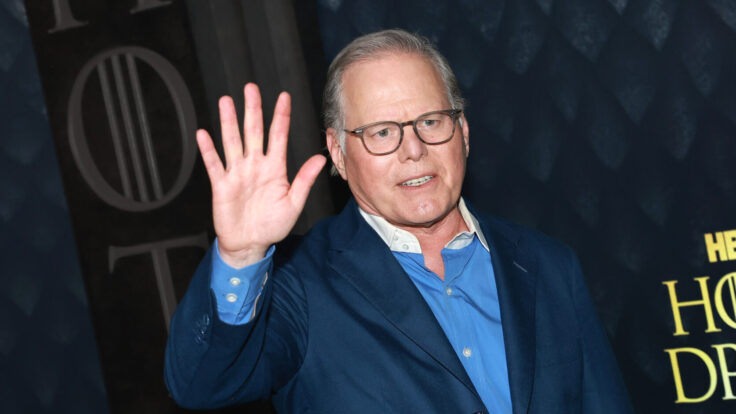
These wealthy private families pride themselves on secrecy, and expect their banker to keep their confidences. Trott has always been a reluctant interviewee. (He declined my request to chat. Essentially, I was told that hell would freeze first.) But the fact that there have been so many leaks about who is kicking the tires at NAI—the Ellisons, Apollo, David Zaslav, and now the ubiquitous Byron Allen, etcetera—is not the way Trott and his clients usually like to do things. One must conclude that the leaks have been strategic, to try to convince the market that this time Shari means business.
My sense is that the events of October 7 also changed the priorities for Shari and her children, who were raised in a religious Jewish household in Boston. (Shari’s former husband was Rabbi Ira Korff, the chief Lubavitcher rabbi in Boston and a spiritual leader in the city.) The world is a dangerous place. And, I’m newly told by someone close to NAI, that its financial prospects are not as bad as feared, or rumored to be. After the upcoming debt payment to Wells Fargo, the NAI debt should be “under $200 million very soon,” plus the $125 million of preferred, and that the debt “has declined precipitously over the years.” As for the Sumner estate tax payments, I’m told nothing is due for “10+ years” other than “relatively minor” interest payments. The estate tax payment, when it comes due, will be “significantly less” than the $1 billion number “that’s being circulated.” So, it seems, financial difficulties at NAI may not be driving Shari’s decision to sell now. But we shall know soon enough.
Then there is the Warren Buffett connection. Buffett, of course, is the largest economic shareholder in Paramount Global, further complicating the whole tableau. Buffett has described Trott as his favorite Wall Street investment banker, and one of the few he trusts and uses. (Though his view of Trott might change if the sale of NAI actually happens and the non-Redstone Paramount shareholders get left in the dust.) After Trott’s mentor at Goldman, Hank Paulson, introduced Trott to Buffett in 2002, he advised Buffett on a few acquisitions. In Buffett’s 2003 letter to shareholders, he wrote that Trott “understands Berkshire far better than any investment banker with whom we have talked and—it hurts me to say this—earns his fees.” (High praise from a man who once lowered his multibillion-dollar offer for Alleghany, the big insurance company, just to avoid covering Goldman Sachs’ $27 million advisory fee.)
Trott brought Buffett to Goldman in the midst of the 2008 financial crisis and arranged for his $5 billion preferred stock investment, which gave Buffett’s seal of approval at a highly tenuous moment for the bank, and allowed Goldman to raise another $5 billion in equity from the public markets soon thereafter. (Buffett’s money, of course, is expensive. He made a fortune on his preferred investment in Goldman, along with $500 million of annual dividends.)
Also in September 2008, when the mighty GE, and its GE Capital division, ran into financial difficulty, C.E.O. Jeff Immelt reached out to Trott, then still at Goldman, to suggest that Buffett do for his company what he had done a few weeks earlier for Goldman. Like Goldman, GE was hoping to do a massive public stock offering, and the Buffett preferred investment was seen as an essential catalyst for making the public offering a success. “It was unclear whether he would agree,” Immelt told me when I was writing my recent bestseller, Power Failure. “All we could do was hope.”
There was an 8 a.m. call on October 1, 2008, scheduled between Immelt, Buffett, and Trott. “If Buffett says no, we’re fucked,” Keith Sherin, then the GE C.F.O., told Immelt. But it was good news. Buffett invested $3 billion in GE in a preferred with a 10 percent dividend, similar to the Goldman structure, along with five-year warrants to buy GE stock. “Thanks Warren, we won’t let you down,” Immelt told Buffett. (Once again, Buffett made a fortune.) The Buffett investment helped GE raise an additional $12 billion from the public markets at an existential moment for the company, in part thanks to Trott. |
|
|
| After making his first fortune as a Goldman partner, Trott has added to it, considerably, with his decision to leave the firm in April 2009 and create BDT Partners—for Byron David Trott—as an advisory and investment firm, based in Chicago, catering to wealthy private families. Part of his success stems from his own Horatio Alger story and his Midwestern roots. He was born in 1958, in Springfield, Missouri, and moved to Union, Missouri, a small city southwest of St. Louis, with his parents and three older sisters when he was 2.
His father, a decorated World War II Army veteran, served as an honor guard at General George Patton’s funeral. He worked digging wells after the war before working as a repairman for Southwestern Bell Telephone Company. “My dad was a great role model,” Trott told the Horatio Alger Association when he was inducted into it in 2011. “He coached me in sports and taught me the values of integrity, honesty, and hard work.” His mother sold Avon products door-to-door, and then had her own small dress shop. She made sure the Trotts attended church several times a week. “She always said, ‘Anything is possible if you set your mind to it,’” Trott said. He balanced high academic achievement with a modicum of athletic prowess. When he was a senior in high school, the St. Louis Post-Dispatch named him a “Scholar Athlete.”
After graduating in 1977, Trott was off to the University of Chicago, paying for it with a combination of loans and scholarships. He majored in economics and then was accepted into Booth for his MBA. He graduated with both degrees after five years, and with $50,000 in student debt. He was a four-year varsity letterman in both baseball and football. He was also an entrepreneur, having started his own clothing store in Union with a $10,000 loan that his father helped arrange. His first summer in college, he worked at his store back in Union, and in subsequent summers he worked at Boise Cascade Company, in St. Louis, and at Continental Bank, in Chicago.
After he graduated with his M.B.A., in 1982, he joined Goldman, in securities sales, in New York. He then spent six years in private wealth management at Goldman, in offices in St. Louis and Chicago. In 1989, he moved to Goldman’s investment banking group. He made partner five years later, and stayed at Goldman when many other partners fled. In 1996, he became co-head of Goldman’s Chicago office and then a vice chairman of investment banking in 2005. In April 2009, he again chose the entrepreneurial route when he started his eponymous firm.
According to Bloomberg, Trott has advised 10 of the 30 wealthiest people in the world. He also has a sizable private-equity fund, which makes investments in clients and other family-owned companies, as is the case with NAI. He bought a stake in Tory Burch’s lifestyle company after her split from her husband, Chris. (Trott joined the company’s board.) In 2011, he made an investment in Colfax Corp., which enabled the company to make an acquisition. He also made an investment in the Reimann family operations when it started on its buying spree. (He and Bart Brecht, the chairman of the Reimanns’ holding company, went to the University of Chicago together.)
Not everything works out great, of course. Trott and BDT were one of the investors in Pilot Travel Centers, the truck-stop business owned by the Haslam family of Tennessee, that later caught some trouble with the F.B.I. (One Haslam brother owns the Cleveland Browns; the other was the governor of Tennessee.) In 2017, Trott’s friend Buffett paid $2.8 billion for a 38.6 percent stake in Pilot, with an intention of buying the rest by 2023, from the Haslams, who owned 50.1 percent, and the Maggelet family, which owned 11.3 percent of the company. In 2023, Buffett paid $8.2 billion for another 41.4 percent of Pilot, leaving the Haslams with the remaining 20 percent. Then things got ugly. In December 2023, Buffett and the Haslams sued each other over the sale price. In January, the lawsuits were settled.
In 2023, Trott decided to merge his firm with MSD Partners, a firm that since 2009 has been investing the family fortune of Michael Dell, the founder of Dell Computers, and other “like-minded” investors. The new firm, awkwardly named BDT & MSD Partners, has been able to attract the likes of former Goldman partners Dina Powell and Gregg Lemkau as executives. Its assets under management are now more than $60 billion, including investments not only in NAI but also in companies such as Under Armour, Qualtrics (along with Silver Lake Partners), and Weber grills, which Trott took private in February 2023. In January, the firm closed on a new $14 billion investment fund, its fourth.
When asked how he defined success by the Horatio Alger crowd, Trott replied, “I think it is being the very best in everything you do. In my profession, it means putting your clients’ interest first and finding solutions that help them meet their long-term objectives. On a personal level, it means being the best husband, son, father, brother, and friend I can be.” |
|
|
| Trott will need all of that definition of success and more if he’s going to succeed in helping Shari sell NAI. In addition to the $500 million-plus of debt and Trott’s $125 million of preferred, the company also owns 837 struggling movie screens in the U.S., U.K., and Latin America under the Showcase, Cinema de Lux, Multiplex, SuperLux, and UCI brands. Shari also owns 77.3 percent of the voting shares of Paramount Global, and 9.8 percent of the economic shares of Paramount, worth around $900 million these days.
Shari, of course, will want much more than $900 million for conveying voting control of Paramount—and that’s certainly fair—but how much more is the open question, as is who, if anyone, will pay her the premium she wants and inherit all the problems at NAI plus those at Paramount Global. In other words, it’s the sort of internecine family thicket that Trott specializes in and will require all of the skills he’s developed during his 42 years on Wall Street to untangle. “Remember,” our friend Rich Greenfield, the research analyst, twixxed Wednesday morning, “Paramount has yet to open [its] books to any bidders.” |
|
|
|
| FOUR STORIES WE’RE TALKING ABOUT |
 |
|
 |
|
 |
|
 |
| Leather Heads |
| On the unassailable fashion dominance of Hermès. |
| LAUREN SHERMAN |
|
|
|
|
|
 |
|
|
|
Need help? Review our FAQs
page or contact
us for assistance. For brand partnerships, email ads@puck.news.
|
|
You received this email because you signed up to receive emails from Puck, or as part of your Puck account associated with . To stop receiving this newsletter and/or manage all your email preferences, click here.
|
|
Puck is published by Heat Media LLC. 227 W 17th St New York, NY 10011.
|
|
|
|