{{ 'now' | timezone: 'America/New_York' | date: '%b %d, %Y' }}
|
|
|
Welcome back to the Wall Power Inner Circle, where we solve the art market’s current
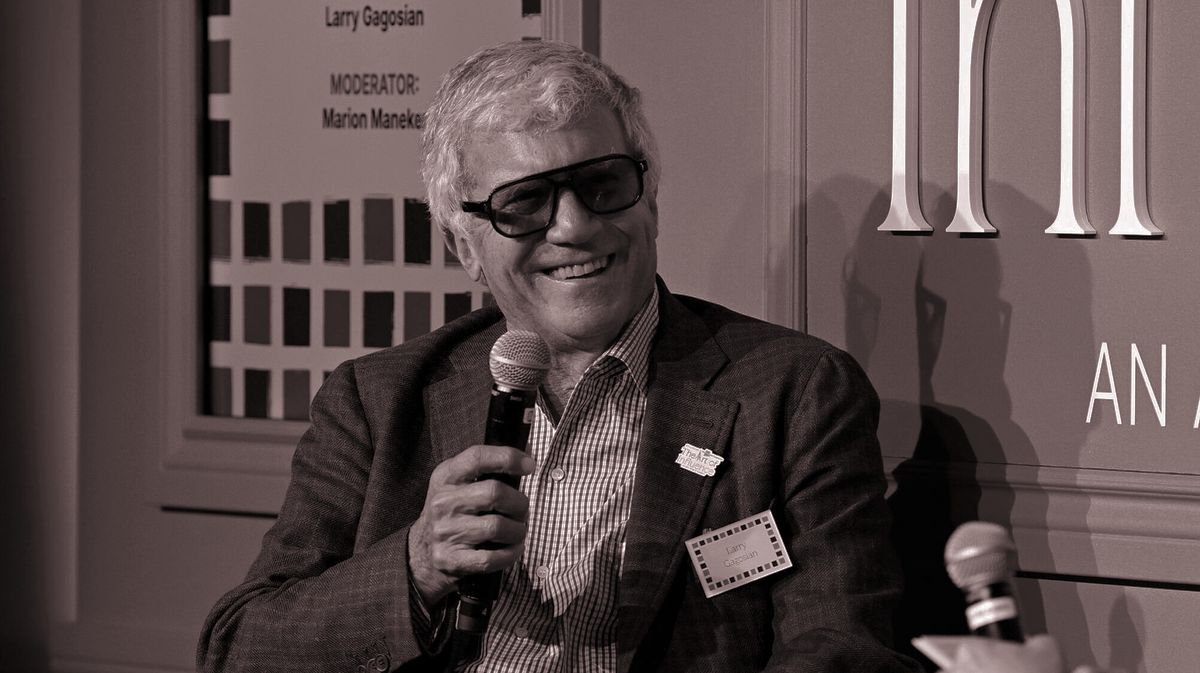
obsession: where Larry Gagosian got his sunglasses. I’m Marion Maneker.
Tonight, I’m going to bring you inside The Art of Influence, our summit with the FLAG Art Foundation that gathered some of the leading figures in the art world. Over the next few months, I’ll be publishing excerpts from the panels and interviews for those of you who could not attend. Inner Circle subscribers will also get direct access to videos of each panel and
interview.
First up, Gagosian gives us his take on the current market slump and what it will take to snap out of it.
Let’s get started…
|
- Larry’s look: The sunglasses that Gagosian wore during his interview at The Art of Influence were Jacques Marie Mage’s Evans model in superlight green with personalized lenses, and we know this because the couple who gave them to him told me so last night. (Thank you!) They will receive a status-defining Puck hat, as will the astute and fashionable reader who identified the make and model, which is sadly sold out. (You can
get notified if it comes back in stock). The rest of you had some great guesses, including a custom eyeglass maker I may visit for myself. Thanks for playing.
- A little more on this: I know we’re all just having fun tracking down a pair of sunglasses, but it does point to something important: the power of community. Wall Power aspires to provide our
readers with actionable information that benefits all our members and, I hope, the broader art world. Please keep your questions, observations, and ideas coming—they really help, and I promise to be an honest broker with the information. You can always reach me by replying to this newsletter or contacting me at +1 917.825.1391 on WhatsApp, Signal, and SMS. I’ll be heading to Scotland, London, and Paris in the coming weeks. If you have suggestions for museum and gallery shows, let me know. (Food
and drink recommendations are always welcome, too.)
|
|
|
A MESSAGE FROM OUR SPONSOR
|
Have you planned for the future of your art collection?
Explore our guide for valuing, appraising and transferring your art collection to ensure the
pieces you spent decades collecting live on as you intended.
|
|
|
-
Speaking of help from the community: My friend Josh Baer was quick to point out that I got some of the facts around Richard Prince’s Spiritual America incorrect yesterday. The image of Brooke Shields is from a series of photographs taken by Garry Gross, not a still from Louis Malle’s Pretty Baby. I was relying on my memory and should have checked. Josh said the image is “the
single most important work of that entire generation.” I wouldn’t argue with that, and it’s another great reason to see the Lévy Gorvy Dayan show Downtown/Uptown: New York in the Eighties.
- Marina Abramović celebrates her 80th birthday in Venice: The Gallerie dell’Accademia in Venice announced that it will present Marina Abramović: Transforming Energy during the 61st Venice Biennale. The exhibition is curated by Shai
Baitel “in close collaboration with the artist.” Abramović has created a series of interactive Transitory Objects (stone beds and structures embedded with crystals) that visitors will be invited to lie, sit, or stand on—thus, according to the press release, “activating what Abramović calls ‘energy transmission.’” The show will include projections of the artist’s early performances in addition to works like Imponderabilia (1977), Rhythm 0
(1974), Light/Dark (1977), Balkan Baroque (1997), and Carrying the Skeleton (2008), as well as Pietà (with Ulay) (1983), “placed in direct dialogue with” Titian’s Pietà.
- Christie’s announces massive Yves Klein for Paris: The star of Christie’s Paris sale of contemporary art will be Yves Klein’s 13-foot-wide expanse of International Klein Blue titled
California (IKB 71), from 1961. The work was on view at The Metropolitan from 2005 to 2008, and comes from an American collector. The estimate for the work is unpublished, but Christie’s expects it to sell for $20 million.
|
Now, let’s get to the main event…
|
|
|
The legendary art dealer is feeling optimistic about the market, notwithstanding
its current difficulties. During a candid chat at Puck’s Art of Influence conference, he discussed the slow but broadening market, working with Jeff Koons, why everything has a price, and more.
|
|
|
Tough art markets don’t last, but tough dealers do, and I cannot think of a fiercer
operator than Larry Gagosian. Arriving in New York in the 1980s with a “combination of charm, chutzpah, good looks, and great instinct,” in the words of curator Jared Quinton, he reshaped the art world by being direct. In 1984, he cold-called the prominent collectors Burton and Emily Tremaine, who had a
Brice Marden painting that Gagosian wanted to buy for a client, without even knowing if the work was for sale. Years later, Gagosian would tell an interviewer that he liked “an assignment.” He made the deal.
Gagosian’s timing was fortuitous. The Tremaines had a huge collection of art but recent bad experience with museum donations; they were also pleased that the then-booming market for 20th century art “seemed to validate their tastes and investing savvy,” as Quinton
wrote, and, unbeknownst to Gagosian, they were “eager to liquidate their assets.” The cold call led to a lucrative relationship in which the dealer made “dozens more” sales for the couple over the next few years before the rest of their collection went to auction, per Quinton.
|
|
|
A MESSAGE FROM OUR SPONSOR
|
Have you planned for the future of your art collection?
Explore our guide for valuing, appraising and transferring your art collection to ensure the
pieces you spent decades collecting live on as you intended.
|
|
|
Of course, the ’80s boom would end with the dark, fallow period of the early 1990s. Since then, the
art market has experienced various peaks and valleys, including the drop that followed the September 11 terrorist attacks, the 2007 zenith before the fall of the global financial crisis, the later highs of 2014-2015 and 2022, and the dips between. But Gagosian grew his business throughout, with 18 galleries around the world, and a dominant position in the secondary market.
With this in mind, I asked Gagosian to give me his sense of the art market today. What follows is the related portion
of our recent interview at Puck’s Art of Influence summit in Midtown—we’ll have more on how Gagosian thinks about his business another time. This portion of the interview has been lightly edited for clarity.
|
“Things
Are Starting to Improve”
|
Marion Maneker: What’s different now in the art
market?
Larry Gagosian: We’re going through a kind of art recession. That’s probably the simplest way to describe it. Prices have come down for a lot of historical works, as well as living artists. And volume has come down. Auction houses are feeling quite a bit of pain. This is a normal cycle; to me, it’s nothing to get terribly alarmed about. It’s more about how you deal with it, because the cycles are unavoidable. Nothing now is even close to what happened in
the early ’90s. The phone didn’t ring; nobody wanted to buy art. I don’t think we’re anywhere near there now. In fact, I think things are starting to improve.
There’s an advantage for a gallery like mine in this kind of auction market, particularly because, notwithstanding the guarantee structure, many collectors are more inclined to sell things privately now, so you’re seeing a lot of very big private sales in the last six months. The problem is, we don’t have the megaphone of the
auction house to trumpet our successes, because we’re supposed to be discreet. The picture isn’t balanced. Also, private galleries and private dealers tend to be a little more nimble, and they can adjust more easily than a company that has 2,000 employees. That’s something I wouldn’t want to be in the middle of.
The other big issue in the primary market is that prices have gone up substantially. There are a lot of artists whose primary prices are higher than their secondary sales.
What’s the way out of that situation?
There’s this thing that pricing is somehow sacrosanct, and that you can’t lower a primary price, because it’s some sort of sign of defeat. That doesn’t make sense to me. It’s like any market—you have to adjust, and you try to do it in an intelligent way that preserves the value of the artists. But you can’t just levitate prices and hope they stay at that level. Those conversations, particularly now, come up more often.
|
|
|
Is there a region where you’re beginning to see activity that may build the momentum of the
market?
Statistically, two-thirds of the art market is U.S.-based. I’ll say that China is still pretty active. They haven’t totally gone to sleep. The Middle East is tricky to understand for various reasons, and European collectors have become more active in the last couple of years, even in the downturn. That’s one of the good stories about the art market—even though it’s down, it’s broadened. At the same time, there are new people interested in art, collecting art, building
museums, etcetera. So I’m pretty optimistic.
|
“Everything
Does Have a Price”
|
There’s a lot of cheap art being sold. There’s a lot of interest in art, but
there’s always this question about works in the $5 million–$10 million range.
Masterpieces seem to be relatively unaffected by this. If there’s something really, really great, really exceptional, the market hasn’t gone down much. I think the middle of the market is probably the most vulnerable right now, and younger artists that are less expensive, not so much. I don’t have data on that, but anecdotally, that’s my sense of it.
Is your sense that owners of those
masterpieces just don’t need the money and have no good reason to sell?
Well, they may not want to sell for $100 million; they might want to sell for $300 million. Everything does have a price. Things you thought would never come on the market, when the right person knocks on the door, it could change.
You’ve recently announced that you’re working with Jeff Koons again. How do you plan to approach that?
I think Jeff is a transformative,
once-in-a-generation artist. I certainly would not bet against Jeff Koons. He’s a visionary artist, he’s an ambitious artist. We’re going to be showing new work by Jeff in November in Chelsea. It’s a very, very exciting body of work. That’s what all artists have to do to buck the moment: Make great work that gets people’s attention.
One of the things I told artists is, I know things are kind of crappy right now, but if you do really great work, the best work you can
make, you’ll find that the market is more receptive than you might’ve feared. I think Jeff is certainly in that category. I understand the market has gone down for Jeff’s works, but people will still pay good money for Jeff Koons.
|
I do want to thank Larry for taking the time to appear at our event. It was a real pleasure to be
able to interview him.
I hope you all enjoyed it. We will be back to you again on Friday.
M
|
|
|
The ultimate fashion industry bible, offering incisive reportage on all aspects of the business and its biggest
players. Anchored by preeminent fashion journalist Lauren Sherman, Line Sheet also features veteran reporter Rachel Strugatz, who delivers unparalleled intel on what’s happening in the beauty industry, and Sarah Shapiro, a longtime retail strategist who writes about e-commerce, brick-and-mortar, D.T.C., and more.
|
|
|
Finally, a media podcast about what’s actually happening in the media—not the oversanitized,
legal-and-standards-approved version you read online. Join Dylan Byers, Puck’s veteran media reporter, as he sits down with TV personalities, moguls, pundits, and industry executives for raw, honest, sometimes salacious conversations about the business of media and its biggest egos. New episodes publish every Tuesday and Friday.
|
|
|
Need help? Review our FAQ page or contact us for assistance. For brand partnerships, email ads@puck.news.
You received this email because you signed up to receive emails from Puck, or as part of your Puck account associated with {{customer.email}}. To stop receiving this newsletter and/or manage all your email preferences, click here.
|
Puck is published by Heat Media LLC. 107 Greenwich St, New York, NY 10006
|
|
|
|