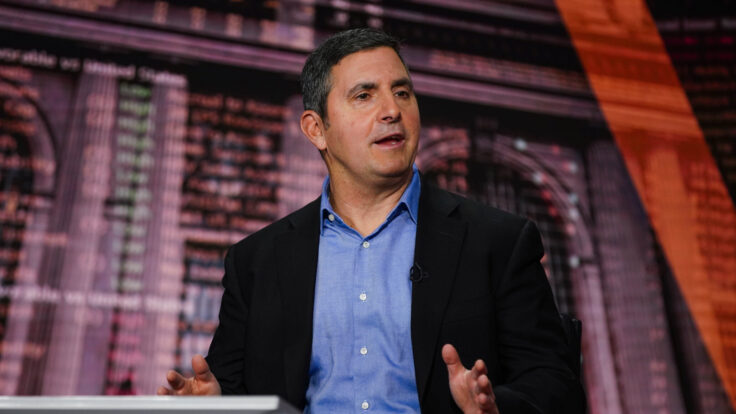
Welcome to Dry Powder. I’m Bill Cohan.
When last I checked in with
Jim Chanos, the affable short-seller was ruminating about Michael Saylor’s latest half-billion-dollar purchase of Bitcoins and why investors were valuing his company, MicroStrategy, at such a substantial premium to the value of the Bitcoin on its balance sheet. True to form, perhaps, Chanos had shorted Strategy while buying Bitcoin, sparking a lively back-and-forth with Saylor in separate appearances on Bloomberg TV.
Now, Chanos is firing
spitballs again, raising questions about whether Meta’s latest quarterly report is overstating the shelf life of its A.I. chips—thus inflating its net income and, by extension, its market valuation. My conversation with Chanos, from his boat in the Mediterranean, is below the fold.
But first… |
- Figma’s
Icarus syndrome…: Well, well, quelle surprise, the Figma stock is already coming back down to—perhaps not Earth, but maybe the moon? After the stock popped 345 percent, from $33 to $147 on the day of its I.P.O., last Thursday, it’s now down nearly 40 percent, to around $89 per share. Notably, the stock managed to tumble some 22 percent on Monday, while the broader stock indices were soaring. So who got singed? The usual suspects, of course: retail investors who tried to
hop on the hot I.P.O. gravy train on Friday, only to watch it derail this week.
Why retail investors never learn this painful lesson is an existential question I’ve been grappling with for the past 40 years or so. The Wall Street investment banks that underwrite these securities get paid to hype them, and then sell them. And in the A.I. era, it seems like tech I.P.O.s are only getting easier to hype, and then to sell.
That Figma prospectus was practically a work of
art—chock-a-block with fancy, colorful graphics to complement the boring financial data and disclosure requirements—but it’s all in the service of hyping and selling. Because let’s face it: A first-day pop of 345 percent is just inexcusable and prima facie evidence of a wholesale failure by the underwriters to understand the market. And now, for the retail crowd, it’s already time for the comeuppance. I guess, in a sense, the Wall Street underwriting game is a bit like
democracy itself: the worst form of government—except for all the others. Sheesh. - Trump’s war on the banks: As I suspected when Trump launched his executive order jihad against several Wall Street law firms, he’s now planning to turn his poison pen on the big investment banks, calling out both JPMorgan Chase and Bank of America for their alleged bias against “conservative” customers. More personally, he doesn’t like these banks
because, he claims, they wouldn’t take his money, especially in the wake of January 6. “I had hundreds of millions. I had many, many accounts loaded up with cash, … and they told me, ‘I’m sorry, sir, we can’t have you. You have 20 days to get out’ … of Chase Manhattan,” he told CNBC on Tuesday morning. “That’s Jamie and JPMorgan Chase.”
Trump then claimed that he tried to move his money to Bank of America, but they wouldn’t take it, either. Trump said
Brian Moynihan, the C.E.O. of Bank of America, “was kissing my ass when I was president, and when I called him after I was president to deposit a billion dollars plus, and a lot of other things, more importantly to open accounts, which banks always like, … he said, ‘We can’t do it.’”
Supposedly, Trump will be issuing an executive order that targets the two banks. However, if he’s looking for retribution against Wall Street banks that stopped doing
business with him, he’ll have to target pretty much all of them, since, as I documented in this 2013 piece in The Atlantic, pretty much all of them stopped doing business with him before he became president. Only Deutsche Bank continued to lend money to him, at least up until the January 6 insurrection. Is Trump serious
about going after Wall Street because it abandoned him after something like six of his companies went bankrupt, or is this just another Epstein distraction? We’re about to find out.
|
Now on to the main event… |
|
|
The storied short seller has recently been focused on Bitcoin and MicroStrategy, but he’s
increasingly turning his attention to the hyperscalers—the tech companies currently spending hundreds of billions on A.I. infrastructure. And though he isn’t shorting Meta, he told me from the yacht that he had some concerns about its lofty valuation. |
|
|
Jim Chanos, the long-admired short-seller, was on a boat in the Mediterranean when I called
him earlier this week, shortly after Meta delivered another gangbusters earnings report. Other investors were practically euphoric: Meta’s quarterly revenue had grown 22 percent year over year, to $47.52 billion, fueled by surprisingly robust advertising income. The stock is now up some 30 percent so far in 2025, and Meta’s market capitalization is closing in on $2 trillion, boosting Mark Zuckerberg’s net worth to more than $260 billion. Pretty much everyone, it
seems, was hailing Zuckerberg as a genius for his timely pivot toward A.I.
Chanos, as I have written, currently spends a bunch of his time shorting MicroStrategy, which he believes is overvalued, while simultaneously being long Bitcoin, its principal asset. But he’s also become interested in Meta, although he has no economic stake in the company. And even
though he was enjoying some R&R on the high seas, Chanos was happy to talk about his evolving views on the company, now the sixth largest in the world by market capitalization.
In particular, Chanos told me, he has a significant accounting concern. He questioned whether Meta’s depreciation schedule for its massive program of capital spending—primarily on Nvidia A.I. chips—was overstating the company’s net income, and thus, arguendo, inflating its market valuation. In other words,
Chanos posited, Meta’s stock could be overdue for a serious correction.
Not to get too technical here—although you guys can handle it—but the idea behind depreciation is to indicate in corporate financial statements how long an asset will have a useful life to the company. For instance, say a company buys some big new piece of factory equipment for $25 million. It’s not unreasonable—and reasonableness is a standard here—to designate that equipment as having a 10-year
shelf life. Therefore, you’d capitalize the $25 million purchase on the balance sheet, and then depreciate the value of the asset over its lifetime, taking an annual $2.5 million expense through the income statement for the next 10 years. But if an asset will lose its usefulness in two to three years, as could be the case with Nvidia A.I. chips, depreciating those assets over a longer period of time would mean that expenses on the income statement may be too low—and profits, therefore,
too high.
Last week, Chanos observed on X that Meta’s depreciable life on its capital base was 11-12 years, as of the second quarter. But “if the true economic life on its G.P.U.s”—those Nvidia chips—“is actually 2-3 years, most of its ‘profits’ are materially overstated.” (This is not investment advice, but materially overstated is not a good look.) Chanos went on
to note that Meta increased its capital base from $145 billion in the second quarter of 2024 to $210 billion in the second quarter of 2025, but the annualized increase in depreciation and amortization was “only $2.8 billion.” His annualized calculation was based on the $700 million increase in depreciation from the second quarter of 2024 ($3.6 billion) to the second quarter of 2025 ($4.3 billion). “That’s 22-year-life, on the margin,” he wrote. “Whatever you think of the stock price
here—that’s patently absurd.” |
“I Have
Some Issues With What Jim Chanos Is Saying…”
|
The immense scale of the tech industry’s investments in A.I. can be hard to contextualize. As my new Puck
partner Ian Krietzberg noted yesterday, all the major hyperscalers—including Meta, Google, Amazon, and Microsoft—are now devoting absolutely mind-boggling amounts of resources to A.I., with as much as $360 billion in total expenditures expected this year. Building and running data centers isn’t cheap, after all, nor are the tens of thousands of
GPUs each one requires. Nvidia’s new Blackwell chips, for instance, are expected to cost between $30,000 and $40,000 apiece.
When Chanos and I connected, via his boat’s Starlink, he pointed me to Meta’s first-quarter filings with the S.E.C.—the second-quarter report hasn’t been filed yet—which suggests that A.I. chips accounted for 85
percent of Meta’s new spending on “property, plant, and equipment,” as indicated by a $7.5 billion increase in “servers and network assets” and a $5.6 billion increase in “construction in progress” costs—“mostly related,” per Meta, to data centers and related network infrastructure. “Accounting is not something that tech investors spend a lot of time on, for generally good reasons,” Chanos told me. “But the numbers now are getting so large that I just think investors need to kind of understand
that if the hyperscalers are depreciating their assets over extended periods of time, relative to the economic life of those assets, then by definition they’re overstating their earnings.”
Nvidia C.E.O. Jensen Huang has been boasting that the company’s new A.I. chips are now coming out on a one-year cycle, Chanos noted, rendering older G.P.U.s relatively obsolete, relatively quickly—a trend evidenced by the falling rates at which third parties are renting out
their older Nvidia chips, which Chanos is tracking closely. “It’s plummeting,” he said, indicating to him, anyway, that the A.I. chips need to be written off over two to three years, not five to six years. “The whole thing wasn’t material two years ago,” he continued, “but it will certainly be material two years from now, and probably is material as we speak. If Meta was depreciating their assets over Jensen Huang’s chip life, they would have no earnings. And now it’s not quite that bad. But
that’s the problem.”
The good folks at Meta, of course, think Chanos is crazy. “I have some issues with what Jim Chanos is saying, and some factual inaccuracies,” Ashley Zandy, a senior director in corporate communications at Meta, told me in an emailed. She urged me not to rely on third-party observations about Meta’s financial judgments and instead pointed me to a footnote in the first-quarter 10-Q, and comments made during the first-quarter earnings call—neither of
which, alas, addressed the concerns that Chanos raised about the pace of Meta’s depreciation schedule and how it might be impacting company earnings. When I asked if Meta would like to respond to Chanos’s specific criticisms, Zandy demurred. “We will decline to comment beyond our public filings,” she wrote. |
Chanos, ever the contrarian, insisted that investors should be attributing a lower multiple to Meta’s
earnings. “I don’t know if it’s going to be resolved by massive writedowns, or what the case might be,” he said, “but one of the ways we can see it actually affecting the business in real time is that free cashflow margins, and actual free cashflows, are beginning to deteriorate. The other sort of interesting observation, as an old guy here, is that these were great software businesses that just gushed huge amounts of cash onto their financial statements—and now they’re becoming the most
capital-intensive businesses in the world. They look like the old frackers or auto companies.”
He likened the boom in A.I. chips, and the valuations of the companies that make them and use them, to the boom that occurred a generation ago in the infrastructure companies that built out the internet, and what happened when the spending spigots shut off. He said it’s important to remember that while, say, Meta, is expensing these chips relatively slowly, as compared to their useful life,
Nvidia is taking the sale of these chips into its revenue and profits all at once. “In terms of the cycle itself, you get a mismatch of dollars, disproportionately benefiting profits to a certain small number of companies,” Chanos said. “In 1999 and 2000, it was the Ciscos and Nortels and Lucents. Today it’s Nvidia. So [Nvidia] gets to book revenues and profits. Meta and Microsoft and Amazon get to capitalize a lot of that spending.”
Chanos wouldn’t offer any predictions about how this
crazy cycle will end, but he’s seen these movies before. And as a short seller, he figures he knows a top when he sees one. “Nobody’s worried about this stuff now,” he told me. “But they should be.” |
|
|
Join Puck’s chief political columnist, John Heilemann, as he roams the corridors of power and influence in America on this
twice-weekly interview show, taking you beyond the headlines with the people who shape our culture: icons and up-and-comers, incumbents and insurgents, moguls and machers in the overlapping worlds of politics, entertainment, tech, business, sports, media, and beyond. The conversations are rich and revealing, unrehearsed and unexpected… and reliably impolitic. A Puck-Audacy joint, new episodes drop every Wednesday and Friday. |
|
|
Puck’s daily political newsletter from Washington on what’s really happening in this town, from the White House to the Pentagon
to Capitol Hill, K Street, and the campaign trail. |
|
|
Need help? Review our FAQ page or contact us for assistance. For brand partnerships, email ads@puck.news. You received this email because you signed up to receive emails from Puck, or as part of your Puck account associated with {{customer.email}}. To stop receiving this newsletter and/or manage all your email preferences, click here. |
Puck is published by Heat Media LLC. 107 Greenwich St, New York, NY 10006 |
|
|
|