Hello and welcome back to The Best & The Brightest. I’m Leigh Ann Caldwell,
recovering from the Lumineers concert last night at Nats Park. It was a good show, though I wish opener Vance Joy would have mixed up his set from his own tour last year.
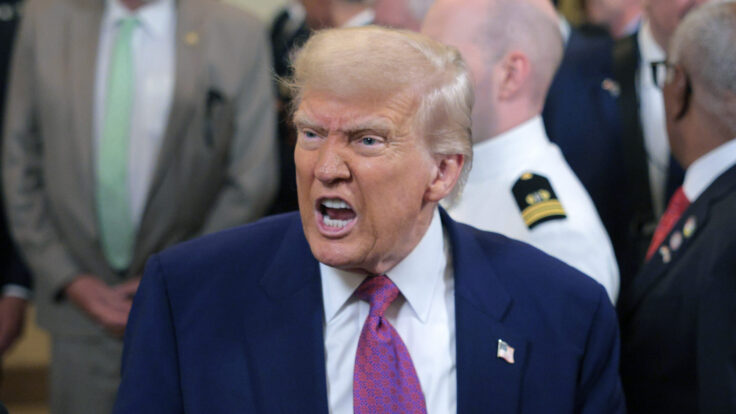
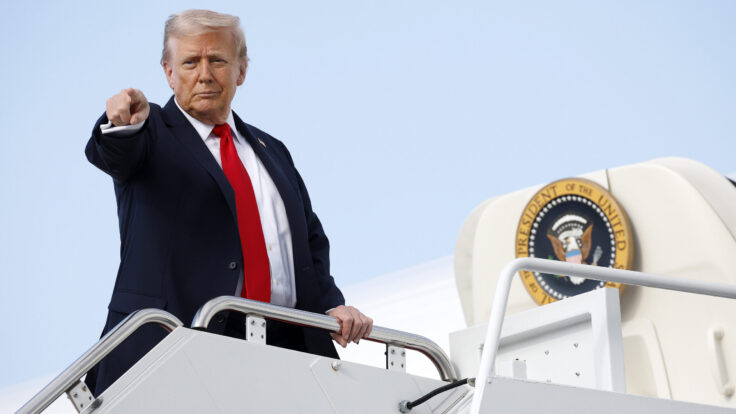
At Arthur Ashe Stadium, 240 miles north of me, President Donald Trump attended his first U.S. Open match since 2015. My partner Dylan Byers, who was sitting courtside, told me that there were cheers peppered in with loud boos when Trump appeared on the big screen before
the match. In other news, Maryland Gov. Wes Moore said he won’t seek the White House in 2028. “I’m not running for president,” he said on Meet the Press. It’s notable because he was so definitive. We’ll see if that sticks.
Also, if you missed my partner Abby Livingston’s event with House Agriculture Chairman Glenn “GT” Thompson last week in D.C., presented by the Modern Ag Alliance, you can read a lightly edited
transcript of their conversation here—or listen to it on this special Saturday episode of The Powers That Be.
In today’s column, a closer look at the D.C. and Silicon Valley factions
within the A.I. world and how those divisions are trying to influence Trump, Congress, and public opinion about the future of A.I.
But first… |
- The
Texas two-step: With the Texas Republican primary race tightening between incumbent Sen. John Cornyn and state Attorney General Ken Paxton, the National Republican Senatorial Committee has issued a scathing memo urging Texas Rep. Wesley Hunt, who’s been flirting with a run of his own, to end his “vanity project” and back Cornyn. “Wesley Hunt continues to cling to the false narrative he pushed as a justification for his own
ambitions,” reads the memo, which was first reported by The Hill. “There never was and never will be a tenable pathway for Hunt.”
The Texas race continues to be a headache for Senate Republicans, most if not all of whom support Cornyn. Paxton and Cornyn hate each other, for starters. The
scandal-ridden Paxton is popular with the base, although Trump has declined to endorse either candidate, and might not ever do so. Meanwhile, Hunt has been sitting on the sidelines, taking advantage of the chaos, while pushing the narrative that he is the unicorn candidate who can win a primary and a general election. The N.R.S.C. had clearly had enough. When I asked a Republican operative close to the Paxton operation what they thought about the new memo, this person texted: “It’s
working out perfectly right now in Paxton’s favor. Team Cornyn has convinced themselves they can win a heads-up (they can’t).
|
|
|
A MESSAGE FROM OUR SPONSOR |
Millions of Americans rely on the health care tax credit to afford their coverage, but it’s set to expire this year.
Without action from Congress, families across the country could see their health care costs skyrocket. Congress: Extend the health care tax credit or families will lose coverage.
Understand the impact if it expires.
|
|
|
- The
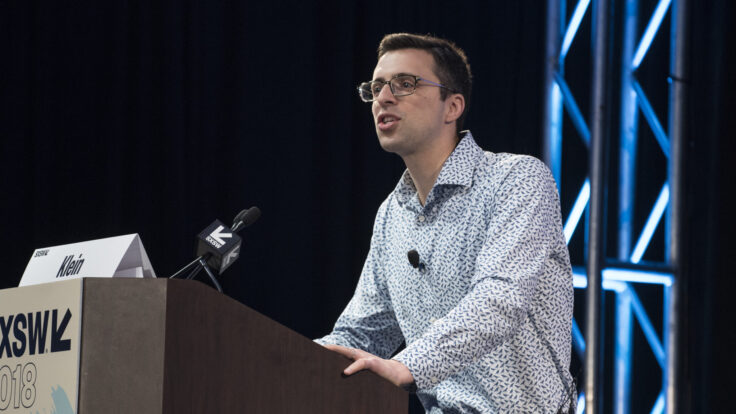
Ezra effect: New York Times columnist and podcaster Ezra Klein had a two-page spread on Sunday encouraging Senate Democrats to consider shutting down the government when funding ends on September 30. It’s a provocative call to action for a party that is still working through its political strategy ahead of the September 30 funding deadline. Notably, Klein has considerable sway with Democrats in Washington, especially after he was one of the
first major liberal pundits to call on Biden to end his reelection campaign. More recently, his new book with co-author Derek Thompson, Abundance, has been adopted by Democrats as a blueprint for how to make government work again.
In his column, Klein presented a scorching indictment of Trump’s expansion
of presidential powers, corruption, and abuse of law enforcement, and argued that Democrats shouldn’t fund any of it. “I’m not going to tell you I am absolutely sure Democrats should shut the government down. I’m not. At the same time, joining Republicans to fund this government is worse than failing at opposition. It’s complicity. If there’s a better plan than a shutdown, great. But if the plan is still nothing, then Democrats need new leaders.” It’s sure to be a topic of conversation among
Democrats this week.
|
|
|
Washington remains divided between Trump-adjacent Silicon Valley accelerationists who want
to advance A.I. at all costs, and skeptical lawmakers from both parties, who warn of unforeseen risks, ranging from copyright theft to national security threats. |
|
|
On Thursday night, some two dozen tech leaders crowded around a long table in the White House state dining
room to lay out how their investments in A.I.—erecting data centers, semiconductor factories, nuclear power plants, etcetera—were helping to make America great again. Apple C.E.O. Tim Cook said his company planned to invest $600 billion in the U.S., while profusely thanking Trump for his leadership. Mark Zuckerberg, who was seated next to the president, quickly matched that number, saying Meta would spend “at least $600 billion through
’28 in the U.S.” Trump, beaming, responded to praise from OpenAI president Greg Brockman by saying he couldn’t believe they were all building “the biggest buildings ever.”
The dinner was performative, of course, but the Trump administration’s excitement about the A.I. industry is very real. Since his first day in office, when Trump arranged Cook, Zuckerberg, Jeff Bezos, Elon Musk, Google’s Sundar Pichai, and OpenAI’s
Sam Altman behind the dais at his inauguration, the president has leaned on Silicon Valley to support his vision for A.I. as the cornerstone of a manufacturing renaissance in the U.S. and a geopolitical weapon against China. In his first major overseas trip—with Musk, Altman, IBM’s Arvind Krishna, and Nvidia’s Jensen Huang in tow—he declared that he’d secured pledges for hundreds of billions of dollars’ worth of A.I. partnerships with Saudi
Arabia, the U.A.E., and Qatar. In July, the White House released its much-anticipated “A.I. Action Plan”—a document that, as my partner Ian Krietzberg reported at the time, was loaded with Silicon Valley talking points and closely mirrored OpenAI’s own proposal for minimal regulation on the industry.
During the legislative battle over the One Big
Beautiful Bill Act, Republicans clashed repeatedly over a provision, inserted at the urging of the White House and championed by Ted Cruz, that would have blocked states from regulating A.I. for a decade. But Cruz’s Republican colleagues in the Senate, led by Marsha Blackburn and Josh Hawley, rebelled; the provision was watered down to a five-year moratorium, and then scrapped altogether. |
|
|
A MESSAGE FROM OUR SPONSOR |
Millions of Americans rely on the health care tax credit to afford their coverage, but it’s set to expire this year.
Without action from Congress, families across the country could see their health care costs skyrocket. Congress: Extend the health care tax credit or families will lose coverage.
Understand the impact if it expires.
|
|
|
Hawley, who has been a particularly vocal critic of A.I. companies training their models on copyrighted
material without permission, has introduced legislation to enable artists to sue. Blackburn, meanwhile, has raised concerns about the potential exploitation of children, and Chuck Grassley has introduced a bill to protect whistleblowers in the A.I. industry who report on security failures. Marco Rubio has complained about A.I. deepfakes, even as the president has posted multiple deepfakes himself, including an A.I.-generated video showing Barack
Obama being arrested by the F.B.I.
Not surprisingly, the president’s strong support for the A.I. industry appears to be driven more by short-term political opportunism than by principle. Earlier this year, Trump was dead set against Nvidia selling chips to China due to purported national security concerns. But after meeting with Huang in July, Trump changed his tune—announcing that Nvidia could sell its H20 chips to China after all. A few weeks later, Nvidia and AMD agreed to
share 15 percent of their revenues from chip sales to China with the U.S. government, in what might amount to an unconstitutional export tax. In early August, Trump called on the C.E.O. of Intel to resign, claiming Lip-Bu Tan was compromised by his ties to China; a few days later, he reversed himself, declared Tan a “success,” and announced that the U.S. government would take a 10 percent equity stake in his company.
The high stakes surrounding A.I. export controls remain
unresolved and, according to many experts, at an inflection point. In May, Trump halted implementation of the Biden administration’s Diffusion Rule, which was designed to place tighter export controls on A.I. models and chips, and essentially block exports of the technology to Russia and China. The White House has promised a replacement, but I’m told by multiple sources that there’s been no consensus on what it should look like. In any case, if Trump’s glowing
response to the latest display of Big Tech genuflection is any indication, Silicon Valley has every reason to believe that business under this administration will be good. |
The president’s reversal on semiconductor export controls reflected the shifting balance of power among
well-funded factions of the A.I. world to influence government policy. Under Biden, the most prominent thought leaders in the A.I. world tended to be cautious, safety-first types. Washington was under the sway of the Effective Altruist movement, whose proponents focused on pragmatic steps to achieve what they saw as the maximal human good—including pouring money into efforts to prevent low-probability existential disasters, like pandemics or machine superintelligence that decides it’s better off
without people. (Sam Bankman-Fried, the now imprisoned crypto billionaire, was among its biggest advocates.)
Other major donors included Dustin Moskovitz and Cari Tuna, the tech power couple behind Open Philanthropy, which gave more than $100 million to groups with ties to Effective Altruism, including the Center for Security and Emerging Technology at Georgetown. In 2021, Vitalik Buterin, co-founder of the cryptocurrency
Ethereum, gave $665 million to the Future of Life Institute, a nonprofit focused on reducing A.I. risks to the human race.
Until Trump came into office, the tentacles of the E.A. movement reached far and wide, influencing A.I. policy thinking across Capitol Hill. The Horizon Institute for Public Service, for example, has placed altruism-focused fellows in more than a dozen key congressional offices, providing free expertise in the offices of Republican Sens. Mike Rounds
and Jim Banks, and Democratic Sens. Brian Schatz, Richard Blumenthal, and Martin Heinrich. Fellows also serve in the Defense and Commerce departments and other federal agencies. Rand Corporation C.E.O. Jason Matheny, a former Biden advisor on tech and national security who sits on Horizon’s board and is a founder of Georgetown’s A.I. institute, has been a particularly effective advocate for steering
government A.I. policy toward E.A. principles. Back in 2017, in a speech hosted by the Effective Altruism website, Matheny boasted that even “fairly junior positions across government … have a potential for high impact.”
But the dawn of Trump’s second term, which coincided with major advancements in A.I. models, has caused a sea change in Washington. Sure, there are still Silicon Valley luminaries who are concerned about sci-fi existential threats. Former Google C.E.O. Eric
Schmidt and Dan Hendrycks, the director of the Center for A.I. Safety, wrote a study and a recent Time piece arguing that A.I. is “perhaps the most geopolitically precarious technology since the atomic bomb.” But the safety-first cohort has lately been eclipsed by the so-called accelerationists. Altman and Musk, who originally
co-founded OpenAI because of their shared concern over the dangers of A.I., are now racing to build more powerful models with fewer safeguards. There’s simply too much money on the line not to move fast and, potentially, break things. |
|
|
In just the last few weeks, investors have pledged as much as $200 million to fund two new super PACs, one
backed by Meta and the other by Brockman and Andreessen Horowitz, to support candidates friendly to the aggressive development of A.I. The timing couldn’t be more critical, as Congress faces a range of questions relevant to the industry, including oversight of exports, copyright, child safety, energy use, and other environmental impacts. Notably, they appear to be taking a page out of the super PAC playbook recently executed by the crypto industry, which poured well over $130 million into the
2024 elections and has already amassed more than $141 million to deploy this cycle to ensure Capitol Hill is teeming with sympathizers. But, as demonstrated on Thursday night at the White House, perhaps the A.I. industry’s most effective tool is the aura of power, money, and influence surrounding its leaders—and their willingness to flatter the president. |
The Republican Party, while more monolithic than ever, does make room for competing views on A.I. policy,
even within the president’s orbit. On one side are the likes of Vice President J.D. Vance, crypto and A.I. czar David Sacks, and Michael Kratsios, director of the White House Office of Science and Technology Policy, who want to incinerate red tape. But they’ve run into opposition from populist Trump allies like Rep. Marjorie Taylor Greene, a huge critic of A.I. who has repeatedly expressed concerns about the impact it could have
on jobs and young people entering the workforce. Steve Bannon, the populist voice of MAGA, helped kill the state regulation moratorium by riling up his followers on his War Room podcast. Bannon has
characterized A.I. as borderline demonic—a technology that could usher in the “most radical transformation in all human history” and “must be stopped.”
Then there are the China hawks, some of whom want domestic guardrails around A.I., but who are particularly concerned by the prospect of exporting advanced technologies
to China, worried that that the country will gain and eventually surpass U.S. A.I. capabilities on the backs of our innovation. They include Sen. Tom Cotton, the chair of the Senate Intelligence Committee, as well as House China Committee chairman John Moolenaar and Foreign Affairs Committee member Bill Huizenga, who has introduced the Chips Security Act to prevent the smuggling of U.S. chips. “The Biden folks had a more kind of centrist
approach, a more unified approach to it, and you didn't have these two very diametrically opposed factions on A.I. that you see in the Trump administration,” said former Democratic congressman Brad Carson, co-founder and president of Americans for Responsible Innovation, a nonprofit working to steer A.I. policy in the public interest. “There’s a lot of debate internally about export controls, as well as A.I.”
Nvidia is pushing back against the Chips Security Act, arguing
that smuggling isn’t an issue, and that inserting so-called kill switches in chips that remotely make them inoperable if they are used for illicit purposes—is unrealistic and unnecessary. Co-sponsors of the bill call that argument a red herring and counter that the bill doesn’t require kill switches.
In the absence of clear guidance from the White House, other ideas to track chips are cropping up: Moolenaar has also proposed something called a “rolling technology threshold,”
which would sell China chips that are marginally better than what China can produce on its own. And others in the safety community are calling for China to rent U.S. chips or only have access via the cloud. The fact that there’s still an effort to push for safety parameters around the sale of chips, especially to adversaries, is a sign that the issue is far from settled. And all the lobbying cash will only escalate the division. |
|
|
Join Emmy Award-winning journalist Peter Hamby, along with the team of expert journalists at Puck, as they let you in on the
conversations insiders are having across the four corners of power in America: Wall Street, Washington, Silicon Valley, and Hollywood. Presented in partnership with Audacy, new episodes publish daily, Monday through Friday. |
|
|
Unique and privileged insight into the private conversations taking place inside boardrooms and corner offices up and down Wall
Street, relayed by best-selling author, journalist, and former M&A senior banker William D. Cohan. |
|
|
Need help? Review our FAQ page or contact us for assistance. For brand partnerships, email ads@puck.news. You received this email because you signed up to receive emails from Puck, or as part of your Puck account associated with {{customer.email}}. To stop receiving this newsletter and/or manage all your email preferences,
click here. |
Puck is published by Heat Media LLC. 107 Greenwich St, New York, NY 10006 |
|
|
|



_01K4D79V9948E54329KGAMTMRV.png "BlueCross BlueShield Association")