{{ 'now' | timezone: 'America/New_York' | date: '%b %d, %Y' }} |
|
|
Hello, and welcome back to The Best & The Brightest, your daily political dispatch. It’s foreign
policy Thursday, and I’m Julia Ioffe. I can’t believe it but my book, Motherland, is out in less than a month! Preorders are critical to a book’s success, so if you haven’t done so already, please consider
getting it in hardcover, e-book, or audio, which is narrated by yours truly.
This was a big week, with world leaders converging on New York for the
annual meeting of the U.N. General Assembly, or UNGA as we foreign policy dweebs call it. Lots of ostensibly important things happened—Syria’s president, Ahmed al-Sharaa, a former jihadist, went on a successful charm offensive; a number of countries
joined France in recognizing a Palestinian state; Donald Trump suddenly claimed Ukraine could win back all its territory, if not more. But it was all overshadowed by
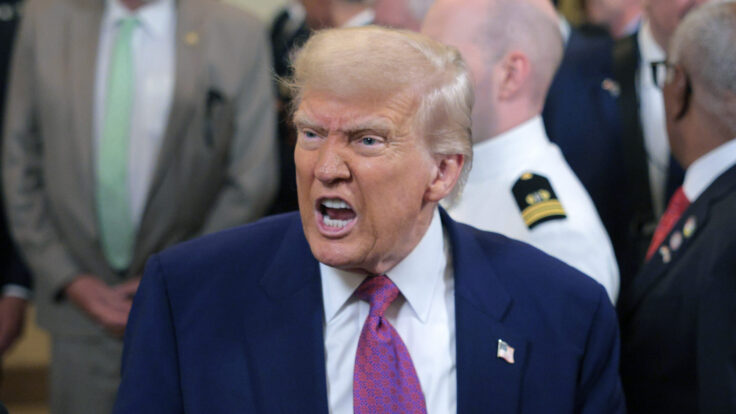
“not one, not two, but three very sinister events” Trump encountered: a broken escalator, a faulty teleprompter, and bad sound in the auditorium. Coincidence—or, as Trump claimed, “triple sabotage”? (Karoline Leavitt, who tipped the
president off to this possibility, called for swift investigations, which showed that it was his own team that was responsible for the infelicities.)
This, of course, sent the NatSec universe into convulsive laughter. “The idea that @UN could even do ‘single sabotage’ is absurd,” Richard Gowan, the U.N.
director at the Crisis Group, tweeted. Coming on the heels of Trump’s batshit speech to the General Assembly—which included him telling the assembled foreign leaders that their countries “are going to hell”—the president’s demand for accountability in escalatorgate doesn’t quite come across as a show of brute force and manly strength. Such thin skin on the leader of the free
world is, let’s face it, unbecoming.
Tonight, though, I want to take you back to the State Department, where America’s career diplomats are increasingly becoming accessories to the Trump administration’s brutal deportation tactics. Let’s just say that this is not what the bleeding hearts at Foggy Bottom signed up for when they took the foreign service exam. |
|
|
A MESSAGE FROM OUR SPONSOR |
Hospitals are here when you need us most – but hospitals across America are at risk of closure. |
|
|
- Our
man in Havana: Back in August, when Lt. Gen. Jeffrey Kruse was fired as the head of the Defense Intelligence Agency, almost everyone
assumed that it was because D.I.A.’s leaked assessment contradicted Trump’s boast that Operation Midnight Hammer had totally “obliterated” Iran’s nuclear program. But a new wrinkle has emerged. Earlier this month, Rep. Rick Crawford, the Republican chair of the House Permanent Select
Committee on Intelligence, said that Kruse was actually fired for his “treatment of A.H.I. victims”—that is, those who experienced the anomalous health incidents, also known as Havana Syndrome, that afflicted U.S. personnel in Cuba and elsewhere. The first to report this news was Catherine
Herridge, a Trump-friendly NatSec journalist who posted a photo of newly released congressional transcripts earlier this week.
Two sources in the I.C. told me that yes, it’s true. “[Kruse] was blocking progress on the investigation and Hegseth had enough of it,” one of them explained. Apparently, Hegseth and D.N.I. Tulsi Gabbard
believe Havana Syndrome is real, that there is a foreign adversary behind it, and—you’ll be shocked to know—that the intelligence assessments issued about it during the Biden administration were faulty.
But this is not just about making the Biden administration look bad. There has always been a
sense among some that the C.I.A.’s assessment, which attributed most A.H.I.s to medical causes, was essentially a cover-up. And for people like Gabbard, who come from the part of the political horseshoe that melts into conspiracy theories, the lure of exposing a deep-state cover-up is pure catnip. I’m told that the administration is serious
about A.H.I.s and there will be more disclosures coming before the end of the year. - Russian oil: For weeks now, Trump has been saying that Europe has to stop buying Russian oil and gas in order for the West to defeat the country. “They have to immediately cease all energy purchases from Russia,” Trump said at UNGA. “Otherwise we are all wasting a lot of time.” I found this curious for several reasons. I’ve
written extensively about how Europe, once Moscow’s largest energy market, ceased buying Russian energy almost immediately after its full-scale invasion of Ukraine. The two big exceptions have always been Slovakia and Hungary, both of which are led by Kremlin-friendly governments but are, nonetheless, minor customers. Turkey, which is in NATO, is a big buyer, but it’s not an E.U.
country.
Had I missed something? I called Dan Yergin, the world’s preeminent expert on the topic and Bill Cohan’s annual interlocutor. “The volumes [of Russian oil sold to Europe] have gone down dramatically; Russia has lost its biggest market,” he told me as he sat on the tarmac, headed for a conference. Same deal with gas. “The biggest
beneficiary is L.N.G. [liquified natural gas], and the biggest supplier of L.N.G. to Europe is the U.S.,” Yergin explained. “Shale gas has really come to the rescue.” There’s still a little dribble left coming from Russia, Yergin said: Forty percent of Europe’s gas is L.N.G., and 15 percent of that is from Russia. “But basically they have put in place regulations that would
make Russian L.N.G. completely illegal by 2026,” he said.
So what was Trump talking about? “Oh, you’ll have to ask Angela,” Yergin said, passing the phone to his wife, Angela Stent, a former U.S. intelligence officer, a veteran Russia specialist,
and professor at Georgetown. Stent didn’t mince words. “I think he’s using that as an excuse not to do anything,” she said.
|
And now on to Foggy Bottom… |
|
|
As Trump bends more of the federal government to focus on expelling migrants, the
bleeding-heart foreign service officers of the State Department are finding themselves pulled into a project they never signed up for: deport, deport, deport. |
|
|
On September 5, 14 West African migrants who were being held in an ICE detention facility in Alexandria,
Louisiana, were taken from their cells in the middle of the night. Then, according to a complaint filed in D.C. District Court by five of them, they were put on a military cargo plane bound for Ghana, even though none of them had Ghanaian citizenship or any connections to the country. During the flight, some of them were allegedly forced to sit in straitjackets
for 16 hours and given nothing to eat but bread and water.
When they arrived in Ghana, the complaint continued, they were placed in a squalid military camp just outside Accra, the capital. Several were then deported to their countries of origin, and the rest of the plaintiffs alleged they were told they’d meet the same fate, despite U.S. immigration judges having granted them protections from removal over credible fears they would be tortured in their homelands. In one case, a bisexual
man was returned to the Gambia, in direct violation of those protections, because homosexuality is illegal there and punishable by a life sentence. According to the complaint, the man is now in hiding. |
|
|
A MESSAGE FROM OUR SPONSOR |
Hospitals need your help to stay. Protect 24/7 care—because when the doors close, it is too late. |
|
|
Deporting migrants to a third country is not new. Detainees released from Guantánamo were
often sent to third countries, for example. But the Trump administration has been using the tactic in unprecedented ways. Primarily, it has become a way to get around protections from removal, which are issued by immigration judges when there is a credible fear that a migrant will be tortured or killed if they return home. If D.H.S.
deports someone, but not to the place prohibited by a judge, then they’ve managed to remove the migrant without technically violating the court order.
What the third country then does with the migrants, the Trump administration has claimed in court, is not their business—or in their control. “The United States is not saying that this is okay,” a Justice Department lawyer argued during a hearing for this case. “What the United States is saying is that the United States does not have the power to tell Ghana what to do.” But the judge—none other than Tanya Chutkan, who heard many of the January 6 cases, including Trump’s—wasn’t buying it. She called the practice an “end run” around the court-ordered protections. Still, it appeared to work: A furious Chutkan ultimately
concluded that, given how the Supreme Court has ruled and with the migrants out of the country, she could do little to stop it. |
The other new aspect of these third-country deportations is the ways in which the State Department has been
implicated. In the case of the deportations to Ghana, the complaint alleged that the Trump administration had secured an unwritten agreement with the Ghanaian government, which D.O.J. lawyers confirmed. At a September 12 hearing, they assured Chutkan that the State Department had received “diplomatic assurances” from Ghana that
the deportees “would not be tortured or taken to a place where they would be tortured.” “[T]he United States received a diplomatic note from Ghana indicating that they were going to abide by the international treaties,” the lawyers told the court. “[T]he State Department took this matter and this agreement very seriously.”
The State Department has traditionally negotiated these kinds of agreements through the regional desks at Foggy Bottom, which would then reach out to the law
enforcement attaché at the relevant embassy. Usually, these mutual legal assistance requests, or M.L.A.s, have pertained to extradition requests, spy swaps, and yes, deportations. “But not in these numbers,” said Eric Rubin, a retired career diplomat who until recently was the president of A.F.S.A., the foreign service union.
The White House has demanded that every government agency contribute to its immigration efforts, and more and more State Department employees are
being dragooned into helping the Trump administration, in Stephen Miller’s words, deport, deport, deport. Foggy Bottom’s support has come in several forms. “The biggest piece of it is D.S.,” Rubin said, referring to diplomatic security, which is largely tasked with protecting U.S. embassies and consulates abroad and has a large contingent of military veterans.
A smaller subset of D.S. investigates visa and passport fraud, and it is under this pretext that they
are being roped into helping with deportations. “They are including D.S.—who, by the way, are members of the foreign service—in their raids with ICE,” Rubin said, naming a number of cities, like D.C., New York, Chicago, and L.A., where diplomatic security has an immigration enforcement presence. Other members of the foreign
service, horrified at this development, have been circulating photos from the news where they’ve spotted their D.S. colleagues—who are also masked. |
Meanwhile, at the consular level, foreign service officers in overseas embassies and consulates are being
asked to pull visa records on people who are being rounded up by ICE inside the U.S. “That’s not something the foreign service has ever been asked to do,” Rubin noted. “It’s pretty unprecedented. We have our own role in carrying out immigration law, but not in a domestic enforcement capacity.” |
|
|
Senior foreign service officers have also been roped in. People at the regional bureau level—that is,
officers who specialize in and work on a certain region—are being tasked with focusing solely on deportations to that region, like in the Ghana case. According to one current State Department official familiar with the process, some of these positions are brand new. “Each agency is supposed to give manpower to support these deportations,” the official said. “These positions were created during this administration to support the administration’s efforts to deport people” to regions like Africa
and Latin America.
Deportations have come up in other contexts. In May, Lew Olowski, the colorful head of State’s H.R., told a group of career foreign service officers that they would be viewed more favorably for ambassadorships if they could persuade foreign governments to accept deportees. According to a senior State Department official who was
at the meeting, Olowski made clear that it would be even better if American diplomats convinced other governments to take deportees from third countries—the way, say, Ghana or El Salvador do.
The official was horrified that this would count toward promotion, let alone be a key to unlocking the ambassadorships that are the peak of any diplomat’s career. Moreover, the official said, given Olowski’s statements, “I would not be surprised to hear that foreign service personnel in overseas
embassies in Africa are being deployed to persuade the host governments to accept deportees from El Salvador or wherever.” In a statement, a State Department spokesperson said, “Every nation has the obligation to take back their citizens. Many are doing even more by establishing safe third-country agreements. The department will continue to negotiate and facilitate the implementation of these agreements while working with D.H.S., ICE, and others to deliver on President Trump’s promise to protect
our great country, secure our border, and restore the rule of law.”
Foreign service officers, both active duty and retired, are nauseated. Negotiating murky, unwritten agreements to deport people in contravention of removal protections is not what they went into the foreign service to do. Many of them are idealists who became diplomats because they wanted to serve the country, see the world, and make it a more peaceful place. And yet many of them
are caving because, well, the alternative is worse. “There are obligations under international law that are being violated,” Rubin said. “But you can’t say no because you’ll get fired, even if you say there’s no legal basis to deport a South African to El Salvador.” There is such a climate of fear—of losing one’s job in a brutal D.C. job market, of doxxing, of physical violence—that even retired foreign service officers are scared to speak up. “People are terrified,” Rubin said.
|
That’s all from me, friends. I’ll see you back here next week. Until then, good night. Tomorrow will be
worse.
Julia |
|
|
Join Emmy Award-winning journalist Peter Hamby, along with the team of expert journalists at Puck, as they let you in on the
conversations insiders are having across the four corners of power in America: Wall Street, Washington, Silicon Valley, and Hollywood. Presented in partnership with Audacy, new episodes publish daily, Monday through Friday. |
|
|
Unique and privileged insight into the private conversations taking place inside boardrooms and corner offices up and down Wall
Street, relayed by best-selling author, journalist, and former M&A senior banker William D. Cohan. |
|
|
Need help? Review our FAQ page or contact us for assistance. For brand partnerships, email ads@puck.news. You received this email because you signed up to receive emails from Puck, or as part of your Puck account associated with {{customer.email}}. To stop receiving this newsletter and/or manage all your email preferences,
click here. |
Puck is published by Heat Media LLC. 107 Greenwich St, New York, NY 10006 |
|
|
|