Happy Sunday and welcome back to Dry Powder. I’m Bill Cohan. Welcome to summer. I hope you’re staying cool out there.
In tonight’s issue, a rebuttal of sorts to a rose-colored corporate history served up by Jeff Immelt, the former C.E.O. of GE, who recently defended his ill-fated leadership of the company (and took a few potshots at yours truly along the way). The three companies that once largely constituted GE—GE Aerospace, GE Vernova, and GE Healthcare—have all risen in
value since the breakup executed by Larry Culp. But as one former GE executive told me, to imply this bounce-back was Immelt’s strategy all along “is another example of delusional, revisionist thinking.” My own candid assessment of his legacy, below the fold. After all, I wrote the (816-page) book on the topic…
But first…
|
- Elon’s xAI cash burn: Now that Elon Musk has returned to his business empire, his initial focus seems to be raising capital for xAI, his burgeoning artificial intelligence company, and home of Grok, his “truth-seeking” chatbot. You’ve got to hand it to Elon: He has a talent for combining his businesses—as he did with Tesla and SolarCity—to bail himself and others out of financial trouble. In March, xAI acquired X, formerly Twitter, allowing the more valuable company to rescue the Wall Street banks sitting on $13 billion of debt, which had been proving very difficult to sell given how terribly X was performing.Now, thanks to a bit of financial alchemy, investors have been rolled over into a fast-growing A.I. company rather than a challenged social media business. According to the Financial Times, a recent $300 million tender offer for employee shares in the combined X and xAI valued the entity at $113 billion—$80 billion for xAI and $33 billion for X. (You will recall that Musk paid $44 billion for Twitter in October 2022.)
But xAI is running out of cash, and fast. Bloomberg reported that xAI has been burning through more than $1 billion a month, and is expected to spend $13 billion in 2025, with just $4 billion of cash left on the company’s balance sheet at the end of March. Hence the need for fresh capital. On Friday, xAI completed a $5 billion debt financing and is raising an additional $4.3 billion of equity at the $80 billion valuation.
Of course, the ability to raise this much capital at what is basically a startup has everything to do with the investor mania surrounding A.I. companies. If Elon had to rely solely on X to lure new money to the party, it would never have happened. That’s one reason I found the FT’s recent profile of Emily Bender, co-author of The A.I. Con, so timely and thought-provoking. “It’s to their benefit to have everyone believe that it is a thinking entity that is very, very powerful instead of something that is, you know, a glorified Magic 8 Ball,” she said, referring to the A.I. hype machine. Maybe something to ask Grok about?
|
|
And now, back to Immelt and GE…
|
|
|
|
Correcting the record on the decline and dismantling of GE—once the most valuable company in the world—under Jeff Immelt.
|
|
|
It’s been a strange few years for GE, and for Jeff Immelt, its chief executive from 2001 to 2017. GE, of course, recently completed the process of splitting itself into three companies, after more than a decade of spinoffs and fire sales designed to pay off its stratospheric debts, course-correct after poorly timed deals and much capital misallocation, and resuscitate its flatlining stock. And Immelt—the executive who oversaw its decline from being the most valuable company in the world to getting booted from the Dow Jones
Industrial Average—is now weirdly taking a victory lap.
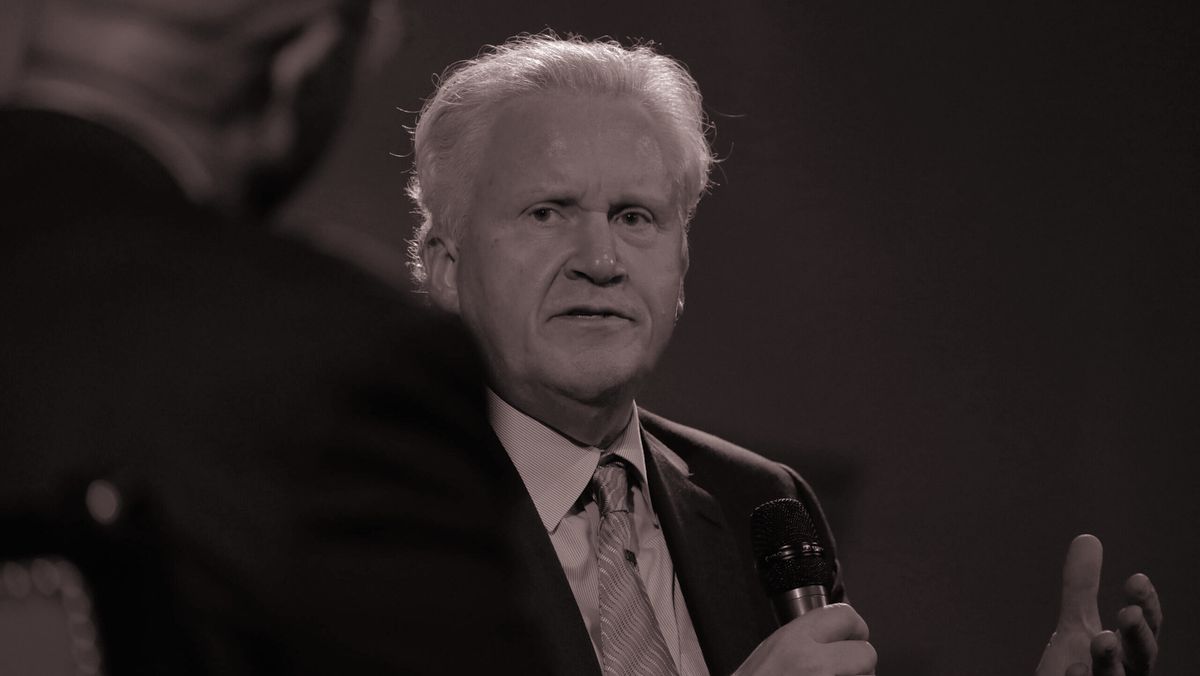
In a recent post on LinkedIn, titled “Go GE!,” Immelt presents a rose-colored, revisionist history of both his tenure and the current state of the business—a counterpoint to the negative “commentary” at the time, and, in particular, to Power Failure, my 2022 book about the decline of GE. “Bad cycles were frequently confused with bad intentions,” he wrote. “GE took risks in the face of volatility and crisis. As business cycles improved, we knew that GE would win. And it has.”
It’s true that GE has recovered from its lows after the company’s current chief executive, Larry Culp, executed the blueprint designed by John Flannery, Immelt’s short-lived successor, to break up what remained of GE in 2021. But it’s simply not the case, as Immelt suggests, that the component parts of GE are now worth $800 billion—24 percent more than the company was valued at in 2000, in the latter days of the reign of the legendary Jack Welch.
On LinkedIn, Immelt pointed in particular to GE Aerospace, GE Vernova, and GE Healthcare. These businesses have done relatively well as publicly traded companies, especially GE’s jet engine business—now run by Culp—and GE Vernova, the old power business. But together, the market value of those companies adds up to $421 billion. Even if you add in the full market values of companies that GE once owned, sort of, such as Baker Hughes, Synchrony, and Wabtec—GE did not own 100 percent of either Baker Hughes or Wabtec—that only adds another $100 billion. That’s still not $800 billion. Whatever.
I understand why Immelt is doing all this, of course. Immelt is now a lecturer at the Stanford Graduate School of Business, where he teaches a class called Systems Leadership about “leading through change,” and remains a venture partner at New Enterprise Associates, where he invests in startups and backs promising entrepreneurs. But the truth, as carefully documented in my bestselling 816-page book, Power Failure, is of course more complicated.
|
Houston, We Have a Problem
|
|
“I retired from GE eight years ago,” Immelt begins his LinkedIn essay—but the reality is that the GE board fired him, in June 2017, many months before he originally suggested he was going to retire, after a sequence of momentous decisions he made following the 2008 financial crisis. There was, for example, his fateful decision to cut the sacred GE dividend, which pissed off shareholders; to sell NBCUniversal to Comcast, without an auction, for just $30 billion; to overpay for the power business of Alstom, the French rail transport manufacturer; and to jettison GE Capital, the company’s cash cow, in 2015.
That business had historically generated nearly half of GE’s earnings in any given year, but Jeff abandoned it after begging the government for a rescue following the Great Recession. There were also growing time bombs on the GE balance sheet—among them, a liability related to long-term healthcare insurance—and the fact that the power business was in freefall.
Things came to a head for Immelt in May 2017, after a disastrous appearance at the annual Electrical Products Group conference at the Longboat Key Club, off the west coast of Florida—an annual event for Wall Street research analysts who cover the electrical industry. At the time, Jeff had been clinging zealously to the idea that GE would still earn $2 a share in 2018, despite no longer having the profits from GE Capital; or from Synchrony, a credit card business that was spun off; or from a struggling power business.
Immelt was warned that this was folly. Among others, his own C.F.O., Jeff Bornstein, told Immelt that $2 a share was an utterly unrealistic goal and that he shouldn’t keep pushing it. But at EPG, Immelt ignored what he was told and stuck to the mantra. The Wall Street research analysts were incredulous, and pretty much laughed in his face.
The fallout began immediately afterward. At the Sarasota airport, Immelt took a GE private jet to Houston, where he was being honored, and where he would review the integration plans for the announced merger of GE’s oil and gas business into Baker Hughes, a publicly traded company. As he was returning to the airport in Houston, he got a call from Susan Peters, GE’s
head of human resources, who told him that Jack Brennan, the company’s lead independent director, wanted to speak with him immediately to discuss a timetable for his departure.
Immelt also got a call from Ed Garden, then a partner at Trian, the activist hedge fund run by Garden’s father-in-law, Nelson Peltz. After GE announced that it was selling GE Capital, Immelt had invited Trian to invest in GE, thinking it would be better to have an activist investor inside the tent than throwing bombs from the outside. (Trian invested $2.5 billion, only to see the investment wither away.) He figured Trian would be friendly since he had known the Garden family since he was at Dartmouth.
Immelt bet wrong on that, too. “Jeff, it’s over,” Garden told him over the phone, as I recounted in Power Failure. “It’s over. People have stopped listening. People have just stopped listening. You have no credibility.” Jeff was soon out, replaced by Flannery, a longtime GE executive who was then C.E.O. of GE Healthcare.
|
Immelt was, in many ways, an exceptionally unlucky executive, taking over from Welch on September 10, 2001, a day before two planes flew into the World Trade Center—GE made the engines on the jets—and then having to lead in the aftermath of a number of business scandals that led to the Sarbanes-Oxley Act. During one of the many interviews I conducted with him for my book, Jeff told me that he’d had only one good day in his first year on the job. But a different leader would have made different choices. In truth, Immelt was the wrong C.E.O. at the wrong time, and that’s Jack’s mistake for choosing him, as he freely admitted to me before his death in March 2020.
In his LinkedIn post, Immelt singled out Power Failure for “trashing” his decision to acquire Alstom. “I smile when I think of GE Vernova (GE’s power business),” he wrote. “Only five years ago, this business was a ‘loser,’ thought to have completed the worst acquisition in history. … But the team had made generational bets on natural gas, electrification, competitive wind, distributed power, and global capability. They didn’t listen to the ‘crowd,’ but followed a deep knowledge of the market. They were right.”
For what it’s worth, my book did not trash the prospects of GE’s power business. I merely reported how dim the prospects for that division had become after the expensive Alstom transaction and a series of business blunders. To try to stem what looked like increasing losses, the executives in the power business had given customers generous payment terms—for instance, GE Power did a $1.1 billion deal with Angola for a power station, getting no cash upfront, only a long-term receivable—and were also generally “factoring” receivables, or selling them at a discount, to get badly needed cash. GE Power also gave lenient terms to customers buying so-called “upgrade kits”—akin to putting a new engine in an old car—as demand for them faded.
GE Vernova, the successor to GE Power, has been revived only because of the unprecedented and unpredicted demand from A.I. data centers, which are gorging themselves on electricity at unheard of levels. GE Vernova now has a market value of $133 billion, up 256 percent since it was spun off a little more than a year ago. “No one saw that coming in 2015,” explained one former GE executive, “and to imply it was the strategy all along is another example of delusional, revisionist thinking.”
Jeff is entitled to his own version of events, of course. His February 2021 book, Hot Seat, is testament to that. In it, he settled all sorts of scores with his former GE colleagues, touting what he thought were his accomplishments while ignoring many inconvenient facts. He does more of that in the LinkedIn piece. “Industrial businesses are built over time,” he wrote. “They are built through cycles that rarely sync with investor time horizons. We were taught to ‘keep our cool’ when the conditions were tough, to see opportunity when others saw risk. Much of our leadership in aviation was built after 9/11 or during the financial crisis when others were retreating.” Nota bene: No one retreated more during the financial crisis than Immelt, who sold NBCU to Comcast in 2009 for a song.
At least Immelt has landed on his feet. He gets an annual payment of around $5 million for the rest of his life from GE, thanks to the company’s generous supplemental pension plan, and gives back by teaching, introducing his students at Stanford to his network of C.E.O.s and founders and sharing their stories of “grit.” He’s “built a training course for leaders from startups and small public companies,” whose goal is to “help people focus on things that matter, on how to have a positive impact.”
Immelt also wrote that he is now “active” in Bible study, and that he is “rebuilding” his high school, is “more present” with his family, and is starting a business with his son-in-law. “I don’t believe in regrets,” he wrote, adding that he is “proud” that he worked at GE and helped to make it what it is today. “Our flowers are blooming,” he concluded.
But his willingness to paper over his role in GE’s demise strikes some of his former colleagues as delusional, at best. “Jeff was 100 percent committed to a command-and-control model that layered huge overheads and lack of decision-making rights on what had been good businesses,” one of them wrote to me after Immelt posted to LinkedIn. “They were slowly dying under the old format, and that would have continued. It was breaking with that past that created the GE we see today.”
This former GE executive gave Culp the credit for executing “flawlessly” the blueprint that Flannery had left him of splitting GE up into its component parts. “The renaissance of GE is not to be found in the decisions made a decade ago, but in the moment they took the keys away from Jeff and GE went down a polar opposite path,” the executive concluded. “His legacy is incontrovertible. Good businesses awash in debt and struggling to stay alive. For him to take credit for what has subsequently happened is Exhibit A of his penchant for ‘success theater,’ and for seeing things as he wants to see them and not what actually happened.”
|
|
|
|
Join Puck’s chief political columnist, John Heilemann, as he roams the corridors of power and influence in America on this twice-weekly interview show, taking you beyond the headlines with the people who shape our culture: icons and up-and-comers, incumbents and insurgents, moguls and machers in the overlapping worlds of politics, entertainment, tech, business, sports, media, and beyond. The conversations are rich and revealing, unrehearsed and unexpected… and reliably impolitic. A Puck-Audacy joint, new episodes drop every Wednesday and Friday.
|
|
|
|
Puck’s daily political newsletter from Washington on what’s really happening in this town, from the White House to the Pentagon to Capitol Hill, K Street, and the campaign trail.
|
|
|
Need help? Review our FAQ page or contact us for assistance. For brand partnerships, email ads@puck.news.
You received this email because you signed up to receive emails from Puck, or as part of your Puck account associated with . To stop receiving this newsletter and/or manage all your email preferences, click here.
|
|
Puck is published by Heat Media LLC. 107 Greenwich St, New York, NY 10006
|
|
|
|