{{ 'now' | timezone: 'America/New_York' | date: '%b %d, %Y' }} |
|
|
|
Welcome back to Dry Powder. I’m Bill Cohan.
Early this morning
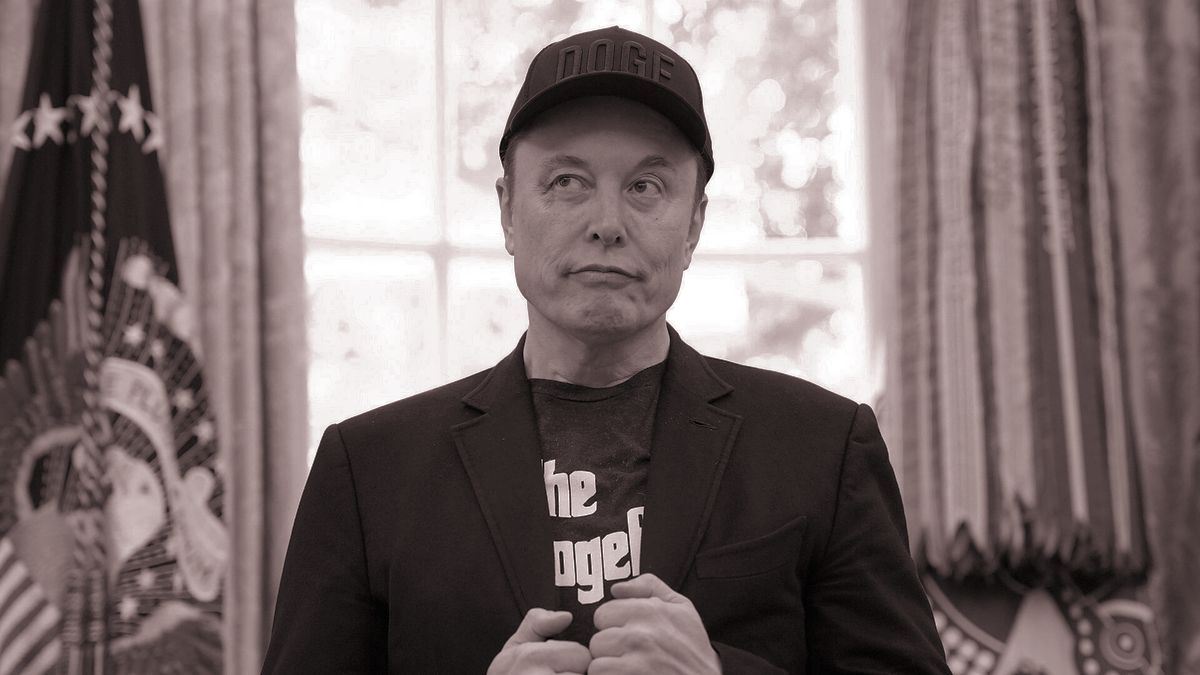
Elon Musk posted, “On my way to Beijing in Air Force One” to his 239 million followers on X. He was accompanying Donald Trump on the president’s two-day summit with China’s leader, Xi Jinping. Also on the trip were a gaggle of other stars from the Dry Powder cinematic universe, including BlackRock’s Larry Fink, Goldman’s David Solomon, Citigroup’s Jane Fraser, Blackstone’s Stephen
Schwarzman, Nvidia’s Jensen Huang, Apple’s Tim Cook, and so on. On Truth Social, Trump called the trip an “incredible gathering of the World’s Greatest Businessmen/women proudly going to China,” then slammed CNBC for incorrectly reporting that Jensen hadn’t been invited. “In actuality, Jensen is currently on Air Force One and, unless I ask him to leave, which is highly unlikely, CNBC’s reporting is…FAKE NEWS.” (Worth noting that Jensen wasn’t on the
trip originally and only joined Air Force One during a refueling stop in Alaska.)
Whatever else may come from the first meeting between a U.S. president and a Chinese premier since 2017—it was Trump and Xi then, too—it’s a fair bet that the Wall Street entourage won’t come home empty handed. (Whether that augurs well for the future of democracy, I’ll let you decide.) But Musk, who’s worth around $688 billion, per Bloomberg, is by far the wealthiest man on this junket. The financial trade
has been speculating whether he will be the world’s first trillionaire. Below, I’ll interrogate that claim. I hope the answer intrigues you.
Also mentioned in this issue: Larry Page, Orlando Bravo, Anna Gomez, Brooke Harrington, Brendan Carr, and more…
But first… |
- Where’s
the Trump phone?: Are you one of people who put down a “refundable” $100 deposit for a Trump phone a year ago? You may recall the hype: The so-called “T1” phone would be gold-colored, of course, with all the usual tech accoutrements: a fingerprint sensor, “A.I. Face Unlock,” etcetera, as well as “telehealth services”—a nod, perhaps, to the phone’s target demographic. All for the “promotional price” of $499, Trump promised.
Incredibly, 600,000 people plunked down the
$100, for a total of $60 million. But is the Trump phone fake news? Language promising the phones would be “built in the United States” disappeared from the company’s website, and the T1’s initial shipping date of August 2025 came and went. A year after Trump boasted about the phones being for sale, no phones had shipped. When I called Trump Mobile earlier this week, a woman told me the phones would start being shipped “any day now.” The brand’s social accounts are now trumpeting that “phones
start shipping this week!!!” though given how the first supposed shipping date went, perhaps that claim, too, warrants skepticism. I’d love to hear from anyone who actually receives one!
The good news is that while you wait for your Trump phone, you can use your existing phone on a Trump MVNO—a mobile virtual network operator, essentially a leased network branded Trump Mobile—for $47.45 a month, naturally. Anyway, this is all chump change for the Trumps these days. The family has
raked in $2.66 billion in cash and gifts over the past 522 days, according to the Center for American Progress. And that’s probably a conservative estimate. - More heavy Medallia: A quick update following my recent piece about how Medallia’s lenders—led by Blackstone, Apollo, and KKR—were taking control
of the software company from Thoma Bravo, the Chicago-based private equity giant that put some $5.2 billion in equity into its $6.4 billion buyout of the company in 2021. Thoma Bravo is now poised to lose essentially all of its investment, while the lenders take control of the company. In effect, Thoma Bravo is walking away from Medallia uncontested. As Dry Powder readers know, that does not happen often.
Meanwhile, the Blackstone-Apollo-KKR consortium—the company’s new equity holders—are
investing another $100 million of working capital into the business to keep it functioning during the transition. We’ll see whether Blackstone, now the company’s largest stakeholder, can turn Medallia around. I wouldn’t bet against it, even though I can barely figure out what Medallia does. Blackstone, after all, once rescued Hilton from the financial precipice and transformed it into one of the most successful buyouts of all time. I’ll keep an eye on Medallia for you.
|
And now, some heady Musk math… |
|
|
|
If the inevitable and possibly imminent SpaceX I.P.O. debuts anywhere near its rumored
valuation, investors will effectively ratify Musk as a sovereign financial ecosystem unto himself. |
|
|
|
Elon Musk may be America’s chief broligarch, to borrow the phrase coined by
Dartmouth sociologist Brooke Harrington. But is he also about to become the world’s first trillionaire? It sure looks that way. According to Bloomberg, Elon is worth $688 billion at the moment, up $69 billion so far this year alone—twice as wealthy as Larry Page, a distant second. We have no idea how Bloomberg does its calculations, but we do know how much Elon’s stake in Tesla is worth. And with SpaceX preparing to go public, we can begin to put a number on the
rest of Elon’s empire, too.
Elon owns roughly 42 percent of SpaceX, which has hired Goldman, Morgan Stanley, JPM, Bank of America, and Citigroup to lead its public offering. The company’s prospectus, which has been confidentially filed with the S.E.C., is not yet public, so there’s no way for investors to know precisely how SpaceX is performing financially or even what all of SpaceX’s businesses are. For instance, we think—as crazy as this is—that SpaceX recently acquired xAI in an
all-stock transaction that valued the company at approximately $1.25 trillion, less than one year after xAI acquired X (formerly Twitter) in a deal that valued X at $33 billion (including debt) and xAI at $80 billion. (What either of these two companies has to do with SpaceX’s primary business of launching rockets is unclear, beyond the fact that they all share Elon’s favorite letter.) But we won’t know for sure if that’s true until the S-1 is filed publicly, which could be any day
now.
Anyway, SpaceX’s business is manufacturing reusable rockets to shoot various payloads into space: consumer internet satellites (Starlink), government and defense satellites (Starshield), even the occasional astronaut (SpaceX has more than $20 billion of contracts with NASA). The company is planning, but has not yet launched, something called Terafab, “the most epic chip-building effort ever.” And of course there’s plenty of merch for sale on its website, which also notes
that SpaceX has completed 648 missions with 609 “total landings”—the difference representing the number of rockets that blew up, returned in pieces, or were never recovered.
At the moment, the proposed midpoint valuation of the SpaceX I.P.O. is $1.75 trillion. At that valuation, Elon’s 42 percent stake would be worth around $735 billion. But the number could easily rise, given the astounding level of Wall Street hype surrounding the deal. At a $2 trillion valuation, Elon’s stake would be
worth $840 billion. Of course, Wall Street designs I.P.O.s to trade up—often dramatically—so that institutional clients can sell into a rising stock. That is not the official party line, but it’s very much how highly coveted I.P.O.s tend to play out.
For Elon’s SpaceX stake alone to be worth $1 trillion, the company would need a valuation of $2.38 trillion, putting it into the same rarefied club as Nvidia, Apple, Microsoft, Amazon, and Alphabet. Is it realistic to think that the SpaceX
I.P.O., if priced at the current midpoint of $1.75 trillion, would trade up by the 36 percent necessary for the company to be valued at $2.38 trillion? I don’t think that is the least bit crazy—even if the valuation is not justified by the financials. By now, we should all understand that Elon operates within his own financial ecosystem, and the valuations attached to his companies often aren’t justified by financial performance.
All that matters is what the market decides the company is worth after the stock becomes publicly traded. Bottom line: Don’t be surprised if in the days and weeks after the I.P.O. is priced—perhaps as soon as mid- or late June—Elon will have a paper net worth of $1 trillion from SpaceX alone. |
But we don’t even need to make that leap for Elon to be worth $1 trillion on paper. Let’s use the current
proposed $1.75 trillion valuation for SpaceX. That gives Elon a stake worth $735 billion. He also owns roughly 20 percent of Tesla, fully diluted, which has a market capitalization these days of $1.3 trillion, making his stake worth $260 billion or so—at least on paper. If he ever tried to sell that stake, it certainly would be worth less. Don’t get me started on whether Tesla is appropriately valued at $1.3 trillion. (As usual, this is not investment advice.) That battle was lost long ago. In
any event, adding $260 billion to the $735 billion gets you to $995 billion—from just those two holdings.
But there’s more. Last year, remember, Tesla shareholders approved Elon’s insane new compensation package after he threatened to leave the company if they didn’t give him what he wanted. The package grants him way-out-of-the-money stock options that could eventually be worth as much as $1 trillion if Tesla hits various operational and financial milestones. As I wrote
in February, for Elon to obtain all of his 12 tranches of options, Tesla would have to become by far the most valuable company on Earth—something on the order of an $8 trillion market cap—while simultaneously transforming itself into some sort of crazy robotics, robotaxi, and A.I. company, with electric cars becoming almost a sideshow.
Whether any of that happens is beside the point here, though. For accounting purposes, Tesla has already been forced to publish a “grant date, fair value”
for Elon’s compensation package. According to Tesla’s public S.E.C. filings, that number falls between $87 billion and $130 billion. For ease, let’s call that another $100 billion of paper wealth. So now, we’re at $1.1 trillion, on a relatively conservative basis, without any SpaceX I.P.O. pop.
There is still more. Elon is also the “majority owner” of Neuralink, recently valued at around $10 billion. Let’s conservatively give him another $5 billion for that. He
owns around 70 percent of The Boring Company, valued in the $7 billion range, which adds another $5 billion. And we’d have to add even more if it turns out that xAI and X are not, in fact, part of SpaceX. In other words, Elon Musk appears to already be the world’s first trillionaire—albeit on paper, and not fully realized until the SpaceX I.P.O. becomes a fait accompli. That should happen within the next month or so, as long as the equity markets continue their inexplicable tear. It’s
astonishing to contemplate. Talk about income inequality! |
|
|
|
Join Puck’s chief political columnist, John Heilemann, as he roams the corridors of power and influence in America on this
twice-weekly interview show, taking you beyond the headlines with the people who shape our culture: icons and up-and-comers, incumbents and insurgents, moguls and machers in the overlapping worlds of politics, entertainment, tech, business, sports, media, and beyond. The conversations are rich and revealing, unrehearsed and unexpected… and reliably impolitic. A Puck-Audacy joint, new episodes drop every Wednesday and Friday. |
|
|
|
Puck’s daily political newsletter from Washington on what’s really happening in this town, from the White House to the Pentagon
to Capitol Hill, K Street, and the campaign trail. |
|
|
|
Need help? Review our
FAQ page or contact us for assistance. For brand partnerships, email ads@puck.news.
You received this email because you signed up to receive emails from Puck, or as part of your Puck account associated with {{customer.email}}. To stop receiving this newsletter and/or manage all your email preferences, click here. |
Puck is published by Heat Media LLC. 107 Greenwich St., New York, NY 10006 |
|
|
|
|