Welcome back to The Varsity. I’m John Ourand, coming to you from Washington, D.C.
My
focus this week is on Austin, where all-stars from the MLS and Mexico’s Liga MX will face off tomorrow night. You’ll be able to watch the game on Apple TV+, as well as MLS Season Pass via DirecTV, Xfinity, and Amazon Prime Video. When MLS signed its 10-year, $2.5 billion deal with Apple in 2022, league officials believed that it would be the linchpin of the deep-pocketed streaming service’s sports strategy. But in the ensuing three years, Apple has more or less stood pat—which is why MLS execs,
perhaps more than anyone, have to be encouraged by Apple’s current activity. It’s rumored to be close to a deal for Formula 1 rights, and is one of three media companies in the running for ESPN’s package of MLB rights.
Speaking of streamers’ sports strategies, Julia Alexander is using tonight’s private email to dive into Netflix’s viewership stats and determine what sports content is working (the WWE and feel-good docs) and what isn’t (the audience for Drive to
Survive, while still popular, is dropping). This is a must-read story that is available only to Inner Circle members, so click here to upgrade.
Now, here’s Julia… |
Stat of the Week: 2.18 Million
|
That’s the average audience for last week’s ESPYs, the lowest (excluding the Covid years of 2020 and 2021)
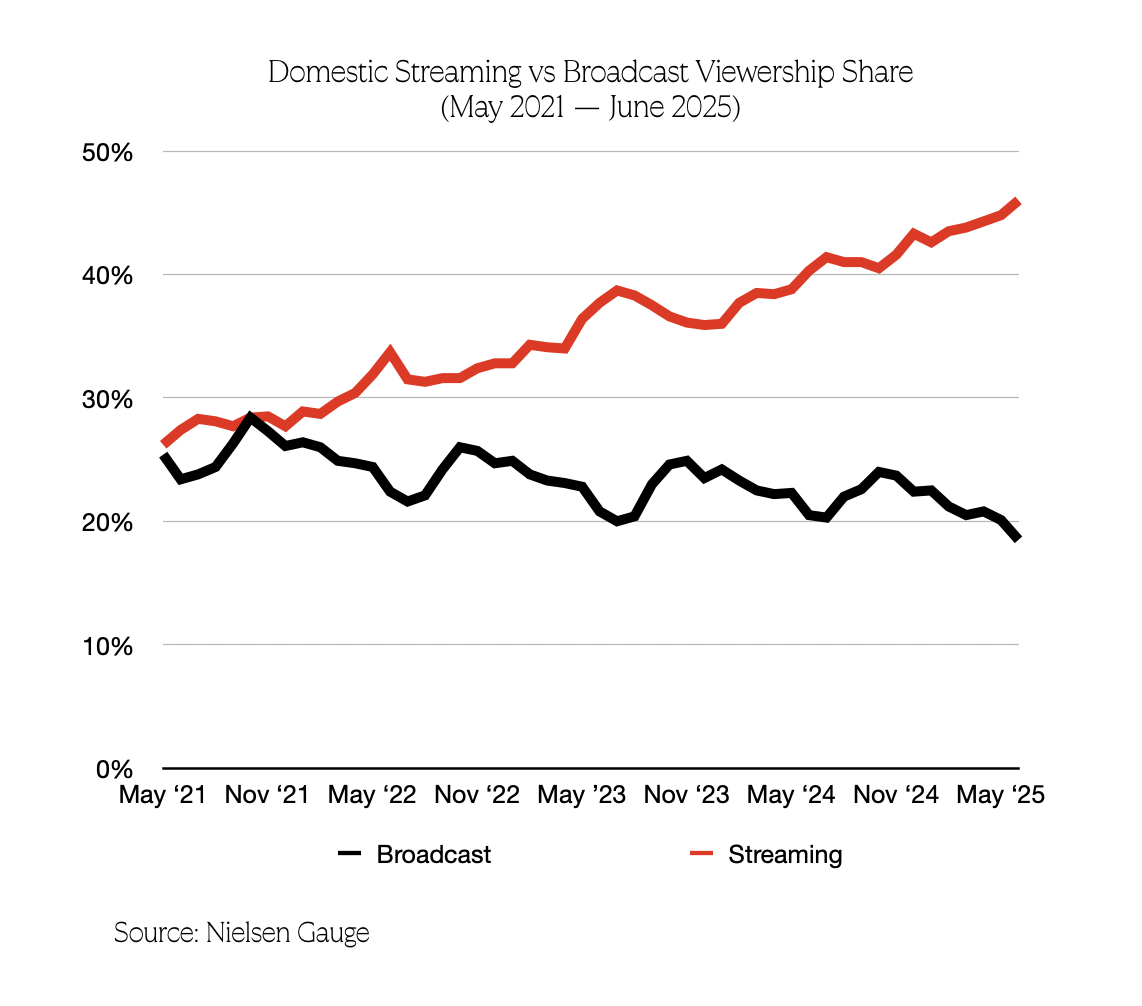
since 2011, when it was just shy of 2 million. It begs the question: Why are we still doing this? The ESPYs made sense back when broadcast accounted for more than 18.5 percent of all TV activity in the U.S. (as of June, per Nielsen), before algorithmic recommendations stopped us from channel-surfing, and when monoculture opportunities were less risky to bet on. One could argue the ESPYs were even a great brand vehicle at one point—but if fewer people are watching each year, does an event like
this still matter? Going forward, maybe the ESPYs will be an ESPN app exclusive for a couple hundred thousand bored fans, but it’s probably time to throw in the proverbial towel. |
- The
Portnoy Fox romance: It should come as no surprise that Barstool and Fox are taking things to the next level, with founder Dave Portnoy becoming a recurring host on Big Noon Kickoff. (The two entities will also collaborate on a pregame show with lesser Barstool personalities.) Portnoy, who has become a somewhat frequent guest on Fox News during Trump 2.0, represents the kind of brash, no-apologies manosphere character that has ascended in these
times. ESPN has its in-house lightning rods in Pat McAfee and Stephen A. Smith, who seems to have become even more agitated over the past couple of years.
The value of personalities like McAfee, Smith, and Portnoy goes beyond ratings; they can create news cycles—involving players, other commentators, and even fans—that make their shows appointment viewing. At a time when Fox Sports and ESPN are gearing up to launch their own streaming services, and
trying to woo younger generations of cord-cutters and cord-nevers into paying a hefty fee to access sports, outspoken commentators are a huge value add. This is likely just the beginning of Fox and Barstool’s mutually beneficial relationship. - Elon’s soccer bet: When Elon Musk took over Twitter (now X) in mid-2023, he made big proclamations about what X would become under his rule. (Remember
“X, the Everything App”?) But so far—as is so often the case with Elon—his promised innovations are running a bit behind schedule. While TikTok, Instagram, and YouTube Shorts have each crossed the 1 billion monthly user threshold, X’s user base just reached 600 million as of April. That stat comes from ex-C.E.O. Linda Yaccarino, so
perhaps take it with a few grains of salt, but it’s probably in the correct zip code. (X’s monthly active users are no longer disclosed as it’s a private company.)
And, while Musk encouraged popular YouTubers like MrBeast to post more regularly on X, and has encouraged former news network anchors like Tucker Carlson and Don Lemon to host their own independent shows on his platform, neither gambit succeeded. Lemon, who was fired less than
two months into his tenure following a contentious interview with Musk, is now suing X for breach of contract. (Actually, he’d never signed a contract, but I’ll let the lawyers take it from here.)
Having mostly failed in the news space, Musk is trying to preserve X’s importance to the sports world. More than 50 percent of sports fans said they’d used X in the past month, compared to 44 percent of the general population, a 2023 report
found. The platform is partnering with the U.K’s Burnley Football Club for the first ever “X Originals” content series in the U.K., which will include behind-the-scenes, documentary-style videos produced in close to real time. But will audiences want to watch longform video content on X, an app not designed for that kind of experience?
The NFL had a
partnership with Twitter back in 2016 to stream games, but that ended when those contests moved to Prime Video. My gut says the Burnley docuseries is a long shot—it feels more like an experiment to gauge audience interest—but keeping sports fans in the fold is central to X’s future, so it’s safe to expect more such “experiments.” - The Bills get the Hard Knocks treatment: HBO’s behind-the-scenes NFL preseason docuseries may get more
interesting this year, following a league rule change earlier this year. Previously, teams who’d made the playoffs in the past two seasons or went through coaching changes, for example, couldn’t appear on the show. The new rule, which allows certain playoff teams to participate if they choose, should broaden the series’ appeal significantly going forward, given that, you know, playoff teams tend to have the biggest stars, the most engaged fans, and the highest stakes going into
a new season. (No offense to the Jets, Dolphins, or the Bears—okay, maybe a little offense to the Jets.)
And the Bills, who will appear this season, check all three boxes. You can understand why executive producer Ken Rodgers, who sat down with The Athletic this week to talk about the new season, is more
excited than usual.
|
And now, on to the main event… |
|
|
With two full years of Netflix audience data, we now have a clear sense of how its series
perform. So what’s still working, and what absolutely isn’t? And when it comes to sports, is it better to be “adjacent” or in on the action? |
|
|
One of the main themes of Netflix’s famous Culture Memo is the premium the company puts on data: using “data
to inform intuition,” for instance, and making candid decisions based on performance and information. And true to form, over its 20 years, the streamer has collected an enormous amount of audience data. And in the process, a lot has been learned about what co-C.E.O. Ted Sarandos likes to call “sports-adjacent” programming. With shows like Drive to Survive and Break Point, Netflix has carved out a role as sports’ benevolent parasite, creating content
that boosts interest in leagues whose live games, matches, or races are broadcast elsewhere.
While live sports are still the premium experience, sports-adjacent content is much cheaper. Sarandos, his co-C.E.O. Greg Peters, and chief content officer Bela Bajaria have spent years trying to find the right—and the right amount of—sports-related content to meaningfully engage fans in all the countries Netflix serves. Do they need F1 rights if they have
Drive to Survive? Why pay top dollar for the U.S. Open if you have Full Swing?
For the past two years, Netflix has released in-depth viewership data, which not only lets us track how well a show did in its first few months, but also the decay rate (or loss in audience over time). So despite some limitations with the data—Netflix’s report is global, and most fans are regional—it’s possible to conduct a meaningful analysis of their sports programming over that
time span. Here are the three key takeaways. |
1. The Top
Performers Are Not About Sports
|
Big surprise: Controversy and star power are big draws. That’s true for unscripted content in
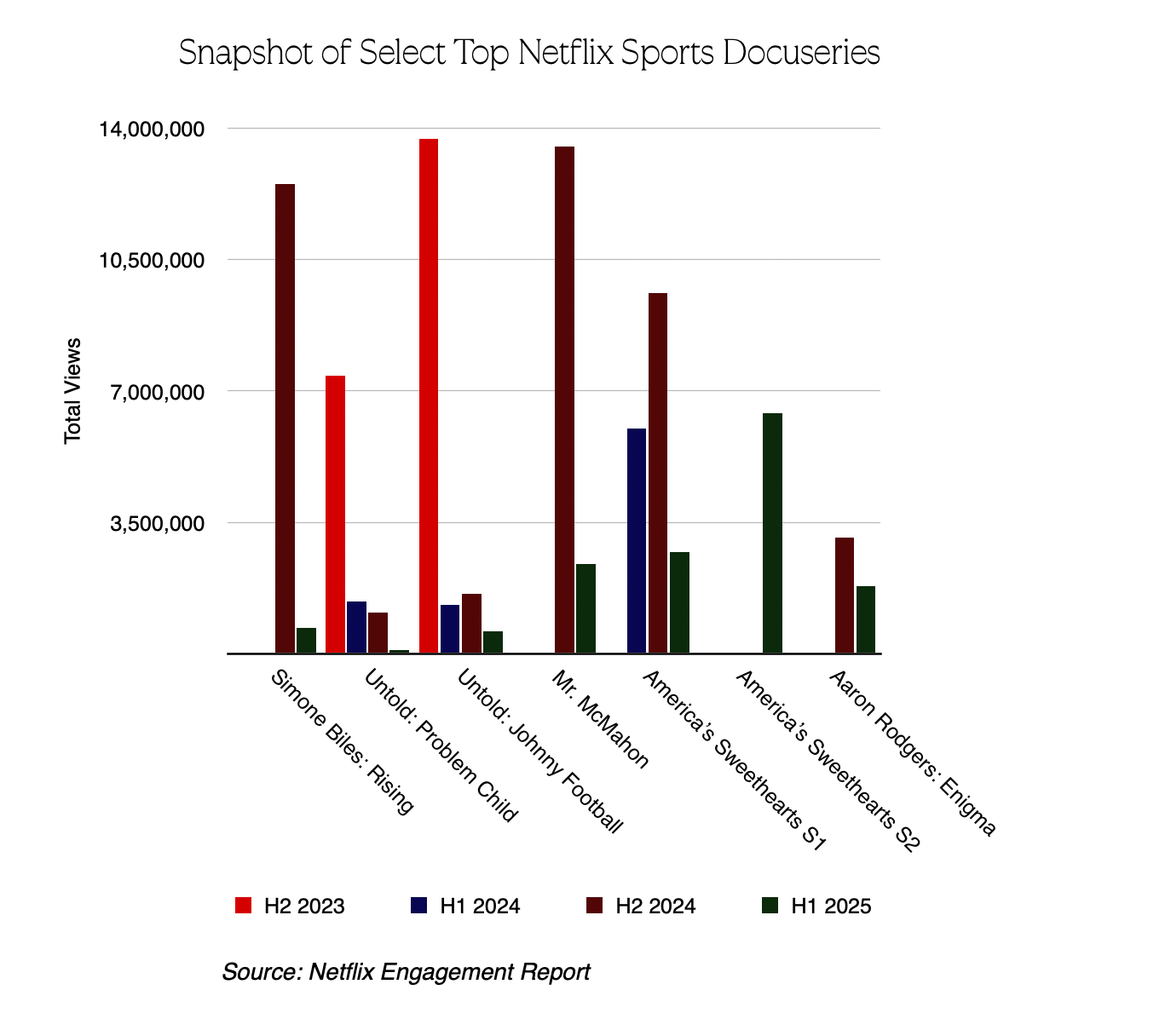
general, with age-old genres like true crime accounting for nearly half of the 20 most watched docuseries in 2024, per Luminate. American Murder: Gabby Petito was the sixth-most-watched Netflix title in this most recent report and the most watched documentary, with 56.1 million views. Meanwhile, the most watched Netflix sports docuseries remains Beckham, which debuted with close to 44 million views in the second half of 2023, good for the seventh spot on that semester’s
most-watched titles list. (The series has since tallied more than 7.5 million views.)
Other popular series include the Untold episode on quarterback Johnny Manziel, which garnered 13.7 million views in its initial report window—higher than the premiere episodes of Seasons 5, 6, and 7 of Drive to Survive in their respective release periods. (Netflix started releasing these reports after the first four seasons were released.) The series has added
another 3.5 million views since. Jake Paul’s Untold episode, Problem Child, which followed his journey from troubled YouTuber to professional boxer, brought in 7.4 million views in the first half of 2023, and an additional 2.6 million views since.
Even with controversial figures, judging the success of a Netflix docuseries can get tricky. Take Enigma, the three-part docuseries about Jets Q.B. Aaron Rodgers, which debuted in
December 2024, put up 3.1 million views in its first two weeks on Netflix, and amassed an additional 1.8 million in the first half of 2025. That 4.9 million total so far puts it just below the full second season of Full Swing (5.8 million views), but more than double what Under Pressure, a doc following the 2023 U.S. women’s World Cup soccer team, scored in its debut frame. Enigma debuted not long after Rodgers made a series of controversial appearances on
Pat McAfee’s show, making everyone—sports fans and casual viewers—interested in learning more about the NFL’s weirdest malcontent quarterback. But even with all the interest around Rodgers, the show never cracked the Netflix top 10 in the United States, the NFL’s primary market, meaning it likely wasn’t a hit for Netflix, and illustrating the limitations of docuseries focused on individual athletes. |
Another genre that’s worked for Netflix is feel-good American sports stories. Simone Biles: Rising
and America’s Sweethearts, which follows the Dallas Cowboys cheerleaders, are two of its best performers. (The latter was also one of the few docuseries to land on Nielsen’s top 10 in the U.S.) Sweethearts’ entire second season (6.4 million views) dropped in mid-June, just a couple weeks before the first-half report’s cutoff, but was nonetheless up 7 percent compared to Season 1 in its own debut frame. If it follows the trajectory of the first season, which
saw viewership increase 1.6x in the second half of 2024, Sweethearts will be a hit for Netflix.
Meanwhile, Simone Biles: Rising collected 12.5 million views, placing it in the top 100 global Netflix titles in the second half of 2024. Rising peaked around the Olympics, then suffered a significant drop-off in the first half of 2025, losing more than 90 percent of its audience, demonstrating both the power and high decay rate of especially timely titles like a
docuseries about an Olympian. Still, Rising and other star-powered Olympic docuseries like Court of Gold, which pulled 6.6 million views in its release window, are probably the best examples of Netflix successfully tying content to a major event that it doesn’t own the rights to.
Perhaps the largest takeaway from Netflix’s data is also the simplest: Actual sports can generate ratings no docuseries ever will, but a solid sports docuseries can keep finding
new viewers for months or even years past the final whistle or checkered flag. |
2. Drive
to Survive Is Downshifting
|
Let me be clear: It’s impressive for a streaming original show of any genre to reach a seventh
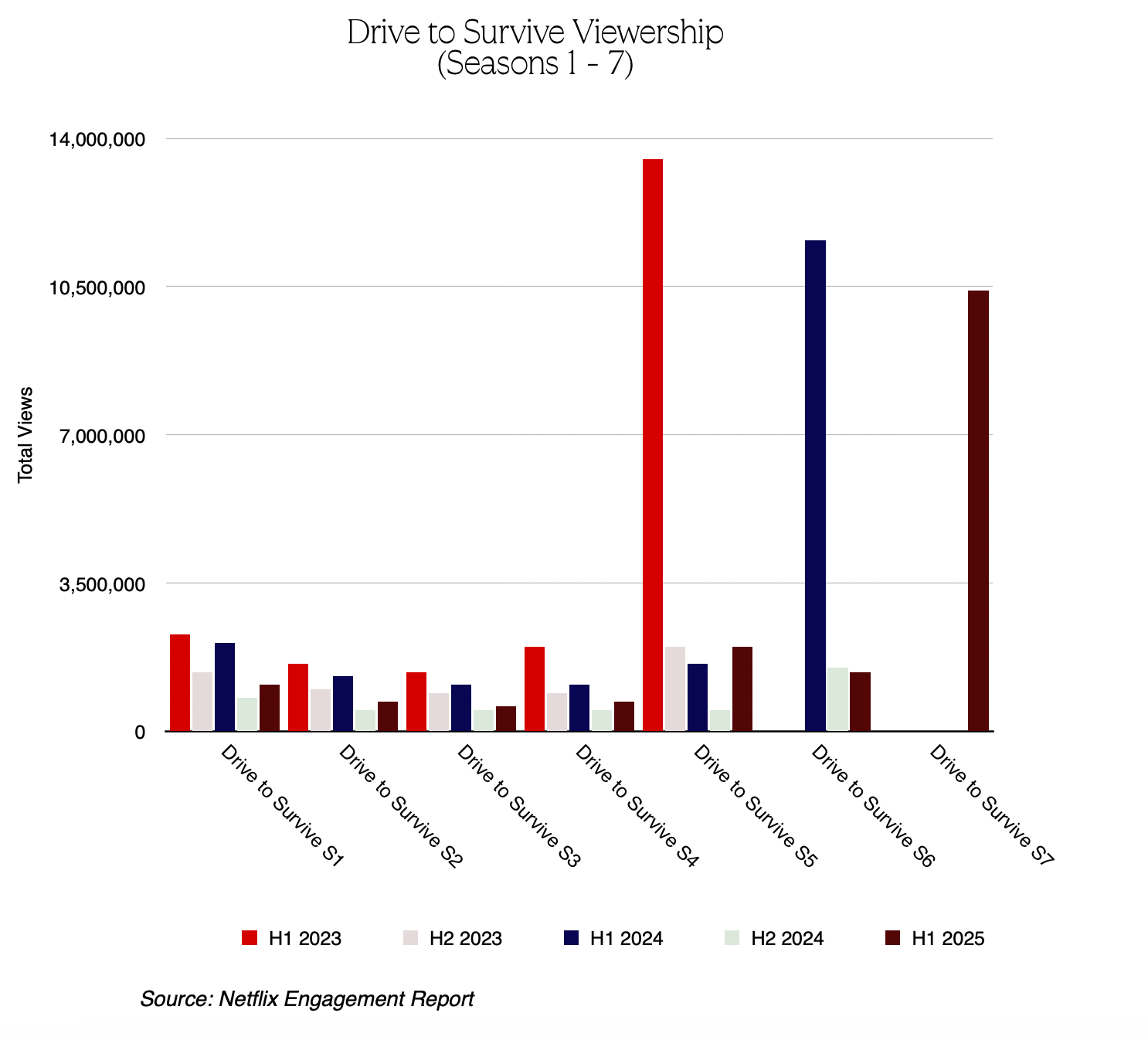
season. But you can already see the steady decline of Drive to Survive. The seventh season of Netflix’s F1 docuseries collected 10.4 million views in the first half of 2025, down about 23 percent from the fifth season and 10 percent from the sixth in their respective debut frames. Yet Drive to Survive Season 7 was also the most-watched season of a sports docuseries season in the first half of 2025. |
When Netflix first started streaming Drive to Survive, in 2019, live sports wasn’t part of
the company’s public plans. Since then, Netflix has experimented with one-off tournaments that haven’t performed well, including the Netflix Cup (700,000 views total in the second half of 2023), and some bigger bets that have done exceptionally well, like Jake Paul’s depressing (and worse, boring) fight with Mike Tyson, which generated 49.1 million total views between December 2024 and June 2025, and the two NFL Christmas games, which combined for 28.7 million views.
But picking up F1 rights would be much riskier, and much more expensive—especially considering that advertising inventory for F1 races is practically nonexistent. Not to mention that, although overall F1 viewership has more than doubled in the U.S. since 2018, it has stagnated over the past few years on ESPN. |
If viewership for a sport isn’t going to hit NFL numbers, and if running ads during the actual event is a
challenge, why wouldn’t Netflix focus on sports and sports docuseries that attract advertisers? Drive to Survive is still big enough that advertisers will flock to new seasons. And if Netflix were to bid on, say, an NFL package, not only is that guaranteed appointment viewing, it’s also advertising gold. All this may help explain why WWE was the first “major” sports acquisition Netflix decided to pursue. |
3. The WWE
May Be Netflix’s Sports Sweet Spot
|
Before WWE Raw moved to Netflix in January, it was averaging 1.66 million viewers in the U.S. on USA
Network. On Netflix (bearing in mind that the platform’s viewership is global), Raw is now averaging about 3.4 million views. WWE Raw has also appeared on Netflix’s weekly top 10 list in the United States every week so far this year.
The WWE provides a glimpse of Netflix’s sports future: It gives the streamer sought-after advertising inventory, which it has sold out for the next few quarters. It also creates opportunities for ancillary content focused on characters and engaging
controversies. Take Netflix’s high-performing docuseries Mr. McMahon, which followed Vince McMahon from his role in shaping the WWE into a multibillion-dollar business through the sexual misconduct charges that led to his exit from the company his father founded. The series amassed 13.5 million views in the back half of 2024, putting it in the top 90 titles for that frame, and added another 2.4 million views in the first half of this year.
There are plenty of
ways to interrogate the performance of Netflix’s sports documentaries and docuseries, but one truth stands above all else: These series will never replace the audience engagement, advertising potential, and cultural prowess of actual live sports. Nor are they driving anywhere close to the engagement achieved by definitive Netflix hits, like Stranger Things or Love Is Blind. But that may not matter to Netflix.
Nevertheless, Netflix executives
don’t want to rent the rights to leagues where tonnage is the main advantage: Netflix doesn’t need the NBA in the way that Peacock might. Instead, their docuseries titles are appealing, cheap, and brand safe. As Netflix enters its next phase as an ad-first company, maybe that’s all these shows need to be. But with a bigger supply of sports docs in recent years—the number of orders more than doubling between 2019 and 2025,
per Ampere Analysis—we may also watch Netflix pull back on its own orders, hunting down more Beckhams as executives start to better understand their investment in sports overall. If Sarandos, Peters, and Bajaria are focused on event tentpole strategies for sports, maybe the same can be said for its
sports docs. |
Thanks, Julia. See you all on Thursday.
John
|
|
|
Puck sports correspondent John Ourand and a rotating cast of industry insiders take you inside the executive suites and owners boxes where
the decisions that shape the entire sports business are made. You’ll hear interviews with players, network execs, and everyone in between. The Varsity is an extension of John’s private email for Puck by the same name. New episodes publish every Wednesday and Sunday. |
|
|
The industry’s go-to source for unflinching reporting on the trillion-dollar business of artificial intelligence - perhaps the single most
important technology of our time. Ian Krietzberg, the powerhouse journalist behind The Deep View, delivers twice-weekly insights into the latest dealmaking and breakthroughs in A.I., and how the intersecting worlds of finance, entertainment, media, and politics are being transformed in its wake. |
|
|
Need help? Review our FAQ page or contact us for assistance. For brand partnerships, email ads@puck.news. You received this email because you signed up to receive emails from Puck, or as part of your Puck account associated with {{customer.email}}. To stop receiving this newsletter and/or manage all your email preferences, click here. |
Puck is published by Heat Media LLC. 107 Greenwich St, New York, NY 10006 |
|
|
|