|
Welcome back to Dry Powder. I’m Bill Cohan.
Late Friday afternoon, Elon announced that he had decided to sell X, formerly Twitter, to xAI, his newish artificial intelligence company. It was a surreal moment, and a fitting capstone to what has been a strange couple of weeks on Wall Street, in which the hype machine has been working overtime. In today’s issue, a close look at that deal, and the I.P.O. drama surrounding CoreWeave, a cloud A.I. company that provides GPU-as-a-service. Plus, my partner Eriq Gardner shares some of his surprising chat with legal legend David Boies about Trump’s flurry of executive orders against Wall Street law firms.
But first…
|
- Passion of the Weiss: In the wake of the spectacular $40 million Paul Weiss capitulation, Wall Street law firms are experimenting with a few new strategies for dealing with Donald Trump. Skadden Arps, for instance, is attempting to head off Trump at the pass by agreeing to provide a stunning $100 million of pro bono legal services to Trump-related causes before the president could even issue an executive order pertaining to the firm. “We engaged proactively with the president and his team in working together constructively to reach this agreement,” Skadden said in a statement, adding that the agreement “is in the best interests of our clients, our people, and our firm.” At least one Skadden lawyer, Brenna Trout Frey, resigned in protest.Other firms, meanwhile, are fighting back against Trump’s punitive, probably illegal, and certainly petty, executive orders. The venerable Chicago law firm Jenner & Block, which was targeted by an executive order last week, filed a lawsuit on Friday “to stop an unconstitutional executive order that has already been declared unlawful by a federal court.” Two other firms, WilmerHale and Perkins Coie, have also decided to fight back. On Friday night, two different federal judges issued temporary restraining orders in favor of Jenner & Block and WilmerHale, preventing Trump, at least temporarily, from taking retributive actions against them.
Watching these disparate tactics play out will be riveting. As I reported on Wednesday, Wall Street firms are facing a real Sophie’s choice when it comes to dealing with these executive orders. Is it better to sacrifice your morals by capitulating to the bully and then move on, or to fight for what’s right and risk the fallout? That’s a question as old as time.
|
|
And now, here’s Eriq and David Boies…
|
|
|
 |
Eriq Gardner |
|
- Boies will be Boies: Over the weekend, I had lunch with legal legend David Boies, and caught up on his ongoing battles with the likes of Mark Zuckerberg and Michael Rubin. We met at Joe’s Seafood, just a few blocks from the White House, where the 84-year-old tore into fried chicken—first as an appetizer, then again as the main course—followed by peppermint ice cream drowning in a double portion of hot fudge. Watching this octogenarian commit such a delightful act of dietary abandon was something of a marvel. And it whetted my appetite for what this clearly undaunted man might say about the topic du jour: Donald Trump’s escalating war on Big Law.Just days earlier, Trump had signed executive orders targeting two more major law firms—Jenner & Block and WilmerHale—while striking a more conciliatory deal with Skadden Arps following a similar agreement with Paul Weiss. The president’s retribution tour is in full swing, and he appears more than willing to wield the levers of power—security clearances, federal building access, government contracts—to force the legal industry into submission. “Me and my law firm have always been associated with liberal causes,” Boies noted at one point, prompting me to wonder whether he was bracing for an executive order of his own. But in the next breath, he seemed to brush off the possibility and the potential impact of such a move.
He pointed to the caveats and legal hedging embedded in the executive orders—likely inserted by a cautious White House counsel—before offering what can be described only as a surprisingly generous assessment of Trump’s motives. Speaking of the criminal prosecutions the president faces, Boies mused: “If it had been Donald Smith instead of Donald Trump, there wouldn’t have been a prosecution. I can entirely understand how he felt what happened to him was an injustice.” On the question of law firms refusing to represent Trump, he took a measured stance: It was wrong, he said. And when asked about the firms—Skadden and Paul Weiss—striking deals with the Trump administration, he demurred: “I don’t want to comment. People have to do what they have to do. I’ve got a lot of friends in both places.”
Still, beneath the lawyerly calibration, there was a flicker of discomfort. The liberal lion, who stood at the center of Bush v. Gore and some of the most consequential legal fights in recent American history, seemed unsettled by the moment. He expressed dismay at the idea of attacking lawyers simply for their associations, and a faint, perhaps even wistful, hope that Trump might move on—and that the left and right might yet find their way back to some semblance of civility. And if the executive orders keep coming, and a targeted law firm asks for his help? “If a law firm came to me and asked me to represent them, I would,” he said. Would his own firm let him? “I’m pretty sure they would,” he answered, with just enough hesitation to leave a hint of doubt hanging in the air.
|
|
|
|
News and notes on the biggest deals of the week on Wall Street, for better or worse.
|
|
|
|
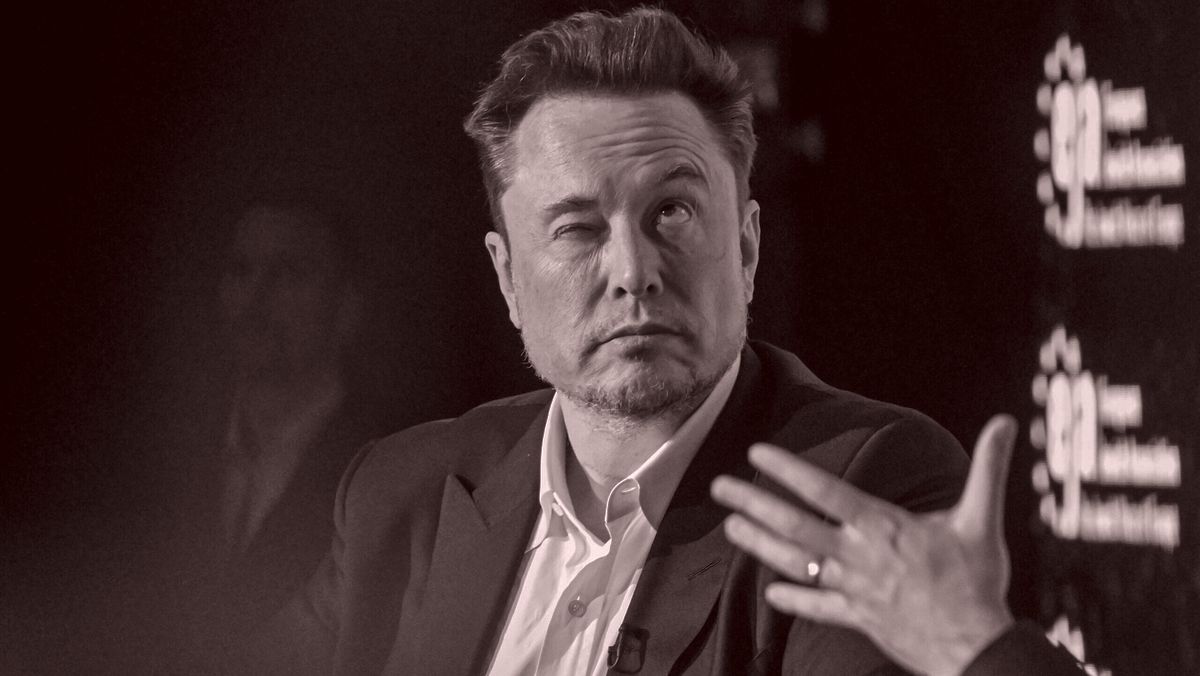
Despite all the vicissitudes in the market, the Wall Street hype machine was working overtime on Friday. First came Elon Musk’s bizarrely timed announcement, at 5:20 p.m. ET, that he had decided to sell X, formerly Twitter, to xAI, his newish artificial intelligence company best known for Grok, its A.I. chatbot. It was one of the more surreal deal announcements I’ve seen since at least 2018, when Elon announced that he was considering taking Tesla private for $420 a share and had “funding secured” for the deal, which he definitely did not.
Needless to say, Elon hyped the combination. “xAI and X’s futures are intertwined,” he wrote on X. “Today, we officially take the step to combine the data, models, compute, distribution, and talent. This combination will unlock immense potential by blending xAI’s advanced A.I. capability and expertise with X’s massive reach. … This will allow us to build a platform that doesn’t just reflect the world but actively accelerates human progress.” The all-stock transaction valued xAI at $80 billion and X’s enterprise value at $45 billion—$33 billion of equity plus the $12 billion of debt still remaining on X’s books. Will Linda Yaccarino be the C.E.O. of the combined entity? Did she even know it was happening? Who knows? “The future could not be brighter,” she tweeted after Elon announced the deal.
To me, the combination harkens back to the hype surrounding the infamous AOL/Time Warner merger, where a hugely overinflated internet stock was used to buy an old-line media company. The outcome, as anyone on Wall Street will recall, wasn’t pretty. But one X creditor scoffed at my comparison. “AOL was peak and on the way down,” he wrote. “X is coming off the lows and on [the] way up. Supported by a new technology [with] huge runway not a dying one. And the richest person in the world. Great, great outcome
for X creditors.
|
|
|
|
A MESSAGE FROM GOLDMAN SACHS
|
Early financial gains from recent tech cycles were captured by hardware companies.
After that initial boom, infrastructure software usually takes over, bridging hardware innovation with app development — a transition fast approaching for AI.
Read more on how AI is re-platforming the economy.
|
|
|
|
Maybe, but let’s examine this deal for a moment. First, not so long ago—back in November, to be precise—Elon raised a fresh $5 billion for xAI at a $50 billion valuation. Now, four months later, this stealth deal values xAI at $80 billion, a 60 percent increase, during the same time period when the S&P 500 has been down nearly 6 percent. Nice work if you can get it. Then, Elon raised a fresh $1 billion of equity for X, at an equity valuation of $32 billion, or 23x its $1.4 billion of 2024 EBITDA, in order to pay down $1 billion of X debt. Now, two weeks later, that equity value has miraculously increased, on paper, to $33 billion, a 3 percent increase in no time.
Second, as faithful readers will recall, Elon paid $44 billion for Twitter in October 2022, using $31 billion of equity—$24 billion of which came from him personally, along with $7 billion that came from F.O.E.s, including Larry Ellison, Marc Andreessen, and Prince Alwaleed. Through the miracle of stock-for-stock deal alchemy, that $31 billion of equity, which was arguably worthless in the first two years of the Elon adventure, is now suddenly worth $33 billion, or 6 percent more than it was worth in October 2022. That’s not a great return, of course, but it’s a whole lot better than zero.
Third, X already owned roughly 12 percent of xAI—a stake the company received in exchange for incubation costs, like the use of its computers, engineers, and Nvidia chips. (Elon originally awarded X a 25 percent stake in xAI, which was subsequently diluted down to 12 percent after he raised new equity.) Back in November, when xAI was still valued at the sufficiently hyped $50 billion, that stake was worth $6 billion, which was enough of a boost to the overall X valuation picture to get the $13 billion of X debt, which had been stagnating on the balance sheets of the X banks, to move—first at around 90 cents on the dollar, and then at par. Thanks to this new deal, X’s 12 percent stake in xAI is now worth nearly $10 billion, or almost a third of the overall equity valuation of the company. Abracadabra.
Fourth, xAI is being trained on all the data being generated on X, and is paying the company $200 million a year in exchange for it. Needless to say, as that investor noted, the X creditors couldn’t be happier. Thanks to the wampum being spread all around here, the combined xAI and X is now worth an enterprise value of $125 billion, with $12 billion of debt, an attractive loan-to-value ratio of less than 10 percent. I presume that the X debt is now trading well above par, and are trending toward their call prices of par for the floating rate loan and 107 for the fixed-rate loan. “Pretty, pretty good,” my creditor friend wrote in Larry David-ese.
Of course, I’ve got plenty of questions. Did anyone know X was for sale? Was the company shopped around before deciding to sell out to xAI? Were any bankers hired to value the two companies and set an exchange ratio? Yes, the two companies are private and majority-owned by Elon, but there are plenty of minority investors at each company. Were they consulted? Was anyone looking out for their interests?
Also, on the governance front, were there special committees of the boards of directors set up to evaluate the deal and make sure it was fair to the non-Elon shareholders? Supposedly, Morgan Stanley represented both companies in the deal. (Morgan Stanley was also the lead advisor to Elon when he bought X in October 2022, and was the lead underwriter on the $13 billion of X debt.) “This combo makes a lot of sense,” tweeted Gene Munster, the managing partner at Deepwater Management, which owns equity stakes in both companies. “Grok brings the brains. X brings the distribution (600M MAUs) and a unique data asset.”
Sure Gene, whatever you say. Robust regulators in Washington would never let this deal happen without a whole lot of scrutiny, nor would judges in Delaware. But we know there will be none of that here. When you’re the richest man in the world who hangs out all day in the Oval Office, you can do pretty much whatever you want.
|
|
Elsewhere on Wall Street, investors are trying to make sense of the disappointing I.P.O. of CoreWeave, a cloud A.I. company that essentially rents out the computing power of its Nvidia chips as an enterprise service. The buzzy public offering, another Morgan Stanley special, was supposed to mark the much-ballyhooed return of the I.P.O. market in the new light-touch Trump administration. Instead, it pretty much flopped.
|
|
|
|
A MESSAGE FROM GOLDMAN SACHS
|
What trends are emerging today that will shape the markets tomorrow?
Hear in-depth discussions with bankers, traders, investors, and researchers at the center of capital markets on the Goldman Sachs Exchanges podcast.
Listen now.
|
|
|
|
The company initially hoped to raise $4 billion in equity, and then dropped that aspiration to $2.7 billion during the road show, after it realized investor demand was waning. In the end, CoreWeave raised $1.5 billion, selling 37.5 million shares at $40 per share, for a valuation of $23 billion, around what it was privately valued at in October 2024. Wall Street had hoped CoreWeave would be valued at more than $35 billion in the I.P.O., but alas, it was not to be. (The stock closed at $40 per share on Friday, after trading up and down for most of the day.) “It marks a difficult moment for the U.S., and global, I.P.O. market given the profile of the deal and the hope that surrounded it,” Samuel Kerr, head of equity capital markets at Mergermarket, wrote in a note following the deal.
CoreWeave has its share of haters. Among them is Ed Zitron, who has an eponymous P.R. agency and writes a newsletter, Where’s Your Ed At?. He called CoreWeave a “time bomb” in a March 17 piece after reviewing the I.P.O. prospectus. “In my years writing this newsletter I have come across few companies as rotten as CoreWeave,” he wrote. He added that it was “rancid,” and that if it weren’t for the Wall Street hype surrounding A.I., it would be seen clearly as such. Instead, it exists, he wrote, in its “own reality distortion field.”
Zitron correctly pointed out that 60 percent of CoreWeave’s business comes from a single customer, Microsoft, which may or may not be changing its A.I. needs. It also has $8 billion of debt that it may or may not be able to service because the company lost $863 million on revenue of $1.9 billion in 2024. “CoreWeave’s underlying financials are so dramatically unstable that it’s unclear how this company will last the next six months,” Zitron wrote. (Emphasis his.)
What has Wall Street buzzing about CoreWeave’s debt financing, though, is that it’s largely secured by its Nvidia GPUs chips, which Zitron believes are “depreciating assets” that eventually will “slide into obsolescence, as new chips and new manufacturing processes come out,” ultimately forcing CoreWeave to “increase its monthly payments as the collateral is (presumably) no longer sufficient to satisfy the outstanding debt.” Zitron’s critique reminds me of how David Einhorn sounded the alarm about Lehman Brothers in November 2007, nearly 10 months before the investment bank went down the tubes.
Of course, CoreWeave C.E.O. Mike Intrator is singing a different tune. He said the I.P.O. marked an important milestone for the company, and will give it “reliable access” to capital to build out its infrastructure. “Some people, they need more time to understand what is a fundamentally different business model,” he told Axios. “We go out and we win a contract, and then we go out in the debt lending syndicate and marry up those two contracts so there is an accretive contract that can pay off the debt. You can scale the business to enormous size.”
I have my doubts. There’s clearly a strong business case for GPU-as-a-service: As more and more companies use and deploy A.I. products, there’s a growing market for renting cloud computing power. The question is whether CoreWeave is correctly positioned to benefit. As Zitron notes, the company is massively leveraged with some quarter-million Nvidia chips that were state-of-the-art a year ago but could quickly become obsolete. If Nvidia’s next-gen chip, Blackwell, is as good as Nvidia C.E.O. Jensen Huang says, does it matter that CoreWeave is a Nvidia-preferred customer? Plus, nothing good has ever come of having such an undiversified customer base. If that big Microsoft contract is scaled back, or goes away, CoreWeave will need to replace billions of dollars in revenue—fast. In the latest version of the perpetual Wall Street hype machine, what could possibly go wrong?
|
|
|
|
Puck founding partner Matt Belloni takes you inside the business of Hollywood, using exclusive reporting and insight to explain the backstories on everything from Marvel movies to the streaming wars.
|
|
|
|
A professional-grade rundown on the business of sports from John Ourand, the industry’s preeminent journalist, covering the leagues, players, agencies, media deals, and the egos fueling it all.
|
|
|
Need help? Review our FAQ page or contact us for assistance. For brand partnerships, email ads@puck.news.
You received this email because you signed up to receive emails from Puck, or as part of your Puck account associated with . To stop receiving this newsletter and/or manage all your email preferences, click here.
|
|
Puck is published by Heat Media LLC. 107 Greenwich St, New York, NY 10006
|
|
|
|


_01JQ7JDG8796VYCZ3HTTNZVVV7.jpg "Goldman Sachs")
_01JQ7JDHYEVZTGJYFGR1YZFX2P.jpg "Goldman Sachs")