|
Welcome back to The Best & The Brightest. I’m Tara Palmeri.
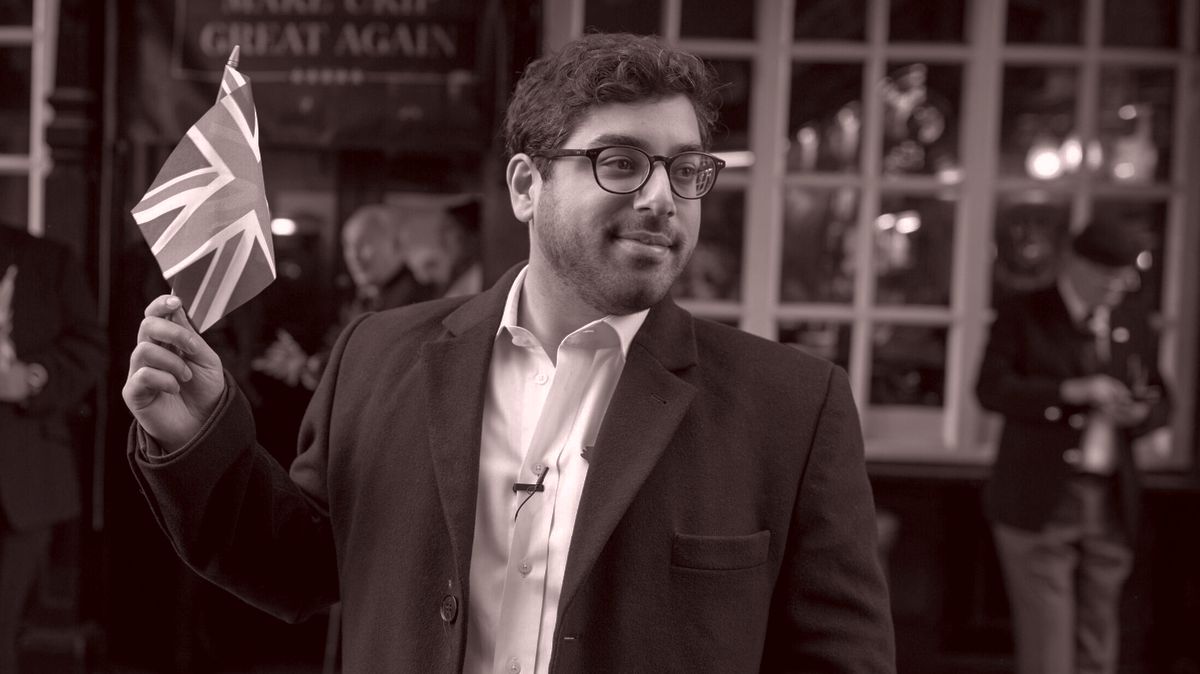
In tonight’s issue, my conversation with Raheem Kassam, the former longtime Nigel Farage deputy and newish editor-in-chief of The National Pulse. I met Kassam nearly nine years ago at the United Kingdom Independence Party conference in Doncaster—a former Labour town you’ve probably never heard of—where I was covering Brexit for Politico Europe.
Kassam and I witnessed the first wave of the populist movement in 2016 with Britain’s exit from the E.U. amid a surge of anti-immigration sentiment.
When we reunited this week on my podcast, Somebody’s Gotta Win, Kassam didn’t hold back in his criticism of Elon Musk’s plans for European domination and his recent social media assault on his old boss Farage, who was hoping to win some Musk bucks for his Reform UK party. Farage was uncharacteristically at a loss for words when Elon called on him to step down, saying that he was “surprised” to hear this from someone he has called a “friend.” Kassam’s thoughts, below the fold.
But first, here’s Abby with an update on A.O.C.’s ongoing redemption tour…
|
|
|
 |
Abby Livingston |
|
Earlier today, House Democrats finally named Alexandria Ocasio-Cortez to the House Energy and Commerce Committee, a trophy she’s pursued for much of her still relatively nascent, vertiginous political career. While this might seem like a consolation prize after her failed bid for the top minority slot on House Oversight, A.O.C. has paid her dues—both figuratively and literally. It was only four years ago that she lost a bid to join this very committee to Kathleen Rice, a now-retired New York Democratic rebel who learned to successfully play the inside game. Now, A.O.C. seems to be following a similar trajectory. “She’s entering her fourth term now; she’s making amends for past perceived sins; she’s playing the game smarter,” former Democratic Rep. Cheri Bustos told me.
Even based purely on seniority, it was well past time for A.O.C. to land an “A” committee slot. (She’s the most senior among the new Dems slated so far to join her on E&C.) Meanwhile, the Oversight race, which she lost to Gerry Connolly, only increased her standing in the caucus. Indeed, the final tally—131 to 84—demonstrated that dozens of House Democrats consider her a member of the team. It also didn’t hurt that last year, for the first time, she paid $250,000 to the D.C.C.C. to help vulnerable colleagues. Given all of this, it’s fair to assume she’s the frontrunner to lead Oversight once Connolly retires. If she sticks around, the 36-year-old potentially has decades to move up the seniority ladder at E&C, and could therefore end up serving as the chair of not one, but two committees.
Ironically, A.O.C.’s career is starting to resemble those of two recent Republican powerhouses. Back in the aughts, Paul Ryan was something of an A.O.C.-ish phenom, himself, capturing the hearts and minds of the Gen X and millennial Alex P. Keatons of the G.O.P. (He’d also spent enough time in his youth working as a Hill staffer and as a waiter at Tortilla Coast to grasp Capitol Hill politics more quickly than A.O.C. did.) The other is Patrick McHenry, the just-retired North Carolina Republican who entered Congress as a conservative rebel in 2005, but retired as the Financial Services chairman, after proving to be the glue that held the conference together amid its speakerless October of 2023.
Of course, the perpetual question in New York politics is whether A.O.C. will run for Senate, the presidency, or both. For most members, the House is the lowliest rung in national politics—but there are a handful who could have run for Senate at some point but chose instead to remain in the lower chamber,
eventually attaining positions as powerful as those of any statewide official. ( Nancy Pelosi and Ryan were third in line to the presidency.) Looking at her career from the committee angle, perhaps there’s logic to her sticking around.
|
|
|
|
Not content to limit his meddling to U.S. politics, the world’s
richest man has turned his sights overseas—tweaking the left in Germany and going full Farage in Britain. But as the international MAGA ambassador Raheem Kassam explains, Musk’s games are already alienating would-be allies.
|
|
|
Having successfully inserted himself into U.S. politics, Elon Musk is now turning an eye toward a few of the major powers in Europe—namely, Germany and the U.K. In recent days, he endorsed Germany’s far-right AfD party, whose leader he plans to host on an X livestream this week; and last week, he spent several days on the platform attacking Keir Starmer, Britain’s Labour prime minister. He simultaneously praised the right-wing populist Reform UK party of Nigel Farage, the Brexit artist who has become a fairly common sight at Mar-a-Lago, while also saying Farage “doesn’t have what it takes” to lead the party… just hours after Farage described Musk as a “friend” in an interview on the BBC. Heavy stuff.
For more on Elon’s meddling, I rang up Raheem Kassam, a former advisor to Farage and editor of The National Pulse who has become a fixture in the MAGA multiverse with strong opinions on trans-Atlantic populism. Interestingly, despite his former affinity for Musk, Kassam now believes that the world’s richest man is having a deleterious effect on politics writ large. Kassam and I discussed it all on my podcast, Somebody’s Gotta Win. In this lightly edited excerpt, he explains why Elon is taking an interest in the U.K., what he doesn’t grasp about Farage, and why he should keep his fortune out of British politics.
|
|
Tara Palmeri: Why is Elon Musk suddenly so interested in the U.K.?
Raheem Kassam: What does the man with all the money in the world want? He doesn’t want more money; he wants more power. You see this in Italy at the moment, with his capture of [Prime Minister] Giorgia Meloni. I’ve known Giorgia for the better part of a decade, and she’s completely changed as a result of Elon’s involvement with her. You’ll see that with Trump as well. I want to make it clear: I actually think the Reform party should refuse any advances and cash from Elon Musk.
So you’ve changed your mind?
Here’s the thing: 100 million dollars, or 100 million pounds, is equivalent to five election cycles in the U.K. Most parties spend about 15 to 20 million dollars on an election cycle; it’s not like here [in the U.S.], where you spend $1 billion. I have changed my mind, having seen how he’s behaved. I always use [George] Soros as the example: Before Soros comes along and starts stroking checks to the Democratic Party, the Democratic Party still considers itself a pro-American worker, pro-union, antiwar party. Then suddenly, all of these corporate donors—of which Soros is probably the most identifiable—come along and fundamentally change the party.
To avoid something like that, you have to keep big-money interests out of your political parties and out of your political movements. I keep telling Republicans, “You can knock down Kevin McCarthy, you can knock down Mike Johnson, you can knock down Tom Emmer. But unless you get the money out of that situation, all of these people lining up are going to be the same person.” They’re just a facsimile of the wider problem. That’s something I don’t want in British politics, and Elon has shown himself to be that guy.
You liked Elon Musk for a while; you were actually a proponent of his.
I don’t know if I’d go that far. I wouldn’t say proponent. I was definitely somebody who cheered him on when he seemed to be going in the right direction—but I stopped as soon as he stopped going in that direction. I’m more than happy to call balls and strikes when I see them. People on the left will say he’s dangerous for democracy. That may well be true. I would say he’s dangerous for the political right worldwide.
Nigel Farage has called Elon a hero and said he’s pleased Elon is backing the Reform party. I have a hard time imagining anyone but Nigel leading the party. So what’s the current beef between Farage and Elon?
Elon likes to collect people. And he thought he was on his way to collect Nigel Farage, but he doesn’t work like that. People have come to him with big checkbooks before and asked him to change his position on Brexit. That’s just not who he is. He’s always been his own man. He’s probably even more independent-minded than Donald Trump. Nigel has been doing this since the early ’90s, whereas Trump is still quite new to politics in the grand scheme of things. Musk’s kind of dug in on this issue of the grooming gangs, Keir Starmer—all of this stuff is being weaponized in a way that is really terrible. I say this as a person who helped Tommy Robinson out of prison in 2018. This is a street activist who is now in prison, who Elon is championing in a big way on X. And this is where the fight really lies. Elon is trying to push Tommy Robinson as a figure on Nigel Farage and the Reform party, without understanding that there’s a longstanding animosity between those men that will push Nigel Farage away from Elon Musk in a greater way than Elon could ever understand. And that shows how green Elon is to all of this stuff.
|
|
Farage has said he wants to be the intermediary between the U.K. government and Trump. That he’s frequently seen at Mar-a-Lago and in Washington obviously heightens his profile. But a U.K. representative has dismissed the idea. So why is Farage hanging out with Trump all the time? Unless he just wants to be relevant and famous and get elected?
Well, Nigel Farage is already very famous, at least in the United Kingdom. So he doesn’t really need that. What he needs is the legitimacy of having the global superpower’s leader, the leader of the free world, endorsing him, as Trump just did. I was emceeing the New York Young Republican gala over Christmas, and Trump sent not one, but two videos endorsing Nigel.
Nigel understands he can parlay that power into electoral relevance in the United Kingdom. And it’s done him a great lot of good to be seen with and around Donald Trump. It has cut the rug out from underneath the Conservative Party and its leader, Kemi Badenoch. It causes the Labour Party all sorts of problems because they don’t know what Trump is back-channeling to Nigel, and vice versa. Nigel wants to serve his country in any way he can. So if Peter Mandelson, or whoever’s going to be the next British ambassador to the U.S., comes along and asks for his help, he’ll help them. The problem is, the political establishment in Britain doesn’t want to give [Farage] that credence and that credibility, because that elevates him further and almost makes him the prime minister in waiting.
The U.K. could find itself in a precarious situation, given Trump’s tariffs and his statements that the U.S. should lower its security commitment to Europe. How great of a threat do you think this poses to the U.K.—and is there any way Nigel Farage could save the day?
Yes, absolutely. To my understanding, there have already been conversations about carve-outs for the United Kingdom. We know that Trump obviously has a soft spot for the U.K. Brexit allowed the U.K. government to go out and make its own tailored trade deals with individual nation states, and indeed, with the E.U. itself. The problem is the Conservative Party and Labour Party have had no interest in doing that. The incoming Trump administration has the ability to make Brexit a functional success by agreeing to just one bilateral trade deal.
I think they’ll do it, and I think it will be done because Nigel Farage keeps popping up at Mar-a-Lago and talking to the right people about this—he’ll never get the credit he deserves. But that will ameliorate any Brexit regret that lingers, and it will allow the country to move into a new economic prosperity period. If Nigel can convince Trump to have that carve-out, especially on the tariff regime, he’ll be an international hero.
|
|
|
|
Puck senior political correspondent Tara Palmeri grapples with the aftermath of what may be the most chaotic and consequential presidential election cycle of our lifetime. With 15 years covering politics, Tara speaks with the smartest political minds to discuss what’s happening behind the scenes in Washington, D.C., from the campaign trail to the Capitol.
|
|
|
|
Unique and privileged insight into the private conversation going on inside Wall Street, as told by the best-selling journalist and former M&A banker.
|
|
|
Need help? Review our FAQ page or contact us for assistance. For brand partnerships, email ads@puck.news.
You received this email because you signed up to receive emails from Puck, or as part of your Puck account associated with . To stop receiving this newsletter and/or manage all your email preferences, click here.
|
|
Puck is published by Heat Media LLC. 107 Greenwich St, New York, NY 10006
|
|
|
|