{{ 'now' | timezone: 'America/New_York' | date: '%b %d, %Y' }} |
|
|
|
Welcome back to Dry Powder. I’m Bill Cohan. Tonight, something a little
different…
In addition to the latest update on the saga unfolding between our boy Zaz and the Ellisons, I’m bringing you a special piece that I recently published in Air Mail, which joined Puck late last year, about a fresh scandal on Nantucket. It’s a story about what happens when insane wealth, environmentalism, and
Trump-era animosities overtake an eroding island kingdom in the offseason. I hope you enjoy reading it as much as I was fascinated by the reporting process.
Also mentioned in this issue: Peter Supino, Roger Goodell, Bari Weiss, Gerry Cardinale, Stephen Schwarzman, Eric Schmidt, David Rubenstein, Paul Salem, Burton
Balkind, Ed Davis, Meridith Moldenhauer, and… Nantucket’s geotubes.
But first… |
- Will
the Ellisons fork over another $25 billion?: Paramount Skydance’s $111 billion acquisition of Warner Bros. Discovery isn’t slated to close until the end of the third quarter, but Wolfe Research analyst Peter Supino has already identified an interesting wrinkle: According to his March 20 research report, PSKY should raise as much as $25 billion in new equity soon after the deal closes, primarily to begin paying down the combined company’s staggering $79 billion debt
load.
This hypothetical fundraise and debt service would help ParaBros make meaningful strides toward becoming an investment-grade-rated company. “Paramount’s bid to become a vertically integrated, diversified media behemoth requires significant investment in content and distribution,” Supino wrote. “The Ellison family’s long-term focus and unique incentives explain Paramount’s plan to proceed from the closing of the Warner merger with an eye-watering $79B of debt, more than 6.5x pro
forma combined EBITDA. At the same time, Paramount has communicated a desire for an investment-grade credit rating and a substantial public float of its equity.” Ergo, the need to raise new equity pronto, post-closing—which would signal to the market that the Ellisons are serious about debt reduction, achieving an investment-grade credit rating, and increasing the public float for the ParaBros stock.
Supino figures that without the equity raise, the Ellisons and RedBird Capital
will own 83 percent of the company, with the public shareholders owning the remaining 17 percent. Of course, the thin public float of PSKY tends to exacerbate the fluctuations in the company’s stock price. So far in 2026, the stock is down 34 percent. The Ellisons may not care that it’s taken a big hit this year, but other PSKY shareholders probably do—including, presumably, those Free Press shareholders who took PSKY stock as consideration for Paramount’s $150 million acquisition
of Bari Weiss’s newsletter company.
According to Supino, a $25 billion PSKY–WBD equity raise would lower the company’s leverage to 4x EBITDA and increase the public ownership of PSKY’s stock to 51 percent, which would vastly increase the stock’s float and liquidity—and, presumably, its value. He wrote that within three years of closing the merger, ParaBros would need to pay down $38 billion in debt to get to a desired, investment-grade-worthy 3x pro forma EBITDA.
He posited that plenty of debt could be paid off over time from an equity raise, the company’s cashflow (generated primarily from its linear TV assets), and the $5 billion or so in cash on its balance sheet. “We believe this is achievable so long as synergies drive pro forma free cashflow to ~$10B by 2030,” he wrote—a notably higher target for “synergies” than the $6 billion that PSKY management has cited so far. In short, it seems like the forthcoming Hollywood bloodbath will get only bloodier,
especially if Roger Goodell forces the Ellisons to fork over an additional billion-ish dollars a year for NFL rights.
It’s all starting to add up: The ParaBros debt, the higher price for crucial programming, the need for a larger public float, and the desire for an investment-grade credit rating ensure that RedBird’s Gerry
Cardinale—the financial architect behind this deal—will be kept very, very busy trying to reengineer the company’s capital structure soon after the behemoth closes. The WBD shareholders, meanwhile, are scheduled to vote on the PSKY deal on April 23. (Usual disclosure: Due to a recent transaction, David Zaslav is a de minimis shareholder in Puck; RedBird is a minority investor.)
In an interview, Cardinale called Peter’s analysis a “little premature” and
a bit superficial. “There’s got to be a re-rating of the stock,” he said of PSKY, noting that they could have taken it private but decided to keep it public—which means “we’ve got to deal with this commentating from the sidelines.” Everyone, he said, says big media deals don’t go well. But, he continued, “I’m very financially sophisticated, and if anybody thinks I’m going into this like a cowboy over-levering this thing—I don’t have RJR Nabisco on my hands here. We have a real company with real
synergies that we’re executing on. We’ve already shown it in the short time that we’ve owned Paramount.”
|
|
|
|
The alleged vandalizing of geotubes installed to prevent beach erosion is exposing fault
lines between the island’s affluent summer residents and year-round locals. |
|
|
|
Burton Balkind, known to many as just “Spruce,” is the president of the Nantucket Coastal
Conservancy, a highfalutin name for a grassroots, volunteer nonprofit on the island that has given itself the task of monitoring the mostly pristine beaches that surround it. Nantucket, of course, has become a premier summer playground for many of America’s richest and most powerful, from Stephen Schwarzman to Eric Schmidt to David Rubenstein. “We have great arts and culture, and we have amazing
restaurants and a beautiful harbor,” Balkind, who has called Nantucket his home for the past 25 years, told me. “But, really, the draw to Nantucket is our beaches, and I feel like one of the most important things we can do as a community is protect our beaches.”
Now retired, Balkind is an avid outdoorsman. He’s a surfer, a photographer, and a birder. He’s a member of the rescue team at the Marine Mammal Alliance Nantucket, which recently performed a much-publicized autopsy on a rare sperm
whale that had washed up on the beach in front of the Nantucket house of private-equity mogul Paul Salem. He’s also a part-time ranger for the organization that seeks to protect the large spit of barrier beach, known as Coskata-Coatue Wildlife Refuge, that curls around Nantucket Harbor.
The day I caught up with him in mid-February he was off-island, in Vermont, about to go snowboarding, and anxious to eat his breakfast. But he was also eager to get back
to Nantucket before the blizzard of 2026 hit, so that he could keep an eye on what the storm did to the beaches. “I think there’s going to be a significant erosion event,” he said.
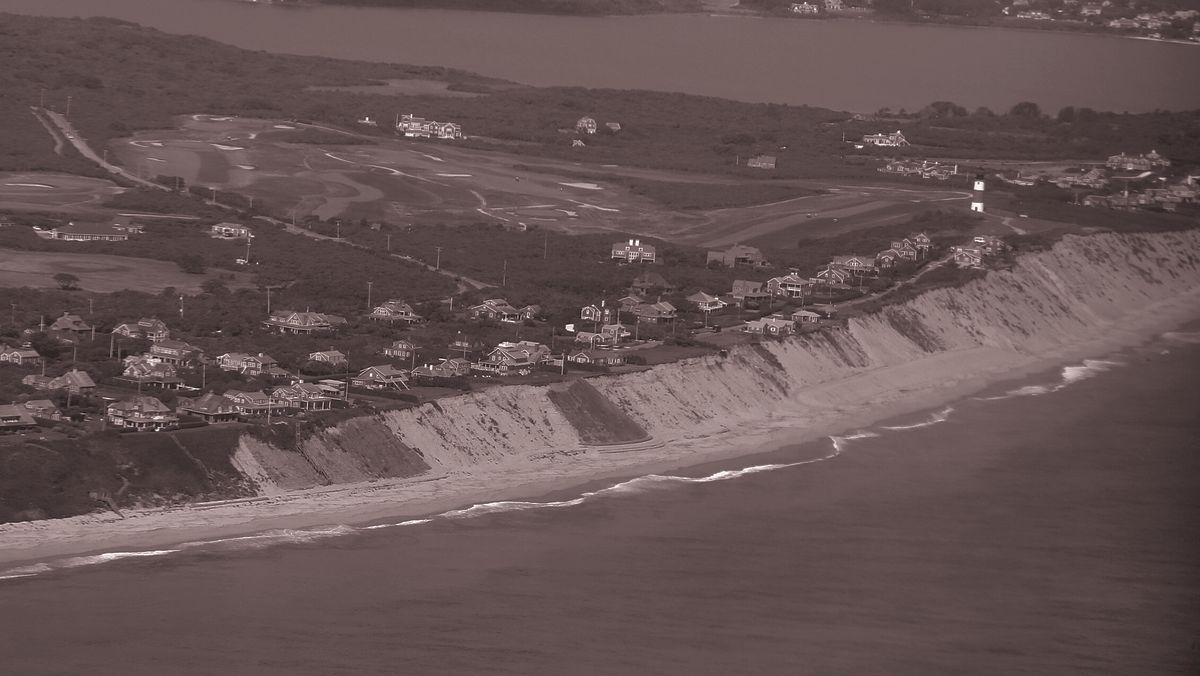
A few weeks earlier, on Saturday, January 30, Balkind had sent his aerial drone to Sconset, on the far eastern edge of Nantucket, to take pictures of the so-called geotube project, which spans a roughly 1,000-foot-long section of remote beach some 75 feet below the Sconset Bluff and Baxter Road (home to about
80 summer residents, including me). The geotube project is a network of very large, sand- and water-filled geotextile-fabric tubes embedded into the beach that together act like a sort of old-fashioned granite breakwater. The tubes, designed to protect the toe of the bluff, were installed on an emergency basis in 2014, after a big storm, and were paid for by many of the Baxter Road residents in an attempt to prevent further erosion of the bluff and of the road itself—as well as to try to keep
any more of their homes from falling into the Atlantic.
The geotubes have so far prevented the road from breaching, which would cut off access to a number of homes and to the historic 1850 Sankaty Head Lighthouse, a major island tourist attraction. If Baxter Road breaches, the town would be on the hook to replace it, and the utilities underneath it, at an estimated cost of some $40 million. Even still, the geotube project has been the source of plenty of controversy.
In addition to
being a playground for the wealthy, Nantucket is also home to those who harbor a robust Puritan streak and who abhor any actions taken around the island that are not “God’s way,” even if it means that people lose their houses to a constantly shifting and eroding coastline. To the critics of the geotubes, of which there are legions around the island, the idea of embedding big textile tubes into an otherwise pristine beach to preserve the homes of rich people simply does not fly. Too bad
is their cri de coeur—Nantucket is a big pile of sand in the middle of the ocean, and if it erodes, so be it. Typical of the comments posted recently on Facebook about the geotubes are “You can’t out-engineer Mother Nature,” courtesy of Bo Neato, and, from Kevin Shlatz, “It’s not nice to mess with mother nature. Why not just let it erode?”
The state of Massachusetts has also joined the fray, and in some ways
added to the controversy. On January 29, the Massachusetts Office of Coastal Zone Management issued a report critical of a proposed expansion of the geotube project. “There may be temporary and permanent impacts to resource areas associated with the construction, maintenance, and mitigation that have not been identified,” the report read in part. But then, on February 10, the Massachusetts Executive Office of Energy and Environmental Affairs gave the project a procedural green light when it
determined that no full environmental-impact report on the proposed expansion was needed, and issued a certificate allowing work to proceed. |
Once a month for five years now, Balkind’s drones have been flying over the geotubes. He’s one of the
project’s self-appointed gadflies, and the drones are his way of making sure that the Sconset Beach Preservation Fund (S.B.P.F.), the nonprofit organization that arranged for the installation of the geotubes and maintains them, does what it has promised to do to preserve them.
Balkind told me he is skeptical that the S.B.P.F. has properly maintained the geotubes over the years, specifically by failing to cover them on a regular basis with an agreed-upon amount of so-called sacrificial
sand, and believes the geotubes have contributed to erosion on other nearby beaches. His harsh assessment of the S.B.P.F. and the geotubes is much debated along Baxter Road, where residents credit them for preventing further erosion and hope Nantucket voters will approve the expansion of the project in front of more homes on the bluff (including mine) at the Annual Town Meeting in May. Getting that approval has been considered a long, but not impossible, putt.
Back on that Saturday in
late January, when Balkind looked at the drone pictures of the geotubes, he noticed that a 90-foot-long section of one had deflated and its contents had spilled onto the beach, potentially putting part of the bluff, and the road above it, at risk of fresh erosion. Balkind’s antenna shot up. There was no such deflation on the geotube images his drone had taken in December. “I actually thought it was storm damage,” he said. Balkind notified the town about the compromised geotube and sent the video
to the Nantucket Coastal Conservancy, which posted it on Facebook. “We interpret this to mean that after 12 years in place, the existing geotubes are nearing the end of their service life,” he wrote to town officials. He did not notify the S.B.P.F. about the damage.
The next day, Vincent Murphy, the sustainability programs manager for the town’s Division of Climate and Resiliency, emailed Meridith Moldenhauer, one of the leaders of the
S.B.P.F., and told her that he had a copy of Balkind’s video and that it looked like a portion of the geotubes had failed in two places. “I immediately responded, saying that we would get somebody out there as soon as possible,” Moldenhauer told me. (There was a nor’easter on the following Sunday, preventing an immediate visit.) “I was just like… let’s find out what’s happening and figure out what we can do,” she recalled.
On Monday, a crew from the S.B.P.F. went to inspect the geotubes.
Soon after, Moldenhauer received a set of close-up pictures. She was astonished at what she saw. There were multiple long slits along the horizontal side of one of the geotubes. The images showed that “the tubes had not naturally failed,” she told me. “I couldn’t believe that somebody would take such horrible actions.” She called the Nantucket Police and reported the alleged act of vandalism. “We are extremely concerned and frankly shocked,” she emailed the Nantucket Current, the local news
website. “This was a deliberate criminal act, and this kind of behavior cannot be accepted or minimized.” She also sent an email to S.B.P.F. supporters: “Someone vandalized the geotubes and as a result we have an emergency situation.” |
All hell then broke out, or what passes for all hell breaking out on Nantucket during the slow winter months.
The police opened an investigation and filed a report. “At this time, I haven’t been able to gather any information regarding this incident,” Officer Jonathan Santoro concluded on February 2. He even went out to the site to see if there might be video cameras installed; alas, no.
Flint Technical Geosolutions, the geotubes’ manufacturer, showed up to assess the damage, and on February 3, William Smallwood, its president,
wrote to the S.B.P.F. that “the cuts were made by a very sharp instrument, such as a box cutter or knife. This is made evident by the smooth edges of most of the cuts.” He added, “The damage caused to the geotextile tube structure was, without any doubt, caused by malicious vandalism with the sole intent of causing a structure failure.”
Conspiracy theories ricocheted around the island. Was this intended as sabotage ahead of the Town Meeting vote to expand the geotubes? Was it an effort to
divert attention away from the two recently issued, and conflicting, state determinations? Or was it God’s way? “I’m OK with it,” Adam Rapoza posted on Facebook. “Let the coast do whatever it does naturally and don’t tell me erosion control is done for any other reason than greedy economics.”
In the subsequent days, the entire compromised section of the geotubes, three layers high, gave way, depositing more sand onto the beach and once again increasing
the risk of further erosion to the bluff. On February 7, Moldenhauer sent out a fundraising letter to the S.B.P.F. faithful, explaining what had happened and that the alleged vandalism was continuing to damage the integrity of what had grown to be a 117-foot section of the nearly 1,000-foot-long project.
“This act of sabotage could not have come at a worse time—in the heart of winter storm season,” she wrote. “The damage is continuing to evolve, exactly as one would expect from an attack
intended to destabilize the entire system.” She wrote that the cost of the immediate repairs was estimated to be $1 million. Another $700,000 was needed to pay for legal, environmental, public relations, and administrative costs, plus the expense of placing more sand on top of the exposed geotubes. Without the immediate funding, she wrote, “we may be forced to walk away from the existing geotube array and from defending our hard-won approval for expansion.”
In the days after the alleged
vandalism, someone—no one will say who—hired Ed Davis, a former Boston Police commissioner who now has his own security consulting firm, to investigate the alleged geotube vandalism. In an interview, Davis told me that after he was hired, he sent a “man on the island” right over to the site. He also dispatched a former F.B.I. agent and a former police chief to the beach.
Davis, who has also been on CNN talking about the Nancy
Guthrie kidnapping case, concluded, “The clean, linear cuts are consistent with a premeditated and willful act of vandalism. This was in no way an accident or the result of natural forces.” Davis told me he thought the perpetrator must have used “some type of heavy knife” since “that material is not easy to cut through.” He issued a report to his mystery client but declined to share it.
The S.B.P.F., meanwhile, is offering a $10,000 reward to anyone who shares information
with the police that leads to an arrest of the culprit. “Hopefully that will prompt some phone calls, if anybody is bragging about it, or is responsible for it, and has mentioned that,” Davis told me. He thinks the Nantucket Police have done “a good job” of canvassing the community to try to “turn something up,” but conceded that the site of the alleged crime is a remote beach with no Ring cameras or other surveillance devices. “Nature is a tough opponent down there,” he said.
He said the
Nantucket Police are taking the lead on the investigation. “It’s a criminal act that occurred in the jurisdiction,” Davis continued, “but we’re happy to help in any way and try to generate some leads.”
Jody Kasper, the Nantucket chief of police, directed me to speak to Lieutenant Angus MacVicar about the investigation. MacVicar is very affable and chatty. He told me how he rides his fat bike on the Nantucket beaches,
including on Sconset Beach, during the winter months, when no one is around and the surface is nearly frozen and the tide is low. “I think the geotubes have worked quite fine,” he said. “And I think if I owned property, like you do, I would want to take every measure I could to protect it.” But, MacVicar also told me, the investigation has gone nowhere: “We haven’t received any leads since that notification of the reward was done.”
Whether, come the May Town Meeting, this act of vandalism
creates a groundswell of support for approving the extension of the geotube project in front of more homes on Baxter Road remains to be seen. The Inquirer and Mirror, the local newspaper, editorialized about the “senseless, foolish and criminal act” of cutting the geotubes, and that while “debate has raged for more than a decade … there’s been more than enough rancor, mud-slinging and legal machinations to go around, without resorting to malicious destruction of property.” The
paper argued for the need for everyone to come together to reach “some sort of resolution” on the geotube expansion project, and on the geotubes themselves. It wrote that getting approval for the extension at the Town Meeting is “no doubt a steep climb,” but “it’s not worth giving up on.”
Moldenhauer isn’t sure whether there is enough support among town voters for the extension, or whether the incident has created any goodwill for it. Yes, the state of Massachusetts will probably issue a
needed construction permit soon. And, yes, the effort finally has the backing of the town selectmen and of the local Conservation Commission, after years of negotiation and compromise, essentially because the project shifted from being one designed primarily to protect a bunch of private homes from falling into the ocean to one designed to try to protect Baxter Road itself and the public infrastructure underneath it—and, of course, as a way to avoid the $40 million cost of replacing the road and
that infrastructure.
But Moldenhauer is still a bit cautious about the vote, it seems. “We’ve always been nervous about having the support of the local Nantucket community,” she said, “but we were hopeful that … with our co-partner—the town—embracing and moving forward on the project … that we would be in a much better position in the Town Meeting. With this new, unexpected circumstance of the vandalism, we hope that it renews everybody’s support for the project, and only makes more acute
the fact that this is needed in order to protect this area that gets … a high level of erosion.”
Spruce Balkind, at the Coastal Conservancy, still thinks the geotubes have caused more problems than they have solved, primarily, he argued, because the beach in front of the geotubes has “almost disappeared.” He cited Mark Borelli, a coastal geologist in Provincetown, Massachusetts, who claims the beach will “disappear in the next few years.” He said Borelli
told him geotubes are not “erosion-control projects,” but rather they are “erosion-relocation projects,” because “they move the erosion to other places.” (By my reckoning, Balkind is exaggerating the consequences of the beach erosion caused by the geotubes, although there continues to be erosion all over the island, the vast majority of which is not protected by geotubes or anything else.)
But, Balkind concedes, the damage done to the geotubes does appear to be an act of vandalism. The
cuts “look suspiciously linear,” he said, adding that “vandalism on Nantucket should not be tolerated.” He said he’s been cooperating with the police and sent them his video as well as additional pictures related to the incident. “If it is vandalism, find the person that is guilty of it and make them pay for what they did,” he said. |
|
|
|
Puck sports correspondent John Ourand and a rotating cast of industry insiders take you inside the executive suites and owners
boxes where the decisions that shape the entire sports business are made. You’ll hear interviews with players, network execs, and everyone in between. The Varsity is an extension of John’s private email for Puck by the same name. New episodes publish every Wednesday and Sunday. |
|
|
|
Puck’s daily political newsletter from Washington on what’s really happening in this town, from the White House to the Pentagon
to Capitol Hill, K Street, and the campaign trail. |
|
|
|
Need help? Review our
FAQ page or contact us for assistance. For brand partnerships, email ads@puck.news.
You received this email because you signed up to receive emails from Puck, or as part of your Puck account associated with {{customer.email}}. To stop receiving this newsletter and/or manage all your email preferences, click here. |
Puck is published by Heat Media LLC. 107 Greenwich St., New York, NY 10006 |
|
|
|
|