Welcome back to The Varsity. I’m John Ourand in D.C., licking my wounds
from a disastrous fantasy football season here at Puck. Just this weekend, Eriq Gardner’s team, Paperless Lion, beat the Grinfuckers by 85 points!
Did you see The Athletic’s deep dive on Panini’s lawsuit against Fanatics? The headline highlights Panini’s “‘weird’ sales pitch,” and it only gets worse from there for the Italian trading-card and collectibles company. Worth a
click…
Today, the inimitable Julia Alexander talks with Matthew Ball, the well-respected media strategist turned venture capitalist, about a fascinating dark horse topic: When will Electronic Arts become a legit bidder for live sports rights? And, like all of Julia’s excellent work, it’s available only to
Inner Circle subscribers. Click here to upgrade. It’s worth it.
Mentioned in this issue: Saudi Arabia’s Public Investment Fund, Taylor Swift, Steve Kornacki, Patrick Mahomes, Marshmello, Bundesliga,
Travis Scott, Jay Marine, Ted Sarandos, the “Albanian army,” Cristiano Ronaldo, and many more…
Take it away, Julia… |
Stat of the
Week: Four Minutes
|
That’s about how many minutes of ads ran on NFL RedZone last Sunday across the afternoon
windows, per an SBJ report. Doesn’t sound like much, sure, but fans had gotten used to the ad-free experience—for which they’d been paying top dollar. Then executives started turning the revenue dial… slowly, at first, and now a lot less slowly.
It’s a perfect example of Cory Doctorow’s theory of enshittification—which posits that financial incentives are inevitably making most tech products worse. During the
first week of the NFL season, the league suggested the ad load would remain relatively low on the formerly ad-free product. But the number of commercials keeps creeping up: Last Sunday, RedZone ran about 16 ads, all 15-20 seconds in length. What are the chances it stops there? Yup, zero! |
|
|
A MESSAGE FROM OUR SPONSOR |
Forever at the top of its game, the trailblazing BMW 7 Series. Engineered to win. Learn more at
BMWUSA.com |
|
|
- Bravo’s NFL
takeover: For the longest time, I thought I was one of the few people on the planet who enjoyed watching NBC’s Sunday Night Football as much as I loved catching up with my favorite psychopaths on Summer House. But the success of Reality Hot Seat, Sunday’s Bravo/SNF crossover featuring Peacock and Bravo reality stars commenting on games, suggests there’s more of us than I thought. (It was awesome, by the way…)
The pitch is pretty straightforward: As
Bravo/Peacock unscripted chief Frances Berwick told Deadline, “We’re starting to see the female viewership for the NFL go up, and Reality Hot Seat is a way of harnessing these two huge fandoms.” Indeed, more women are watching the NFL than ever before, thanks in part to the Taylor Swift effect. But also, as Vulture rightfully pointed out, it’s just plain fun to live in a universe where Peacock airs a Texans–Chiefs game while
Below Deck’s Kate Chastain uses Steve Kornacki’s Big Board to draw tears falling down Patrick Mahomes’s face. It’s rare to see new formats for NFL games. Even if this is just an attempt to appeal to the “four-quadrant” household that Versant boss Mark Lazarus liked to talk about during his NBCU days, it certainly works. - Versant’s outlandish viewership data:
During Versant’s big investor day last week, the company displayed a chart for analysts that offered an elite case study in the art of spin. The chart suggested that Versant’s suite of orphaned cable channels ranked second in total hours watched behind only Netflix, with 14.4 billion hours compared to the streaming giant’s 40.5 billion. Versant’s data put the company ahead of Hulu’s 13.8 billion hours and Disney+’s 10.4 billion hours.
Accurate, perhaps, but missing some
important context. After all, there’s a big difference in value between declining, stagnant audiences and audiences that can be converted to digital subscription platforms. To wit: Cable’s share of total TV time dropped from 33 percent in November 2022 to around 22 percent last month. Meanwhile, digital platforms are now collecting more than 50 percent of total TV advertising spend. So while Versant has more total hours watched than Hulu or Disney+, it’s safe to say that the vast
majority of investors, advertisers, and audiences would pick Hulu and Disney+ over Versant any day of the week. (As my partner Bill Cohan says, this is not investment advice.) - Fox’s silly World Cup ad win: Sports, as everyone knows, isn’t about the underdog victory or the sorrow that follows a team’s dynasty coming to an end. It’s a chance to sell ads. (The money’s got to come from somewhere!) Which is why I am
genuinely tickled by FIFA’s new “hydration rule” for next summer’s World Cup, which dictates that games be stopped 22 minutes into each half to allow players to have a bit of water—a true TV timeout.
On the face of it, a hydration rule is not a bad idea—especially after the last World Cup, in Qatar, where concerns were raised about playing in scorching temperatures. (That’s partially why the tournament was held in November and December.) Certain parts of the United States and Mexico will
likely experience sweltering heat this summer, too. The rule does help with player safety, but perhaps no one is more excited about this opportunity than Fox’s Lachlan Murdoch and Eric Shanks, who will undoubtedly use those extra six minutes to slake their thirst for very, very, very expensive ad buys. Well-hydrated players and well-compensated broadcasters: a win-win.
|
And now for the main event… |
|
|
The world’s second-largest video game publisher is no longer simply
battling other game makers for eyeballs. It’s also competing against Netflix, Amazon, TikTok, etcetera. Does that make its entrée into the sports rights wars inevitable? |
|
|
Back in September, when video game publisher Electronic Arts announced plans to go
private in a $55 billion deal led by Saudi Arabia’s Public Investment Fund, I surfaced a simple, albeit outlandish, theory floated by the brilliant futurist Matthew Ball. Could the maker of such beloved franchises as Madden and FIFA move to seriously pursue live sports rights at some point in the not-too-distant future?
The sports media ecosystem is rapidly changing. TikTok and Instagram are pummeling fans with a nonstop targeted feed of highlight reels
and behind-the-scenes moments—clips that are often more engaging, and definitely more easily consumed, than the actual games. For their part, gaming companies are under pressure to compete for these same eyeballs while monetizing a new generation of sports fans. The emerging strategy, it seems, is to provide content that looks a lot like TV.
We’re beginning to see the early signs of where this might lead. Fortnite, for example, staged in-game concerts by
Marshmello and Travis Scott that drew tens of millions of viewers. Meanwhile, Evan Dexter, EA’s V.P. of brand strategy and marketing, noted in an interview a few weeks ago that the company has already experimented with augmenting live
games. For the past two years, they’ve partnered with Peacock on a “MaddenCast” that lays the game’s graphics over a live NFL match-up—an effort to “make the viewership experience better and more data-immersive for existing football fans,” said Dexter, “as opposed to leveraging outside I.P. to attract new ones.” |
|
|
A MESSAGE FROM OUR SPONSOR |
Forever at the top of its game, the trailblazing BMW 7 Series. Engineered to win. Learn more at
BMWUSA.com |
|
|
But this kind of partnership is a far cry from active sports rights bidding and
acquisition. Ball, a venture capitalist and consultant who is known for his accurate predictions of audience migration habits, recently published a widely circulated essay that dove into why and how this could play out. He believes it’s inevitable that live sports will start appearing on EA’s gaming platform—especially as gaming becomes more integrated into fans’ day-to-day lives.
|
EA tipped its hand in May, when the company licensed four MLS matches from Apple,
allowing gamers to watch them inside the FC Mobile app. Sure, it was only four matches, but Ball noted that this kind of experimentation is always the first sign of real interest. To wit, Amazon’s Jay Marine now reportedly spends more than $3 billion a year on live sports, but the habit started by doling out $50 million for nonexclusive Thursday Night Football games. At Netflix, Ted Sarandos and Gabe Spitzer just entered their
first multiyear sports commitment via a $50 million-a-year deal for MLB’s Home Run Derby.
But content FOMO isn’t the only driving factor. As Ball has pointed out, consumer spending on the gaming sector has declined by roughly 12 percent since 2021, and the only games really seeing growth are social “black holes” like Fortnite and Roblox. In this
challenging environment, perhaps the biggest growth opportunity for EA is to lean into the high-engagement titles that power its business, like College Football, FC, and Madden—which, Ball wrote, “constituted upwards of 80 percent of EA’s total nonmobile playtime” in 2024. Crucially, he told me, “The industry has become comparatively more concentrated, and boasts more and bigger misses than Hollywood. It’s a clear example of a media category that, at least
recently, has been losing the attention war.”
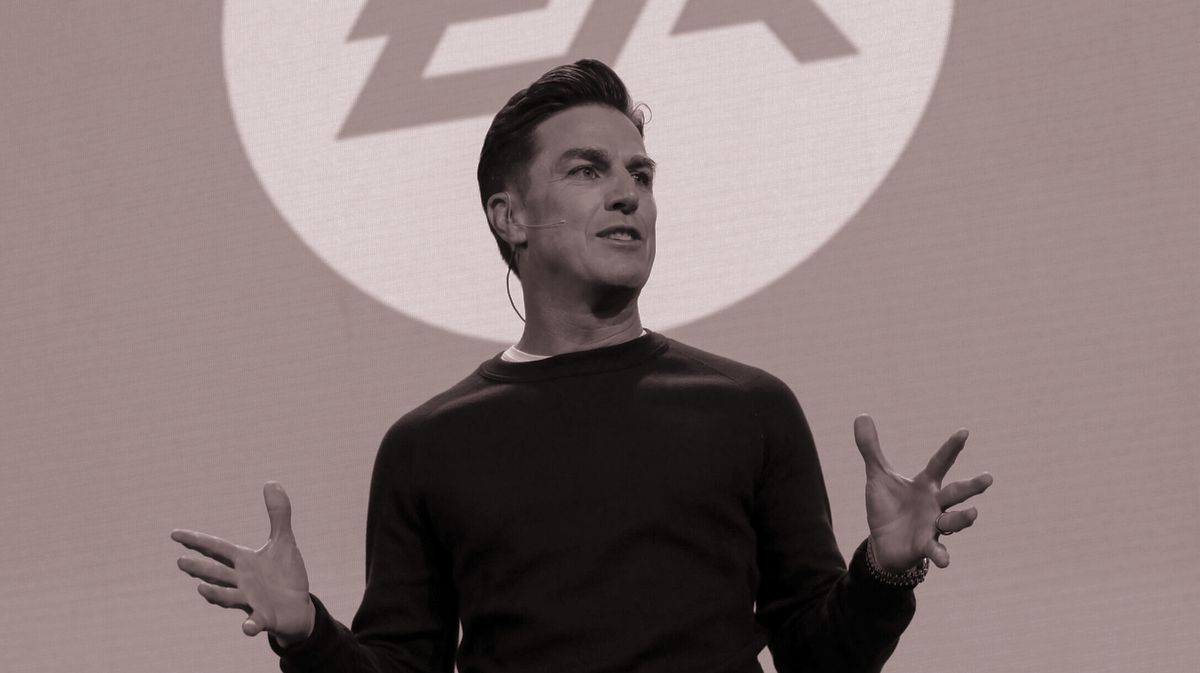
Given these headwinds, the pursuit of live sports rights might be one of the few viable untapped revenue opportunities for EA C.E.O. Andrew Wilson, despite the significant upfront costs. And clearly, it’s been top of mind. During a recent investor day, Wilson noted that EA Sports titles attract about 265 million monthly players, but that there’s an audience of 4 billion sports fans that the company has in its
crosshairs. As the overlap between gaming and TV time continues to increase, Wilson wants EA to become the home base for as many fans as possible.
Naturally, that might involve expanding their platform ecosystem. One idea, Ball suggested, is to build a new TV app (and potentially a new mobile app) that would be available to download on any television set, allowing the company to serve users live sports content directly. Meanwhile, Ball told me, “You don’t get into live
sports—least of all marquee sports—to be a tiny, nonexclusive participant.” In other words, the company wouldn’t necessarily start with a domestic focus. Given PIF’s heavy investment in EA, perhaps there’s a distribution opportunity with the growing Saudi Pro League, where Cristiano Ronaldo collects his checks. |
“You Have to Stay Paranoid”
|
The timing would be ideal, and the company might be able to capitalize on several of the
biggest trends in sports. First, leagues are trying to create more one-off games and tournaments to meet demand from the likes of Amazon, YouTube, and Netflix. Media partners are also starting to sublicense some of their own sports rights in an effort to bolster revenue and offset rights cost burdens. At the same time, leagues are increasingly trying to reach fans
directly. EA isn’t a direct competitor to any traditional media company—it represents new, experimental territory, making it the kind of bidder that could excite tech-forward leagues like F1. Other leagues may be interested in collaborating at a low cost, just to see if it benefits their own expansion efforts.
This sort of experimentation obviously
seems more enticing for developing organizations, like the Saudi Pro League, than for the NFL or NBA. But there may be incentive to experiment for mid-tier leagues, like the Bundesliga—or even MLS and the NHL. It’s why MLS and Apple agreed to a deal with EA in the first place. If you remove the U.S. market from the equation, it starts to get much more interesting. “EA is already a more valuable company than some major U.S.-based media licensors of sports media rights,” Ball told me. (It’s also
many multiples larger than Paramount Skydance, for what it’s worth.) “And abroad, it financially dwarfs most national or regional licensors.”
The most difficult and fascinating part of my job is distinguishing seismic changes in the entertainment industry from noisy distractions. Netflix was a DVD rental business whose larger ambitions were scoffed at; now the “Albanian army” is on the verge of owning the studio that made Casablanca. TikTok and YouTube were apps for bored teenagers; now
they collectively bring in tens of billions of dollars in global advertising revenue. “There are always new bidders and platforms for sports rights. In 2030, we’ll be talking about someone, maybe multiple new someones,” Ball told me. “Is that EA, or TikTok, or Epic Games, or OpenAI—or Instagram, or Qatar, or PIF, or something not yet founded? I don’t know. You have to stay paranoid.” |
Thanks, Julia! See you all on Thursday.
John |
|
|
Ace media reporter Dylan Byers brings readers into the C-suite as he chronicles the biggest stories in the industry:
the future of cable news in the streaming era, the transformation of legacy publishers, the tech giants remaking the market, and all the egos involved. |
|
|
Puck sports correspondent John Ourand and a rotating cast of industry insiders take you inside the executive suites
and owners boxes where the decisions that shape the entire sports business are made. You’ll hear interviews with players, network execs, and everyone in between. The Varsity is an extension of John’s private email for Puck by the same name. New episodes publish every Wednesday and Sunday. |
|
|
Need help? Review our
FAQ page or contact us for assistance. For brand partnerships, email ads@puck.news.
You received this email because you signed up to receive emails from Puck, or as part of your Puck account associated with {{customer.email}}. To stop receiving this newsletter and/or manage all your email preferences, click here. |
Puck is published by Heat Media LLC. 107 Greenwich St., New York, NY 10006 |
|
|
|