{{ 'now' | timezone: 'America/New_York' | date: '%b %d, %Y' }} |
|
|
Welcome back to The Varsity. I’m John Ourand, pouring one out for
Mike Tomlin, who could walk into any TV job he wants right now. (I’m betting he winds up at Fox, which still hasn’t replaced Jimmy Johnson.) But after coaching for 19 straight years without a losing season and notching two Super Bowl appearances—and one Lombardi Trophy—don’t be surprised if another team convinces him to stay on the sidelines a few more years.
Today’s biggest sports media news is that Fanatics is getting into the production business,
setting up a joint venture with OBB Media, dubbed Fanatics Studios, that will produce feature films, documentaries, the ESPYs, and more. Michael Ratner, the C.E.O. of OBB, will be on tomorrow’s episode of the Varsity podcast to break it all down. Subscribe here or
here.
In today’s Inner Circle issue, the incomparable Julia Alexander dives into ESPN’s legal dispute with Sling and considers what the executives in Bristol need to do to attract both diehard fans and casual viewers these days.
Take it away, Julia… |
Stat of the Week: 83 Games
|
To absolutely nobody’s surprise, the NFL once again dominated Nielsen’s ranking of the
most-watched broadcasts in 2025, with 83 games landing in the top 100. But that number was down from 2023, when the NFL occupied 93 spots. The league might have cracked the 90s again if it weren’t for college football, which put seven games on the list—one of the sport’s most prominent years.
Could that record be broken in 2026? After all, there’s no question that this year’s championship game, between Fernando Mendoza’s Hoosiers and Carson
Beck’s Hurricanes, will rank high on next year’s list. Who wants to wager on Kalshi how many spots college football will take? (You can also reply to this email with your guess!) |
- Milan’s ice problem: Just a few weeks out from the February 6 start of the Winter Olympics in Milan, alarm bells are ringing in the ice hockey universe following a report from The Athletic’s Chris Johnston—a Canadian, and therefore an expert on all things frozen—who toured Milan’s still-unfinished Santagiulia Arena. While watching a test game on the arena’s rink, Johnston tweeted about a sizable hole in the ice near one of the nets.
This came several months after NHL officials first raised concerns about the lack of progress at the facility. The anxiety has been compounded by the fact that this is the first time the league has allowed its players to compete in the Games since 2014.
The good news, I suppose, is that Olympic organizers have promised that everything will be in ship shape by the time the torch is lit next month. But these obstacles—and the lack of frozen water in particular—were
tragically predictable considering the arena’s extended construction delays. Might be time to attach flotation devices to your shoulder pads, boys! - Sideline billionaires: Even though Mark Cuban has stepped away from the Dallas Mavericks after selling his majority stake in the team, the Shark Tank mainstay can’t seem to stay away from sports. After his recent, undisclosed contribution to the football program at
Indiana University—his alma mater—Cuban has been a fixture on the sidelines of Hoosiers games. He even made it onto the field to celebrate the team’s 56-22 blowout of the Oregon Ducks in the CFP semifinal. Sure, it’s not unusual to see billionaires sitting courtside or cavorting in private suites during professional games, but it’s a bit of a novelty in college.
This dissonance was perhaps best summed up by St. John’s basketball coach Rick Pitino. At the end of last year,
he posted on X that college basketball is “no longer college basketball. It’s professional basketball with budgets that rival the Euroleague. … Unfortunately the game I’ve been in for over 40 years no longer exists.” (We won’t let Rick’s dismissal as Louisville’s head coach in 2016 amid a pay-to-play recruiting scandal distract too much from his otherwise salient point.) Indeed, now that big money has become sanctioned within college sports, and billionaires are throwing dollars at some of the
largest D1 schools in the country, I expect the landscape (and the sidelines) to look even more Forbes List-y by the end of this year. - Could an in-season tournament save MLB?: Tonnage was once Rob Manfred’s biggest asset, but amid a declining cable business and the collapse of the regional sports network model, he suddenly has a lot of games that streamers don’t want. Manfred, like others of his commissioner station,
is trying to find ways to eventize MLB beyond the World Series, All-Star Game, and Home Run Derby. Part of the answer may look very similar to what Adam Silver is trying to do with the NBA and its own midseason tournament.
This year’s NBA Cup, which saw Jalen Brunson’s Knicks take on Victor Wembanyama’s Spurs, pulled in more than 3 million viewers—up 3 percent compared to the year prior (the audience was also much younger thanks to
streaming). The always alluring New York market certainly helped, but either way, it’s evidence that audiences will tune into these midway checkpoints. The only problem facing Manfred, as he’s previously recognized, is how much “more complicated of a thing” it is for baseball, with its 162-game schedule. Hence why the commish would only seriously consider adding the tournament if the league also committed to a shorter regular season. Look, I say this as a diehard Yankee fan: I would not
be opposed to a few more nights off between April and October.
|
|
|
The legal battle between Disney and Dish Network over Sling TV’s “Day Pass” belies
a much more pressing question facing networks and distributors: How do you engage diehard and casual sports fans in an era of unlimited choice? |
|
|
For years, the sports media business has been flirting with micropayments—smallish fees that allow
fans to access content on a one-off basis. In 2018, the NBA experimented with letting fans purchase just the fourth quarter of games. (It didn’t really work.) Last year, Amazon introduced pay-per-view–style transactions for select soccer programming in the U.K., charging around $3.50 a match. More recently, of course, Disney sued Dish Network over Sling TV’s “Day Pass”—a one-day subscription that would allow viewers to, say, watch a full slate of Sunday NFL games for $5… or anything
they want, really. But let’s be clear: These passes are targeted directly at sports fans. (In November, a court denied Disney’s request for a preliminary injunction, meaning Sling can continue offering the passes while the case proceeds.)
On the most basic level, this is a dispute between two companies over a valuable customer base—and the legal arguments are fairly predictable. In the eyes of the distributor, Dish pays for the right to carry ESPN and should be allowed to sell
different packages at preferred price points. ESPN, on the other hand, doesn’t want to lose its most price-sensitive customers. Take last night’s Monday Night Football finale: If people can pay Sling $5 to watch C.J. Stroud’s Texans take on Aaron Rodgers’ Steelers in their AFC wild card matchup, does that limit ESPN’s potential subscriber gains?
But no matter how the lawsuit—and recently filed countersuit—shakes out, it raises a philosophical
question for the industry: How do you engage diehard and casual fans in an era of unlimited choice? Moreover, are micropayments merely a gimmick—or a real solution for getting fickle customers to choose a TV experience over, say, watching highlights on TikTok? Naturally, the answers are complicated, nuanced, and not universally applicable. |
Diehard fans, of course, are on the hunt for year-round (or season-long) access to their
favorite sports, and are presumably loyal to their preferred platforms. Plenty of data bears this out. According to Antenna, more than 4 million customers signed up for ESPN Unlimited and Fox One between their August launches and the end of October; Sunday Ticket (the class action is still going!) has seen a 40 percent increase in customers since Google’s $2 billion-per-year exclusivity deal kicked in in 2023; and even cable (including services like YouTube TV) has seen a tiny resurgence
(300,000 net subscribers gained in Q3) thanks to the popularity of professional and college football. In short, diehard fans can almost always be found somewhere in the funnel—usually near the bottom.
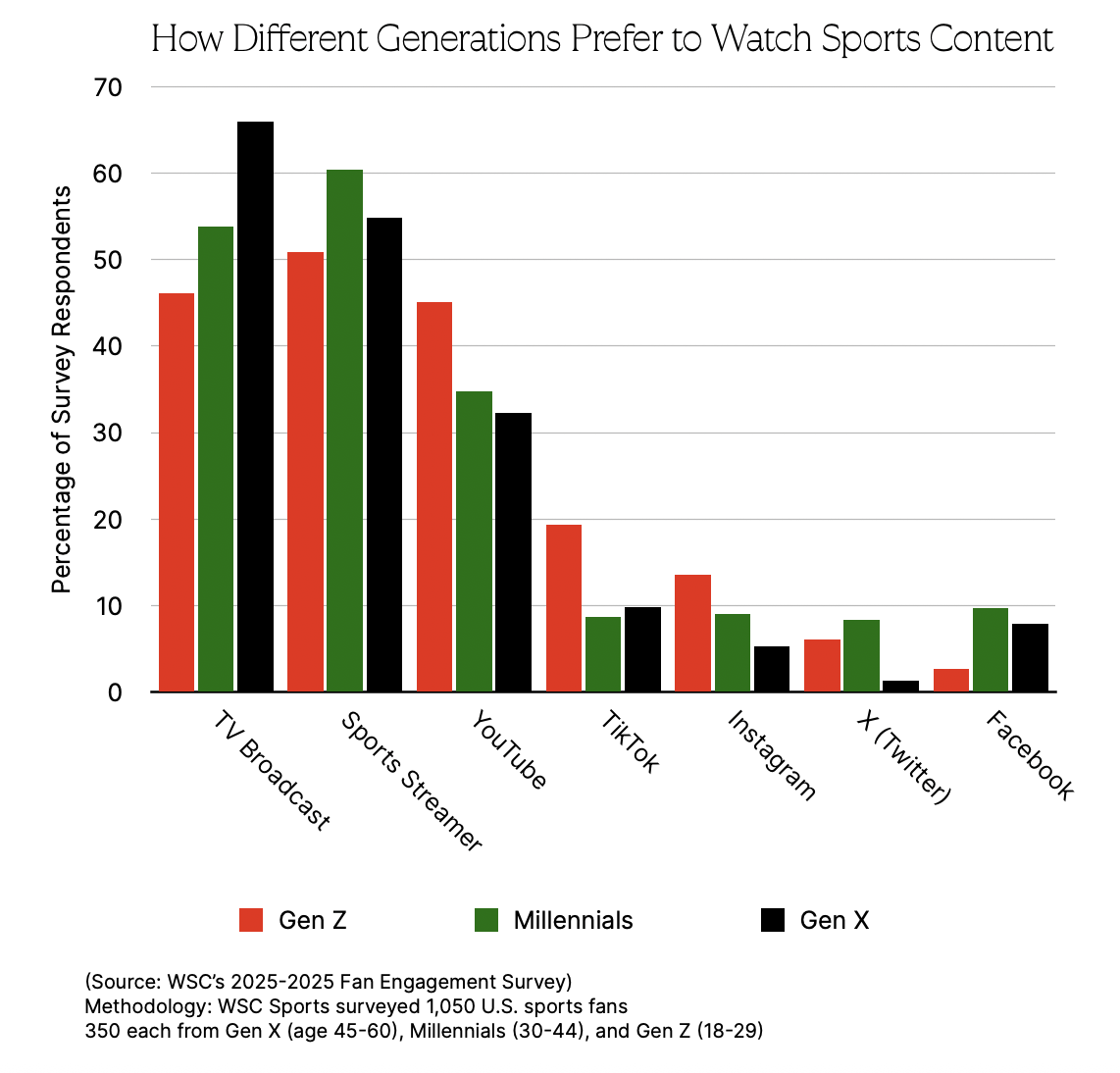
Their counterparts, the casuals, are extremely tricky to retain, especially in the streaming era. That’s one of the reasons why businesses like Sling and Amazon have turned to micropayments: to offer them a low-stakes entry point. After all, recent data shows that casual fans, and
especially young ones, are actually more engaged with sports content than ever before: Last year, WSC found that Gen Zers are 76 percent more likely than Millennials to describe themselves as “casual fans,” who engage in sports-adjacent content like highlight reels and podcasts as well as the occasional live game. Still, Gen Zers are far more likely than Gen Xers or Millennials to consume that content on free social media platforms like TikTok, Instagram, and YouTube than via paid streaming
services. |
It doesn’t take a marketing genius to understand why casual fans would rather watch sports clips on
their phones, for free. It’s not just that the content is portable: Most streaming services have increased their monthly subscription fees by double-digit percentages over the past year or so.
Naturally, this presents a headache for the likes of ESPN chairman Jimmy Pitaro and his new head of platform distribution, Jimmy Zasowski, both of whom know that the future of their business depends on keeping younger viewers in the consumer journey
pipeline. In 2022, Pitaro admitted that worrying about how to reach younger audiences kept him up at night. “As an industry in general, we need to figure out how to be more relevant to younger people,” he noted. Since then, and despite widely held assumptions about the strength of Disney’s streaming business, domestic subscriber numbers have barely budged. And while ESPN Unlimited might help increase subscribers, most analysts will tell you that the total addressable market of
diehard fans willing to spend $30 a month on one of many platforms for live sports isn’t as large as Pitaro is hoping for.
In media executives’ fantasies, the streaming era was supposed to allow networks with built-in audiences, like ESPN, to directly reach their customer base. But an oversaturated entertainment landscape, and the rise of social media platforms as hubs for sports content, has complicated all that. Back in August, when Sling’s Day Pass was announced, the company’s S.V.P.
of product and operations, Seth Van Sickel, said, “This launch is about putting control back in the hands of the fans… all without having to sign a long-term, binding contract.” But what Sling is really proving is that most fans can get their sports fix without unlimited access to games and seasons—which should be a terrifying sign for a streaming company reliant on those very subscriptions. |
Thanks, Julia. See you all on Thursday,
John |
|
|
Join Emmy Award-winning journalist Peter Hamby, along with the team of expert journalists at Puck, as they let you in
on the conversations insiders are having across the four corners of power in America: Wall Street, Washington, Silicon Valley, and Hollywood. Presented in partnership with Audacy, new episodes publish daily, Monday through Friday. |
|
|
Ace media reporter Dylan Byers brings readers into the C-suite as he chronicles the biggest stories in the industry:
the future of cable news in the streaming era, the transformation of legacy publishers, the tech giants remaking the market, and all the egos involved. |
|
|
Need help? Review our
FAQ page or contact us for assistance. For brand partnerships, email ads@puck.news.
You received this email because you signed up to receive emails from Puck, or as part of your Puck account associated with {{customer.email}}. To stop receiving this newsletter and/or manage all your email preferences, click here. |
Puck is published by Heat Media LLC. 107 Greenwich St., New York, NY 10006 |
|
|
|