{{ 'now' | timezone: 'America/New_York' | date: '%b %d, %Y' }} |
|
|
Hello, and welcome back to The Best & The Brightest. I’m Leigh Ann Caldwell. I
hope everyone had a wonderful Thanksgiving, filled with rich and insightful political discussions about Pete Hegseth and Zohran Mamdani and
Marjorie Taylor Greene. I’m on my way back from my father’s 80th birthday bash in Cabo San Lucas, bracing for chilly weather but also slightly tanned.
🎁 It’s officially the holiday season, and a Puck subscription is the perfect gift for your politics, A.I., finance, and media-obsessed friends—and, of course, for yourself, if someone is still
forwarding you this email. It’s also a great gift for the officemates you actually like. Sign up here.
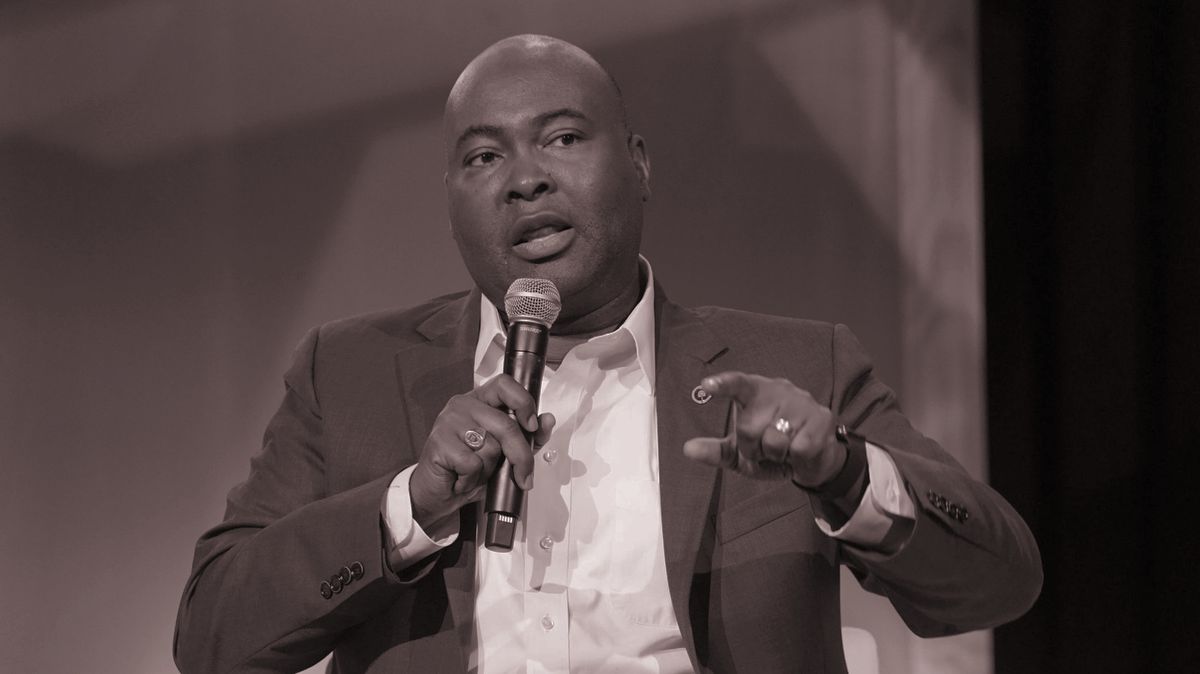
Today, I bring you my very candid conversation with Jaime Harrison, the former South Carolina senate candidate who subsequently chaired the Democratic National Committee. We discuss why Democrats keep losing in rural America—and how they might win again in
swaths of the country that the party has previously written off. Harrison smashed fundraising records in his 2020 challenge to Sen. Lindsey Graham but ultimately lost the race by double digits. Weeks later, he
founded a PAC called Dirt Road Democrats to boost the party in a reddening rural America before stepping back shortly after to take charge of the D.N.C. In 2024, of course, Trump won rural counties by 40 points, his
largest-ever margin. Harrison shares his argument for why Democrats need to reverse the red tide.
But first… |
- Noem’s
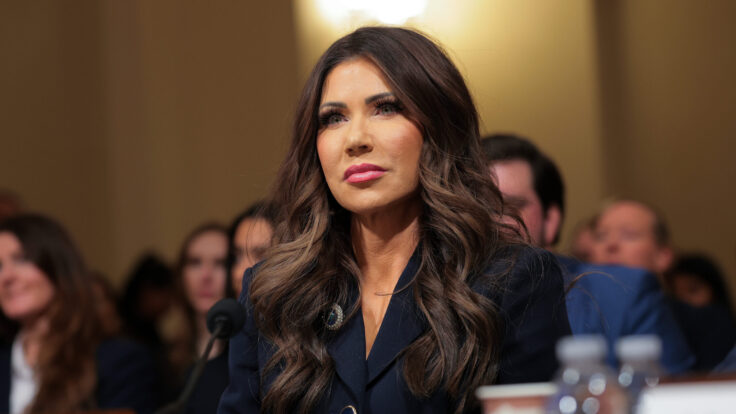
deflections: On NBC’s Meet the Press, D.H.S. Secretary Kristi Noem said the alleged shooter of two National Guard members in Washington, D.C., Rahmanullah Lakanwal, was “radicalized” in the U.S. When pressed on how the Trump administration approved his asylum claim in April, she blamed the Biden administration for inadequate vetting, explaining that the application was allowed “to go forward with
the information that they provided.”
Also on Meet the Press, Noem seemed to dismiss the notion that the administration violated a court order from U.S. District Judge James Boasberg, who ruled back in March that a deportation flight bound for El Salvador must return to the United States—and also evaded a direct question about whether she was the official who made the call. “One of the things we continue to face across this country is activist judges who are using
radical decisions that have no standing and no grounds to try to stop what President Trump is doing to protect America,” Noem responded, suggesting that the judge’s order was somehow illegitimate.
|
|
|
Meta is investing $600 billion in American infrastructure and jobs, creating opportunities in communities across
the country. Phil, a Lead Building Engineer in Los Lunas, New Mexico, has seen the impact that Meta’s investment can bring. "Supporting my family used to mean leaving my hometown and missing out on special moments,” he says. “Now, it doesn't.”
Explore Phil’s story. |
|
|
- Indiana
redistricting: House Speaker Mike Johnson was reportedly scheduled to hold a conference call with Republicans in the Indiana legislature this weekend, ahead of a session in which they plan to take up a bill that aims to redraw the state’s congressional districts to net House Republicans two more seats in the 2026 midterms. It’s a remarkable level of engagement from Johnson in mid-decade gerrymandering, especially considering that many of his own
House Republicans continue to be leery of Trump’s redistricting push after the party’s weak performance in this year’s elections.
Until recently, Indiana’s State Senate leaders had declined to take up the bill. Under increasing pressure from Trump, Senate President Pro Tempore Rodric Bray recently reversed course and announced
that the Indiana Senate could take it up next week. But over the weekend, Republican State Senator Mike Bohacek said he wouldn’t vote for redistricting after Trump used a derogatory term for people with intellectual disabilities to describe Minnesota Gov. Tim Walz. “Those of you that don’t know me or my family might not know that my daughter has Down Syndrome,” he wrote on Facebook.
Former Trump campaign manager
Chris LaCivita quickly attacked Bohacek by posting a link to an article about his recent plea deal in a D.U.I. case. Meanwhile, State Senator
Greg Goode’s home was swatted several hours after Trump criticized him for not supporting redistricting in a Truth Social post. At least eight Republican state senators say they have faced threats of violence or intimidation this month. Another Republican state senator, Greg Walker,
accused the White House of violating the Hatch Act after he was invited to meet the president in the Oval Office—outreach that Walker angrily described as “trying to influence the election on my dime.”
|
|
|
A frank discussion with the onetime Senate candidate and former D.N.C. chair about why he
still thinks Democrats can compete in rural America—and what it will take to win back red states. |
|
|
Over the past decade, Donald Trump has turned America’s town-and-country political divide
into a bottomless chasm you could see from space, winning rural counties by 40 points in 2024 and seemingly extinguishing Democratic hopes in farm country for a generation. And yet, it wasn’t so long ago that Bill Clinton, a Democrat from rural Arkansas, won nearly half the rural vote. Barack Obama
lost it by less than eight points in 2008. As late as 2010, dozens of Blue Dog Democrats represented rural House districts.
Since then, rural voters have largely given up on Democrats, and the national party has mostly returned the favor. These days, the best R.O.I. for donors tends to come from the purplish suburban districts that have swung from
Obama to Trump and back again. Of course, there’s a self-reinforcing logic to the party’s strategy: Urban and suburban areas are where most of the voters are, and rural areas are now so conservative that it’s hard to argue it’s worth investing in longshot races rather than battleground districts that are still winnable in 2026. |
|
|
Meta's AI infrastructure is bringing jobs to local communities. For Phil—and many Los Lunas, New Mexico locals—supporting his family used to mean “leaving town, and missing moments I couldn’t get back." Not anymore. Meta is investing $600 billion in American infrastructure and jobs, creating opportunities in communities nationwide. Explore Phil’s story. |
|
|
But Jaime Harrison, the former U.S. Senate candidate from South Carolina who served a
four-year term as D.N.C. chair, is trying to challenge that logic. He argues that if Democrats give up on rural voters, the party is destined to lose, as population shifts to the South create a better political map for Republicans. His Dirt Road Democrats PAC aims to win back hearts and minds in the rural districts and states where Democrats haven’t won in decades, including next year’s Alabama and South Carolina gubernatorial races.
The point, Harrison told me, isn’t necessarily to win, but rather to lose by less—part of a long-term strategy to rebuild the party’s strength in places where the Democratic brand has become toxic. He knows this endeavor will take time, persistence, and especially money, at a time when
Democratic donors are only just recovering from their 2024 hangover. But Harrison greeted my skepticism with optimism. The following conversation has been edited and condensed for clarity. |
“We Have
to Start Looking in the South”
|
Leigh Ann Caldwell: You started Dirt Road Democrats to help persuade rural
voters to vote for your party. Haven’t Democrats tried this before?
Jaime Harrison: Not really. Not in this way. For the longest time, Democrats had a foothold in rural America. Many of these communities need representation. Republicans claim to fight for rural communities, but right now we’re seeing a massive number of bankruptcies with farmers in this country under Republican control. Many family farms are going under like we have
never seen before. These folks aren’t getting the attention and the resources that they need. We didn’t have Wi-Fi in these communities, and guess what? It was Democrats who actually delivered on that. So what we have to do is talk with the folks in these communities, let them know that we’re fighting for [them].
How can you convince rural voters, who have been turning away from the party for a couple of decades, to come back?
The
first step is showing up. It’s low-hanging fruit to go into urban, suburban areas where you have concentrations of Democratic voters. It takes a little more time and energy and effort to go into rural communities. We have to attend some of the churches, some of the local functions. We have to recruit people from those communities to actually run, and to run under the Democratic ticket—things that we just have not done or done well over the past two, three decades.
Are party
outfits like the Democratic Senatorial Campaign Committee, Democratic Congressional Campaign Committee, or the Democratic Governors Association not doing that? [Ed. note: The D.C.C.C. this weekend announced Our Power, Our Country, “the earliest-ever investment” to engage rural voters and voters of color.]
This is a long-term investment effort, a partnership with state parties that isn’t just cycle-based. If you look at a state like Mississippi, Mississippi is
extremely diverse—50 percent are White, 45 percent are African American, 5 percent are Hispanic, and that number is growing. When Black voters in Mississippi go to the polls, they probably vote Democratic 80 to 90 percent for a really energized campaign.
The problem is that there’s low turnout. And many of those Black voters aren’t just in the big cities. Those folks are in rural communities. If Democrats aren’t showing up in those communities, then the average turnout is maybe 40
percent. You can’t win a race that way. There is no reason why Mississippi should not be a competitive state for Democrats. |
|
|
A lot of the races you are looking at—Alabama governor, South Carolina governor, you mentioned
Mississippi Senate, South Carolina’s first congressional seat, one in North Carolina, one in Tennessee, one in Arkansas—are considered real reaches for Democrats. So why focus on the ones that you might not have any success in?
Because you are planting seeds for long-term growth, and that’s really, really important. Why we are particularly paying close attention to the South is this: If you take a look at presidential politics, the path to 270
for Democrats in these last few elections is going to look very different after 2030. Population shifts to the Southern states are going to add more electoral votes, and so we’re going to need a different path for Democrats to win. That means we have to start looking in the South. |
“Nobody
Thought We Had a Shot”
|
But Democrats are in the minority. So should your resources focus on battleground districts this
cycle to ensure a Democratic majority in 2026?
Coming off the 2004 election, we saw something very similar to what we’ve been seeing over this last year—people writing the obituary of the Democratic Party. We lost [with] John Kerry [as the presidential nominee]; we lost all those U.S. Senate races in ’04. In 2006 things shifted. One, [D.N.C. Chair] Howard Dean [launched] his 50-State Strategy, investing in all
states, not just the battleground states. [There was also] overreach of the Republican majority—George W. Bush tried to privatize Social Security. There are a lot of similarities between ’06 and what we are about to move into in 2026. I believe that we are on the cusp of another wave election, similar to the one in ’06, and in that election cycle, we won seats where nobody thought that we had a shot.
Virginia Governor-elect Abigail Spanberger reached out to rural voters, and she exceeded
Kamala Harris’s vote in those areas by about 10 points, according to exit polls. But she didn’t win them. Were there any lessons learned there?
Sometimes you don’t need to outright win these communities. You just need to cut the margins. In many of these communities, we don’t even have Democrats on the ballot. One of the things I’ve [said to] all of the state parties—I’m working hand in glove with the state party here in South
Carolina—is there needs to be a Democrat on every ballot for every office. Why is that important? It’s important to give people a choice, but it allows the local Democrats to do some organizing around that particular candidate, and therefore drive out a vote that they normally would not drive.
If you’re able to then just shift up, even a few percentage points, Democratic turnout in those areas for a candidate for governor, you cut the margins by which you lose those areas.
[If you] at the same time overperform in your urban spaces, that is the recipe for winning.
Do Democrats need to change some of their policies, like on guns, for example, in order to appeal to rural voters?
I said this on Election Day. We’ve got to go back to what Tip O’Neill said a long time ago: All politics is local. Don’t be a Washington, D.C., Democrat. Represent the people that you’re trying to represent. If
there’s a culture of safe guns in your community, you’ve got to represent the folks who are voting for you. |
|
|
Join Emmy Award-winning journalist Peter Hamby, along with the team of expert journalists at Puck, as they let you in on the
conversations insiders are having across the four corners of power in America: Wall Street, Washington, Silicon Valley, and Hollywood. Presented in partnership with Audacy, new episodes publish daily, Monday through Friday. |
|
|
Unique and privileged insight into the private conversations taking place inside boardrooms and corner offices up and down Wall
Street, relayed by best-selling author, journalist, and former M&A senior banker William D. Cohan. |
|
|
Need help? Review our
FAQ page or contact us for assistance. For brand partnerships, email ads@puck.news.
You received this email because you signed up to receive emails from Puck, or as part of your Puck account associated with {{customer.email}}. To stop receiving this newsletter and/or manage all your email preferences, click here.
|
Puck is published by Heat Media LLC. 107 Greenwich St., New York, NY 10006 |
|
|
|