Hello, and welcome back to Dry Powder.
Thanks for being a part of Puck, our new media company covering the intersection of Wall Street, Washington, Silicon Valley, and Hollywood. And thanks for reading Dry Powder, which is hitting your inbox a bit earlier than usual on Super Bowl Sunday. If you are enjoying these private emails, please consider sharing Puck’s subscription link with a friend.
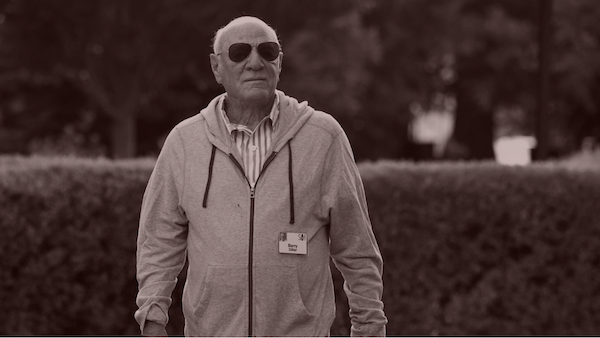
Notes on Diller’s decision to shutter some of his magazines, Fed porn, and Liars Poker war stories. I was not surprised to read that IAC boss Barry Diller, who recently acquired Meredith, the largest U.S. magazine publisher, is axing the print publication of six titles, including InStyle and Entertainment Weekly. Diller, after all, knows better than most that print media is deader than the stuff it’s printed on. Few people still want to be in the business of cutting down trees, printing presses, unions and ink, especially if they are dependent on advertising as opposed to subscriptions.
Yes, there are a handful of mega-successful magazines, such as The New Yorker, that continue to thrive with the support of diversified revenue and a large and loyal audience, willing to shell out hundreds of dollars a year. But we’re soon approaching the point where only the top-tier legacy magazine brands will be able to justify a print edition, even as a loss leader for other revenue lines, as their rate bases become harder to maintain. And as we know first-hand at Puck, you don’t need physical paper—and the huge costs associated with printing and distribution—to build a robust digital media business and to commit serious journalism.
Let’s take a look, for a moment, at the income statement of The New York Times Company, one of the few publicly-traded pure (or relatively pure) plays in journalism, to get an idea of what is at stake, on the cost side, if printing and distribution costs could be avoided. In 2021, the company generated revenue of $2.1 billion, about half of which, or $1 billion, was spent on paying its journalists (hurrah) as well as other costs of getting advertising and subscriptions. A portion of that $1 billion went to printing and distribution costs. We don’t know how much, exactly, because the Times doesn’t break out that information. But even if it were $250 million of the $1 billion, and that expense could be avoided, the savings would more than double the $220 million in net income that the Times Company earned in 2021. A full transition to digital, which overtook print revenue for the first time in 2020, seems inevitable. It’s just a question of when, not if, the paper is no longer printed. (In 2010, then New York Times publisher Arthur Sulzberger predicted the company would stop printing the paper at some point. Now it’s up to his son, A.G. Sulzberger to figure out precisely when.)
Fed Porn
With inflation soaring, stocks down, and the market pricing in multiple rate hikes over the coming year, it certainly appears as if the long-anticipated correction in the financial markets is here at last. And, in my opinion, it’s cause for celebration, not anguish.
Sure, it hurts to watch the value of your stock and bond portfolios shrivel. Since the first of the year, the S&P 500 index has fallen 6.1 percent and the Nasdaq, home to a rash of high-flying technology stocks, is down 10.4 percent. Over the same period, the yield on the 10-year Treasury has increased 382 basis points, to more than 2 percent, up an astounding 23 percent in a short time. The yield on riskier bonds, as approximated by an index published by the Federal Reserve Bank of St. Louis, has made an even bigger move. Since yielding just below 4 percent last September, the average high-yield bond now yields 5.22 percent, a whopping 32 percent increase in four months. Considering that bond yields trade inversely to their price, it has not been a profitable stretch for many bondholders. As traders on Wall Street like to say, “risk” is definitely “off” as investors flee to safer waters.
Then there are the downward moves in a wide swath of really risky assets. Bitcoin, theoretically the most stable cryptocurrency, is down 8 percent so far in 2022. Ethereum is down 19 percent. OHM, a once-popular crypto token, is down 79 percent in a month, and is down 95.5 percent since reaching its high point last April. Remember GameStop? It’s down 20 percent so far this year, while another meme stock, AMC Entertainment, is down 30 percent. Even the stock of Tesla, the much-admired maker of electric cars, is down 25 percent so far in 2022, reducing Elon Musk’s net worth a whopping $30 billion this year.
The proximate cause of this massive change in investor sentiment is, of course, the presumption that the Federal Reserve will start raising short-term interest rates as soon as its March meeting. Wall Street expects there could be as many as five such rate increases this year, or even perhaps seven times, as Goldman Sachs predicted on Friday. Some wonder whether, in its quest to stem rising inflation—growing at a rate of 7 percent annually, the most in 40 years—the Fed might even raise a key short-term interest rate by 50 basis points next month.
The other looming Fed move that is roiling markets is what to do about its Quantitative Easing policies, now entering their thirteenth year, which have flooded the financial markets with cheap money, encouraging investors to take on more and more risk to try to get a higher return on their money than they could otherwise find in many debt markets, where yields remained stubbornly low (despite the recent increases.)
Now it seems that the festivities are finally over. Jay Powell, the Chairman of the Federal Reserve, at long last appears willing to pull the punch bowl away. Perhaps it’s because he’s been renominated for a second term by a president of a different political party and he feels liberated. Perhaps it’s because he, and his fellow Federal Reserve Board governors, have figured out that bubbles were inflating across a variety of financial assets, from stocks and bonds, to NFTs and cryptocurrencies, to real estate in such tony locations as Palm Beach and East Hampton, and that it could all end very badly, with a financial crisis likely to have more devastating consequences than the one many of us lived through in 2008. To be sure, there may still be some bloodletting to come, but there’s no question that some of the breathlessness has evaporated since the start of the year.
Whatever Powell’s reasons, it’s healthy that investors are once again learning that prices of financial assets can also fall. Who among us would complain if the price of gasoline fell by 50 percent? Or if the price of a much-desired home you’ve been eyeing isn’t the subject of a bidding frenzy and could be had for 20 percent less than you previously thought? Or, it seems to me, that if you wanted one of those snazzy new Ford F-150 Lightning electric pick-up trucks and you could get it for say, $35,000 instead of $42,000, you would be delighted. You wouldn’t sit around and moan about how the bloom is off the rose because it’s suddenly 17 percent cheaper. No, you would probably run right out and buy one if you could.
PODCAST 
Rivian to the Moon (Not Investment Advice!)
Rivian, the Tesla competitor, is going through its own growing pains as the company misses production goals. Should shareholders be concerned? Tesla had similar early problems, after all, and now its stock is over the moon (and perhaps on its way back to Earth.)
I have to confess to a little bias here. First of all, last summer I plunked down a $1,000 deposit for a Rivian SUV. At first, Rivian promised test drives last fall and delivery in 2022. The test drive didn’t happen and now delivery is expected in 2023. But I don’t mind! I figure Rivian will deliver when it can deliver and I will use my fossil-fuel guzzler till then.
Part two of the confession is that last December, just prior to Rivian’s I.P.O. and like every other customer who had put down a deposit for a Rivian truck or S.U.V., I was offered the opportunity to buy 175 Rivian shares at the I.P.O. price of $78 per share, without having to pay any transaction fees to Morgan Stanley, the lead underwriter on the Rivian I.P.O. I thought, well, why not? I don’t own any meme stocks or any cryptocurrency or any Tesla, so why not take a $13,650 flier on a hot I.P.O., and for a company and product I respected. After Rivian’s stock shot up to nearly $180 a share, and I was sitting on a gain of more than $100 per share, or $17,500, I was thinking: just keep this up and I’ll get the SUV for free.
Of course, now Rivian’s stock is $65 a share, 17 percent below its I.P.O. price, and I am nursing a paper loss of $2,275. Welcome to the N.F.L., I guess. But again, I am not too worried. I figure Rivian the stock will rebound once Rivian the car company gets its production act together and the electric trucks and S.U.V.s start rolling off the line in Normal, Illinois. Rivian’s market value is $58 billion; Tesla’s is $934 billion. I believe Rivian has a better product, so once it solves its production problems, the negative sentiment on the stock should turn positive. Tesla’s market value is 16 times higher than Rivian’s at the moment. There’s a lot of room for happiness for Rivian investors, like me, if one day Rivian starts producing vehicles like Tesla has been able to do and its stock begins acting like Tesla’s. Maybe it will, maybe it won’t, but it could be a fun ride, especially if I get my S.U.V. next year.
Money Never Sleeps
The esteemable Michael Lewis has been making the media rounds recently, promoting his new podcast and reminiscing about the cult status of his groundbreaking Wall Street tell-all, Liar’s Poker—a blistering indictment of finance culture that, like Gordon Gekko or Jordan Belfort’s Wolf of Wall Street, was embraced as a celebratory totem instead. Michael, who also wrote The Big Short, observed that Wall Street is decidedly less colorful than in the high-flying days before the 2008 financial crisis, when regulators lowered the boom and de-risked the industry, for better and for worse.
Lewis is correct that Wall Street banks, supposedly, can no longer make the kinds of proprietary bets that Goldman did when it shorted the mortgage market, starting in December 2006, and that risk-taking has, again supposedly, been pushed into the so-called “shadow banking system,” beyond Wall Street’s balance sheets. (I say “supposedly” because who ever really knows what the big Wall Street banks are doing?) But in other meaningful ways, I don’t think Wall Street has changed all that much since the 1980s. Wall Street is still all about making money and supplying capital and advice to anyone who wants it and who can pay for it, anywhere around the world. The compensation system, which rewards bankers and traders for taking big risks with other people’s money, hasn’t changed. Nor has the punishing and hierarchical work environment, despite the abundant lip service that Wall Street now pays to “work-life balance.” Yeah, right. The junior bankers still get crushed and the senior bankers are the ones crushing them.
Obviously there have been a few profound changes. First, there are many, many fewer firms than there were when Michael was on Wall Street. For starters, the firm where he worked—Salomon Brothers—no longer exists. It was subsumed into Citigroup in the 1990s. As we all know by heart now, Lehman Brothers is gone. Bear Stearns is gone. Merrill Lynch is hiding somewhere inside Bank of America, which has gobbled up all sorts of other firms. And thanks to Jamie Dimon and his astute management, JPMorgan Chase has somehow emerged at the top of the Wall Street heap, besting by a far distance its main competitors: Morgan Stanley, Goldman Sachs, Bank of America and Citigroup. When I worked at Chase, and then JPMorgan and then JPMorgan Chase, prior to Jamie’s arrival, there were very few people who thought this was even remotely possible. One of the few who did was Jimmy Lee, the late, great JPMorgan Chase banker. (How Jamie Dimon pulled this off might be a good topic for Michael’s next book.)
The other big changes since the 1980s—aside from such innovations as the ATM, the junk bond, derivatives, and the securitization of everything that was not nailed down—came after the 2008 financial crisis, in the form of the Dodd-Frank law and all sorts of new rules and regulations governing Wall Street. For starters, the big five banks are all regulated by the Federal Reserve, and that means they all now have higher capital requirements and are permitted to keep far fewer risky assets in inventory on their balance sheets. It’s now harder for Wall Street banks to make markets for their clients like they used to be able to do and they are now in the “moving” business, rather than the “storage” business—they’ve got to package things up into securities and sell them off to investors. But the basic Wall Street ethos of making money from money hasn’t changed. They are all just making a lot more money these days than they did in the 1980s, and having less fun doing it.
Super Bowl War Stories
Someone asked me the other day whether I have any colorful Super Bowl stories from my days on Wall Street. The answer is no. My banking colleagues—usually the so-called “coverage officers,” the ones responsible for the overall relationship with the clients, not the ones like me, delivering various “products” to them (M&A advice, in my case)—were the ones to get the invites, or to do the inviting, to the Super Bowl. So I’ve never been to a Super Bowl and I’m just fine with watching at home on the couch with my family.
But I can share a story from my early Wall Street days that is in a similar vein. After graduating from Columbia Business School, in 1987, I was working on Madison Avenue in the group at GE Capital that financed leveraged buyouts. One of the first deals I worked on was with media executives Norman Lear and Tom McGrath, at ACT III Communications, to buy Wallace Theaters, a group of movie theaters owned by Scott Wallace, who had worked at AMC Entertainment. That deal led to another deal with Wallace and ACT III buying other movie-theater assets, an early attempt to consolidate the fragmented industry. (Lear eventually sold his theater business to KKR, the private equity behemoth.) Wallace and I became friendly, and he later invited me to the Oscars, in Los Angeles, as his guest.
FOUR STORIES WE'RE TALKING ABOUT 
A behind-the-scenes clash over the Super Bowl halftime show is a case study in the N.F.L.’s effort to protect its brand through a draconian playbook. ERIQ GARDNER 
A candid conversation with Dr. Andrey Sushentsov, a prominent Russian political scientist, about how Putin views the West. JULIA IOFFE 
Disney’s recent streaming rejuvenation suggests some key factors that will dictate the winners and losers in this evolving streaming arms race. JULIA ALEXANDER 
Notes on Zaslav’s plans for Warner Bros. Discovery, more insight into the CNN mess, and plenty of succession questions. DYLAN BYERS 
You received this message because you signed up to receive emails from Puck.
Was this email forwarded to you?
Sent to {{customer.email}}
Puck is published by Heat Media LLC.
For support, just reply to this e-mail. For brand partnerships, email ads@puck.news |


SHARE