 |
 |
|
Welcome back to The Stratosphere. I’m Teddy Schleifer.
|
|
Today, a tour through the Republican fundraising world, where some DeSantis bundlers have stopped bundling, some Nikki Haley donors are still waiting for Paul Singer, and Jan Koum is quietly placing new seven-figure political bets. If you have any thoughts or tips, reply to this email.
But first…
- It was quite ironic to see Ron DeSantis’s aides gloating today about Democrat Reid Hoffman’s $250,000 donation to Republican Nikki Haley’s super PAC. (Read on, by the way, for dish on a new $5 million donation from Silicon Valley to that Haley group...) The irony is that Reid’s team would’ve been happy to make the donation to the DeSantis super PAC, if only he were polling better. Longtime subscribers will remember our story in March about how Hoffman, controversially, originally planned to back the pro-DeSantis efforts as a way to kneecap Trump. Alas, DeSantis’s support cratered and Hoffman was forced to look for greener pastures. Team DeSantis didn’t get a Reid check, but at least they got a snarky press release.
- I am only loosely reporting on the Silicon Valley congressional race to replace Anna Eshoo, and won’t bore you with all of the incremental updates, but I am hearing that Peter Dixon, a former Marine who now works at the intersection of venture capital and the military, is preparing to run and is expected to announce his bid on Thursday. Dixon is also the co-founder of With Honor, a super PAC that backs military veterans and was the recipient in 2018 of a rare, $10 million political check from Jeff Bezos.
- Lastly, I hear that Diane Hendricks—the Wisconsin roofing billionaire and one of Trump’s biggest individual donors during his 2016 bid—has been keeping her powder dry and has told people she is sitting out this primary cycle.
|
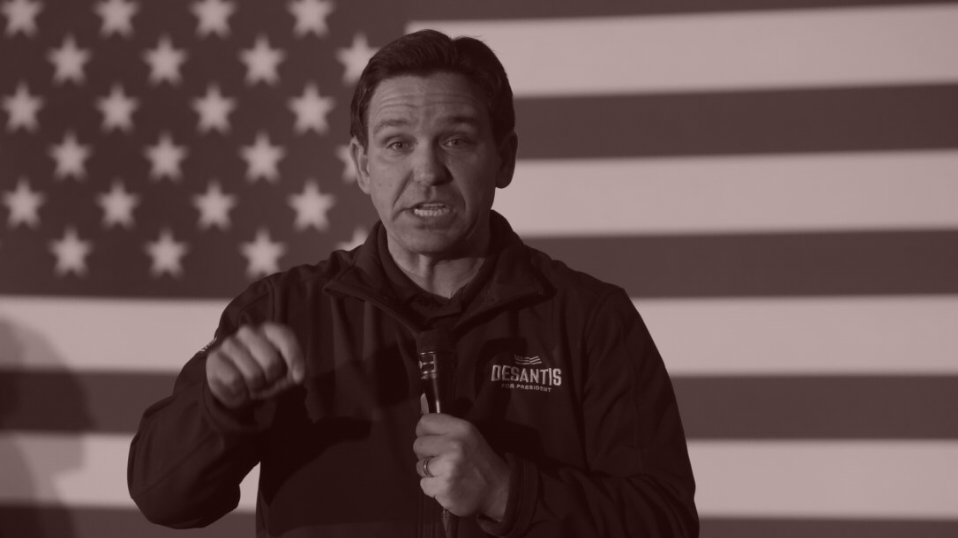 |
| The DeSantis Megadonor Panic Room |
| As his operation falls further into disarray, everyone is pissed at everyone else, and the money guys behind the scenes are having to make tough calls. Plus: a scoop on WhatsApp co-founder Jan Koum’s $5 million investment in Haley. |
|
|
|
| Last May, upon the swaggering debut of the DeSantis presidential campaign, I flew down to Miami to stake out the Four Seasons, where some 150 eager and ego-filled bundlers bounded about—barking into phones, cavorting in the hotel bar, rifling through their iPhone contacts—in the hopes of raising ungodly sums of money to dethrone Donald Trump in Iowa and beyond. The bundlers, holed up in a luxury hotel equivalent of a bomb shelter to participate in the “Ron-o-Rama,” wielded clipboards and wore campaign pins, proudly indicating their membership on the team since “Day One.” The campaign raised a record $8.2 million in its first 24 hours.
I’ve kept in touch with these bundlers, and at least a few of them haven’t done much dialing for their guy in the 194 days since “Day One”—especially not now, with DeSantis languishing in the polls and only six weeks until Iowa. I know at least one person who attended the Miami phone-a-thon who has effectively switched sides and is now steering his network toward a different candidate. Bundling, after all, is laborious work: It relies on enthusiasm, and it’s clear that enthusiasm for DeSantis—outside of his Yale homies and Florida lobbyists—has waned. “I think people are starting to pull back,” said one DeSantis bundler who has de-escalated his involvement. “I don’t see a finish line here.”
There are multiple causes and culprits, to be sure. At present, most DeSantis allies are fixated on the drama that has ensnared the outside groups—the so-called soft-money world—including the launch of a rival super PAC, near-physical fights, and most recently, a wave of resignations from the original DeSantis super PAC, Never Back Down. Among the exits was Never Back Down C.E.O. Chris Jankowski, who stepped down just before Thanksgiving with a public jab about disagreements that went “well beyond strategic differences.” Then, over the weekend, replacement C.E.O. Kristin Davison was also sent packing for unspecified “management and personnel issues,” alongside Erin Perrine and Matthew Palmisano, in what one campaign-aligned person rather gleefully described to me as a “housecleaning.”
Perhaps the most concerning exit, however, was that of Adam Laxalt, DeSantis’s close friend and former roommate, who officially left to spend more time with his family but whose departure is being read by some donors as indicative of cratering internal confidence in the group. Now, Scott Wagner, one of DeSantis’s Yale-Florida homies and a political neophyte, is at the controls and has to work with Never Back Down’s chief strategist Jeff Roe… the guy whom he almost fought. |
|
A MESSAGE FROM INSTAGRAM
|
| |
 |
| New federal legislation will give parents a say in teen app downloads.
Giving parents a say in which apps are right for their teens helps them support their teens in having a positive experience online.
That’s why Instagram wants to work with Congress to require parental approval wherever teens under 16 download apps.
Learn more. |
|
|
|
|
| Rather than print a dozen pissy blind quotes—although my notebook is full of ’em—let’s just say there is some serious blame-gaming among DeSantis campaign donors toward Roe, and also toward the PAC itself. There is also widespread anxiety about the structure of the broader DeSantis campaign, which essentially outsourced many of its most vital operations—travel, events, door-knocks, etcetera—to an outside group in the early months of the primary.
And let’s not forget that the campaign’s weaknesses were in some ways disguised, or papered over, by the fact that DeSantis was able to transfer some $90 million from his state account to Never Back Down at the beginning of the race, creating an artificial—and arguably misleading—advantage. (As a Ted Cruz 2016 embed, it isn’t lost on me that these are precisely the sort of multi-super PAC tensions that somewhat undermined Roe’s former presidential campaign efforts, too.)
Anyway, all that may be less important than the fact that bundlers—for whom raising money is a sort of professional sport, with leaderboards and awards—like winning. And at present, the DeSantis team is down some 30 points in Iowa, nearly 40 points in New Hampshire, and trailing by even more in DeSantis’s home state of Florida. Like a sports team, a bunker-like mentality can persist: A few DeSantis bundlers told me they didn’t believe those polls: “There’s no way [Trump’s] ahead 50 points. Nobody’s ahead 50 points. Mother Teresa’s not ahead 50 points,” said one.
But it’s also probable that DeSantis’s campaign-finance obituary is being written a bit prematurely, especially if he can place a close second or even beat Trump in Iowa, which is the sort of narrative violation that DeSantis’s team thinks would radically reset the race. I’ve learned that Jay Bergman, a Chicago-area oil baron who has donated millions to Republicans, recently flipped his support from Mike Pence to DeSantis. The two had a private meeting a few weeks ago, and he has been sufficiently impressed to volunteer for his Illinois delegate slate and to start planning contributions. “He’s a little bit more conservative than I am, but that’s beside the point,” Bergman told me. “I can’t say this guy is the most wonderful thing in the world. But he seems to have the background for it. So I think he’d be a good president.”
And there are plenty of megadonors who are still on the DeSantis train. Elsewhere in the Upper Midwest, Wisconsin’s Dick and Liz Uihlein remain committed DeSantis folks, I’m told by multiple sources, and they met with DeSantis and Never Back Down at their company headquarters on the same trip as DeSantis’s visit with Bergman. One of those sources told me that both Uihleins see DeSantis as a long-term bet—a “young man”—and that he could be a viable candidate in future national elections.
Still, there are not many new DeSantis megadonors these days. So I asked Bergman: Was he not concerned about the trajectory of the DeSantis campaign? “I’m somewhat concerned about it,” he offered. “DeSantis, I think, peaked too soon. He turned out to be the number two early on, and of course Trump and everybody else down the line attacked him because he was number two.” Nikki Haley, he conceded, clearly has the momentum. |
|
|
|
|
| The next shoe to drop may be what happens with the members of the American Opportunity Alliance, whose ultra-wealthy membership has yet to fully engage in the presidential race. Some of them are feeling the Haleymentum—“Unfortunately for us, there is a mass movement toward Haley with all the billionaires,” one DeSantis donor told me this week—but not all of them are moving toward her, and several Opportunity Alliance members have argued privately that Haley’s path to victory remains much narrower than DeSantis’s. In short, there’s still an Iowa-sized shot.
On Wall Street, “everyone is waiting for the signal” from one American Opportunity Alliance honcho in particular: Paul Singer, the multi-billionaire hedge fund manager and Republican megadonor. Singer, to some people’s disappointment, did not attend what I hear was a packed Haley fundraiser on Monday in New York City, despite being hosted by several people tied to Singer, including his longtime girlfriend Terry Kassel (though she skipped it too, I hear). The hope is that Singer will step in over the next few weeks and bring his forceful donor-whipping operation to bear. Singer has said nice things about Haley, but hasn’t formally weighed in, or even confirmed that he’ll endorse anyone. We’re also still waiting on Ken Griffin, who many people expect to back Haley, too. But he can be mercurial, and it hasn’t happened until it happens.
Meanwhile, in Silicon Valley, the Haley conversation continues to revolve around Jan Koum, the WhatsApp co-founder (net worth: $15 billion) who has publicly donated $5 million in two chunks to the super PAC behind her. Koum—an ardent pro-Israel philanthropist who is attracted to Haley’s hawkishness—has worked in the past with Haley adviser Jon Lerner, and I hear he’s been making introductions for Haley to various other pro-Israel donors. In fact, I’ve learned that Koum donated another $5 million in August to the Haley super PAC—meaning that he has actually donated a total of $10 million to the outside group, making him one of the single largest donors to date in the G.O.P. primary.
Still, plenty of the people donating six or seven figures to Haley or DeSantis at this point don’t reasonably expect their candidate to win, a phenomenon I’ve never experienced before. The dominant feeling among major donors is a sense of apathy—that this is Trump’s race to lose, to say the least. Among others, there’s a sense of fear. “Trump’s big talk of retribution has got a lot of people thinking, ‘Look, the guy’s ahead by 30 points. There’s probably not a whole lot we can do. How much do I want to be in the crossfire at the end?’ And so we might not have as many people publicly going at him as you might hope,” said one person in touch with several major anti-Trump donors. “If Trump runs away with this, they’ll all come in. And there will be lots of apology money … and if our folks come in with some big checks, a lot will be forgiven.” |
|
|
|
| FOUR STORIES WE’RE TALKING ABOUT |
 |
|
 |
|
 |
|
 |
| Niche Film Magic |
| Dissecting the post-Thanksgiving theatrical boomlet. |
| SCOTT MENDELSON |
|
|
|
|
|
 |
|
|
|
Need help? Review our FAQs
page or contact
us for assistance. For brand partnerships, email ads@puck.news.
|
|
You received this email because you signed up to receive emails from Puck, or as part of your Puck account associated with . To stop receiving this newsletter and/or manage all your email preferences, click here.
|
|
Puck is published by Heat Media LLC. 227 W 17th St New York, NY 10011.
|
|
|
|