Hello, and welcome back to The Best & The Brightest. It’s foreign policy Thursday and I’m your host, Julia Ioffe.
Tonight, much ado about the Ben Franklin Fellowship—a group of conservative former and would-be diplomats trying to become the Federalist Society for the foreign service. Hilariously, they go by B.F.F. The organization’s mission is restoring meritocracy to the State Department—so why does it look so much like affirmative action for white guys? My conversation with its founders, below the fold.
Still getting this email forwarded to you? Click here to subscribe to Puck, or email Fritz@puck.news to inquire about a group rate for your office.
|
|
|
|
A MESSAGE FROM AMERICAN BEVERAGE
|
We are American companies, making American products with American workers in America's hometowns.
America's beverage companies – The Coca-Cola Company, Keurig Dr Pepper and PepsiCo – have been a part of the American story for more than 100 years.
We are local bottlers and manufacturers, operating in all 50 states. We provide 275,000 good-paying jobs – the kind that require only a strong work ethic.
Our companies are central to their communities. Across the country, we contribute $2.8 billion to charities.
We’re proud of what we do and how we do it.
Learn more at
WeDeliverForAmerica.org.
|
|
|
|
Now, here’s Abby with notes on an intriguing pre-pre-midterms ad buy…
|
|
|
 |
Abby Livingston |
|
House Democrats Map Fantasies
|
|
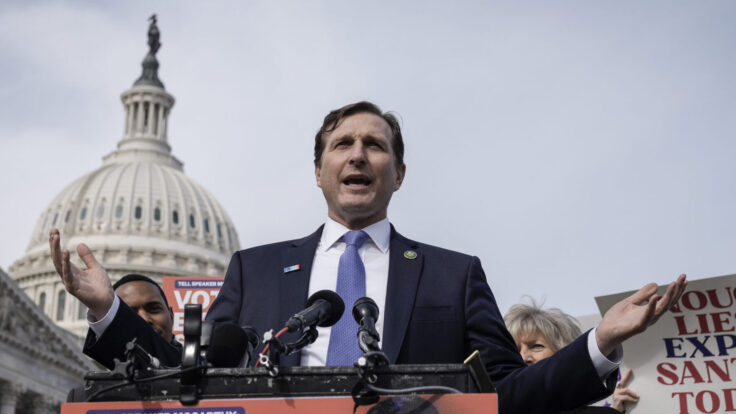
House Majority Forward, a group aligned with House Democratic leadership, announced a digital ad campaign yesterday in 26 Republican-held districts. I’m told that the campaign has six figures behind it—a minimal media buy, to be sure, but still an interesting early indication of where Democrats detect Republican vulnerability and hope to expand the map.
The usual targets are all there: New York’s Mike Lawler, Arizona’s Juan Ciscomani, Iowa’s Mariannette Miller-Meeks, etcetera. Most intriguing, though, are the buys targeting a handful of Republican incumbents who haven’t seen competitive general election races in a long time—if ever. These districts fall under the “Likely Republican” category, as rated by the Cook Political Report, and include Michigan’s Bill Huizenga (who’s considering a Senate run, which would create an open race to succeed him); Virginia’s Robert Wittman; North Carolina’s Chuck Edwards; Montana’s Ryan Zinke; Wisconsin’s Bryan Steil; and California’s Kevin Kiley. The list also includes Missouri’s Ann Wagner and Iowa’s Ashley Hinson, whose races are not rated as competitive.
It’s still effectively spring training for the House elections, but the buy will test the political waters and signal to local Democrats that the national party is paying attention. The consensus in most House circles is that Dems have the upper hand, but there’s very little room to expand the battleground map beyond the usual 40 or so competitive seats. Meanwhile, Republican consultants I’ve spoken with acknowledge it’s been a rough spring, but they’ve been pleasantly surprised by early downballot polling. Republican incumbents, it turns out, haven’t taken the post-Liberation Day popularity hit that Trump has.
|
|
|
|
Now, on to the MAGA pipeline at the State Department…
|
|
|
|
Inside the Ben Franklin Fellowship’s efforts to restore the foreign service to a mythical meritocracy of yore, when the watchwords were “pale, male, and Yale,” and women weren’t getting so many dang promotions.
|
|
|
To hear its founders tell it, the Ben Franklin Fellowship began as a scrappy, outsider effort to get conservatives their own cafeteria table at the very progressive, and very cliquey, Department of State. “There were a lot of these affinity groups,” recalled Simon Hankinson, a former longtime diplomat. There were groups for Black foreign service officers, gay officers, for women, and for Asian Americans and Pacific Islanders. Each had a kind of unofficial status, Hankinson said, but was allowed to use official conference rooms during the workday. “The one internal group that didn’t have that,” he noted, “were conservatives.”
Hankinson, who left the foreign service in 2022, decided to do something about it. In the wilderness, he met other kindred spirits: Phillip Linderman and Matthew Boyse, both also conservative, recently retired from the foreign service, and already working on a plan. “This had been getting on my nerves for a while,” Boyse, who left the foreign service in 2021 after serving as a deputy assistant secretary, told me. He had joined the State Department when Reagan was president and didn’t appreciate how the place had changed. “The overt drift to progressivism during the Obama years was so thick, you could cut it with a knife,” he lamented. “We’re in a 50-50 country, not 95-5, like we are in D.C.,” Boyse said. In the foreign service, he felt like a true minority.
In early 2024, the three men formed the Ben Franklin Fellowship, a group for people who felt like conservative outcasts and oddballs at State—which, Hankinson told me, “is probably the wokest agency out there, other than maybe the E.P.A.” The aim, according to Boyse, was to create “a network of people that also contributes to the definition of diversity.” While they awaited their tax-exempt 501(c)3 status, they began accepting new members—anyone with significant experience in foreign policy, and conservative views. The group listed eight core tenets, starting with a belief in strong national borders and tight immigration controls, and ending with a conviction in a certain kind of meritocracy. (After recent attention in the press, the group removed the words “America First” from its “Principles” page.)
|
|
|
|
A MESSAGE FROM AMERICAN BEVERAGE
|
We are American companies, making American products with American workers in America’s hometowns.
You can find us on every street corner, in every small town and big city, with more than 4,400 manufacturing and distribution facilities across the country. We are an economic force in America, delivering $324 billion for the U.S. economy and $70+ billion in state and federal taxes.
Our success means success for small businesses and jobs for millions of Americans. We support an additional 4.2 million jobs that depend, in part, on beverage sales for their livelihoods.
Learn more at WeDeliverForAmerica.org.
|
|
|
|
Almost immediately, they began hosting events on a shoestring budget. Early on, they had a networking happy hour and asked people to chip in $10 for cocktails. At a dinner at the Army and Navy Club, they asked people to pay for the value of the meal. And while the fellowship is in the process of applying for grants from organizations that fund conservative projects, they still have a donation button on their website. (Both Boyse and Hankinson declined to name where they’d applied for funding, saying only that it was, essentially, the usual suspects. Not the Koch brothers, though. “They’re more libertarian than conservative,” Boyse said.)
Boyse took pains to paint the group as little more than a D.I.Y. policy forum. “It started off as a network,” he explained. “People who are conservative like to be in the company of like-minded people, like any tribe of people.”
Of course, nothing in D.C. is really just for fun, and neither is the Ben Franklin Fellowship. Even if it truly began as a mere discussion club for self-selectively underrepresented white conservative men, it quickly became something else in November 2024: a talent pool for the incoming administration. “When Trump won, they were looking for people who were not going to be part of the resistance,” Boyse told me. “The percentage of people who vote ‘R’ in the department is very small.” One of the new goals of the Ben Franklin Fellowship, it now seemed, was to create a pipeline of MAGA-friendly (or at least MAGA-tolerant) policy experts within the State Department—people who would, as Boyse explained, resist the “resistance” in the Trump era. “The fellowship is likely to be a pool of people that a conservative administration can look to to nominate someone that is aligned with the mission,” Hankinson told me. “Like the Federalist Society.”
|
The Federalist Society, of course, set out in the early 1980s to unbend the liberal bent of the American judiciary, starting from the top of the funnel: law schools. It eventually became, in the words of The New Yorker, “a kind of Rolodex for legal jobs around the country, especially clerkships and judgeships.” Forty years later, the organization has been so successful that it claims a large proportion of federal judges and a majority of Supreme Court justices.
The Ben Franklin Fellowship hopes to achieve something similar for the country’s diplomatic corps. For years, MAGAworld has viewed the State Department as the nucleus of the so-called deep state—a warren of globalist elitists and liberal interventionists who have dedicated themselves to thwarting Trump’s agenda. Staties, naturally, bristle at this characterization. They pride themselves on being nonpartisan in the office (if not at home) and serving administrations of any political stripe. They are, they maintain, cool-headed professionals.
There is some truth to the notion that bureaucracies, including the State Department, can slow-roll initiatives they don’t like. But it doesn’t quite square with my knowledge of the place. I know so many Staties who have bitched and moaned about a presidential policy during both Democratic and Republican administrations in private, only to march back into the office in the morning and faithfully carry it out. “I never once in my 38 years of service saw a career member of the foreign service fail to carry out administration policy with absolute commitment, nor did I ever see or hear of a career member of the foreign service trying to sabotage any president’s agenda,” said Eric Rubin, the recently retired head of A.F.S.A., the foreign service union. “It just did and does not happen.”
When I asked Boyse for an example of departmental resistance to carrying out an administration’s directive, he was at a loss. “An example?” he stuttered. “Oh God. Probably. I’m sure there is [one], I just haven’t thought about it in a while.” He noodled on it for a bit, then offered, “This is not a question of the bureaucracy openly resisting the administration. It’s more that there’s so much evidence that the bureaucracy clearly prefers ‘D’ presidents and ‘D’ secretaries of state.”
This is where the B.F.F.s—yes, that is the abbreviation—come in. They are a like-minded tribe, in Boyse’s parlance, ready to implement Trump’s agenda. To veteran foreign service officers, though, the fellowship has become a haven for opportunists. It’s the perfect chance, they say, to advance in an organization that’s being emptied of its most seasoned and qualified officers. As veteran foreign service officers retire (or are cut) in droves, space opens up for people whose chief qualifications seem to be ideological loyalty and ambition. “Some of them are just genuinely more conservative than the norm at State,” said Tom Malinowski, a former assistant secretary. “But some of it is younger opportunistic white guys seeing a chance to run things at age 25.”
|
|
|
In fact, several B.F.F.s are serving in very senior positions at State, including Christopher Landau. Others, like Lew Olowski, who is now the second-in-command at the department’s personnel division, had so little experience that A.F.S.A. felt compelled to issue a statement condemning his appointment. Several current and former senior State Department officials went through the list of B.F.F.s with me. They found most of the people’s promotions puzzling. “He wouldn’t have had a prayer of getting [that senior position] otherwise,” one senior State Department official said of a B.F.F. who had recently ascended to a plum post. “He’s not a bad person. He’s just not qualified.” This was a characteristic response. “They’re not necessarily the best of the best,” said one recently retired senior State Department official. “It’s a weird, eclectic group of people,” added a current official. “They don’t have very many heavy hitters.”
Boyse characterized the charge of opportunism as classic “backbiting,” and Hankinson was absolutely sanguine. “Is it possible that we get some Johnny-come-latelies who want to use this to get ahead?” he shrugged. “Sure. We’ll try to be aware of that.” A senior State Department official read from a similar script when I reached out for comment. “There are many incredible F.S.O.s here at the State Department who love their country,” this person told me. “They’ve had a front-row seat to the department’s decline. Secretary Rubio and his team value the insights, ideas, and leadership provided by members of the Ben Franklin Fellowship. We’re grateful for their service to our country.”
|
But what really drives the Ben Franklin fellows? “The question of merit is very, very important,” Boyse explained. Back when he joined in the 1980s, he said, “there was a lot of focus on merit. That has really weakened over time. That’s an important subtext of this story.” The subtext of this story—and of the emphasis on a mythical bygone meritocracy at Foggy Bottom—is, of course, diversity, equity, and inclusion. “What we’re really seeking here is, after four years of the pendulum swinging too far to the left, of D.E.I. loyalty tests and identity being part of the promotion process,” said Hankinson, “is trying to return the foreign service back to what people say it is, but it isn’t—which is a neutral, professional cadre that carries out a president’s policies without fear or favor.”
After leaving the State Department, Hankinson joined the Heritage Foundation, home to Project 2025. ( Kiron Skinner, who wrote the chapter on the State Department, is a B.F.F.) He began churning out essays and reports about how D.E.I. had corrupted and corroded the State Department. One report is titled, “Is the State Department Using ‘D.E.I.A.’ to Discriminate Against Men?” (The “A” is for accessibility.) “Women have a clear promotion advantage in all five occupational concentrations—ranging up to 13 percent,” the paper argues. “Are women simply better at every job than men?”
In lieu of answering that rhetorical question, I’ll simply point out that Donald Trump himself made no secret of his preference for hiring women for certain jobs. “He said a good woman is better than 10 good men,” recalled his former subordinate Barbara Res. “I think he believed that women had to prove themselves more than men. So a good woman would work harder and be constantly trying to gain the recognition and the respect of other men, and, of course, their boss, which would be him.”
Anyway, Hankinson repeated this reverse-sexism claim to me when we spoke. “Women were being promoted more than men,” he said. “And that can be because of two things: All women are better at the job on average, or some bias has crept into the system. There’s a perception that you have to work twice as hard to be promoted if you’re a woman or if you’re Black.” That wasn’t true anymore, he said. In today’s State Department, “you’re more likely to be promoted if you’re a Black officer than a white officer.” And something about that didn’t seem right, especially when he saw an overt effort during the Obama and Biden years to put people who looked different at the top, and, as he put it, when “it was affecting people’s chances of promotion.” It was clear which people he meant.
Back before Foggy Bottom was considered progressive, however, before it was seen as a den of the resistance, it was known as something very different: male, pale, and Yale. It was also racist, sexist, and so deeply antisemitic that it made a concerted effort to keep out European Jews fleeing the Nazis. Is that the hallowed meritocracy that the B.F.F.s are trying to return to? “There was no perfect time when everything worked,” Hankinson agreed. “There was discrimination in the ’50s. There was discrimination in the ’80s. Our goal is to have no discrimination.”
I asked Hankinson why the vast majority of the fellows listed on their website are older white men. He was annoyed. “It’s certainly not an aim of ours to be made up of any one age group or group,” he replied. “But if you were someone who benefitted from positive discrimination in the Biden administration, you’re probably not going to join an organization that promotes meritocracy.”
There it was, the real definition of “meritocracy,” and the classic assumption at the core of the right’s anti-diversity backlash, which was, not coincidentally, summarized by Darren Beattie, Trump’s undersecretary of state for public diplomacy. “Competent white men must be in charge if you want things to work,” he wrote in a social media post before getting the job at Foggy Bottom. Or, as Hankinson told me of the Ben Franklin Fellowship: “We’re trying to provide a little bit of top cover to people who believe that this country should be a meritocracy, and that people should be able to get ahead because of how good they are at their job, not what they look like.”
|
|
That’s all from me, friends. I’ll see you back here next week. Until then, good night. Tomorrow will be worse.
Julia
|
|
|
Need help? Review our FAQ page or contact us for assistance. For brand partnerships, email ads@puck.news.
You received this email because you signed up to receive emails from Puck, or as part of your Puck account associated with . To stop receiving this newsletter and/or manage all your email preferences,
click here.
|
|
Puck is published by Heat Media LLC. 107 Greenwich St, New York, NY 10006
|
|
|
|