 |
|
Hi you,
It’s the end of January, and we really have to stop hitting the snooze button in an attempt to avoid 2024. It’s time to wake up and face the fact that, yes, a consequential election is coming up, and not just for us in the United States: more than 50 countries will be tallying ballots this year. I find it hard to believe that it’s been almost four years since the last time these two candidates faced each other, which begs the question: Does it count as déjà vu if we’ve literally seen this before?
Before diving into today’s main story (Jon Stewart is back!), here’s some of what’s been grabbing my attention as I make the rounds through my feeds, conversations with friends, and gatherings to discuss how to defend democracy:
- Usually when we say countries have a “totally separate internet,” we’re referring to authoritarian regimes like China or Iran, which surveil and restrict the digital activities of their citizens. America has gone the other way: a laissez-faire, market-driven approach that has created a mentally toxic environment, especially for children. Europe, on the other hand, is establishing a set of healthier rules that might result in a “totally separate” internet for the better. This post from Open Future lays out an inspiring vision for digital public spaces not controlled by commercial interests. It’s a good reminder that another world is possible, and we don’t have to settle for what we have. (Hat tip to New_Public for sharing.)
- Once upon a time, when I was a Friday night regular on MSNBC’s The 11th Hour with Brian Williams, we had a recurring segment with me, Brian, and Bill Kristol, someone with whom I never thought I’d agree on anything. But I truly enjoyed those conversations, and started subscribing to The Bulwark, his anti-Trump conservative news site, to see what other sane things Kristol & Co. were putting into the ether. Last week, they published this open letter to Nikki Haley from U.S. Marine Corps veteran Michael Wood, who described her as a “forward-looking governor reduced to dissembling about the cause of the Civil War lest she offend Lost Cause neo-Confederates whose approval she desperately sought.” Ouch! Wood then invites her to do something useful with her moment in the spotlight: “Go to your home state and tell the truth. You’re incredibly smart and well spoken—imagine how much better you’ll sound when you liberate yourself from trying to placate the MAGA cult and say what you actually think.” Read it all, and allow yourself to indulge in Wood’s inspiring vision of an honest Nikki Haley. Rising authoritarianism makes for strange bedfellows so, run, Nikki, run??
- Apple released its face computer! I got to try it for about an hour (check out these Apple-approved photos of me being impressed by the experience). My quick thoughts on Apple’s $3,500 ski goggles: It’s too heavy; it’s more technically impressive than I imagined; and it’s surprisingly easy to navigate. I went on the Techmeme Ride Home podcast, one of my daily must-listens, to discuss it further, and how generative A.I. will transform the web. Listen to the episode here or watch it on YouTube. Much has been made of the Vision Pro’s lack of media and apps (see my colleague Julia Alexander’s latest piece for a smart look at why the Vision Pro might struggle for content), but I think the truly killer app will be immersive virtual travel, education, and training.
- Finally, with Black History Month approaching, here’s some media I’m eager to dive into. As you read this, I’ll be in a movie theater watching Ava DuVernay’s Origin. During my workouts this week, I’ll be diving into the true crime podcast Radical, an exploration of the life and murder conviction of Imam Jamil al-Amin, formerly known as H. Rap Brown, who was prominent in the Black Panther Party and Black Power Movement. And I’ve preordered Princeton professor Ruha Benjamin’s book, Imagination, a manifesto urging us to consider our imaginations as a place of both struggle and of possibility.
|
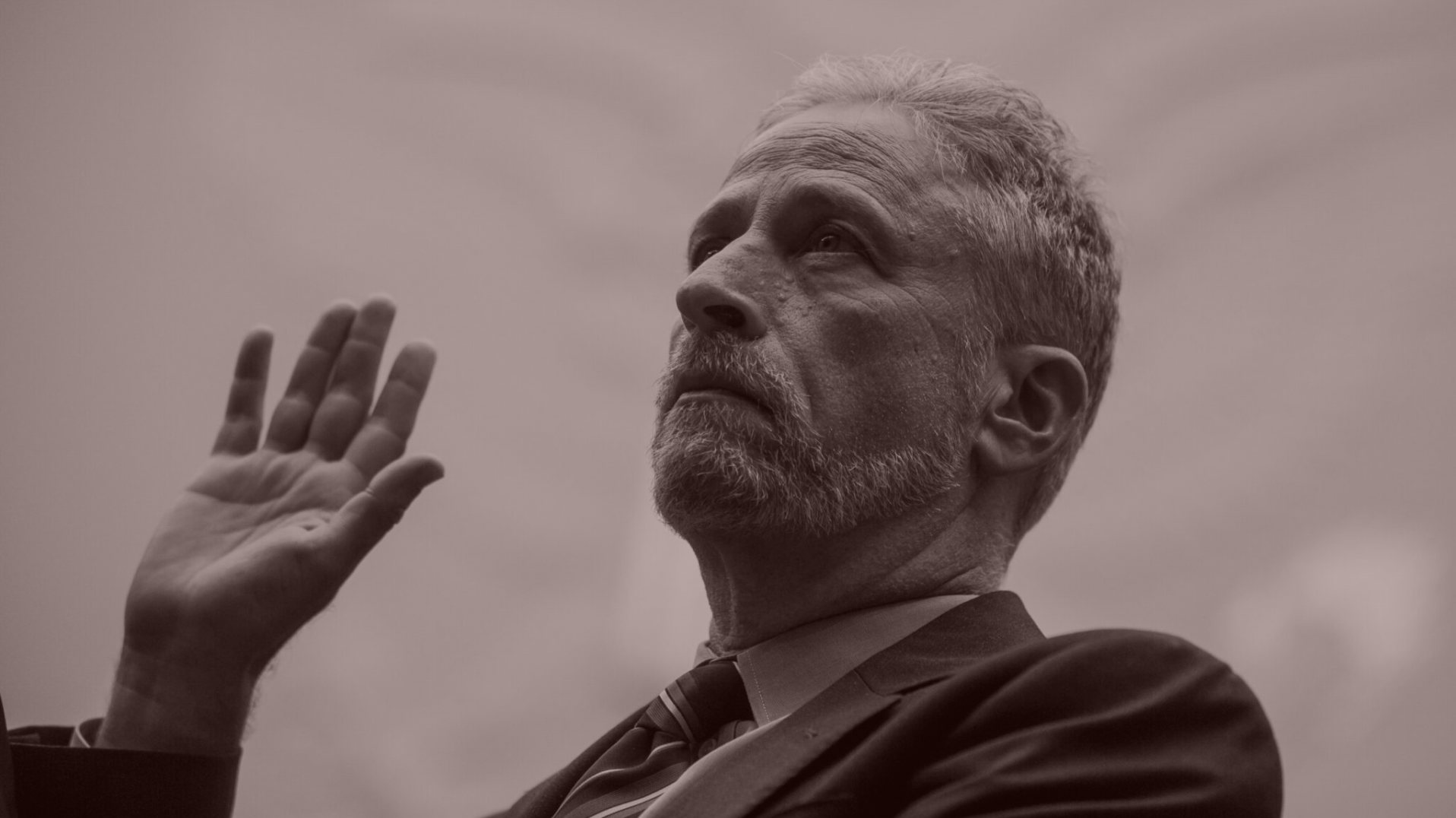
| And now, for today’s main story: Jon Stewart is returning to The Daily Show as an executive producer and Monday night host. As a longtime executive at The Onion during Stewart’s apotheosis, and as a former executive for The Daily Show as Trevor Noah took over, I have some impassioned thoughts about what his return means for the future of late night, the future of satire, and the future for us all as Trump tries to retake the White House. Let’s dive in. |
 |
| Citizen Stewart |
| Jon Stewart returns to the Daily Show anchor chair as a citizen, not just a comedian, and at a time of crisis for the media he lampooned, for political comedy itself, and for the nation. No pressure! |
|
|
|
| The king is back. Jon Stewart, the original cable news satirist who spawned a dozen imitators, will be returning to The Daily Show to host Monday nights, at least through the election, and will be executive producing the series through 2025. The question is whether an old dog can learn new tricks in his old dog house—and no, I’m not calling him a dog. The fact is, Stewart has changed. The media has changed. And somewhere along the way to Charlottesville and January 6th, political comedy started getting more serious.
When Stewart first started hosting The Daily Show, back in 1999, his targets were easily and deservedly skewered: hypocritical politicians, bloviating pundits, the absurdity of fundamentalism, the shallowness of cable news. Over the years, of course, as Stewart ascended to one of the most revered figures in the culture, it became harder to pretend it was all just a joke. But Stewart never dropped the self-deprecating shtick—“We’re just the show on after Crank Yankers”—even after his “Rally to Restore Sanity and/or Fear” drew more than 200,000 people to Washington, D.C.
Since leaving the show in the summer of 2015, just a few weeks after Trump launched his presidential campaign, Stewart has embraced his more serious side. He’s used his platform to advocate for 9/11 victims and veterans, offered congressional testimony and tackled weighty topics on his since-canceled Apple TV+ series, The Problem With Jon Stewart. That show wasn’t quite the hit Stewart or Apple were hoping for, but it did keep him in the zeitgeist—especially through popular social media posts. (You can bet he will continue that at The Daily Show too, given its linear ratings have plummeted 75 percent since his exit in 2015.) It also seemed to allow him to work through some of the contradictions of his legacy, including the tension between cynicism and citizenship.
So, yes, I’m excited that Stewart is returning to where it all began—a place I know better than most. I first auditioned for The Daily Show in April 2006, when I was invited to try out as a correspondent. Unfortunately, my TV experience at the time was limited to watching lots of it, and it must have showed: I auditioned with two scripts, doing well on one and essentially bombing the other. I didn’t get the job, but that experience made me hungrier than ever. The very next year, I moved to New York and got a job at The Onion, a.k.a. “America’s Finest News Source,” where for five years I led political coverage and helped define its digital media strategy.
By 2015, I was a regular guest on cable news, hosted a TV series, ran my own comedy-based startup, had published a book, and become even more deeply steeped in political media (and mildly internet famous due to my Twitter addiction). That year, I also returned to The Daily Show, not to audition, but to help lead its first post-Stewart year as a producer alongside Trevor Noah. He wanted me to adapt Jon Stewart’s Daily Show into something more germane to our changing media and internet environment. We faced innumerable challenges, from the way the staff was organized—I ended up creating an entirely new department that worked horizontally across the organization—to how we used technology and social media, to how the show related to its audience while maintaining a fresh voice and identity. Our answer was radical experimentation, which I think Stewart, in his return, will also need to embrace. |
|
|
| Nine years after his exit, it’s obvious that Stewart can’t simply continue his pre-Noah approach. The world has changed dramatically: politically, of course, but also in terms of platforms and culture. Comedy, and particularly media satire, needs to reflect not just the substance of the times but its form. The Onion, for example, resembled the object it satirized: a print newspaper. It later expanded to poke fun at other formats including books, TED talks, and television news programs through the Onion News Network, which still slaps over a decade later. (Clickhole, a sister site, was created to parody Buzzfeed.)
But in our fragmented and A.I.-populated media world, we’ve begun to lose our common reference points. Cable news, in particular, is no longer the window through which Americans view current events, even if the visual format still connotes authority. And The Daily Show was built to satirize that specific, now declining format: the authoritative host, wood-paneled desk, a rotating cast of correspondents, curvilinear backdrop and flashing over-the-shoulder graphics. Fifteen years ago, it felt like a necessary sendup. Now, it almost feels like punching down.
As a producer on Noah’s version of the show, my focus was to move the experience beyond television. From 2015 to 2016, we eagerly twisted that form to engage people on various social platforms including Snapchat and Twitter. We invited the audience to participate on second screens with interactive, March Madness-style brackets, and created digital assets that viewers could use to make content we incorporated into the show, like this parody Ted Cruz ad. It was a lot of work, and perhaps a bit ahead of its time. The department I created is still around, and I’ve watched from a distance as some of our early work has evolved in ways that keep the show relevant beyond the cable or streaming experience, primarily through online video production.
The other challenge, then and now, is that we live in a time of declining trust—particularly in the media. As a result, audiences are flocking to individual creators and commentators on platforms like YouTube, TikTok, Rumble, Twitch, and so on. Perhaps they were moved by an article, agreed with a tweet, or encountered a viral clip that resonated with them. More importantly, they are responding to what feels like a more authentic relationship than being talked at from behind a desk. When Stewart first took over The Daily Show, people were getting their misinformation from Bill O’Reilly and Lou Dobbs. Today they’re listening to Ben Shapiro and Aaron Rodgers.
Of course, Stewart, like the rest of us, is now a multiplatform “creator,” too. He’s more than a show, he’s a brand—our grizzled voice of reason in an increasingly scrambled, scary world. And he brings a large, diverse audience whose trust he has earned over more than two decades. For The Daily Show team, this means opportunity beyond mocking Fox, MSNBC, and CNN and aggressively posting video clips to the internet. The rise of self-appointed news interpreters on social video, the lack of common narrative due to algorithmic silos, the inability to distinguish real media from A.I.-generated misinformation—these are just a few of the new formats available for satire. Will he maintain the anchor conceit, the desk, and the focus on social media distribution, or could the show go further, leaning into less polished, more authentic monologues while speaking to the real sense of horror, and possibility, of the moment? |
|
|
| Not to overstate its potential, but The Daily Show with Jon Stewart 2.0 has the chance to truly affect the vibe of the country, at least for the political center-left, during the least desirable presidential race in memory. Absolutely no one is looking forward to the general election. Barring some change in candidate eligibility, we’re settling in for a rerun of a grueling film we hoped to never watch again. But the stakes feel higher than last time, while our collective energy feels lower. It’s a dangerous combination. Stewart’s task will be to massage our dread each week without undermining how seriously we take the threat of a second Trump administration.
Many of the same questions that “real” news outlets face about how to handle Trump will also apply to The Daily Show, which mainly revolve around tone and the volume of coverage. And the “Trump comedy” genre is even more fraught, filled with uninspired parodies that are really just impressions—affected recitations of Trump’s greatest hits, played for laughs. More often than not, they minimize his danger, letting him (and us) off the hook.
There are other ways to satirize Trump without downplaying his menace. Perhaps the best to ever do it was the comedian Tony Atamanuik, creator of The President Show on Comedy Central. He didn’t just perform Trump, he became him, and in doing so, revealed his darkness and how it affects us all. Tony’s impressions started funny and ended scary; each performance was a warning. I imagine it taxed him psychologically to channel the spirit of a wannabe despot, and I’ll always consider his comedy to be a form of public service.
But impressions run the risk of making the subject into a novelty, which is exactly what we can’t do this time around. Trump has told us exactly who he is, what he wants to do, and who he wants to do it to. He’s promised to prosecute political adversaries, make it harder to vote, deport millions of people, end birthright citizenship, and fire civil servants while replacing them with loyalists. With the stakes so high, how will Stewart discuss the big, orange elephant in the room? I hope it’s less about criticizing dying cable news coverage in the mold of his infamous 2004 CNN Crossfire takedown and more about showing us what the country and world might look like under Trump 2.0. He can also remind us of the extreme double standard applied to the former president, as he did in this April 2023 interview with actual victims of the U.S. criminal justice system. And he can highlight constructive steps we can all take to maintain our sanity and our democracy.
The 2024 election, after all, isn’t the only news event that Stewart and team will have to address. The U.S. is involved in wars in Ukraine and the Middle East; college campuses are facing existential crises over free speech; diversity, equity, and inclusion programs are under attack; plus there’s the familiar all-too-American challenges of wealth inequality, gun violence, and climate change. If there’s anything we learned from his Apple TV+ show, it’s that Stewart wants to take big swings. I hope he lands some hits on these other topics, too.
It’s also possible that not much will change. I asked Tony Atamanuik what he thought of Stewart’s return, and he connected it to a failure to pass the baton to the next generation we see reflected in the Trump-Biden rematch. “I don’t think if you’re trying to get in touch with young people in particular and people of color, [that you need more] white guys spewing to people with varied experiences about what they should do, or what’s right, or how to interpret it,” he told me.
It’s a fair point. There are many other, younger voices speaking to the moment—hi, Amber Ruffin, Akilah Hughes, Ramy Youssef, Roy Wood Jr. and others!—and ultimately, we shouldn’t expect any single person, whether one seeking a return to the presidency or a return to a TV show, to save us. But if they can help us save ourselves and see ourselves, we’ll be much better off. I’m planning to use my own voice much more this year in that mission, and I’ll be rooting for Jon Stewart as he does the same. Welcome back, Jon! |
|
|
|
| FOUR STORIES WE’RE TALKING ABOUT |
 |
|
 |
|
 |
| Hit and Ronna |
| A close look Trump’s R.N.C. arm twist. |
| TARA PALMERI |
|
 |
|
|
|
|
|
 |
|
|
|
Need help? Review our FAQs
page or contact
us for assistance. For brand partnerships, email ads@puck.news.
|
|
You received this email because you signed up to receive emails from Puck, or as part of your Puck account associated with . To stop receiving this newsletter and/or manage all your email preferences, click here.
|
|
Puck is published by Heat Media LLC. 227 W 17th St New York, NY 10011.
|
|
|
|