Welcome back to Wall Power, Inner Circle edition. I’m Marion
Maneker.
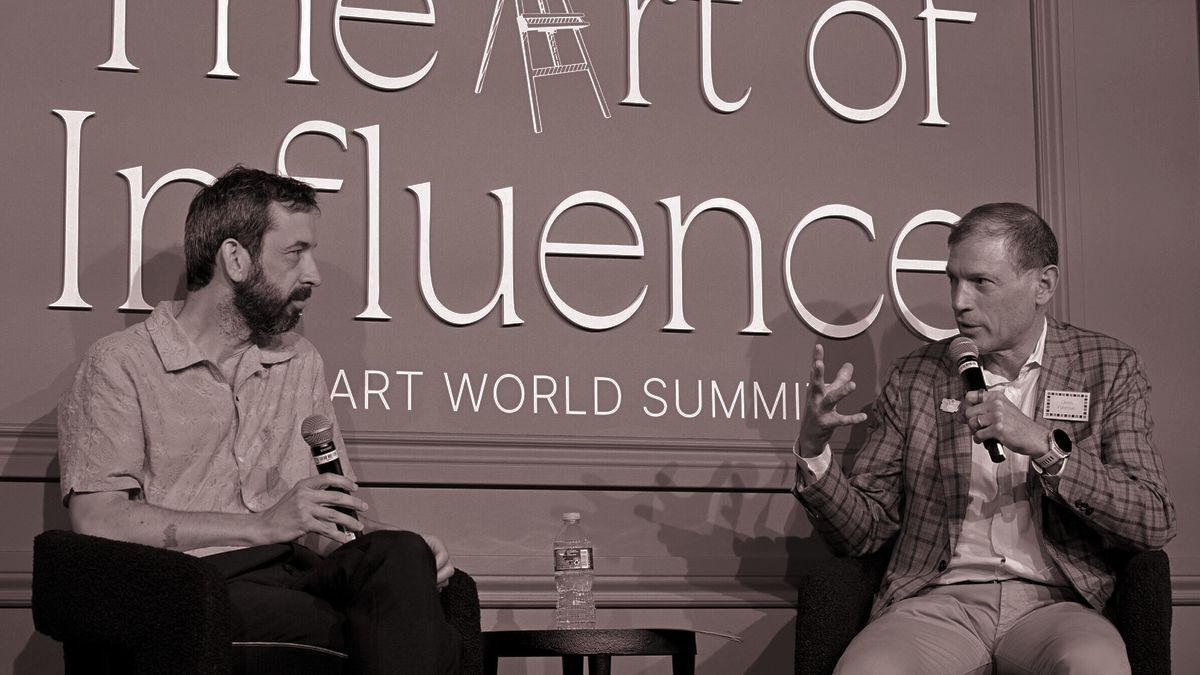
Tonight, we’ve got more from Puck’s Art of Influence summit, organized with the FLAG Art Foundation, whose founder, Glenn Fuhrman, interviewed artist Nicolas Party at the event. Glenn covered a number of different subjects with Party, including how he has dealt with success as an artist, what it means to manage relationships with multiple galleries, and why he sometimes makes art that he doesn’t intend to sell. We’ll get into all of that
below the fold.
But first… |
|
|

| Julie Brener Davich
|
|
- A scoop on Irsay’s
guitars: Christie’s has won the battle with Sotheby’s and Julien’s to sell the collection of Jim Irsay, the late owner of the Indianapolis Colts who led the team to Super Bowl victory in 2006. He died this past spring at the age of 65. Christie’s will offer his mammoth collection of American history, sports, and rock ’n’ roll memorabilia in a series of sales
starting in March 2026.
In 2022, Guitar.com magazine declared Irsay’s guitar collection “the greatest on earth.” It included Kurt Cobain’s Fender Mustang from Nirvana’s “Smells Like Teen Spirit” video, which he bought for $4.4 million; Pink Floyd guitarist David Gilmour’s famed black Fender Strat, a $4 million purchase; as well as guitars that had belonged to Bob Dylan, Prince, Eric Clapton, The
Beatles, and the Grateful Dead. Irsay also reportedly outbid Paul Allen to win Ringo Starr’s drum kit for $2.2 million. Other Irsay treasures include a Jackie Robinson game-used bat, J.F.K.’s rocking chair, and Jack Kerouac’s manuscript of On the Road, which Irsay bought for $2.4 million in 2001. “Rock ’n’ roll and N.F.L. football—that’s America, man, that’s what it’s about,” he was quoted as saying in
his Times obituary.
Irsay toured his collection through 10 U.S. cities between 2021 and 2024, but he never expressed interest in selling, even “if someone offered me a billion dollars,” as he told Bloomberg News in 2022. At that point, his collection was valued at about $100 million.
|
|
|
A MESSAGE FROM OUR SPONSOR |
|
|
- Woodruff murals find good homes: Museum consultant Nina Del Rio has brokered a deal to help the tiny Alabama H.B.C.U. Talladega College raise $20 million, per the Times, by placing four of the university’s six Hale Woodruff murals. Under a formal arrangement between four distinct institutions, three murals are being jointly acquired by the Crystal Bridges–affiliated Art Bridges Foundation and the Terra Foundation, and one
will go to the Toledo Museum of Art; two others that relate directly to the history of the college will remain on site. With fewer than 1,000 students, Talladega has faced intense financial pressures since the pandemic. The school commissioned these murals in the 1930s, and they are the largest works Woodruff ever created.
Del Rio clearly took a lesson from the turmoil that Fisk University kicked off in 2005, when it tried to sell two works that had been gifted by
Georgia O’Keeffe to the school—triggering a long court fight that resulted in an agreement between Crystal Bridges and Fisk to share the works. For the Talladega deal, Del Rio approached Anne Kraybill and Turry Flucker at Art Bridges and the Terra Foundation, respectively, both of which have large collections that they lend to institutions; they were interested in the three murals Woodruff made about the Amistad rebellion. Meanwhile,
Adam Levine at the Toledo Museum of Art expressed interest in the mural of the Underground Railroad, as a way to highlight Ohio’s abolitionist past.
As a result of the partnership among the four institutions, Woodruff’s most impressive works will be seen by more people in more places. It’s a perfect example—along with the recent announcement that the Pearlman collection will be shared among LACMA, MoMA, and the Brooklyn Museum—of a growing trend of joint
ownership of art in the public domain. And let’s not lose sight of the $20 million the Times says Talladega is getting, either. Whether that’s accurate or just a ballpark figure, it’s still an astonishing sum considering Woodruff’s highest auction price was set in 2019 at $750,000. Of course, no museum or charitable institution would want to be seen removing these works of art from an H.B.C.U. without fair compensation—and then some. The final bow on the deal was to commit to reuniting
the four murals in Talladega every few years.
|
Now on to the main event… |
|
|
At Puck’s Art of Influence event in September, collector Glenn Fuhrman
interviewed Swiss artist Nicolas Party about the challenges and opportunities of being a successful international artist—from pricing and the politics of the studio visit to the freedom of creating work that isn’t for sale. |
|
|
Nicolas Party, the Switzerland-born, Glasgow-trained painter, has been on
a rocket-ship career trajectory since settling in New York. In 2019, Glenn Fuhrman’s FLAG Art Foundation held an exhibition in which Party combined Old Masters paintings with wall murals that were not permanent—“meant to disappear,” as Party put it—and of course not for sale. But his characteristically flat, pastel-colored work had already been attracting market attention, and an extraordinary run at auction soon followed. Within a few short years, he has become a distinctive
presence in the international art market.
In many ways, Party’s journey came full circle last month when he returned to the FLAG Art Foundation for Puck’s inaugural Art of Influence summit. Taking the stage as a headliner, Party sat down with Fuhrman to talk about why he stopped doing street art (“mainly because it’s illegal”), what it’s like joining a global mega-gallery (Hauser & Wirth), and how being a dad has made his art better. This conversation has been edited for clarity and
length. |
“Everything Will Eventually
Disappear”
|
Glenn Fuhrman: Can you talk about the practice of
making works—like the murals you made for FLAG—that you spend so much time on, but aren’t really a part of your saleable production?
Nicolas Party: I grew up doing street art, and when I stopped doing it for various reasons—mainly because it was illegal and very costly if you got caught—I kept using the wall as a surface. For an artist, the wall is probably the oldest surface ever used. Some of the most important artworks have been created on walls. Painting on the wall
requires a physical presence and is a fairly intense practice. The work is always meant to disappear. My murals always stay for the duration of a show. Some only stay for literally two or three days. |
|
|
A MESSAGE FROM OUR SPONSOR |
|
|
You could paint on the surface that can be taken off the wall, and then sold
and repurposed. Is that not in keeping with the philosophy of these works?
For me, the fact that they’re going to disappear is a very important part of the practice. I allow myself to do different work when I do murals, because they’re just here for a period of time. The culture of art is so precious. The climate is like, Everything has to stay forever. That’s obviously an illusion; everything will eventually disappear. As an artist, it feels very nice when you do
something that’s disappearing so quickly, so you don’t have the pressure of being like, Oh, this is going to stay forever.
You’ve also done some curating. As an artist, what is it like doing a studio visit? What are some of your dos and don’ts when you go to a studio, and when you’re having people come to your own studio?
When artists do visits, there are more technical chats. Most of the studio visits that I have with
curators, art collectors, and galleries, they’ll never criticize the work directly. As artists, we’re more direct. There are some artists that came to my studio and were really direct, like, Oh, I don’t think this is really interesting.
Does that bother you?
No, that’s kind of the best. Because as an artist, especially when you have a little bit of success, you only hear, That’s great, it’s great, it’s great. And you’re well aware that not
everything is great. I know that some pieces I’m making are not good. Sometimes it’s actually a good test to put some bad pieces in. |
What was the process like to go to a mega-gallery like Hauser & Wirth? What
were the driving factors and reasons to do it? And what’s been the reality of being part of a giant global gallery?
So I have six galleries now, and they’re very different from each other in terms of scale, in terms of my collaboration with them, and how they operate. I felt like it was a steady progression. I learned so much step by step. And when I got to Hauser, I felt I knew a little bit about the art world and art market. It’s much more intense—the pressure and prices and
everything are quite different. When I started at the Modern Institute, my paintings were sold for $2,000. That’s different than when you have to sell things for hundreds of thousands. It involves a different operation in many ways.
I think the drive for me to go to a big gallery was because you keep hearing about the mega-galleries and the great spaces, and you just want to see how it is. As is the case with anything else, it’s about relationships with people. I’m Swiss—I connected very
well with Iwan and Manuela [Wirth], and Marc [Payot]. They have a great presence. It feels very warm and very human. So this mega-structure was actually very well absorbed by the human connection I had with the people there.
You’ve had such global success and your works appeal to a global audience. There’s something about it that really seems to resonate cross-culturally. Was that something you
set out to do, or is it a coincidence that what you wanted to do appealed to such a broad range of people?
If you see what’s successful, there are millions of different things, different styles, and different profiles. Nowadays, it’s not like everybody is one type of artist. And also, when you start in your late 20s and 30s, your success comes very gradually. It took me 10 years. And I was always surprised in a way. New York is different—you’re surrounded by a lot of successful
people—but I spent six years in Glasgow, and then two or three years in Brussels, where most of my colleagues didn’t have success at all. |
Praise in the Form of $7
Million
|
You had to have had incredible success at auction. Can you go back to the first
time your work started selling for millions? What was that experience like for you?
It was kind of fun. It was kind of thrilling. The one that sold when the market was so high, years ago, at $6.7 million or something. An artist has a little bit of ego. And that was a type of praise. It was like, Oh. My. God. Someone spent almost $7 million to buy something that I made. |
|
|
Are you very active in setting the prices for your primary works? How does
that work?
That’s where Hauser enters the picture. It was very important to be with people that have a lot of knowledge and experience and expertise, especially with the gap between the primary and secondary market. Between artists, we don’t talk enough about pricing. But I recently made a list of about 15 painters to see what their prices are for the same size of painting. I don’t want to be way more expensive or way lower.
It also has to be tied to the
production, right? If you make 10 paintings a year, and somebody else makes 100 paintings a year, you have to think about the dollars per year you’re getting.
When I was asking around among the artists of my generation, that’s a big factor. If an artist makes eight paintings a year or 60, that’s very different. But, you know, some artists make tons of paintings and they are super expensive.
I think your career has been handled so brilliantly. At your last show, you
had these spectacular small paintings of dinosaurs, and none of them were for sale. Where did that come from, and are you now making works like that that are for sale?
I’ve been really into these tiny paintings on copper, which was a very common medium in the 1660s in Germany and in Holland. Copper is a very soft surface, so it’s great for details. I’ve started to copy my own paintings in a very small version. It takes a long time, and I don’t sell them, so it’s
not the most lucrative way of spending my time in my studio. But I love the idea of having those tiny little objects, and they’re also so different from the pastel in terms of texture and scale and how they take up the space. It’s been a fun, new aspect of my practice—but not for sale.
Tell us about parenthood as an artist, because now you have a real family.
I’m happy you asked, because you always hear about mom artists. They never say, What about dad artists?
It drastically affects how you see the world and how you think about art. It makes everything better, because you see the future of sharing your passion and love. |
That will do it for today. I’ll be back on Friday with more on the gathering momentum
for the November sales.
M |
|
|
The ultimate fashion industry bible, offering incisive reportage on all aspects of the business and its biggest
players. Anchored by preeminent fashion journalist Lauren Sherman, Line Sheet also features veteran reporter Rachel Strugatz, who delivers unparalleled intel on what’s happening in the beauty industry, and Sarah Shapiro, a longtime retail strategist who writes about e-commerce, brick-and-mortar, D.T.C., and more. |
|
|
Finally, a media podcast about what’s actually happening in the media—not the oversanitized,
legal-and-standards-approved version you read online. Join Dylan Byers, Puck’s veteran media reporter, and Julia Alexander, a longtime media analyst, as they sit down with TV personalities, moguls, pundits, and industry executives for raw, honest, sometimes salacious conversations about the business of media and its biggest egos. New episodes publish every Tuesday and Friday. |
|
|
Need help? Review our
FAQ page or contact us for assistance. For brand partnerships, email ads@puck.news.
You received this email because you signed up to receive emails from Puck, or as part of your Puck account associated with {{customer.email}}. To stop receiving this newsletter and/or manage all your email preferences, click here. |
Puck is published by Heat Media LLC. 107 Greenwich St., New York, NY 10006 |
|
|
|