|
Welcome back to Wall Power, Inner Circle edition. I’m Marion Maneker.
I was in Los Angeles a week ago for Design.Space LA, a fair built around the convergence of art and design. As part of the event, I moderated a talk on this subject with two important Los Angeles dealers: Jeffrey Deitch, who’s been there and done that in just about every way in the art world, and Sara Lee Hantman, the gallerist everybody talks about in town. That conversation was the basis for this week’s Condition Report, which you can read below. Meanwhile, it just so happens that the folks at Christie’s are announcing the sale of Tiqui Atencio and her husband Ago Demirdjian’s art and design works from their London home. So we have a theme tonight.
But first…
|
- We’ll always have Paris: The Paris sales crept up on us without a lot of fanfare. Today, Christie’s sold €30.7 million total from their 20th/21st century evening auction, including Henri de Toulouse-Lautrec’s Jane Avril au Divan Japonais, which made €5.3 million; the auction house will have day sales later tomorrow and Friday. Sotheby’s has works from Brazilian newspaper owner Niomar Moniz Sodré Bittencourt, who died in 2003, and an evening sale tomorrow night. There’s a nice Nicolas de Staël in Sotheby’s sale, along with a Jean Dubuffet Hourloupe work that might be appealing to anyone who has seen the current show at Pace. There’s also a Matisse nude estimated at €2 million that was purchased six years ago for that price. It will be interesting to see how it trades.
|
|
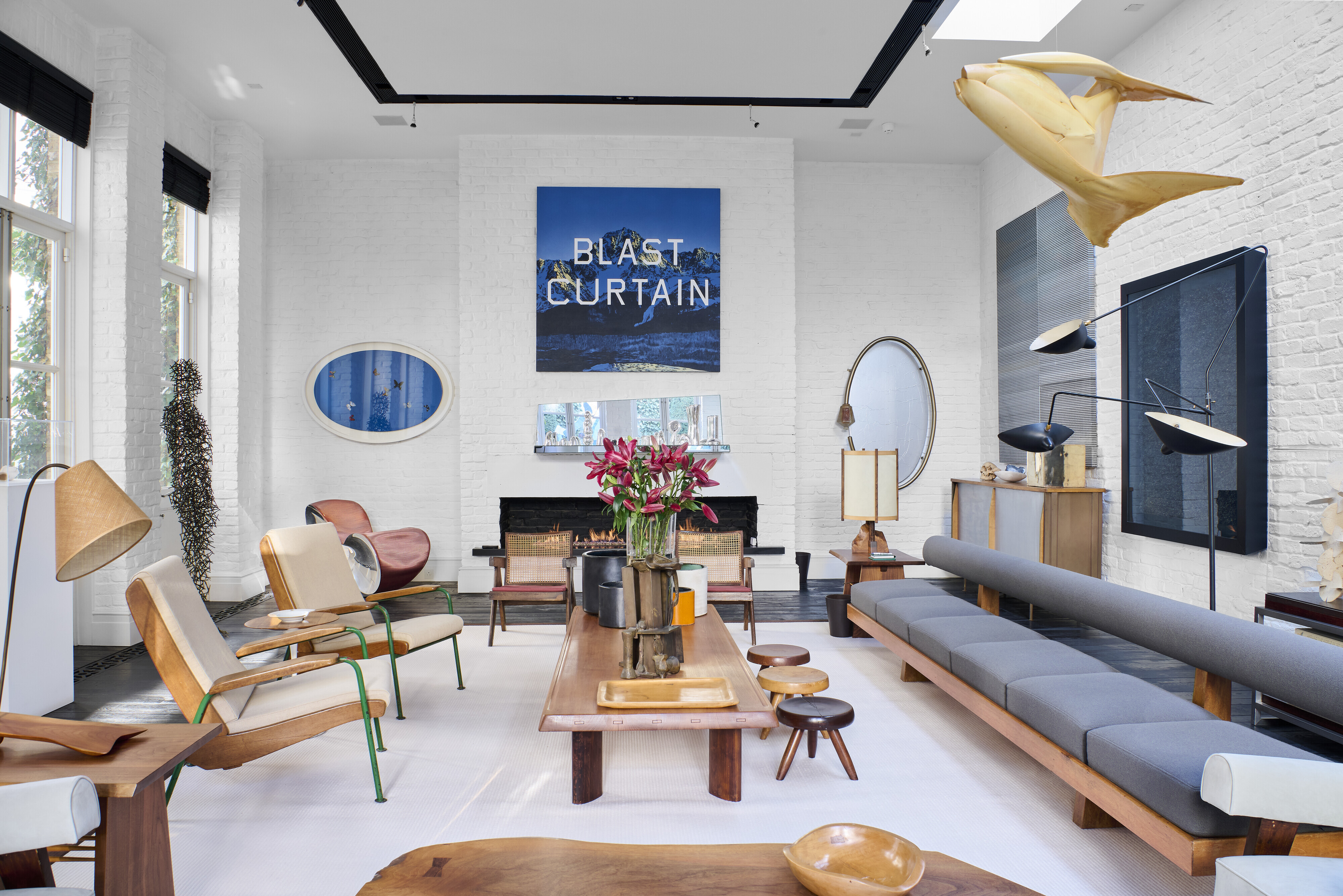
Living room interior, London home of Tiqui Atencio & Ago Demirdjian. Photo: Courtesy of Christie's
|
|
For the influential collector Tiqui Atencio and her husband, Ago Demirdjian, collecting is associated with the cities they’ve lived in—New York, London, Paris, Monaco—and the different artists whose works they’d acquired in each place. Her collecting origins started with her father, who bought her a Bernard Buffet canvas when she was barely an adult, and her uncle, who was a significant art collector in their native Venezuela.
Atencio has been fascinated by how art people—artists, collectors, and dealers—live with their art, so much so that she published three books on the subject, two of them with “For Art’s Sake” in the title. Now that she and her husband are leaving London to spend more time in Monaco, it made sense to pass much of the art and design contents of their London home on to others; calling the sale For Art’s Sake seemed like a no-brainer, too.
|
|
|
|
A MESSAGE FROM OUR SPONSOR
|
|
|
|
The Demirdjians are known tastemakers, and followed a holistic approach to integrating art and design in their homes. Their London home contained works by designers like Prouvé, Perriand, and so forth. With their move, the Demirdjians have chosen 200 works of art and design for sale. (The art is owned by the trustees of Mayfair Oeuvres d’Art Ltd. and Artapar Ltd., the kinds of entities that many collectors use to manage their art assets and advance their philanthropic goals.) The main group of art will be sold in New York in May. After that, there will be a design sale in Paris; then, in the fall, some of their collection of Y.B.A. artists will be sold in London, of course.
Christie’s will include 15 pieces in the May sales in New York. The group is led by two paintings created in 1999: Ed Ruscha’s Blast Curtain, estimated at $4 million, and Cecily Brown’s Bedtime Stories, also at $4 million. Additional highlights include canvases by Elizabeth Peyton, estimated at $800,000, and Julie Mehretu, estimated at $3 million; a 2007 glass cast by Roni Horn, estimated at $700,000; a work by Louise Bourgeois, estimated at $600,000; and the earliest work in the group, a Lygia Clark dating to 1960, estimated at $400,000.
The May design sale will have 60 objects, featuring a three-armed floor lamp by Serge Mouille, estimated at €70,000; a pair of Visiteur armchairs by Prouvé, at €150,000; and a bench by Charlotte Perriand, made for the Sandoz headquarters, estimated at €80,000. The whole collection is guaranteed and is expected to sell for $30 million.
|
|
And now, on to the main event…
|
|
|
|
A revealing conversation with two essential gallerists about the generational shift toward integrating design and art, and why serious collectors are moving beyond just paintings on the wall.
|
|
|
|
As part of Design.Space LA, I moderated a conversation that focused on how art collection is converging with design collection. Jeffrey Deitch, the former museum director who has galleries in New York and Los Angeles, joined me to share some of his nearly 50 years of experience working with collectors and selling art. To get a different perspective, we also spoke with Sara Lee Hantman, the founder of Sea View Gallery. Here’s our discussion, which has been lightly edited for clarity.
|
|
Marion Maneker: Chicken or egg question. Which comes first, the design or the art?
Jeffrey Deitch: Back around 1980, I visited the grand mansion of Hubert Neumann in Chicago, which was packed with great art. But the furniture was absolutely the worst imaginable, just shabby and cheap. That was the typical art collector of that generation. Design was irrelevant. Now, it’s a very different situation. Almost every serious art collector, if you visit, it’s not just the paintings on the wall. There’s very sophisticated design furniture.
|
|
|
|
A MESSAGE FROM OUR SPONSOR
|
|
|
|
Sara, how do collectors approach this? If you want to go deep on an artist, do you end up with the things that aren’t necessarily paintings? Or is it more of a decorating approach?
Sara Lee Hantman: That’s why it’s called collecting, rather than decorating, right? Most of the time, whether that’s art or design, collectors do pick one first. That’s changing. That’s exciting, because I agree with Jeffrey—a good collection should be something that’s seamless within the home, something that’s lived with, or that has a pervasive theme. It’s also an expression of your own interests and passions, and sometimes, as a gallerist, that takes a while to really understand.
Have you seen that change with your clients, that they’re more interested in the design, or coming to you from the design world? How do you manage the expectations and goal-setting?
Deitch: It’s generational. The old-school clients, who are in their eighties and beyond, it’s 100 percent art, and the furniture in the house is an afterthought. But with a younger generation, it’s all integrated, and is part of the trend that we see of blurring the boundaries between art, design, fashion, even what we do in entertainment. That is a primary characteristic of where we are right now, which I’m very enthusiastic about.
Are emerging art collectors more likely to have an interest in design?
Deitch: We know it became very chic for art collectors to acquire mid-century modern design. But I think there needs to be more of a connection between contemporary designers and contemporary art. There are a few people I know who do both, but that’s still very unique.
Hantman: I agree. There’s a real hunger right now—speaking specifically on contemporary collections—for the work to be unique. I’ve seen collectors really try to think about how the work speaks to the interior, and vice versa, rather than how it fits into some kind of cookie-cutter checklist of what a good design collection and good art collection should look like.
|
“Taste Is Made by a Thousand Disgusts”
|
|
Let’s talk about the Lalannes, Claude and François-Xavier. Their work cuts across both worlds: It’s never quite clear whether their work is art or design. Is that a function of who they are, or does that fit into this story of these worlds merging?
Deitch: It took a long time. The Lalannes were there for decades as designers, and not as top artists whose work sells for multimillions. Also, it’s a few people who fuel this. I know somebody in Los Angeles who just got interested in the Lalannes, someone who was used to spending $10 million-plus on paintings, and just plunged into it. The art and design markets are very peculiar, because you might think it’s thousands of people behind it. No, it’s maybe five people behind it.
Is there more recent work that you either see people gravitating toward, or hear about from clients who are curious to learn more or want advice?
Hantman: The Lalannes are a great example of designers who transcended the category of design. There are artists like Katherine Bernhardt, who’s known for her paintings, but she makes incredible furniture; Dan John Anderson, who worked for Alma Allen and wanted to go beyond sculpture and create functional sculpture; Jorge Pardo, who built the space my gallery inhabits. It requires a bit of that risk, which is part of being a tastemaker. There’s an amazing quote by Paul Valéry: “Taste is made by a thousand disgusts.”
Not liking a lot of things is a positive thing. Being honest with yourself about whether something speaks to you or not is really important to developing an interest in something that might not be considered high in design. I speak to a lot of young designers who ask, How can I present my work within an art context? It’s not just on the collector side, it’s on the artist side, where this intersection opens up a world of possibilities, which is at the heart of what makes contemporary art interesting.
|
|
|
|
Deitch: Here in Los Angeles, there are a number of artists and designers in this hybrid category. Last year, I did a suite of three solo exhibitions with Peter Shire, one of the only American members of Memphis, and then the Haas Brothers, who had become very successful and influential, who are increasingly showing in the context of art galleries and art museums rather than the design world. And then a more kind of do-it-yourself design aesthetic, which is very big here, with Sonya Sombreuil. And Jorge Pardo, who used to live in Los Angeles, probably more than anyone else is the one who opened all this up, where it wasn’t just showing his painting, or his sculpture, or his design—it was all together.
Do people come with a vision of wanting to create something out of their home as a work of art, or is it something into which they progressively move?
Deitch: It’s all individual. I visited a collector in Palm Beach who loves the color purple. So there are four beautiful purple automobiles positioned outside of the house. And then inside, it just unfolds. It’s all one story. I told him, You are the artist here. That’s an amazing thing this collector achieved. It’s much more conventional that people start collecting art, and then they get a very good designer who says, We have to up your game. So there’s a big difference between people who have designers and these unique people who create their own world where art, design, music—everything is all integrated.
Hantman: Jean Pigozzi did an interview where he talked about, when you walk into someone’s house and it has all the same things that other people have that you’re “supposed” to buy, it’s not inspiring as a collector. Personally, I was inspired when I saw Francesco Clemente’s collection. He owns a Basquiat, he owns a Cy Twombly, and he owns all this incredible African sculpture that’s seamlessly installed alongside these big names and esoteric things, as well as a lot of gorgeous Italian furniture.
Artists have the best collections, because they’re creative about how they collect. It’s the same for really good collectors. That takes time, of course. But that’s when the collection really stands out. It feels earnest.
Deitch: Sara, you’re correct in citing artist collections. [This is true of] the Clementes in all their homes, and Francesco’s studios. His aesthetic extends to how he dresses, into his persona. The most impressive design-architecture-art fusion I’ve seen recently was when I visited the home of John Currin and Rachel Feinstein; it’s designed by Studio Peregalli. They’re from the school of Renzo Mongiardino, and it is mind-blowing. There’s no difference between architecture, design, furniture, walls, and the art. It’s all integrated in a completely unique way.
I’m assuming, when you’re working with people, this is about discovery. Part of discovery is falling in love with something, maybe falling out of love. How do you navigate that process with clients, about how their tastes change over time?
Hantman: The first thing I tell my clients is you really need to love this work, and it needs to be a good example of what you’re into—because it might not be a decision based of that true example that you’re seeking. Mistakes, to me, are kind of part of the game, too. But it boils down to, what is it that you really love about this work?
Deitch: The notion of a mistake in art and design collecting—there’s a lot of humor to that. When I was director of MOCA, I got a panicked call from one of the trustees. An art consultant had gone into the home and said, You have to sell this. You cannot have this in your house now. It was an artist who we all know, who had gone a little bit out of favor. And that’s what happens. Artists go in and out: They’re on the hot list, and then they’re on the negative list. I calmed her. There was nothing wrong with this piece. But if someone is in this circuit with other museum trustees, and people who follow the market, they’re very conscious of what’s in and what’s out. I know people want to follow that path, but I admire the collectors who stood by the weird things they bought and kept for decades.
|
|
I don’t think this is the last you’re going to hear from us on this subject. But we’ll be back on Friday with our regularly scheduled programming.
M
|
|
|
|
The ultimate fashion industry bible, offering incisive reportage on all aspects of the business and its biggest players. Anchored by preeminent fashion journalist Lauren Sherman, Line Sheet also features veteran reporter Rachel Strugatz, who delivers unparalleled intel on what’s happening in the beauty industry, and Sarah Shapiro, a longtime retail strategist who writes about e-commerce, brick-and-mortar, D.T.C., and more.
|
|
|
|
Finally, a media podcast about what’s actually happening in the media—not the oversanitized, legal-and-standards-approved version you read online. Join Dylan Byers, Puck’s veteran media reporter, as he sits down with TV personalities, moguls, pundits, and industry executives for raw, honest, sometimes salacious conversations about the business of media and its biggest egos. New episodes publish every Tuesday and Friday.
|
|
|
Need help? Review our FAQ page or contact us for assistance. For brand partnerships, email ads@puck.news.
You received this email because you signed up to receive emails from Puck, or as part of your Puck account associated with . To stop receiving this newsletter and/or manage all your email preferences, click here.
|
|
Puck is published by Heat Media LLC. 107 Greenwich St, New York, NY 10006
|
|
|
|