Welcome back to Wall Power’s Inner Circle. I’m Marion
Maneker.
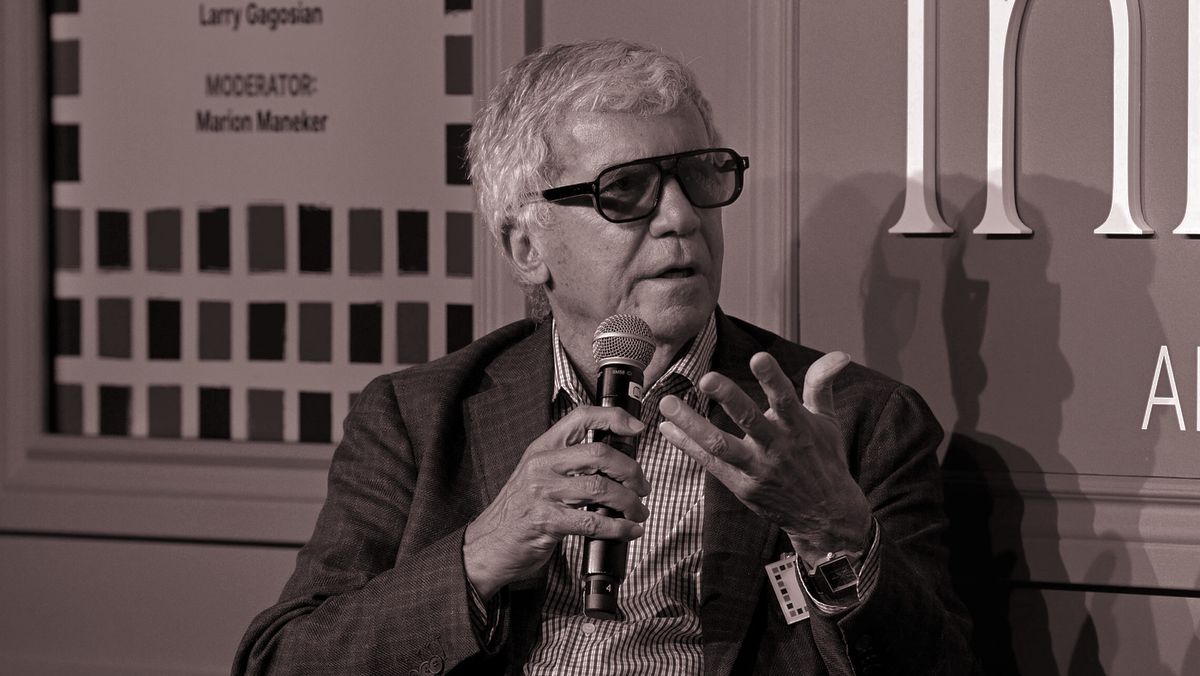
We’re back with more of my interview with Larry Gagosian from The Art of Influence, our inaugural summit with the FLAG Art Foundation, which gathered some of the leading figures in the art world.
The conversation is only a sample of content from the event that we’ll be publishing for Inner Circle members over the next several weeks. Inner Circle subscribers will also get access to videos of each interview and
panel.
But first…
|
- Qatar’s new museum dedication: M.F. Husain, one of the core artists in India’s modern art movement, was a Muslim painter who eventually fell victim to Hindu nationalism and fled to Qatar. He became a citizen there in 2010 and died the following year. Husain is still a dominant artist in the market for South Asian modern art—his work set a record of $13.75 million this spring. Now, the Qatar Foundation will honor him with the Lawh Wa Qalam: M.F. Husain Museum, which
will open in Doha on November 28 and house works commissioned by foundation chair Sheikha Moza bint Nasser.
|
|
|
A MESSAGE FROM OUR SPONSOR |
Greatness isn't achieved in an instant. It's tested until there is no question — only performance. |
|
|
-
Runaway bidding at Sotheby’s modern and contemporary South Asian art sale: Sotheby’s generated £18.9 million (about $25 million) yesterday from its modern and contemporary South Asian art sale in London, but that solid result doesn’t tell the whole story. 50 of the 54 lots sold for final prices that were multiples of the estimates; two lots had as many as 13 bidders participating. Two paintings by Francis Newton Souza,
Emperor (1957) and Houses in Hampstead (1962), were estimated at £1 million and £800,000, respectively, but sold for more than £5
million each. Sayed Haider Raza’s Shanti La Paix, from 2000-01, sold for £1.1 million against an estimate of £300,000. M.F. Husain’s Chittore Fort, from 1964, sold for £1 million, and his untitled work from 1959 was estimated at £200,000 but sold for £825,000.
Indeed, there has been a multiyear run in the category, where estimates will eventually have to catch up with selling prices. Christie’s held its comparable sale
of South Asian modern and contemporary art two weeks ago in New York, where the total was $12.4 million and the top lots were works by Vasudeo Gaitonde, Tyeb Mehta,
Jehangir Sabavala, Souza, and Raza. The Gaitonde and Mehta turned out to be estimated well, with
selling prices in line with expectations, but many other works saw the same level of intensive bidding that drove Sotheby’s results this week. - Christie’s postwar to present midseason sale totals $35 million: Meanwhile, Christie’s midseason contemporary art sale also had many strong performances against estimates. These included Sam Gilliam’s Last September II, from 1973, a colorful beveled canvas that was estimated at
$800,000 and sold for nearly $1.8 million with fees; Alexander Calder’s Brass Spear, a tabletop work from 1949 estimated at $600,000, that sold for nearly $1.2 million with fees; and Olga de Amaral’s Paisaje heredado 4, from 2002, which was estimated at $400,000 but sold for $1.1 million with fees—the exact same price as two of the artist’s other works sold for this year.
Meanwhile, one of Kenneth Noland’s sought-after
circle paintings, Indian Wind, from 1961, was bought in and then reopened to sell for nearly a million dollars—and, yes, the final selling price was above the $700,000 estimate. There were also some very good sales for Alice Neel, Adolph Gottlieb, Manolo Valdés, Josef Albers, Sol LeWitt, Martin Wong, and a rare painting by sculptor Tony Smith.
A
few more interesting lots to note. A reader pointed out that the final lot in Christie’s sale yesterday was Dan Colen’s Holy Shit, from 2004, which sold for $12,700 against a $10,000 estimate. The painting’s first auction price was achieved in 2013 when it was the first lot in Sotheby’s contemporary evening sale, and sold for $341,000. But two years ago, it went unsold in another midseason sale with a $40,000 estimate. Also, a 14-inch Andy Warhol
Flowers painting in bright red, which last sold at auction in 2021 for $300,000, was offered at Christie’s with a very low estimate of $150,000. (Another version of the same-sized image sold for $1 million earlier this year, a price we haven’t seen for a comparable work in a decade.) The red flowers had some slight condition issues, an art advisor informed me, but that didn’t hold it back: The work sold for $419,000.
|
Now, let’s get to the main event… |
|
|
In the second installment of a conversation with Larry Gagosian, the power dealer
discloses his secrets to success in business, from his gallery empire to his restaurant fiefdoms. |
|
|
It’s difficult to pinpoint what fascinates us so much about the legendary art dealer Larry
Gagosian. Maybe it’s the combination of charm, charisma, and chutzpah that has equally impressed and intimidated the art world ever since he hit the scene in the 1980s. Maybe it’s his aggressive and unapologetic approach to trading art or his remarkable success—everyone is curious to know his secret.
As it turns out, Gagosian works on instinct; there is no grand plan. He got into the art market pretty much by accident, and has built a gallery with 18 locations around the world
largely by following his gut. The “Gagosian experience” goes far beyond the galleries, and in this interview, Larry explains how serendipity helped him build a global empire, how he got into the restaurant business, and how to get a massive marble sculpture to the top of a 100-foot cliff. What follows is from our recent interview at Puck’s Art of Influence summit in Chelsea. This excerpt has been lightly edited for clarity. |
“I Work Basically on
Instinct”
|
Marion Maneker: When and how did dealing primary works
become the focus of what you were doing?
Larry Gagosian: I did start selling posters on the sidewalk. I didn’t see that as a pathway to sitting here with you. But the way I got into representing artists was, in L.A., where I had my gallery, I had good relationships with some of the major dealers, particularly Leo Castelli. And I was able to show pretty much any of his artists in Los Angeles. It was a great opportunity
for me to get that kind of credibility and jumpstart my business.
When I moved to New York in 1985, I didn’t represent any artist. So I had to do something to make it look like I was in the game. I went the path of doing historical shows, and I got a lot of attention for that. It was a great start for my business in New York. Then I started to meet artists in the city, and I wanted to engage and work with them. So step by step, I started to represent primary artists. |
|
|
A MESSAGE FROM OUR SPONSOR |
Greatness isn't achieved in an instant. It's tested until there is no question — only performance. |
|
|
Eventually you opened in London and 17 other locations around the world. Were you looking
at individual opportunities in each city, where you thought you could extend your relationships to a global collecting class?
It was exciting for me, as a relatively young dealer, to take a look at what could be done outside of the United States. The catalyst for our first gallery outside of the U.S., which ended up being in London, was that an employee of mine, who I thought was very talented and liked working with, had to move to London for
various reasons. Eventually, we got an office in the Saatchi & Saatchi building. And at that time, Charles Saatchi was probably the most influential collector in the world. It was a little bit of serendipity, because I wasn’t planning to open a gallery in London—I didn’t want to lose this very intelligent employee, so in response to that, we ended up getting a space there. And then we finally got a gallery space, moved out of the office, and we’re still there.
I knew
London was a very important city in the art world for a few reasons. There was a fair amount of art collecting activity there at that time, and there were some very interesting artists. It excited me to have a gallery in Europe, and it gave me a new kind of energy and a new adventure, which was very stimulating.
Did you discover clients that you hadn’t known of through the gallery? I assume being in these various cities in the ’90s would have enabled you and your directors to
bring new clients to the gallery.
Shortly after we opened our gallery in London, the Anthony d’Offay Gallery was by far the preeminent gallery, and Anthony d’Offay decided to retire at a fairly young age. So that was a bit of good fortune for us because it opened up relationships that would have been blocked by d’Offay’s representation. I didn’t see that coming.
How much does luck play in the growth of the
gallery?
It’s a difficult question to answer. I work basically on instinct, for better or worse. It doesn’t always work out, but I’m more comfortable doing things that I feel are right. I’m not into metrics of how many collectors are in a certain region, or what their annual art budgets are. That’s something that auction houses are a lot better at than I am. But you get a feeling for what’s evolving in the city, how the culture is evolving, how
the art scene is evolving. And I’ve kind of followed my nose.
Do you do that with people, too? You’ve mentioned creating an environment that your directors feel a part of.
Yes, a similar way of hiring directors. Interestingly, and this is something I never intended, but almost every director in a Gagosian gallery is a woman. Our director in Hong Kong, our director in Los Angeles, our director in Chelsea, our director in London, our
director in Paris, Athens, Rome—they’re all women. I don’t know why I mentioned that, but it just seems like a curious kind of footnote. They’re all obviously very talented people in the art world. |
Sculpture
Delivery by Helicopter
|
You’ve got a lot of directors, so how do you manage the
people?
I’m not sure how I do that, but I will say that I’m in touch with almost all of my directors, virtually on a daily basis. Just checking to see how a deal is going, how an artist situation is going, whatever the issue is. I’m constantly on the phone, getting feedback and making decisions. It’s a system that I’ve used for a long time, and it seems to work.
Having built your brand, I’m sure you’ve realized there’s a lot of
interest from luxury conglomerates to get into the art world. Do you think there’s a benefit of the two worlds being cross-owned?
I haven’t seen any evidence of how that works out. People are looking at the luxury world as a support system for the art world in various ways, but if you’re talking about luxury brands owning art galleries, I think that could be tricky. Different cultures, different agendas, different styles. And I think at the end
of the day, the luxury company will probably have too strong a say in how you run your business—so that is not something I would personally rush into. |
|
|
You’ve recently opened a couple of restaurants; you bought a bookstore in East
Hampton—there’s a Gagosian experience. Are all those things hobbies of yours?
They weren’t intentionally something that I thought would work in the primary businesses. But I had an opportunity to open a restaurant in my building 12 years ago, and I’m very happy with how it turned out. And I have a little Mexican restaurant in East Hampton, which I bought 17 years ago. I love the bookstore in East
Hampton. We’re keeping it as a community-based general interest bookstore, but we’re leaning more heavily into art, architecture, and photography. I didn’t know what the appetite would be for those kinds of titles, but I figured it was probably a good get because of the number of artists and collectors and museum people that stay in that neighborhood. And I’ve been pleasantly surprised.
My vision of the ultimate Gagosian experience is the Casa Malaparte event that you do every
year. I'm curious to hear how that came about, how it works, and how it fits into what you do.
I knew about Casa Malaparte primarily through the movie Contempt with Brigitte Bardot and Jack Palance. It’s a wonderful, quirky movie. Many of the scenes were shot at Casa Malaparte, on the roof. So I was somewhat familiar with the building. And then somebody said, Would you like to do something
there? So I went and I looked at the building and the roof. I said, Let’s do an art show there. Every summer we show a significant artist. And it’s interesting because there are no electric lights in the main salon, where we primarily show. So when it gets dark, the show is over. Then everybody goes up on the roof—and we have a beautiful dinner for about 60 people. We do that approximately once a year. It’s something I look forward to enormously. I plan to keep it going, even
though I’m a little bit concerned with the knees and climbing up the stairs to the villa.
How do you get all the art in? Casa Malaparte sits on top of a 100-foot cliff with steps leading down to the water.
Well, that’s a very interesting question. Previously, we would just walk it in, up the stairs from a boat. The last show was Maurizio Cattelan. The work was all massive marble sculptures. The only solution,
it turned out, was to bring them in with a helicopter. We lowered them onto the roof and then brought them into the salon. They were too heavy to get up the stairs. So that was the first time we had to go that route. Hopefully we won’t have to do that every time we have a show. |
If you haven’t yet gotten your fill of Gagosian, here’s another
interview just published in a French magazine, Numéro, conducted by former New York Times art critic Roberta Smith. She asked him some interesting questions and he didn’t hold back: “I love selling big paintings—expensive, famous paintings.”
In the interview, Smith points out that Gagosian has been criticized for making
art dealing “a blood sport.” To which he admits that art dealing could be “rough and competitive,” but “what gets me is when people say I don’t love art. How could I possibly do what I do without caring deeply about it?” There are some other great nuggets, too.
However, if you are maxed out on Gagosian, we will be back to our regular programming on Friday.
M |
|
|
The ultimate fashion industry bible, offering incisive reportage on all aspects of the business and its biggest
players. Anchored by preeminent fashion journalist Lauren Sherman, Line Sheet also features veteran reporter Rachel Strugatz, who delivers unparalleled intel on what’s happening in the beauty industry, and Sarah Shapiro, a longtime retail strategist who writes about e-commerce, brick-and-mortar, D.T.C., and more. |
|
|
Finally, a media podcast about what’s actually happening in the media—not the oversanitized,
legal-and-standards-approved version you read online. Join Dylan Byers, Puck’s veteran media reporter, as he sits down with TV personalities, moguls, pundits, and industry executives for raw, honest, sometimes salacious conversations about the business of media and its biggest egos. New episodes publish every Tuesday and Friday. |
|
|
Need help? Review our FAQ page or contact us for assistance. For brand partnerships, email ads@puck.news. You received this email because you signed up to receive emails from Puck, or as part of your Puck account associated with {{customer.email}}. To stop receiving this newsletter and/or manage all your email preferences, click here. |
Puck is published by Heat Media LLC. 107 Greenwich St, New York, NY 10006 |
|
|
|