Welcome back to Wall Power’s Inner Circle. I’m Marion
Maneker.
Thanksgiving Eve isn’t really a thing, but I know that many of you are traveling or otherwise occupied with the holiday. So tonight, we’re going to follow up yesterday’s newsletter on the Phillips Collection deaccessioning backlash by speaking to Anne Pasternak, the director of the Brooklyn Museum, and Scott Rothkopf, the director of the Whitney. Anne and Scott address head-on the contradictory pressures that museum directors face to
attract more visitors, create community programs, lower admission fees, and grow revenue. Naturally, the cost burden tends to fall on members, patrons, and trustees, who are already stretched thin.
This conversation comes from our art world summit, The Art of Influence, which we produced in collaboration with the FLAG Art Foundation. Whether you were able to join us or are thinking about attending next year, I’d love to hear your thoughts on the programming. What did you like?
What subjects would you want the next event to explore? Who would you most like to see onstage? Let me know by responding to this email or texting +1 (917) 825-1391 on WhatsApp, Signal, or SMS.
Also, if you’re getting this email forwarded to you, please consider subscribing. You won’t have to depend on the good graces of your friends or co-workers, and you’ll be able to be the one to start the conversation. Subscribe here or upgrade to the Inner Circle here.
Let’s get started… |
- Duchamp’s last move: The Museum of Modern Art is getting ready for an important Marcel Duchamp retrospective, its first in more than 50 years, curated by MoMA’s Ann Temkin and Michelle Kuo along with the Philadelphia Art Museum’s Matthew Affron. The last time MoMA put on a Duchamp retrospective, in 1973, the museum paid tribute to Duchamp’s obsession with chess—who can forget the famous
photo of Eve Babitz playing with the artist?—by staging a simultaneous chess match between Larry Evans, a chess grandmaster, and 50 young players. Now, Francis Naumann, a scholar and art dealer who was among those original players, is organizing a reprise of the match, set for April 25 at MoMA. This time,
grandmaster Susan Polgar will take on 50 players simultaneously. If you would like to be one of those players, you can throw your name in the hat here.
|
|
|
A MESSAGE FROM OUR PARTNER |
|
|
- Heffel’s fall sale makes $22 million: In all of last week’s hullabaloo over the billions of dollars being sold amid the return of the art market, Heffel’s 30th anniversary sale of Canadian art got a little lost. But the entire suite of four sales—Post-War and Contemporary; Canadian, Impressionist, and Modern Art; as well as the Lillian Mayland McKimm collection and the Hudson’s Bay Company’s art collection—brought in C$31 million, or $22 million.
The top lot
of the sales was Group of Seven protégé E.J. Hughes’s Entrance to Howe Sound, from 1949, which was estimated at around
$900,000 but sold for $3.4 million with fees. The work came from the McKimm collection. Another top lot from that collection was Lawren Harris’s Lake Superior Sunrise,
from 1925, which made nearly $800,000. The top lot in the Hudson’s Bay collection sale was Winston Churchill’s Marrakech,
from 1935, which was estimated at $285,000 but sold for a little more than $1 million. Works by Adam Sherriff Scott and
Francis Holman were bid well into the six figures even though they carried four-figure estimates.
The big surprise in the Canadian, Impressionist, and Modern sale was expat James Wilson Morrice’s Le Pont,
from 1907, which was estimated at $425,000 and sold for almost $1.3 million with fees. Across the sale, works by Cornelius David
Krieghoff outperformed estimates, but no lot did better than Canadian Autumn, View on the Road to Lake St. John, from 1862, which
was estimated at $70,000 but sold for more than $450,000 with fees. Finally, in the Post-War and Contemporary sales, works by Paul-Émile Borduas, Bernard Buffet, Jean-Paul Riopelle, E.J. Hughes, and Jean Paul Lemieux were all bid well above their estimates to achieve solid six-figure results. Clearly the art market relief rally has legs beyond New York.
|
Now, let’s get to the main event… |
|
|
A prescient roundtable discussion on the unique challenges and
opportunities of running an art museum in 2025, with the Brooklyn Museum’s Anne Pasternak and Whitney’s Scott Rothkopf. |
|
|
Museum directors are under plenty of pressure these days to simultaneously lower
ticket prices, expand access, and manage rising costs. (God forbid you sell a few works to make ends meet.) They’re also navigating creative partnerships to share art across institutions and devise new ways to embed their own museums more deeply into the fabric of their communities, locally and nationally. It’s a big job that’s only become more complicated
amid a charged political environment and shifting economic headwinds.
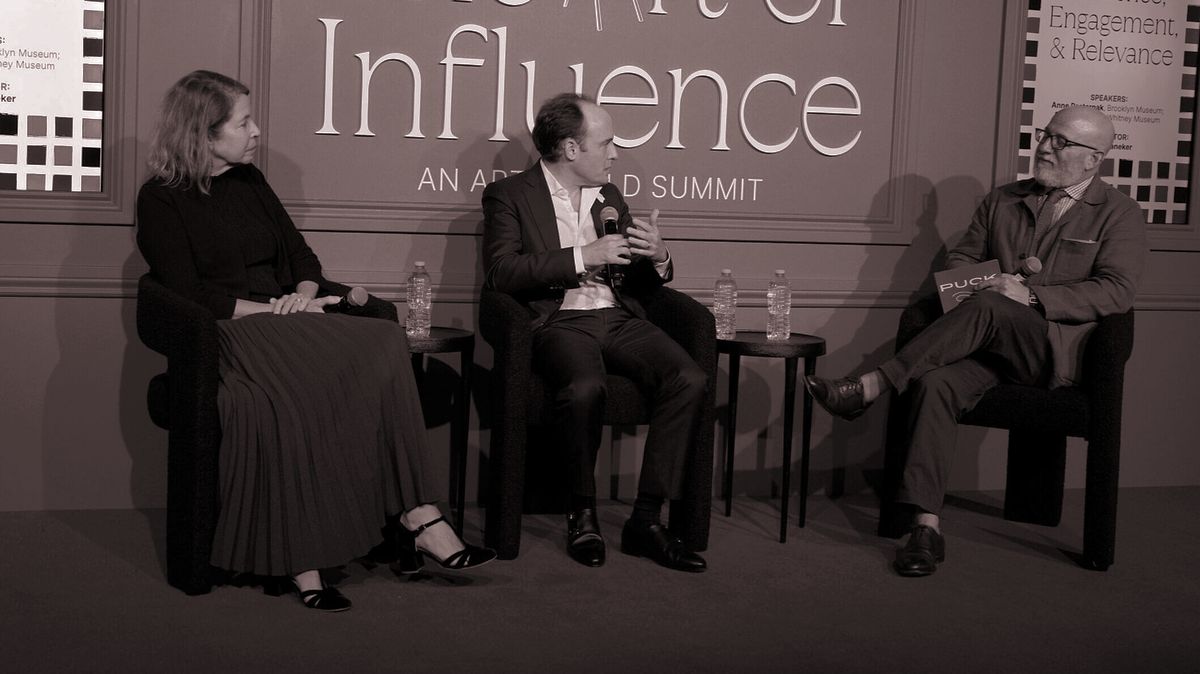
At Puck’s recent The Art of Influence summit, produced in partnership with the FLAG Art Foundation, I sat down with two of the leading museum directors in America: Anne Pasternak, of the Brooklyn Museum, and Scott Rothkopf, of the Whitney Museum of American Art. Both are preoccupied with how they can better engage a broader audience while making do with limited resources. So I figured
it would be the perfect time to share our conversation, which centered on the recognition that ticket revenue, among other things, is not sufficient to support most museums’ missions and programming. The solution, Anne and Scott suggest, is a combination of doing more with less and expanding networks of philanthropic support. (The following has been lightly edited for length and clarity.) |
Getting Young Men Out of Bars
|
Marion Maneker: How do you view your programming in
terms of community building and having a greater connection to your audience, while still focusing on artistic relevance in the broader cultural conversation?
Scott Rothkopf: I think about it in three ways. It’s like a Venn diagram. There’s the artistic program that’s core to what we do—so, our exhibitions. There are community programs, which bridge the gap between those exhibitions and our audiences—that’s the connective tissue. And
then last, and the one I’m probably most conscious of right now, is pricing and reducing barriers to admission at the Whitney. The way these three things line up has been at the forefront of my mind. The good news for me is that, at a time that’s so complicated in this country and in the art world, I’m bullish about the relevance of institutions and the desire and demand for people to be a part of these ones, but maybe in different ways than what we’ve thought of in the past.
Anne
Pasternak: At the Brooklyn Museum, on average, we organize about 15 exhibitions a year, and that’s what I think the art press pays attention to. But the public programs and the educational activities that we do are very important for many, many audiences. We care a lot about economic opportunity for our neighbors. We care a lot about underserved communities. We’ve been a pay-as-you-wish museum for as long as we’ve been around; more than half our audiences don’t pay anything to come. We’re
proud of our accessibility, but we also get out into the community. There’s so much that our institutions are doing to build the art lovers, the artists, and the patrons of the future that I think doesn’t get recognized in the art press and in the mainstream. |
|
|
A MESSAGE FROM OUR PARTNER |
|
|
Anne, you have a long history of being very focused on the Brooklyn
community. How do you consider that in your long-term planning?
Pasternak: The social good has always been a part of the DNA of this institution. Brooklyn started out as a city primarily of immigrants. The museum was established to get young men out of the bars and to teach them about each other’s histories and cultures. And it was a part of the early American project—the idea that if we were more inclusive, we’d be better citizens. That
ethos still defines us today. We offer a very wide array of exhibitions that are intended to lean into the conversations of the day and to connect with history. We can’t ever reach all of our city’s constituents, but we try very consciously to create exhibitions and programs that are going to be engaging for as many constituents as we can. |
Scott, you have had two different gifts that support expanding access to the
museum, making it free for those under 25 years of age, and for everyone on some nights. Can you speak to that a bit?
Rothkopf: With the support of our two youngest trustees, we became free every Friday night from 5 to 10 p.m. And when we’re free, it’s everyone and everything. So it doesn’t matter where you’re from in the world, and it doesn’t matter if you want to see a temporary exhibition or a collection. We became free the second
Sunday of every month, thanks to a really great gift from Alice Walton. Then Julie Mehretu gave what we think is the largest cash gift to a museum that we know of, outside of an artist’s own works. She gave $2.25 million to pay for half of a 25-and-under program for three years at the Whitney.
What we’ve seen over the last 18 months of these programs is that our average age has dropped 10 years. Our audience went up 20 percent in visitation. The
diversity of our audience went up about 50 percent in terms of BIPOC visitors on free Friday nights; that’s two-thirds people of color, which is a very unheard-of statistic. What that shows to me is that we have a very relevant product that people really wanted to be a part of, but either wouldn’t or couldn’t afford. This has reduced so much friction at the gate, and we’re delivering so much better on our mission than I could have imagined even two years ago.
Does that change how
you think about programming? You’ve got a great list of shows coming, but you’ve got a different audience now.
Rothkopf: I think if you take the idea of access seriously, you have to look at everything you do through a different lens: How do your labels sound? What’s your food service offering? What’s happening in your shop? How do you greet your visitors? Contrary to the genesis of the Brooklyn Museum, which was essentially to
serve audiences and a civic good, the Whitney Museum was [founded] to serve artists. Mrs. [Gertrude] Whitney founded our museum, and of course, she was patriotic, but it was to be a platform for artists who were under-recognized. There’s maybe a tension: As we become a more audience-centric institution, how do we remain artist-centric? It’s going to be important that, even though we’re proud of these numbers, they don’t become an end-all-be-all metric for us.
It’s still to deliver on that founding ethos of having a very adventurous relationship to artists in a world of ideas, often before they’re more generally accepted.
Pasternak: It’s not just something you think about in terms of your admission policy and exhibitions. It drives the whole ethos of the institution. When you walk into the Brooklyn Museum, there’s music playing in the lobby. We want people to feel like it’s lively, that this is something familiar to them, that they can
have a good time in the museum. It’s really in every detail of the institution. So yes, our care to have a truly inclusive institution that represents the demographics of New York City is extremely important, as is making sure that our collections represent the demographics of New York City. But it’s really in the DNA of everything that we do. |
Anne, you were recently part of a shared donation to three different
institutions. Can you explain how museums are trying to share resources?
Pasternak: The Pearlman collection of modern masters is coming to the Brooklyn Museum, MoMA, and LACMA. The three of us are sharing the collection. It’s a really fantastic model. Museums have been sharing collections for a long time. Sharing and leveraging each other’s resources is going to be key in the future. We do a lot for community groups,
making sure our space is free and accessible to them. They don’t have places to gather, or they don’t have an auditorium to use—those kinds of partnerships are going to be more important.
Museums have been asked to do more and more. For example, salaries have basically doubled at the Brooklyn Museum since I’ve been there. Insurance has gone through the roof, and there’s concern about whether the federal indemnity program that helps cap insurance costs will continue. Some foreign lenders
don’t want to lend to the United States any longer. Some are saying, even with the federal indemnity, you still have to privately insure. So we’ve been dealing with lots of reasons why the cost of business is going up for museums. I think we’re all considering how we’re going to rethink our business models, our strategies, because you can’t just stretch and stretch without the rubber band snapping.
What are the possible
solutions?
Rothkopf: We’re not going to solve our budget problems through earned revenue. It’s not going to come through more and more ticket sales. The idea of thinking about our audience as the path to our financial stability is kind of depressing and not in line with where I see our museum going. So we will depend on philanthropy, patronage, people wanting to be a part of it. We’ll also figure out what we can do less of and not feel
bad about it. How can we have more honest conversations in our community about what is core to what we’re trying to do? And if half of my visitors on any given day are first-time visitors at the Whitney, I can tell you that stretching an exhibition from 13 to 16 weeks is not the end of my museum. I think there needs to be more pragmatic thinking as we look at these institutions, which, to some degree, we have to run like businesses, even if they’re undergirded by this sort of aspirational and
ideological mentality. There’s a lot of room for improvement and new thinking there.
Pasternak: Scott and I are blessed to have a really extraordinary board of directors who really care about our institutions and our missions. Our board is foundational. Endowments need to grow. It’s not sexy, but if you want these institutions to survive, they need bigger endowments. After that, I think it’s just about having relevant, exciting programming that people want to support. People like
to back winners, and I worry about the midsize or smaller organizations that are going to have a hell of a time surviving through what may be coming. |
Thanks as always to Curtis Rowser for helping with editing the
transcription. I hope you all have a very happy Thanksgiving. Remember, don’t worry about how much you eat—and don’t argue with your relatives. You don’t have to agree with them, just love them.
M |
|
|
The ultimate fashion industry bible, offering incisive reportage on all aspects of the business and its biggest
players. Anchored by preeminent fashion journalist Lauren Sherman, Line Sheet also features veteran reporter Rachel Strugatz, who delivers unparalleled intel on what’s happening in the beauty industry, and Sarah Shapiro, a longtime retail strategist who writes about e-commerce, brick-and-mortar, D.T.C., and more. |
|
|
Finally, a media podcast about what’s actually happening in the media—not the oversanitized,
legal-and-standards-approved version you read online. Join Dylan Byers, Puck’s veteran media reporter, and Julia Alexander, a longtime media analyst, as they sit down with TV personalities, moguls, pundits, and industry executives for raw, honest, sometimes salacious conversations about the business of media and its biggest egos. New episodes publish every Tuesday and Friday. |
|
|
Need help? Review our
FAQ page or contact us for assistance. For brand partnerships, email ads@puck.news.
You received this email because you signed up to receive emails from Puck, or as part of your Puck account associated with {{customer.email}}. To stop receiving this newsletter and/or manage all your email preferences, click here. |
Puck is published by Heat Media LLC. 107 Greenwich St., New York, NY 10006 |
|
|
|