|
Welcome back to Wall Power—the Inner Circle edition. I’m Marion Maneker, and I left the light on for you.
Tonight, I’ve got an analysis of the data stemming from last week’s South Asian modern and contemporary art sales in New York. Amazingly, the record-setting M.F. Husain mural that Christie’s sold for $13.8 million now represents the highest-value lot at auction so far this year. That distinction may not last the next few days in Hong Kong, but it’s still a remarkable factoid to behold. And that category has plenty of room to run. More
details on those sales in a bit.
But first…
|
- Some light H.R. news: Formerly an art advisor and director at Tomasso in London, Emanuela Tarizzo will begin her new role as director of Frieze Masters in April.
- An Art Basel Hong Kong sales report: The sales numbers are trickling in from the first day of Art Basel Hong Kong. The gallerist Thaddaeus Ropac was unsure of how the fair would play out, but he reports that it had “positive energy” and a “sense of cautious optimism which is translating into sales.” He also thinks this year’s fair is more international than the past couple of years, with more Europeans “returning.” The gallery reported sales of a 2010 Georg Baselitz for €1.2 million ($1.3 million), a Daniel Richter for €420,000 ($452,000), a $190,000 work by Lee Bul, a $160,000 Tom Sachs, and a Miquel Barceló for €130,000 ($140,000). David Zwirner gallery reported sales of a $3.5 million Yayoi Kusama infinity net painting, from 2013; Michaël Borremans’s Bob, from 2025, for $1.6 million; Elizabeth Peyton’s Happy Together, from 2022-24, for $900,000; and a Felix Gonzalez-Torres work, Untitled (Loverboy), from 1989, also for $900,000. Hauser & Wirth reported that a Louise Bourgeois bronze titled Cove, from 1988 and cast in 2010, sold for $2 million to a collection in Asia; a 2020 painting by Christina Quarles, Push’m Lil’ Daisies, Make’m Come Up, sold for $1.35 million; an untitled Avery Singer from 2025 sold for $575,000 to a collection in Hong Kong; and Rashid Johnson’s Soul Painting “Comedian,” from 2024, went for $550,000.There’s more: Tina Kim gallery sold two works by Pacita Abad, one priced above $250,000 and another priced above $100,000. The gallery also sold a painting by Ha Chong-Hyun with a price above $100,000. Pace Gallery sold a new work by Loie Hollowell for $450,000, and a 1978 painting by Kenneth Noland sold for $175,000. Perrotin sold a work by Ali Banisadr for $350,000. Lehmann Maupin sold Cecilia Vicuña’s Fauna chilena, from 1978/2024, for $350,000 or more. Massimo De Carlo sold Jamian Juliano-Villani’s Mother and Child (Special Delivery), from 2024, for $100,000 or more.
|
|
And now, for a more comprehensive analysis of the South Asian data dump…
|
A Few Notes on the South Asian Market…
|
|
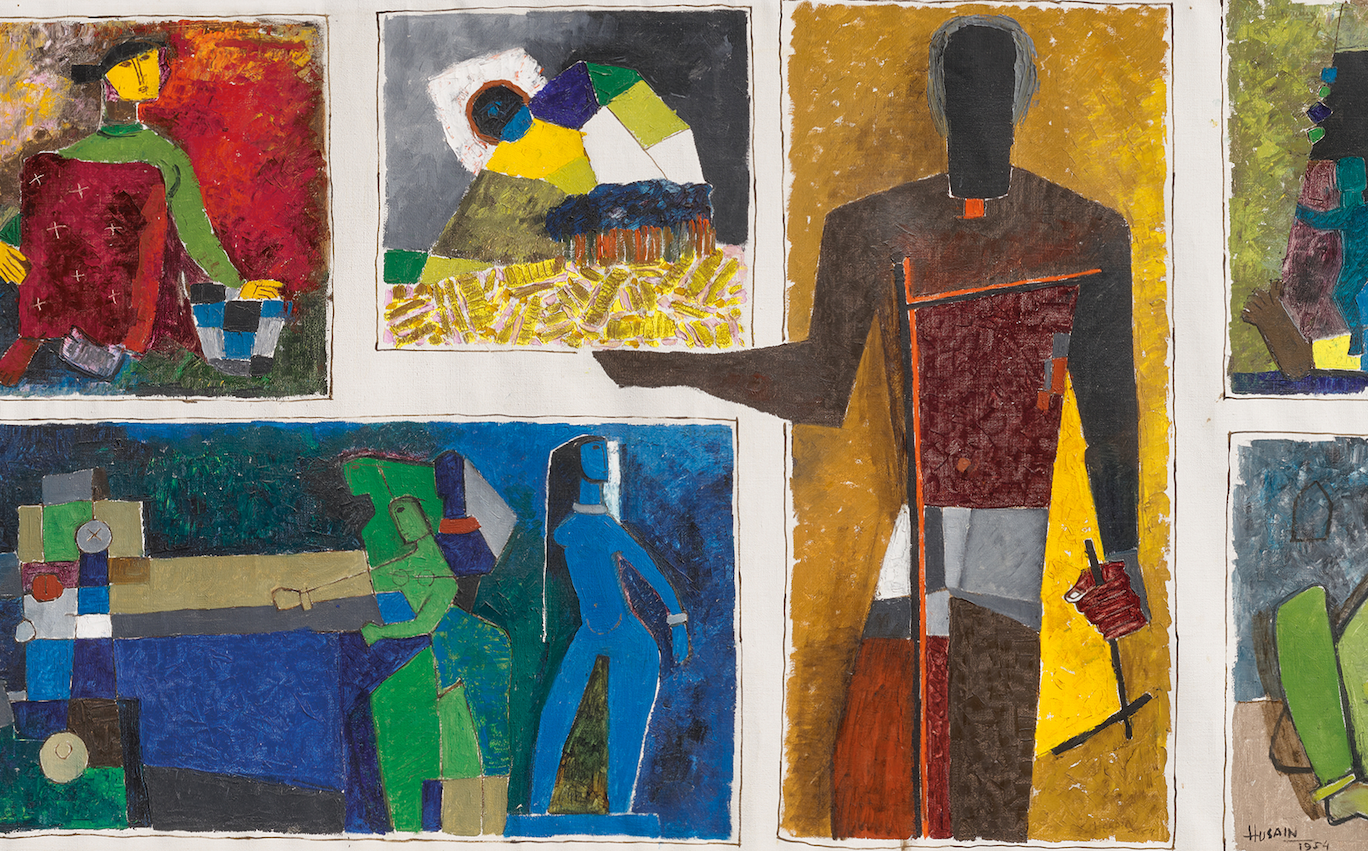
M.F. Husain, selection from Untitled (Gram Yatra) (1954). Photo: Courtesy of Christie's
|
|
The auction market for Indian modern art has been building quietly for the past several years. By the time M.F. Husain’s rediscovered Untitled (Gram Yatra), from 1954, sold for $13.8 million last week—making it the most expensive lot auctioned in the first quarter of 2025—that growth had become too much for the rest of the art market to ignore. Just looking at the March sales in New York over the past five years, total sales in the South Asian modern and contemporary art auctions have almost quadrupled from $11.5 million in 2021 to $41 million total for both sales this season. (There will be another set of sales in September, when we can check back in.)
That March sales growth wasn’t steady. In 2022, the market took off with total sales in New York of $29.8 million; that number fell to $18 million in 2023, probably due to a lack of supply. In 2024, however, sellers clearly found their conviction, because totals more than doubled to $39 million. This year’s number only slightly improved on last year’s.
The hammer ratios in this market tell an even better story. In 2021, the total hammer ratio for these sales was .98—weak, but not too off-putting. The next year, that number brightened to a robust 1.68. Any market would come alive after that signal. In 2023, the hammer ratio increased again to 2.14—normally, estimates rise in response to these numbers. Then in 2024, the hammer ratio rose even further to 2.42, before topping out this season at a blistering 2.66. (Yes, yes… much of that came from the $10 million overage on the Husain painting alone.)
A more interesting metric, perhaps, is the aggregate low estimate of these sales over that span. In 2021, the auction houses brought $9.4 million worth of art to auction. The solid sales of that year brought $14 million to market the following year. But even though the hammer ratio for 2022 was a stellar 1.68, the houses could gather only half the aggregate value the year after that. I haven’t been able to ascertain whether the drop signaled a lack of confidence in the market rise from collectors who were reluctant to consign, or just the vagaries of the art market, where supply can be lumpy and very hard to predict. Whatever the reason, after the success of 2023, both houses were able to bring close to $13 million in aggregate value to the block in each of the following two years.
So, off a slightly lower base value from 2022, these auctions made 30 percent more in total dollar volume during the past couple years. Who doesn’t want to make more from less?
And now, on to the main event…
|
|
|
|
Boetti is a complex artist with an even more intricate market structure. But Ben Brown thinks his works on paper will benefit from other, more lucrative segments of his oeuvre.
|
|
|
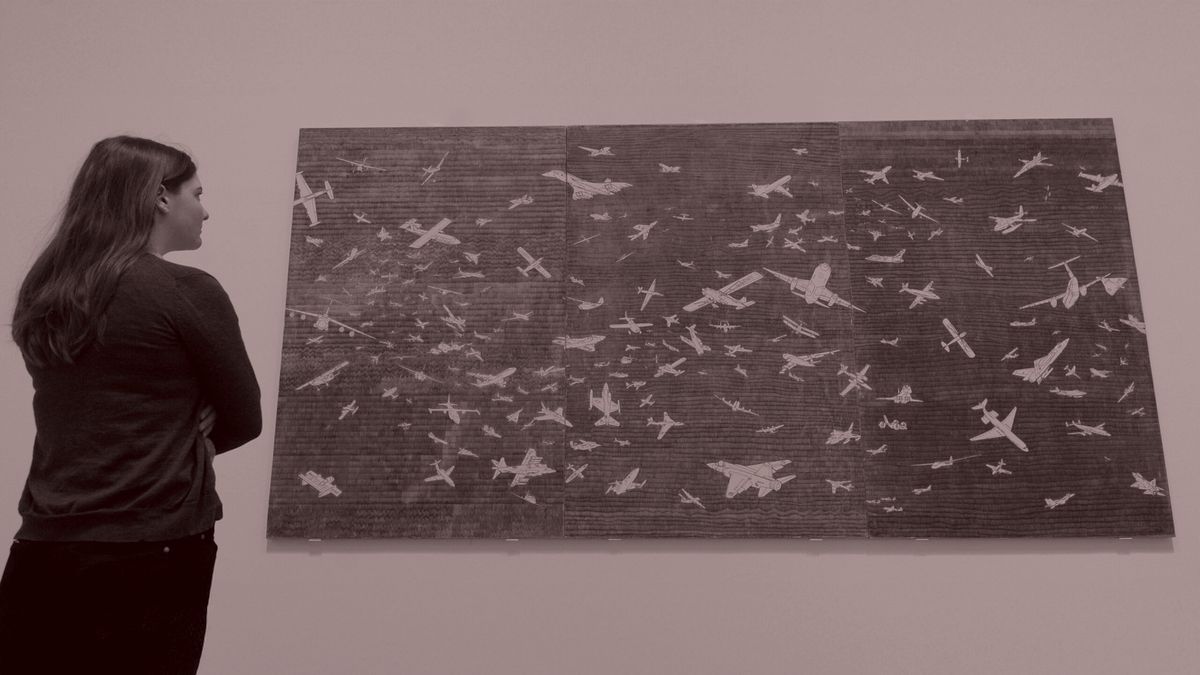
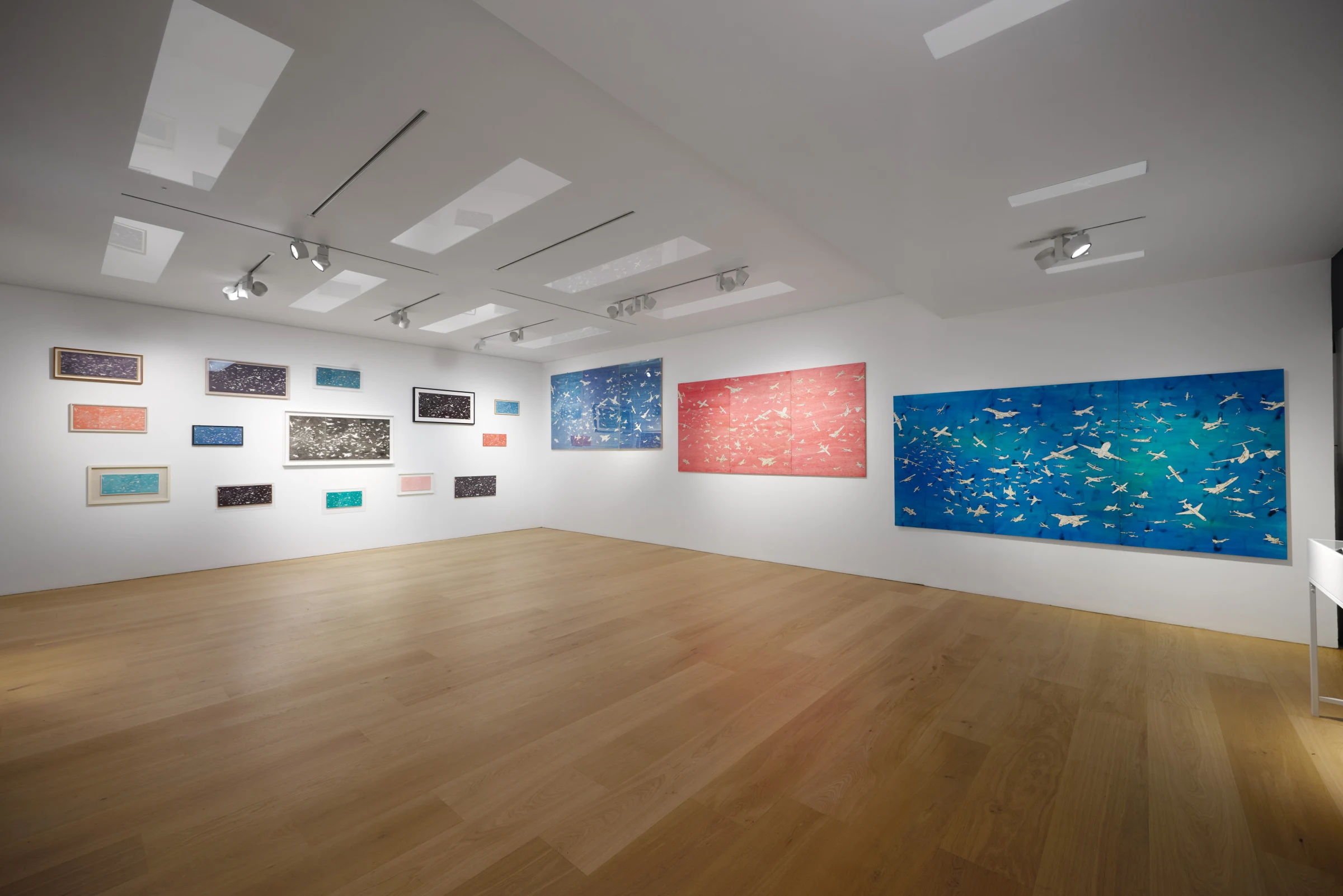
On the face of it, perhaps there’s nothing extraordinary about Ben Brown opening a new show of Alighiero Boetti’s Aerei—the templated images of various airplanes, often tinted with watercolors or hand-colored with ballpoint pen or both—at his underground London gallery. Yes, Boetti is one of the most important conceptual artists of the late 20th century, and his fame, influence, and market seem to have only grown in recent years. And, yes, the gallery attests that there has never been a show of the Aerei, which are all works on paper and therefore considered less valuable than oil paintings or his signature tapestry works. But the show plays a meaningful role in the market structure for Boetti, an artist with numerous discrete bodies of work within his broader practice.
Boetti, an Italian artist who worked with artisans and assistants around the world, was fascinated by order and disorder, global interconnectedness and classification systems. Much of his subject matter deals with maps and alphabets and other systems. The Aerei, which can be viewed as a taxonomy of airplanes, were created in the late 1970s, at a time when global air travel was expanding rapidly, connecting everyone to everywhere.
|
|
Alighiero Boetti, installation view of Alighiero e Boetti: Embellishing the Sky, Ben Brown Fine Arts, London. Photo: Courtesy of Ben Brown Fine Arts London
|
The original image of the Aerei, created by Guido Fuga in collaboration with Boetti, depicts passenger jets, fighter planes, the Concorde, and even propeller planes frozen in mid-flight—each hurtling in a different direction, none touching or overlapping. Brown’s show contains the first tiny version, but Boetti eventually scaled the works to triptychs of varying sizes and employed different methods to color the sky upon which the planes forever fly. All of the Aerei are works on paper, even though many are paper laid on canvas. Brown’s show is an excellent opportunity to see the depth and variety of the works Boetti made, even within the narrow band of one of his many series.
According to the data from our friends at ARTDAI, Boetti’s auction sales first peaked in 2014 and 2015—right after a huge Boetti retrospective traveled from MoMA in New York to the Reina Sofía in Madrid and the Tate Modern in London in 2012. Global auction sales were $30 million in 2014 and almost $25 million in 2015. Auction volume slid over the following years until it bottomed in 2020. Then, suddenly, sales rose to almost $25 million again in 2021 and $31 million in 2022. Auction volume took a breather in 2023, but last year, his sales were back up to $24.75 million. And this is where Brown’s hypothesis becomes so extraordinary.
|
Notably, the composition of sales has evolved. “I felt for a number of years that the discrepancy between the good and the great pictures was too narrow,” Brown told me on a WhatsApp video call as he showed me around his Mayfair gallery. “You had a mediocre Mappa”—the large embroidered maps created for Boetti by Afghan craftswomen —“worth $1.5 million, and a great one was worth $3 million.” At the same time, Brown observed, “a mediocre Picasso was worth $5 million, and a great one $100 million.”
That didn’t last long. Starting in 2021, prices for Boetti’s maps at auction started to expand, climaxing with one piece setting a record for the artist at $8.8 million. I’ve talked a lot about how new high auction values will create confirmation prices. Not only did this dynamic occur with the maps, but it also had a knock-on effect for the small embroidery works.
Most people in the art market are familiar with the unique, colorful, and gridded works that Boetti commissioned from his artisans, many of which were done in smaller five-by-five grids or similar sizes. Those works can be considered entry-level Boettis. In the past half-decade or so, they began to double in price from around €30,000 to €60,000, Brown said. (You can check ARTDAI and see for yourself that this is roughly true of the auction market, but Brown was also referring to many private sales.)
That didn’t entirely make sense to Brown, but he wasn’t going to fight the market. Instead, he started stockpiling Aerei at auction. Now he’s selling them through this show and at his booth in Hong Kong. “I have no problem investing in this market,” he said on the call. He believes in the work. Also, he said, “I think I have the arbitrage right.”
Since the airplanes are works on paper, they tend to be undervalued. But that’s not a bias the entire art world holds. In Asia, there’s a long tradition of works on paper, especially ink paintings, being valued at the same level as oil paintings. (Remember, there’s not a long tradition of oil painting in Asia.)
The secret to the Boetti market is the strong support from museums and collectors. Brown says there are a number of deep Boetti collectors who own something from each series. Even though they might have 20 works by the artist, there’s often that one last piece they need to complete the collection. Brown says he’s sold maps to U.S. buyers recently, but the collector base is mostly European. Interestingly, one of the last things that Len Riggio bought at auction was an embroidery work composed of 49 four-by-four embroidery works spelling out Ammazzare il tempo. Riggio paid $3.9 million for it. You won’t see his heirs selling it any time soon.
|
Thank you for stopping by today. I’ll be back on Friday with another edition of Wall Power for the broader group.
M
P.S.: If you click on the ARTDAI link, you’ll be taken to a landing page. ARTDAI is primarily an institutional data service, but we’ve partnered with them to give Wall Power users access to the service as individuals or small agencies. If you do sign up with ARTDAI, we may receive an affiliate fee.
|
|
|
|
Join Emmy Award-winning journalist Peter Hamby, along with the team of expert journalists at Puck, as they let you in on the conversations insiders are having across the four corners of power in America: Wall Street, Washington, Silicon Valley, and Hollywood. Presented in partnership with Audacy, new episodes publish daily, Monday through Friday.
|
|
|
|
The ultimate fashion industry bible, offering incisive reportage on all aspects of the business and its biggest players. Anchored by preeminent fashion journalist Lauren Sherman, Line Sheet also features veteran reporter Rachel Strugatz, who delivers unparalleled intel on what’s happening in the beauty industry, and Sarah Shapiro, a longtime retail strategist who writes about e-commerce, brick-and-mortar, D.T.C., and more.
|
|
|
Need help? Review our FAQ page or contact us for assistance. For brand partnerships, email ads@puck.news.
You received this email because you signed up to receive emails from Puck, or as part of your Puck account associated with . To stop receiving this newsletter and/or manage all your email preferences, click here.
|
|
Puck is published by Heat Media LLC. 107 Greenwich St, New York, NY
10006
|
|
|
|