{{ 'now' | timezone: 'America/New_York' | date: '%b %d, %Y' }} |
|
|
|
Hello, and welcome back to The Best & The Brightest. I’m Leigh Ann Caldwell,
mercifully far away from D.C., where there’s no progress on either ending the war in Iran or reopening D.H.S. Both the House and the Senate are scheduled to leave town for two weeks after this one.
I told you on Sunday how a handful of congressional Democrats are pushing their party to stop worrying and learn to love A.I. While Congress has still done
next to nothing on the issue three years into the ChatGPT revolution, some states have taken the reins with their own regulation, and today my colleague Ian Krietzberg sits down with one of the key leaders in that effort: New York Gov. Kathy Hochul. Plus, Abby Livingston dissects yesterday’s big night for Democrats in Trump’s backyard, and brings tales of a Michigan flare-up over
polling.
Mentioned in this issue: Emily Gregory, Mallory McMorrow, Abdul El-Sayed, Haley Stevens, Kathy Hochul, Gavin Newsom, Glenn Youngkin, Jared Polis, Sam Liccardo, Bernie Sanders, Josh Hawley, Asad Ramzanali, Abigail Spanberger, Mallory
McMorrow, and more... |
|
|
|
Getting care isn’t always easy. For some patients, simply traveling to a doctor’s office is
a challenge, let alone managing complex health needs. UnitedHealth Group recognizes that bringing care directly to patients is essential for a modernized health system. By deploying nurse practitioners to provide care in the comfort of patients' homes – completing 19 million home visits last year alone – UnitedHealth Group enables clinicians to deliver a highly personalized approach. The result?
Earlier identification of health risks, prevented diseases and better overall outcomes. Learn more. |
|
|
|

| Abby Livingston
|
|
- Mar-a-Lago tilts left: In
another blow to Republican midterm ambitions, Democrats last night flipped a Republican-held state House seat in Palm Beach. Democrat Emily Gregory won by two points in a district that Republicans carried by 11 points in 2024. Because the district includes MAGA safe space Mar-a-Lago, it’s more than a
routine flip—it’s a political trophy with outsize symbolism.
There could also be more tangible repercussions. The Florida Data Geek posted numbers last night indicating that some independents and Republicans crossed over to vote for Gregory, mirroring patterns seen in January’s Texas state Senate election. Meanwhile, I’m hearing early rumblings of concern about Florida Republicans adopting the same maximalist redistricting approach used in Texas.
Florida is expected to redraw its congressional map later this spring in an effort to pick up two to five seats for the
G.O.P. To do so, Florida House Republicans will likely need to accept haircuts among their own voters to make Democratic-held seats more competitive. But a 13-point swing in a state House seat encompassing Mar-a-Lago, driven by Republicans and independents, is making some G.O.P. sources extremely anxious.
|
State Sen. Mallory McMorrow, who has seemed destined for higher office ever since
going viral in 2022, released an internal poll showing her leading the Democratic primary for Michigan’s open Senate
seat—outpacing both former Wayne County health director Abdul El-Sayed and Rep. Haley Stevens. The Global Strategy Group survey, conducted March 19-22, found McMorrow with 30 percent support, followed by El-Sayed at 25 percent, and Stevens at 23 percent.
Almost immediately, the Stevens camp countered with its own poll from Impact Research, conducted February 10-16, which showed a statistically tied three-way race. In that survey, Stevens led with 28
percent, El-Sayed had 26 percent, and McMorrow trailed closely at 25 percent, within a 3.5 percent margin of error.
Both firms rank among the most credible in Democratic politics. As I wrote Monday, the race remains in a holding pattern, with all three candidates clustered within a few points of each other across most public polling. That equilibrium
could shift once AIPAC begins an expected spending onslaught on Stevens’s behalf. Her allies believe that support will help her break from the pack. But AIPAC’s involvement has produced unpredictable results in recent Democratic primaries in New Jersey and Chicago, and may similarly produce an equal and opposite reaction here. Some Michigan Democrats suggest that AIPAC spending could instead boost El-Sayed, particularly in the Arab American stronghold of Dearborn. |
|
|
|
Bernie is talking to Claude, Trump wants Grok in missiles, and Kathy Hochul just wants the
best of both worlds. If Silicon Valley isn’t already regretting hyping a job-obliterating third industrial revolution, the next two elections will show why the politics of A.I. are turning explosive. |
|
|
|
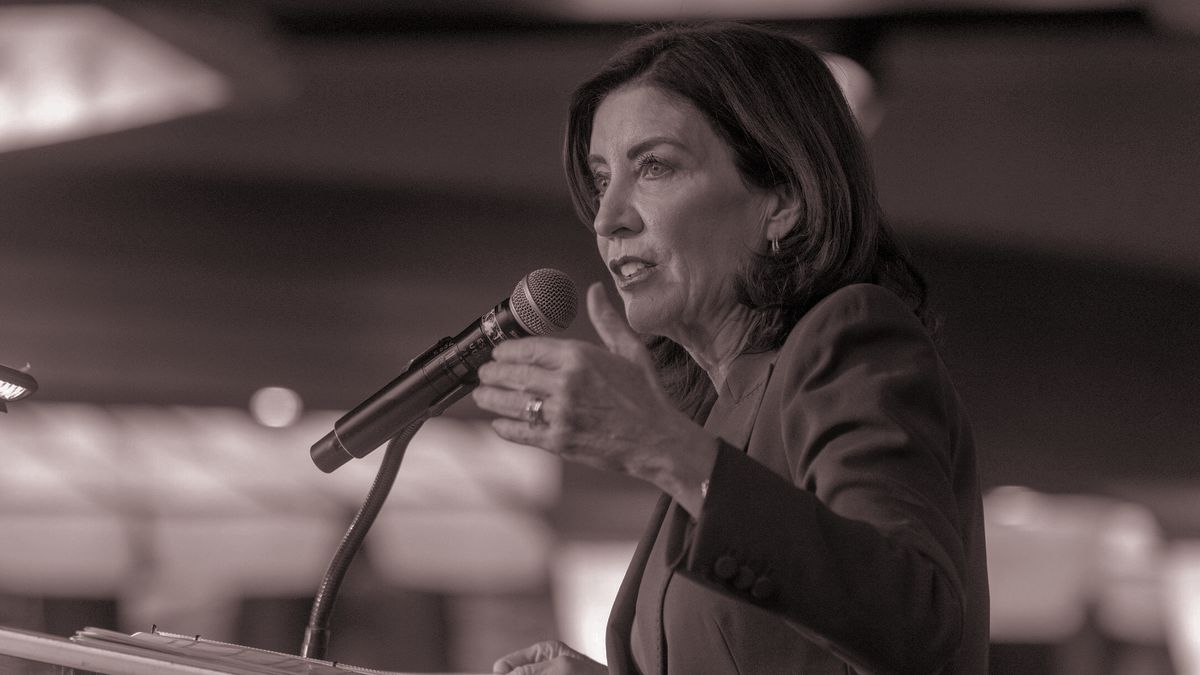
New York Governor Kathy Hochul sounds like many politicians on A.I. these days—impressed,
maybe a little worried, and trying to be practical about the unstoppable technological freight train headed our way. When I called her late last week, she waxed poetic about ensuring A.I. is “compatible with the public good” before ticking off the various trade-offs she’s now trying to navigate: bringing high-paying tech jobs to the state without driving white-collar work to extinction, solving society’s “most-pressing problems” without jacking up constituents’ electric bills, etcetera. In
short, she wants the best of all possible worlds. “I do not want to be alarmist,” she told me. “I see the upside, I see the downside.”
Hochul’s middle-of-the-road mentality is not unique—California Gov. Gavin Newsom is as focused on regulating A.I. as on ensuring the industry
continues to thrive, and former Virginia Gov. Glenn Youngkin talked up “responsible governance” without “stifling” the A.I. industry. Likewise, Colorado Gov. Jared Polis wants to “protect consumers and support innovation” while Rep. Sam Liccardo, the congressman representing Palo Alto and Atherton,
told my Puck partner Leigh Ann Caldwell this week that Democrats need to get over their anxiety and embrace the future. (No surprise there…) |
|
|
|
For people managing chronic and complex conditions, traveling to a doctor’s office isn’t
always easy – even a simple appointment can become a major hurdle. UnitedHealth Group is working to remove these barriers by bringing doctors and nurses directly to patients' homes. This allows them to receive personalized care in a more comfortable, convenient setting.
Ultimately, these in-home visits make managing chronic care less stressful, helping patients stay healthier over time.
Learn more.
|
|
|
|
But as the technology accelerates and the specter of widespread job displacement begins to appear slightly
less hypothetical, a populist backlash is building at both ends of the political spectrum. Hochul told me she’s bracing for a “seismic impact,” and worries about “students who took on debt to get degrees in fields that may be evaporating because of A.I.” Other politicians have gone further: Sen. Bernie Sanders recently called for a national moratorium on all data center construction—not just to keep electric bills low, he says, but to
prevent “a catastrophic impact on the lives of working-class Americans, eliminating tens of millions of blue- and white-collar jobs in every sector of our economy.” Republican Sen. Josh Hawley has sounded similar notes,
declaring that “these companies cannot be trusted with this power.”
Hochul, for her part, is trying to thread the centrist needle of responding to popular alarm while also courting the tech industry. She and Newsom are the two most prominent governors to sign state-level A.I. regulations—though she’s arguably been more cautious about
overreach. (She lobbied, with some success, to make New York’s signature A.I. legislation, the RAISE Act, more industry-friendly.) Yet she also reflected on the fate of the steel industry where she grew up, when a combination of trade and automation wiped out an entire workforce in the 1970s. “Everyone said, ‘The last one out, turn off the lights,’” she said. “I don’t want that to happen.” |
Of course, voters aren’t salivating over the idea of replacing themselves with bots either. Hochul cited
recent polls showing that “almost 80 percent of voters don’t think government has a plan to protect them from A.I. job losses.” More broadly, people simply don’t trust A.I. or the companies promoting it: For years, large bipartisan majorities of American voters have said they want the government to regulate A.I., even at the cost of
slowing down progress.
Asad Ramzanali, the director of A.I. and tech policy at Vanderbilt University’s Policy Accelerator, agreed that the potential impact to employment is one of the main reasons why voters worry about the technology. But he also pointed to two others: data centers, which are driving up electricity costs, and
the effects that A.I. might have on kids. “All of that is part of the milieu of rising inequality and people seeing a chumminess between Big Tech and politicians,” he said. “That’s all the social cost. What’s the social benefit? For most people, I don’t think it feels that transformative, but it does feel that socially costly.”
In the short term, data centers are likely to be the most obvious targets of community dissatisfaction. Local opposition began to reach new heights last year,
seemingly playing a major role in the postponements and cancellations of at least 25 data center projects—a four-fold increase from 2024. And the backlash is only accelerating: In January, 34 data centers were canceled or postponed; in February, that number rose to
71. Last year, the political relevance of data centers was enough to help John McAuliff win a seat in the Virginia legislature, and it was certainly an
aspect of Virginia Gov. Abigail Spanberger’s successful campaign. (Spanberger embraced the centrist message of having data centers “pay their fair share” while praising their potential to create jobs and raise tax revenue.)
The midterms
will provide another test of A.I. politics, though candidates are still fumbling for the right framing. In Connecticut, U.S. House hopeful Luke Bronin is pushing the standard innovation-with-guardrails message; Senate candidate Mallory McMorrow of Michigan wants to
protect kids from chatbots; and the House campaign of New York’s Alex Bores is basically ground zero for the dark-money battle between Leading the Future, a pro-A.I. group backed
by OpenAI president Greg Brockman and Palantir co-founder Joe Lonsdale, and a pro-regulation, Anthropic-backed entity. |
|
|
|
Unlike most issues in politics today, the A.I. fight hasn’t yet coalesced along partisan lines: For now, the
industry finds itself in the unlikely position of fighting both Bernie Sanders and Steve Bannon. “All these politicians are trying to weigh the practical drawbacks of the policy and the political impact of who has money,” said one source who works on House and Senate campaigns. In other words, influence over the emerging anti-A.I. bloc is still up for grabs. Meanwhile, both Democrats and Republicans are offering up variations on the Sanders aria without really answering
the harder question: What happens if the jobs disappear? |
None of this is likely to determine who will control Congress after the midterms—as Eurasia Group’s
Ian Bremmer told me, this election will be more about Iran, affordability, immigration, and possibly Jeffrey Epstein. “I think A.I. will be interesting in a couple of races, but I think it’s 2028, not 2026, in part because lots and lots of different candidates have an angle,” he said. “It’s not a thing. It’s a bunch of things. And when it’s a bunch of things, it’s very hard to coalesce a national message.”
But a source who works with one of the
major A.I. super PACs told me that the technology is definitely “going to be a kitchen-table issue at some point—maybe not this cycle, but definitely next cycle.” Bremmer went on to stress to me “just how uncertain we all are about where this is going to play. There are 20 different ways this could play out meaningfully over the next couple of years, and they’re all happening.” According to a recent
poll from the Rainey Center, 43 percent of voters said it is “essential” that a presidential candidate in the 2028 election have a “clear, detailed plan on A.I. regulation and job protection.” By then, of course, it should be much more obvious whether the best- or worst-case scenarios for A.I. are coming to
pass.
Back in New York, Hochul hadn’t worked out the “clear, detailed” part of this either—indeed, figuring it out is part of the purpose of the commission on worker resiliency she launched last week. “Does this mean we only need A.I. teaching our students? Are robotics and A.I. going to be providing
healthcare?” she wondered, then admitted: “I don’t know these answers.” But she certainly sees the political opportunity. “I don’t want to capitalize on people’s pain, but to the extent you have leaders who are not tone-deaf—who are seeing it, understanding it, feeling it, empathetic to the anxiety that residents are feeling, and talking about having plans for it—I think that gives people a higher level of comfort than leaders who are just ignoring it or trying to monetize it for their own
benefit.” |
|
|
|
Need help? Review our
FAQ page or contact us for assistance. For brand partnerships, email ads@puck.news.
You received this email because you signed up to receive emails from Puck, or as part of your Puck account associated with {{customer.email}}. To stop receiving this newsletter and/or manage all your email preferences, click here.
|
Puck is published by Heat Media LLC. 107 Greenwich St., New York, NY 10006 |
|
|
|
|