Hello and welcome back to The Best & The Brightest. I’m Leigh Ann Caldwell,
wishing my daughter Penrose a big, happy birthday.
I’m writing this from Capitol Hill, where beleaguered senators and staff stumbled out of 27 straight hours in session, during which they took nearly 50 votes relating to the Republicans’ One Big Beautiful Bill before Vice President J.D. Vance heaved it over the finish line with a tie-breaking vote.
The marathon duration was due partly to Democrats forcing votes on messaging bills to protect
Medicaid, food stamps, clean energy programs, and more. But Senate Majority Leader John Thune also had to spend significant time dealmaking for votes. Lawmakers had mixed emotions afterward: On the Republican side, some were pleased about the bill’s passage; others were conflicted. Democrats, meanwhile, were beside themselves with anger.
I’ll have a bit more color below about how it all came together, and what comes next. Plus, my partner John Heilemann
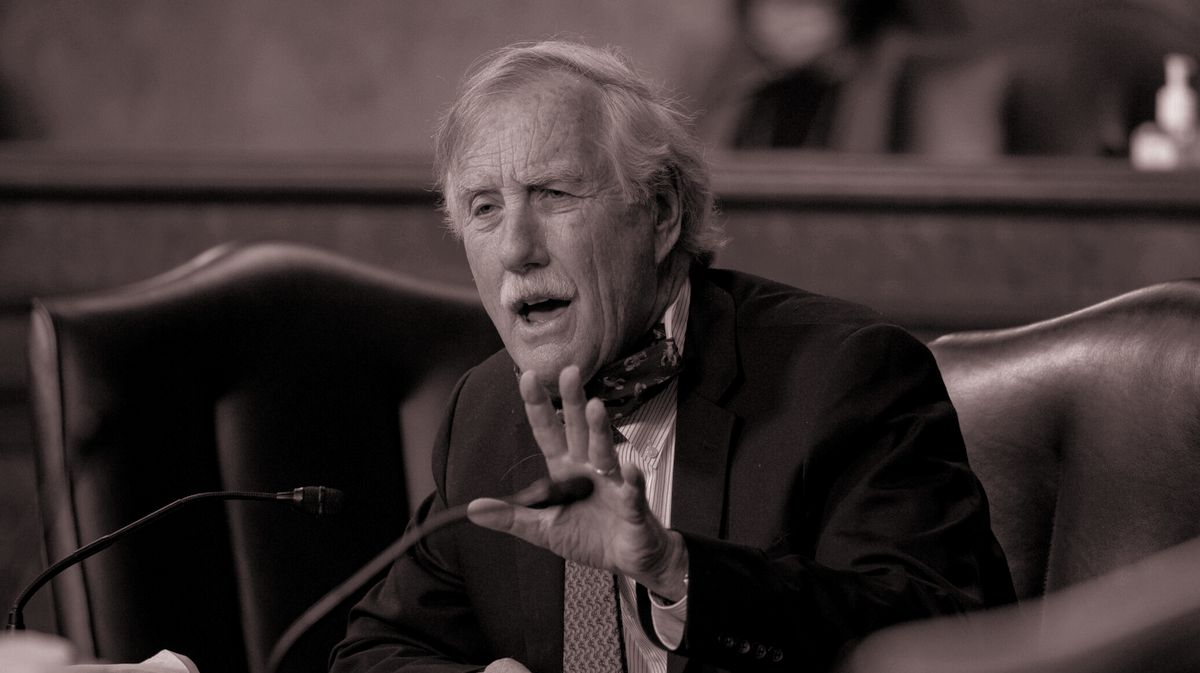
presents his fascinating chat with Maine’s junior senator, Angus King—a rare, genuine independent in today’s tribal world—who had lots to say about the intricacies of the Big Beautiful Bill.
But first… |
- Hold
your applause…: When Vance announced from the Senate dais that he’d cast the tiebreaking vote to pass the One Big Beautiful Bill Act, Republican senators offered some polite applause. Perhaps the tepid response, far from the surge of energy that usually erupts on the Senate floor after a big, hard-fought legislative win, was a product of exhaustion. But it was also a fitting metaphor for the complex politics of the bill, itself.
Ultimately, Thune could only afford to lose three
Republican votes—and he did. Sens. Rand Paul and Thom Tillis announced their “no” votes last night. Senate Republican leaders, who had mostly written off Sen. Susan Collins’s vote, tried at the last minute to get her on board via a $50 billion fund to help rural hospitals survive the bill’s Medicaid cuts. Sen. Lisa Murkowski was likely on board, and getting Collins, too, would have been a coup. Plus, they hoped her assent would
send a signal to House moderates that even Collins voted for the legislation. But their offer proved too little compensation for the $930 billion hit to Medicaid, and she, too, was a “nay.”
Murkowski did get to yes, though she’s previously voted against major Republican priorities, such as Obamacare repeal and the confirmation of Supreme Court Justice Brett Kavanaugh. The Alaska senator got numerous accommodations, which she outlined
here, including the demise of a new excise tax on renewable energy and an exemption from work requirements for native tribes seeking food assistance; and as I predicted, she wasn’t going to cast what would have been the deciding “no” vote. She called it “one of the hardest votes” she has ever taken. Meanwhile, emotions on the other side of the aisle were hot. Sen. King, the Maine
independent, scolded his G.O.P. colleagues as he left the chamber. “Shame on you,” he said, adding that this was the “worst legislation” he’d ever seen.
Now it heads back to the House, whose members will have to vote on it for a second time—in a form that, according to many of them, is worse. It cuts more from Medicaid while spending more than the previous House version, thereby managing to alienate both the centrists and the fiscal hawks simultaneously. Still, House Republican leadership
will try at all costs to avoid making any changes to the bill, which would necessitate more haggling between the chambers, a senior House Republican aide told me. They’re hoping to pass it as early as tomorrow.
|
Now, here’s Abby with a Senate update from Texas… |
|
|

| Abby Livingston
|
|
- Lone Star Dems try again:
As expected, Democratic former Rep. Colin Allred has launched his second race for Senate in Texas, after a disappointing 8.5 point loss to Ted Cruz last cycle—officially joining what could be a crowded primary for the seat currently occupied by Republican John Cornyn. Astronaut Terry Virts recently launched his campaign, and Beto O’Rourke, who got much closer to victory in his own 2018 tangle with Cruz, has
publicly expressed interest in another run, as has Joaquin Castro. But if there’s a fresh Democratic face to keep an eye on in Texas, it’s state Rep. James Talarico, a pastor and former teacher who has repeatedly gone viral for his ability to speak about Christianity without sounding phony, which obviously matters in the state. And oh yeah, he’s advised by Lis Smith and Andrew Mamo.
Texas is still an expensive long shot
for Dems, but the party is drawing some optimism from the early chaos of the Republican primary. Cornyn, for whom Texas Democrats have a healthy respect as a statewide general-election campaigner, is in serious primary trouble against the ethically challenged Texas attorney general, Ken Paxton. Everyone’s waiting to see if Cornyn will even go through with the race, and if he doesn’t, a crowded G.O.P. primary could commence unless Trump plays kingmaker. Rep. Wes
Hunt is clearly maneuvering for a run, and there’s also speculation around Rep. Ronny Jackson, who was Trump’s personal physician.
There are deep divisions among the state’s Republicans even beyond the Senate primary drama. Moreover, Trump’s initiative to redraw the state’s congressional districts is gathering steam in Austin, and will create winners, losers, and yet more acrimony within the state’s G.O.P. delegation. So while Texas shifted more toward Trump last
year (profoundly so in South Texas), and Republicans had seemed to have beaten back the Democratic assault there, the party could well blunt its own momentum through hubris or infighting. - Retirement watch!: Five-term Pennsylvania Rep. Dwight Evans announced his retirement on Monday at the relatively spry (for Congress) age of 73. A stroke last year took him away from votes for months, and although he’s had normal attendance
since January, party patience for health issues is wearing thin—tragically, three members with previously diagnosed cancer have died in office since January, which helped Republicans pass the BBB. Like many of his peers, Evans had previously stated his intention to run for reelection, but his first-quarter fundraising haul of $38,000 was probably a tell that this would be his last term.
Evans is the third House Democrat so far this year to announce they would retire from politics,
following Illinois’ Jan Schakowsky and Virginia’s Gerry Connolly, who has since died. Next month will probably bring more such announcements, whether the members realize it now or not. Zohran Mamdani’s upset victory over Andrew Cuomo should be a warning sign for elders to step aside, but it’s more likely the scale of their primary threats will come later—the week after July Fourth is usually the busiest for candidate
announcements, and consultants tell me challengers are readying their campaigns. Plus, in the races where a challenger has already announced, incumbents might be startled to see their opponents’ financial strength after the July 15 fundraising filing deadline.
|
|
|
And now, speaking of Senator King… |
|
|
A conversation with Maine’s junior Senator, Angus King, a rare independent in a tribal
world, on the eve of the Big Beautiful Bill’s passage. |
|
|
Senator Angus King of Maine is that rarest of creatures in our politics today: neither a
Republican nor a Democrat, but an actual, factual independent who lives and breathes and votes in accord with that affiliation. Still going strong at 81, King moved to Maine in the 1970s—where he’s since won election as the state’s governor twice and its junior senator three times. And although that number may sound paltry compared to the apparently endless tenure of his colleague Susan Collins, who is about to seek her sixth term in the upper chamber, King is by now
both a senator and a Mainer through and through: a guy who can talk your ear off about the intricacies of the Big Beautiful Bill and the differences between hard shell and soft shell lobster with equal verve.
I spoke to King about both of those topics late last week for my Impolitic podcast—in particular, his outrage over the claims of Republicans that the vast cuts to Medicaid and other programs contained in the omnibus reconciliation package that narrowly passed today by the
Senate will not, in fact, inflict the kind of pain on millions of voters that Democrats predict. (Indeed, according to Donald Trump, “You’re not going to feel any of it.”) We also discussed Friday’s controversial Supreme Court decision restricting federal courts from issuing nationwide injunctions, which King condemned as “irresponsible” for its narrow legalism and refusal to address the core issue at hand: the constitutionality of Trump’s executive order ending birthright
citizenship. “They’re acting like [the court’s ruling] is some kind of law review article that doesn’t have real-world implications,” he said.
As always, the excerpt below has been lightly edited and condensed for clarity. You can listen to our entire conversation here. |
John Heilemann: The Supreme Court just issued this ruling that restricts
federal courts from issuing nationwide injunctions—of which there have been a lot so far in Trump 2.0, and those injunctions have been one of the few real constraints on the array of radical executive actions he’s taken. I wonder whether you think the same thing Trump said about Iran and Israel—that “they don’t know what the fuck they’re doing”—can be applied to the Supreme Court?
Angus King: I
just finished reading that opinion. It’s very legalistic and plays a lot of games. I think it’s important for people to know that this is not a ruling on the merits of the constitutional grounds for birthright citizenship. It’s a narrow, procedural ruling about whether or not a single district court can issue a universal injunction. The progressives and liberals are very upset about it, but it can work both ways. However, there are two things that bother me about this case.
One
is, why didn’t they answer the question about birthright citizenship? Why are we now going to have to wait a year or two to get an answer to that? And two, does this mean that [everybody] the administration is trying to deport, who they claim doesn’t have birthright citizenship, will have to sue in a different state, in a different court? That’s the practical problem. Basically, they’re saying you can only issue an injunction that affects the plaintiff that’s before you in your court. And we’re
talking about a lot of folks across the country who don’t necessarily have the keys to a federal district courtroom.
The court also stayed the birthright citizenship order for another 30 days, but if that time passes and no more states challenge the order, ostensibly, birthright citizenship will come to an end in 28 states. Doesn’t that strike you as ominous and potentially disruptive, especially given that birthright citizenship has been enshrined in American law—and American
life—for a very long time now?
It couldn’t be more explicit in the Constitution. And the problem is, it’s a very lawyerly opinion, written by Justice [Amy Coney] Barrett. When people talk about the Supreme Court being in an ivory tower, this is what they’re talking about. Thousands of people across the country who thought they were citizens—and they are, because
the Constitution says so—are now in legal limbo, and these guys can try to deport them. And to say that all of those people have to somehow bring a case in the district court to resolve this question—it’s irresponsible, in my view, that the court didn’t take this occasion to rule on the underlying issue, which ought to only take about a paragraph, because all they have to do is read the 14th Amendment.
Even if you somehow want to argue that the 14th Amendment doesn’t say what it
says, you’d think the court would rule on the merits right now for the sake of legal clarity and the good of the country.
I think they know damn well what’s going on. By the time they rule on the merits of this—and properly, I predict, because it’s so clear that there is birthright citizenship—a lot of people’s lives are going to have been turned upside down. This has been the law of the land for 100-plus years. And it’s not only in the
language of the Constitution, but there’s a case called Wong Kim Ark from the late 1800s that says you’re a citizen if you’re born here. They’re acting like [their ruling] is some kind of law review article that doesn’t have real-world implications. |
Trump was asked the other day about the Big Beautiful Bill and said, “We’re cutting $1.7 trillion and
you’re not going to feel any of it. And your Medicaid is left alone, it’s left the same, and your Medicare and your Social Security are strengthened.” What say you, Senator?
I watched that speech and was just flabbergasted. The heart of this terrible bill is almost $900 billion worth of cuts to Medicaid. There’s also an automatic sequestration of $2 billion or $3 billion to Medicare. So that statement he made was just fundamentally untrue. Here’s
what’s going to happen in Maine: 60,000 people are going to lose coverage—40,000 under Medicaid and 20,000 under the Affordable Care Act. And it’s a double-barreled hit, because the prediction is we’ll lose two to five hospitals that will have to close because of the loss of revenue from these patients.
Some of my colleagues are talking about, Well, we’re going to put a fund together in this bill to help the hospitals. That’s a patch, but it doesn’t help those 60,000 people. It’s
just ridiculous. If they limited the tax cuts to only people who make $400,000 a year and less, you wouldn’t have to touch Medicaid or food stamps or SNAP [Supplemental Nutrition Assistance Program]. We’re taking food out of kids’ hands and taking health insurance away from people in order to give tax cuts to millionaires. It couldn’t be more gross than that.
In April, you told Esquire’s Charlie Pierce you were trying to warn people about
the “grave danger to the country.” You said, “The founders understood the basic principle: that power corrupts and absolute power corrupts absolutely. Their purpose was to see that we don’t have a dictator.” Two months have passed since then. Talk to me about whether the danger is even graver now—are we even further down the road toward something resembling a dictatorship?
Unfortunately, I think we are. A couple of months ago, I was looking at
things like the closure of government agencies without any authorization from Congress, freezing funds, arbitrarily cutting off funds to people [Trump] doesn’t like—like the state of Maine when he got into an argument with our governor. What was worrying me then was the concentration of power. In Federalist 47, Madison wrote, When you have the power of the legislative branch, executive branch, and judicial branch in one set of hands, that’s the perfect definition of tyranny. He wasn’t
mincing words.
What’s happened since then has worried me even more. Throughout history, autocrats have almost always found a group to scapegoat. Well, this guy’s scapegoats are immigrants. I believe what the administration did in Los Angeles was an attempt to create a crisis, to inflame people, and seize more power and make it okay to send agents into communities—and by the way, John, have you ever in your life seen law enforcement officials in the United States wear masks? The pictures
of these guys with masks are absolutely chilling. And then the attempt to mobilize the troops. We have a long history in this country of not using the military for domestic law enforcement. The governor and mayor objected; the police chief said we don’t need them. This was, to me, clearly an effort to create a crisis to justify further authoritarian actions elsewhere in the country.
One of our problems is that we have people walking around in two different factual universes. If you watch
Fox News, all you saw about Los Angeles were burning cars and people with Mexican flags. And you didn’t realize that it only was a few blocks in an enormous city involving a limited number of people. And that’s what’s worrisome. If people agree on the facts, you can solve most problems. But if you don’t have agreement on the facts, it’s almost impossible. |
|
|
Join Emmy Award-winning journalist Peter Hamby, along with the team of expert journalists at Puck, as they let you in on the
conversations insiders are having across the four corners of power in America: Wall Street, Washington, Silicon Valley, and Hollywood. Presented in partnership with Audacy, new episodes publish daily, Monday through Friday. |
|
|
Unique and privileged insight into the private conversations taking place inside boardrooms and corner offices up and down Wall
Street, relayed by best-selling author, journalist, and former M&A senior banker William D. Cohan. |
|
|
Need help? Review our FAQ page or contact us for assistance. For brand partnerships, email ads@puck.news. You received this email because you signed up to receive emails from Puck, or as part of your Puck account associated with {{customer.email}}. To stop receiving this newsletter and/or manage all your email preferences,
click here. |
Puck is published by Heat Media LLC. 107 Greenwich St, New York, NY 10006 |
|
|
|