Welcome back to Wall Power’s Inner Circle, where you get the kind of
art market information no one else will give you. I’m Marion Maneker.
Many of you were keen to go deeper on the top 50 artists of the year, and our friends at ARTDAI were also interested in digging into the next layer of art market information. So they cut their data by auction house size and generated a list of the top 50 artists by total dollar volume, number of lots, overall hammer ratio, and highest price for an individual lot at the mid-market tier—Bonhams, Heritage,
Freeman’s Hindman, Doyle, Rago/Wright/LAMA/Toomey, and Swann. (You can download a copy here.)
I’ll get to that analysis in a minute. But first, there are new names to announce for The Art of Influence, our summit on September 15 in
partnership with The FLAG Art Foundation: Christophe Cherix, the incoming director of the Museum of Modern Art, will join us on a panel with the Whitney’s Scott Rothkopf and Anne Pasternak of the Brooklyn Museum. Brett Gorvy, of Lévy Gorvy Dayan and New Perspectives Art Partners, and Wentworth Beaumont, co-founder of Beaumont Nathan, will also join Patti Wong on a panel of art advisors. All of
that is in addition to our previously announced speakers: Larry Gagosian, Nicolas Party, Charles Stewart, Dasha Zhukova, Michael Ovitz, Tom Hill, and Glenn Fuhrman.
We are sold out of Inner Circle tickets, but we have a handful of all-access tickets still
available. I doubt they will last long. I hope you’ll join us.
In the meantime… |
- Matt Bangser joins AIG: When Tim Blum announced he would be winding down his gallery operations, I asked his team about his partner Matt Bangser’s plans. Bangser had been with Blum (and Blum & Poe before that) for 16 years, in Los Angeles and on the East Coast, and I was told he’d be
focusing on the gallery’s artists, and that an announcement would be made soon. This week, we learned that Bangser will be joining Yuki Terase and Amy Cappellazzo’s Art Intelligence Global advisory firm, starting on September 8.
AIG’s pitch was always that Terase and Cappellazzo’s client bases would be complementary, both geographically and across age ranges. The addition of Bangser gives AIG access to another collector cohort. For Bangser, working with
an independent advisory allows him to access works by a greater range of artists for his clients while retaining the international scope he had with Blum.
|
|
|
A MESSAGE FROM OUR SPONSOR |
ALWAYS CONTEMPORARY
With a bold silhouette that conveys movement even at standstill, the Range
Rover Sport is striking from every angle.
EXPLORE |
|
|
- Artists’ estates explained: Loretta Würtenberger’s Institute for Artists & Estates is holding a workshop for… those who manage the estates of artists. Würtenberger’s experience with the Hans Arp, Sophie Taeuber-Arp, Erwin Wurm, Wim Wenders, and Frank Bowling estates has produced a number of best practices for the field. This year’s workshop will be held from September 16 to
18 at Schlossgut Schwante, a stately home and sculpture park northwest of Berlin. Speakers will include Würtenberger, the Helen Frankenthaler Foundation’s Elizabeth Smith, the Wildenstein Plattner Institute’s Elizabeth Gorayeb, the George Rickey Foundation’s Richard Benefield, and lawyers Pierre Valentin and Friederike von Brühl on the relevant aspects of estate planning, intellectual property law, collaboration
models between estates and galleries, and one of the most overlooked issues—the emotional dynamics of artists’ families.
|
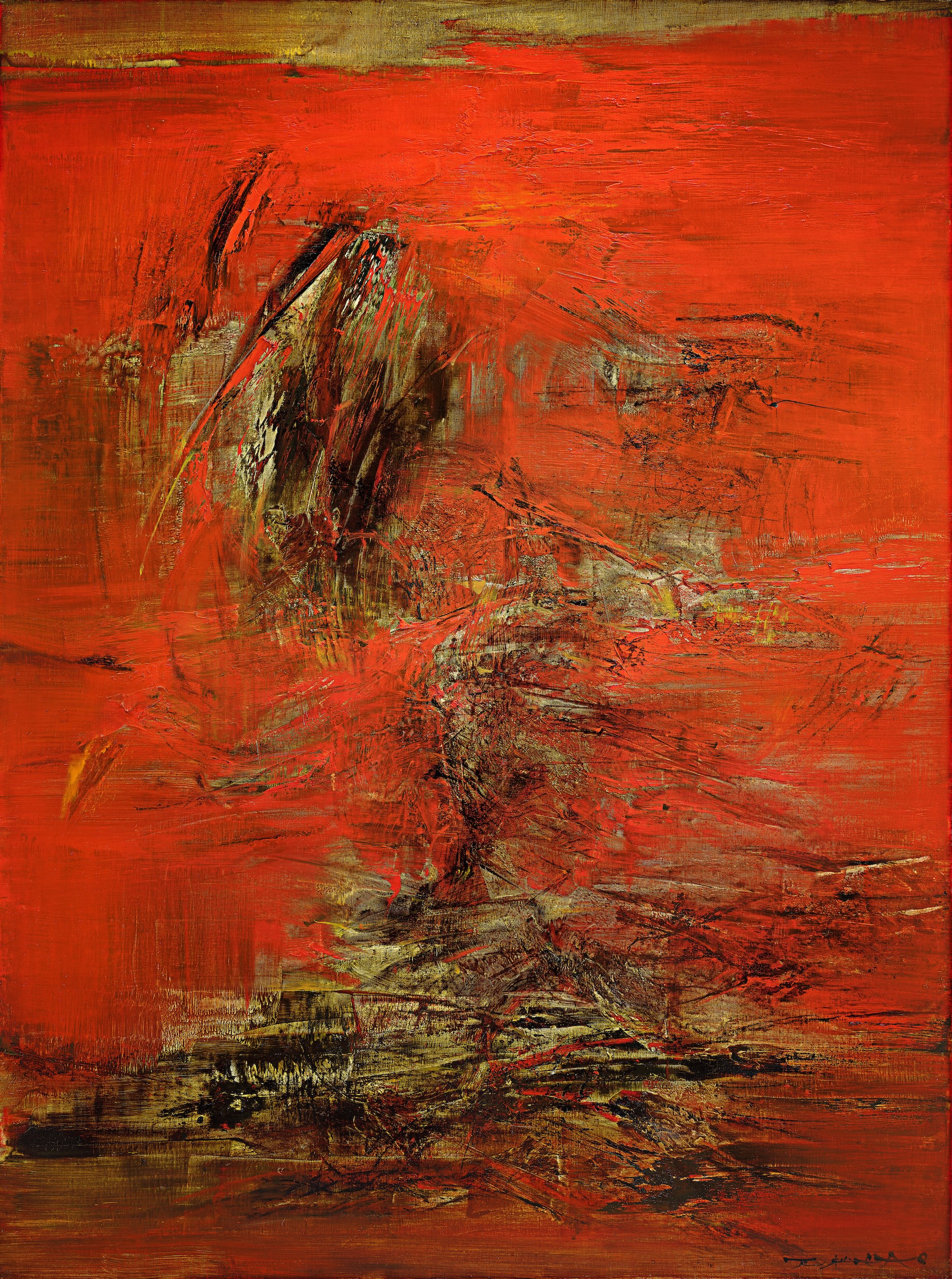
Zao Wou-Ki, 17.3.63 (1963), estimated at HK$70 million ($9 million). Photo:
Courtesy of Christie’s |
Christie’s has unveiled a significant Zao Wou-Ki painting for its
September 26 sale in Hong Kong, 17.3.63 (1963), with an estimate of HK$70 million ($9 million). We talk a lot about the market’s lack of paintings with estimates near or above the $10 million mark. This is especially true of the Hong Kong auctions, where Asian buyers have shown a great deal of caution in recent years. Nevertheless, two works by Zao sold last fall in Asia for prices above $9 million: a triptych from 1980 made nearly $12.3 million in September of 2024 at Christie’s in
Hong Kong, and another sold in Shanghai in November for $9 million at the same auction house.
A fractionally smaller work from the same series as 17.3.63, also in vibrant red tones, sold for HK$76 million ($9.8 million) with fees in Hong Kong in May 2021. With that recent comp, and last season’s signs of demand in the Zao market, this sale might provide an interesting indicator of Asian market interest. So far, the work is being offered without a direct or third-party
guarantee.
Now, let’s get to the main event… |
|
|
Since the most active sector of the art market lately has been the
sales below $1 million, ARTDAI has given us a look at the action at the smaller auction houses: Rockwell and Abercrombie predominate, and collectors keep searching for overlooked value. |
|
|
The art world is less a single, monolithic market than a series of microeconomies
for, say, the work of individual artists or within historical movements. These dynamics can easily be overlooked in the aggregate data from the global auction houses. Last week, we looked at the top 50 artists of the year by overall auction volume, number of lots, overall hammer ratio, and top price for the four largest auction houses: Bonhams, Christie’s, Phillips, and
Sotheby’s. While that list yielded a number of interesting market insights, the most active sector of the market, as I’ve noted before, has been the sales below $1 million. So the data did not reveal as much as we might have hoped.
To compensate, ARTDAI cut the numbers a little differently for us this week. They isolated sales at a group of smaller auction houses to develop a mid-market list of the top 50 artists by the same criteria. (You can download a copy of their report
here.) Here’s what they found… |
The top 10 artists by overall sales volume in the middle market are Norman
Rockwell ($7.81 million), Gertrude Abercrombie ($3.26 million), Bridget Riley ($2.34 million), Alexander Calder ($2.08 million), Rembrandt Bugatti ($1.96 million), Pablo Picasso ($1.9 million), Paul Howard Manship ($1.71 million), John Frederick Lewis ($1.69 million), Willem de Kooning ($1.67 million), and Le Pho ($1.57 million).
|
|
|
A MESSAGE FROM OUR SPONSOR |
ALWAYS CONTEMPORARY
With a bold silhouette that conveys movement even at standstill, the Range
Rover Sport is striking from every angle.
EXPLORE |
|
|
Further down the list are painters Ernie Barnes, who sold
eight works for $1.32 million, and Wassily Kandinsky, who sold five works for $1.31 million. There was also $1.27 million in sales for N.C. Wyeth and $1.17 million for Mai Trung Thu. |
Because of the lower price points in this data, the number of lots sold for each
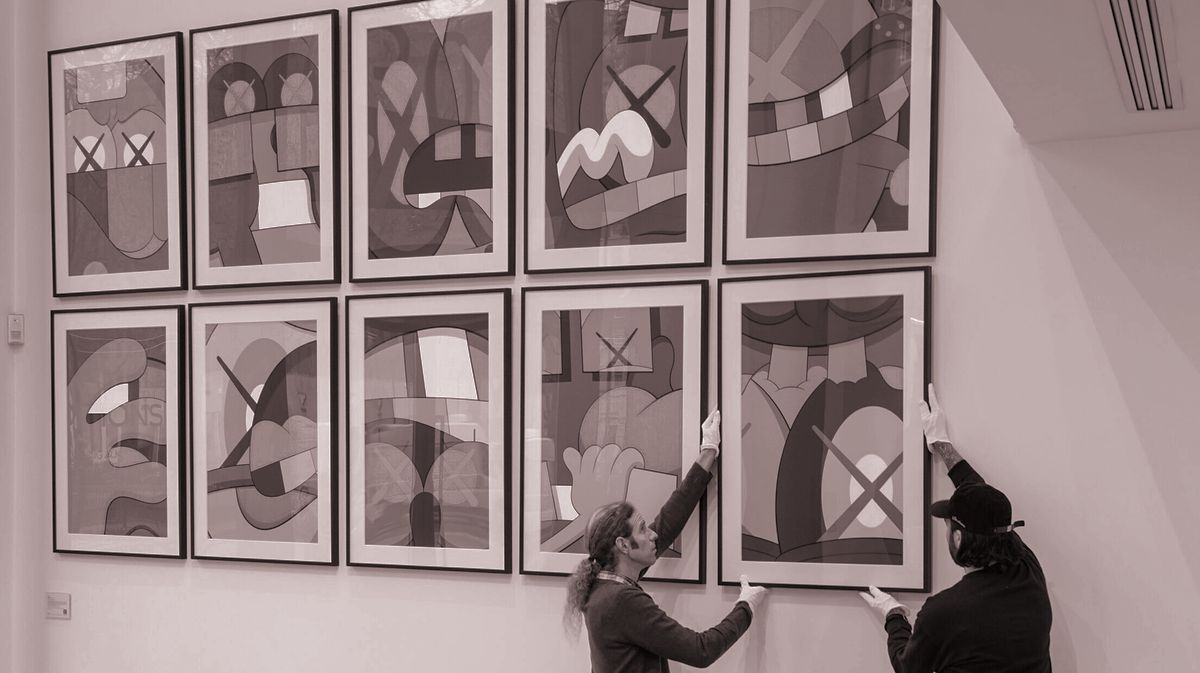
artist might be viewed as a better indication of the market interest in their work. At the top of the list was KAWS with 157, then Picasso with 122, Isabelle de Borchgrave with 61, ceramicist Toshiko Takaezu with 56, Pierre Jeanneret with 52, and Isamu Noguchi with 46. Retna, whose studio was seized in a rent dispute, had 44 lots sold; potter Beatrice Wood sold 34 lots; designer
and sculptor Harry Bertoia sold 33; and Jeff Koons sold 26, mostly editioned porcelain versions of his famous sculptures.
There are more interesting names among the artists with high auction volumes, including Raymond Pettibon with 23 sales, Sam Gilliam with 22, Betty Woodman with 21, Robert Graham with 21, Wolf Kahn with 20, and Duncan Grant with 19.
|
The hammer ratio data—meaning the ratio of the combined hammer prices achieved against
the aggregate estimates, across all works sold by a given artist—can get a little tricky at this price level. Lynda Benglis had the highest hammer ratio, at nearly five times the estimated value of her six works that sold at auction. But the bulk of the overage comes from just two lots, one estimated at $40,000 that sold for more than eight times that amount, and another estimated at the same price that sold for more than three times the amount. Meanwhile,
Rockwell had sales nearly five times the low estimate, which is odd for such a well-established artist, but the number is due in part to the anomalous way that Heritage Auctions provides information on estimates.
Five pieces of furniture by Donald Judd collectively sold for more than three times their initial estimates at Wright. That will be good news to fans of minimalism who have been lamenting the ebbing interest in Judd’s sculptures. The 15 Gertrude
Abercrombie works combined sold for nearly three times the aggregate estimate. N.C. Wyeth also outperformed estimates, with five works also selling for nearly three times the estimate, though one painting from 1912 provided the bulk of that overage.
Retna’s 44 works sold for more than two and a half times the estimate, but it’s likely that the conditions of the sale (see above) favored very attractive estimates. Five works by Western artist Ed Mell, who
died last year, were auctioned for prices that exceeded the total estimate by more than two and a half times. British painter Mary Fedden also had five works that sold for more than two and a half times their combined estimate. Cartoonist Lee Lorenz had 16 works sell for prices more than twice the estimate. And Sonia Delaunay, featured heavily in the Guggenheim’s Orphism show, saw five works auctioned for prices more than double their collective
estimate. |
|
|
It’s worth mentioning that the KAWS market remains quite strong at this level, with
the 157 works he sold achieving a hammer ratio of almost double the estimate. Victor Vasarely sold 11 works at prices that doubled the estimate, too. And those 20 Kahn works made prices 1.75 times the estimate. That’s a strong showing. |
Finally, as a reminder that the smaller auction houses can sell works of meaningful
value, the top artists by maximum selling price were Riley, who saw a $2.34 million painting sold through Bonhams; English Orientalist John Frederick Lewis, whose $1.44 million sale was done there as well; Rockwell, who had a $1.31 million painting sell at Heritage; and Barbara Hepworth, whose $1.29 million sculpture was sold through Bonhams. A de Kooning work on paper sold for nearly $1.1 million there, too; a Calder sculpture made more than $1 million at Doyle;
a Tetsuya Ishida sold for almost $1 million at Bonhams; and a Manship painting made more than $900,000 there, too. Rounding out the top 10 was a work sold for more than $900,000 by Frank Tenney Johnson, a painter of the American West, and a Rembrandt Bugatti sculpture of two leopards that sold for more than $850,000.
Because ARTDAI does not track the sales from specialist auctions in Western art, we’re probably seeing an underrepresentation of that category in this data.
As we’ve seen from our other reporting, there’s a robust market there, too. With that caveat aside, the overarching conclusion suggested by this data is the enduring one we began with: The art market is actually a series of micromarkets, where collectors continue to search for overlooked value. |
I was sent a recent
article in the Observer by art advisor Elisa Carollo that tries to give context to some recent, perhaps overly publicized gallery closures. Carollo’s point is that each of the events is distinct, and has little in common with the others. That said, she does try to address the question of whether gallery cost
structures have gotten out of whack with current sales volumes and margins. Though some of the piece devolves into a bit of a pointless circular firing squad debating margins, there’s also a somewhat too convenient excuse: “Galleries often show what they believe in, not just what they know will move.”
True enough. But, also, that seems to suggest that an art dealer’s passion should somehow suspend the basic laws of microeconomics. And when you think about it, one of the reasons art
remains far more expensive than it should be is the mismatch between a gallerist’s revenue needs and their expenses. (If you’re only going to sell a few works, you’re going to have to charge a lot to cover your expenses.) That leaves us with a real bottleneck in the distribution system.
Perhaps the most valuable parts of the article are the insights that Carollo gathered from gallery owners from around the world. Carollo also makes a point that bears repeating: The interest in art is very
much there from a wide range of collectors, many of them young. If the gallery system can figure out a solution to its own bottleneck, there could be a resurgence in art buying ahead.
That’s it for today. Back on Friday.
M |
|
|
The ultimate fashion industry bible, offering incisive reportage on all aspects of the business and its biggest
players. Anchored by preeminent fashion journalist Lauren Sherman, Line Sheet also features veteran reporter Rachel Strugatz, who delivers unparalleled intel on what’s happening in the beauty industry, and Sarah Shapiro, a longtime retail strategist who writes about e-commerce, brick-and-mortar, D.T.C., and more. |
|
|
Finally, a media podcast about what’s actually happening in the media—not the oversanitized,
legal-and-standards-approved version you read online. Join Dylan Byers, Puck’s veteran media reporter, as he sits down with TV personalities, moguls, pundits, and industry executives for raw, honest, sometimes salacious conversations about the business of media and its biggest egos. New episodes publish every Tuesday and Friday. |
|
|
Need help? Review our FAQ page or contact us for assistance. For brand partnerships, email ads@puck.news. You received this email because you signed up to receive emails from Puck, or as part of your Puck account associated with {{customer.email}}. To stop receiving this newsletter and/or manage all your email preferences, click here. |
Puck is published by Heat Media LLC. 107 Greenwich St, New York, NY 10006
|
|
|
|