Hi, and welcome to Line Sheet’s first Inner Circle-exclusive issue. As a reminder, the Thursday edition of this private email is only available to our highest tier of membership. (If you are being tacky and forwarding this email, recipients can upgrade here.) I’m grateful for your support and also believe that this product is very much worth it.
Thanks to everyone who reached out as we navigate these horrendous fires. My family and I are okay, and I hope you’re okay, too. One big lesson, if you want to get philosophical, is that the lack of local newsgathering makes disasters like these even more difficult to manage. If you are a media executive, it’s never been a better time to crack this local news thing.
Today’s email is about the future of Hermès, one of my all-time favorite topics of conversation. Word in Paris is that the world’s most worshiped luxury firm is prepping for the launch of a new category. More on that below, plus a couple quick thoughts from me. And if you need a true distraction from the tragedy at hand, might I suggest checking out tomorrow’s episode of Fashion People with the inimitable Christopher Kane, whose recent collaboration with the London-based Self-Portrait made me miss seeing his wares on the runway. We go pretty deep, and I hope you enjoy it. Listen here and here.
Mentioned in this issue: Hermès, Nadège Vanhee, Axel Dumas, Chanel, Matthieu Blazy, Versace, the Agnelli family, Mayhoola, Kering, Rick Caruso, Palisades Village, Jonathan Anderson, Loewe, Bottega Veneta, Bruno Pavlovsky, Chris Black, Patrick Radden Keefe, Ozempic, Legos, Babygirl, Daniel- Yaw Miller, and many more…
|
Three Things You Should Know…
|
- Back to big brand dominance?: Over the past few years, the smaller big fashion brands have dominated the industry’s attention: not only Jonathan Anderson at Loewe and Matthieu Blazy at Bottega Veneta, but also Pieter Mulier at Alaïa and Chemena Kamali at Chloé. Too big often meant too boring. Will that change if Anderson is off to Dior (more soon on that, I promise) as Blazy moves to Chanel? If bored consumers respond positively to their visions, the pendulum may swing back toward the megabrands.
A lot will also depend on how people react to Peter Copping at Lanvin, Sarah Burton at Givenchy, Michael Rider at Celine—all of whom will show their first collections this spring—and Louise Trotter at Bottega Veneta, who will take her first bow in October. Whoever wins will need to propose something that is less packaged and less generic than most of what is on offer right now.
- How’s that Versace sale going?: Market sources have been nudging me to flick at who else could possibly buy Versace. One suggestion was that Exor, the Agnelli family holdco run by heir John Elkann, may be interested. (Exor most famously owns a significant stake in Ferrari.) Another theory posits that Kering might be game, but would finance the deal through a joint investment with Mayhoola, the Qatari-backed fund that owns Balmain and is in the process of selling its stake in Valentino to Kering.
But my gut has been telling me that Mayhoola may not want to play in fashion’s major leagues anymore. (In recent years, C.E.O. Rachid Mohamed Rachid has been making investments in smaller brands through another vehicle, Bidayat.) Partnering with Kering, which has the operational expertise that Mayhoola never achieved, could be a more efficient way to stay in the game. Anyway, these are two interesting prospects. Do they have legs? Message me if you know anything.
- L.A.’s Rick Caruso rising: The reports from the Pacific Palisades, where the Los Angeles fires started on Tuesday morning, are mostly about things burning down: people’s houses, Pali High (where Carrie was filmed), Elyse Walker (the upscale boutique and decades-old neighborhood fixture). But there’s also talk of what was spared from significant damage, like the Eames House and the Getty Villa, and, notably for our purposes, Palisades Village, the 6-year-old outdoor shopping center conceived by Rick Caruso, the mega-developer behind The Grove, The Americana, and the Miramar Resort in Montecito.
Caruso, who ran a failed bid for mayor in 2022, has spent the past few days railing against the person who beat him, Karen Bass, the former longtime congresswoman and Jeff Katzenberg-endorsed candidate. Bass has been getting understandably dragged for leaving L.A. for Africa, as part of a U.S. delegation to support the inauguration of the new
president of Ghana, when warnings about the winds and potential fire hazards were getting more serious. Bass has also been criticized for cutting the fire department’s budget by $17.6 million (or roughly 2 percent), reductions that went into effect in July.
Anyway, like I said, Palisades Village wasn’t hit as hard as any of the structures around it—it’s new, and was certainly built with this sort of natural disaster in mind. (Caruso also hired a team of private firefighters—very L.A. of him—to combat the flames on Tuesday night.) Not surprisingly, just as the sentiment around Trump has improved with never-MAGAs post-election, there’s a feeling that Caruso might have had a better handle on this situation, especially among the elites who do business with him.
|
|
Now on to the main event…
|
|
|
|
The legendary, family-controlled leather goods house is contemplating an unprecedented and decidedly old-school move: couture. Do the costs and craft required for this rarefied market make sense for the already stellar quarter-trillion-dollar business?
|
|
|
In fashion, we often say that there is Hermès, and then there is everyone else. The 186-year-old firm doesn’t play by the rules of luxury, it makes them—setting standards in terms of pricing, distribution, and quality, etcetera. Hermès famously doesn’t have a marketing department or hire celebrities to front its advertising campaigns.
Hermès also refuses to charge what the market would bear for its priciest handbags. That’s a pointed tactic that has nestled the company, controlled by the same family for six generations, in the good graces of consumers while still profiting handsomely. Hermès made about $15 billion in 2023, which is peanuts compared to LVMH’s $86 billion, but it had a comparatively advantaged 43.49 percent operating profit compared to LVMH’s 26.5 percent. This spread explains, in part, how its $244 billion market cap is around 75 percent of LVMH’s own $329 billion valuation.
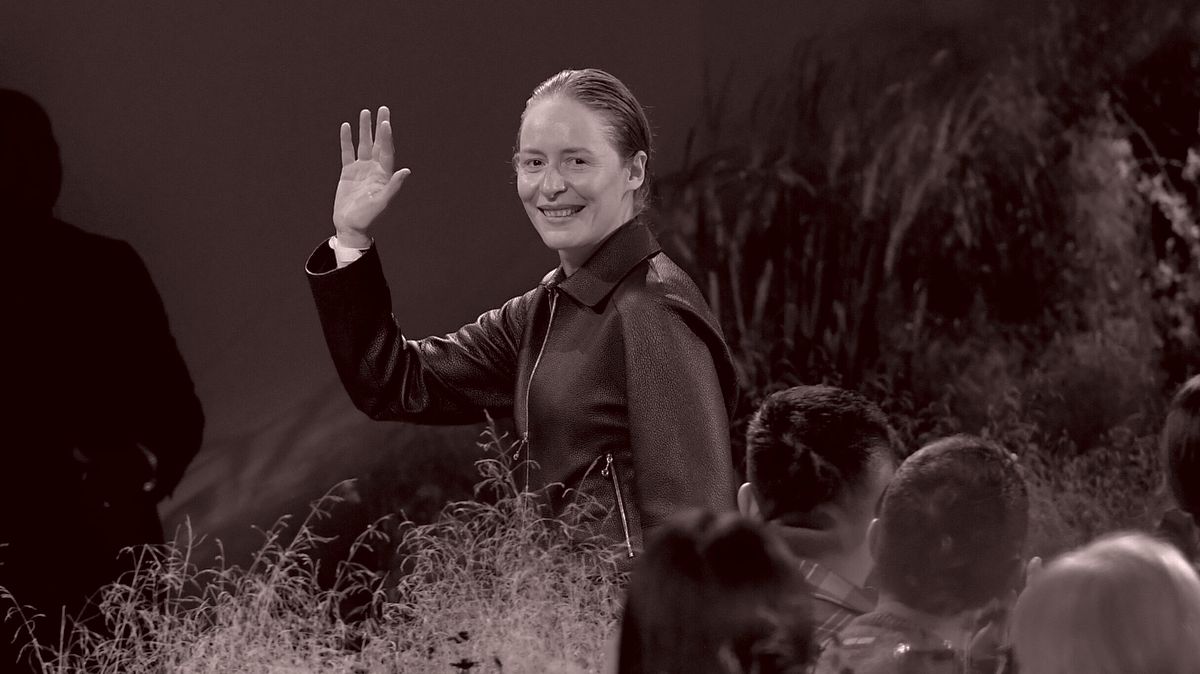
Since Hermès does what it wants, my interest was piqued when I heard recently that the company was plotting an expansion into a category historically devoid of new entrants: couture. According to multiple sources inside the company, womenswear designer Nadège Vanhee has been quietly working on the concept, with the possibility of a 2027 launch. When I inquired, a representative for Hermès provided a simple response: “Maybe
someday.” The statement was consistent with C.E.O., and sixth generation-heir, Axel Dumas’ comment to the Financial Times several months ago. “We could do couture,” he demurred. “We don’t rule it out.”
When I heard the news, I wondered if Hermès viewed a couture collection partly as an employee retention tool. Vanhee’s name was bandied about in the Chanel conversation, and the appointment of Matthieu Blazy as “ artistic director of fashion activities” made me think that Vanhee was perhaps considered, even if it seemed like an unlikely match. (To be clear, I don’t know if a call was actually made.) People don’t leave Hermès—and when they do, they are usually fired. But for a serious designer, Chanel couture is the apex.
In the end, though, my sense from talking to people around Hermès is that couture was a worthy flier—a true why not situation—for a quarter-trillion market cap company. Of course, developing a couture collection would require a substantial initial investment, likely in the tens of millions of dollars. Couture, after all, is not simply custom designs: Every individual piece must satisfy the requirements established by the Chambre Syndicale de la Haute Couture, the governing body. There will have to be a new studio established, with new, highly skilled workers—poached, no doubt, from top competitors. Many European fashion houses that are approved to show couture by the Chambre Syndicale don’t even bother on account of the expense.
|
|
Despite the cost, there may also be a business imperative in giving Vanhee this sort of platform. And it’s one best understood by Hermès’s closest competitor, Chanel, whose business is fundamentally built on couture, the ultimate discretionary item. (The point, of course, is that you wear it once.)
Chanel has long driven the craftsmanship messaging home with its annual Métiers d’Art runway show, which showcases the work of its various ateliers—most now owned by the company—that specialize in everything from featherwork to cashmere milling. Over the past decade, it has also aggressively increased its prices and attempted to convince consumers that its handbags are embodiments of that mystique and therefore as good as Hermès’s. This strategy hasn’t always worked successfully. Consumers have not been entirely swayed that the brand’s bags are worth it, and the company’s frequent mouthpiece-slash-president of fashion, Bruno Pavlovsky, even admitted to reporters that they had pushed too hard on pricing. (The other problem, of course, is that the juxtaposition makes Hermès bags seem so underpriced.) The appointment of Blazy, a designer synonymous with craft, is an indication that Chanel wants to give this strategy another, renewed shot.
Regardless of whether a luxury brand began as a couturier or leather goods manufacturer, these days, the profits are derived from many different channels: Handbags, shoes, wallets, and other high-margin items, and yes, beauty and fragrance. In recent years, Hermès has made a concerted effort to legitimately enter the designer beauty space, which Chanel and Dior, the top couture brands, have dominated. And like Chanel and Dior, Hermès also sells a lot of ready-to-wear. (Chanel may have been the first company to employ a superstar designer, but Hermès was not far behind, hiring Martin Margiela in 1997—a choice that reflected the company’s preference for subtlety and strangeness over pomp and circumstance.) As for whether a leather-goods-first brand can convincingly make couture? I’d argue that Vanhee, who’s been designing the collection for more than a decade, has brought a sense of cultural relevance to the clothes, and I’d be interested in reviewing her proposal.
It’s also an opportunity to engage customers who have a closet full of Birkins, a house full of the company’s objects d’art, and a private jet furnished in Hermès leather, in a new, arguably more special, way. (This is a business, after all.) The luxury industry is at the precipice of a major transformation; the consumer is more jaded than ever. Worse comes to worst, raising the ceiling will only make those Kelly bags seem even more reasonably priced.
|
Congrats to my Actual Dear Friend Chris Black, who is writing an “untitled book of criticism.” This sounds much harder than his last book, a compilation of his best Twitter quotes. (We have two copies if you want me to send you one.) Hopefully the advance for this book was also much bigger. [ X]
After failing to find a buyer, a designerless Y/ Project is shutting down [ WWD]
Jacob wrote a really nice thing (too nice?) about Patrick Radden Keefe’s turn as a J.Crew model. But how much did they pay him?! [ New York Times]
Two of my favorite Danish products, Ozempic and Legos, may get slammed with heavy import taxes if Trump doesn’t get his way regarding Greenland. (If you haven’t heard, he wants Denmark to cede the island to the U.S.) Unclear how real this is, but never underestimate him. [ New York Times]
I know a lot of you enjoy the work of Daniel- Yaw Miller, who covered sports stars and apparel at The Business of Fashion, and wondered where he was headed when he stepped down a month or two ago. Turns out that he joined advisory firm Upland Workshop’s sports culture practice. Upland’s clients in that realm include none other than LeBron James. The firm is run by Adam Mendelsohn, who was foundational to the creation of Puck. Congrats to Dan! [Inbox]
Delia’s take on Babygirl—that it’s worth seeing because they nail the music—is right. (Forget George Michael and “Father Figure” for a minute, though; it’s really about “Deceptacon” by Le Tigre.) I’d also say they nailed New York City, and Nicole Kidman’s powder pink/dove grey/vulnerable girlboss wardrobe. [ Deez Links]
|
|
And finally… Today’s email was made possible by a lot of people. Special thanks to Danielle, Brooke, Gaby, Fran, Joel, and Team Puck.
Until tomorrow,
Lauren
|
|
|
|
A private email offering unparalleled access to the global art market: the mega-auctions and galleries, elite buyers and sellers, and the power players who run this opaque world.
|
|
|
Need help? Review our FAQ page or contact us for assistance. For brand partnerships, email ads@puck.news.
You received this email because you signed up to receive emails from Puck, or as part of your Puck account associated with . To stop receiving this newsletter and/or manage all your email preferences, click here.
|
|
Puck is published by Heat Media LLC. 107 Greenwich St, New York, NY 10006
|
|
|
|