Welcome back to The Hidden Layer. I’m Ian Krietzberg, celebrating ChatGPT’s third
anniversary at Amazon’s AWS re:Invent conference in Vegas. (Yes, it’s only been three years… although I think I still had hair back then.) Lots to get into there, but I’ll save that for next time.
Today, I’m unpacking Trump’s latest A.I.-related executive order establishing the Genesis Mission—this administration’s version of the Manhattan Project, or Project Apollo, depending on which statement you read. Plus, I’ve got news and notes on the regulatory wars, and a
startup’s push to become the leader in A.I. audio models.
Also discussed in this issue: David Sacks, Sam Altman, Asad Ramzanali, Gradium, Kyutai, Elon Musk, Clément Delangue, Suno, Neil Zeghidour, Brad Carson, Chris Stewart, and many more…
Let’s get into it… |
Three Things You
Should Know…
|
- Neil
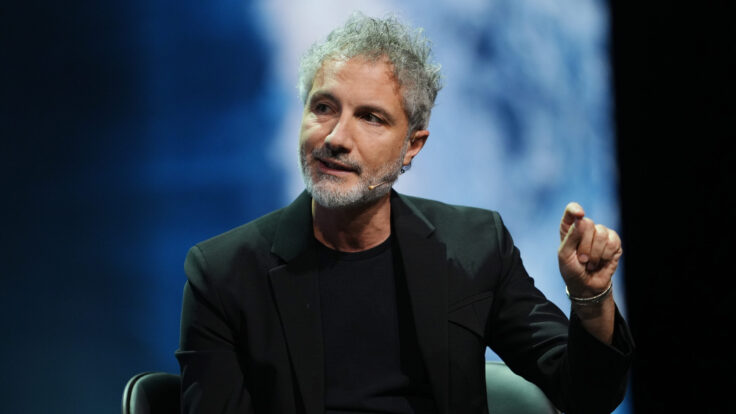
Zeghidour’s $70M seed round: A new French company called Gradium, focused on cornering the market for frontier voice A.I. models, emerged from stealth mode today with $70 million in seed funding. Founded in September by a group of research engineers from Google DeepMind and Meta’s FAIR lab, the company aims to raise the standard for voice A.I. models by making them more expressive, customizable, and usable across numerous contexts, and with no more latency than that of a human
conversation.
In many ways, Gradium is a natural next step for founder Neil Zeghidour, who told me he invented a new audio language modeling approach while working as a research scientist at DeepMind. He left Big Tech several years ago to build Kyutai, one of the first nonprofit A.I. research labs in Europe. Kyutai published
plenty of open research in the audio modeling space, but eventually, Zeghidour and his co-founders decided it was time to launch a company focused on shipping actual products. (According to Zeghidour, Gradium will have a strong partnership with Kyutai.)
Yes, Gradium is going up against a handful of hyperscaler-backed A.I. voice players that have already achieved market dominance. But Zeghidour told me that he’s not intimidated by their scale. Gradium’s advantage, he argued, is the
combined expertise of their team, along with the fact that their models, at just a few billion parameters, are significantly smaller than most L.L.M.s and can be trained on just a few dozen G.P.U.s—in stark contrast to xAI’s Colossus, a data center that houses around 200,000 chips. “We can compete despite being much smaller,” Zeghidour said. “There are things that are specific to the problem of voice, and there are things that are also specific to the fact that we have been
scientifically carrying the field for 10 years. So the accumulated experience is worth a lot.”
While Zeghidour wouldn’t share Gradium’s valuation or other financials, he told me that the company had secured its first customers within six weeks of opening its doors. No surprise, perhaps, given the size of the market—which ranges from healthcare to banking to entertainment—and the company’s current pricing. “This is a big round. The reason why we did it is we want to demonstrate our
velocity,” he said. “We try to also show that in three months, we are able to catch up with the incumbents. That’s why we needed significant capital.” - PAC men: Last week, former Reps. Brad Carson and Chris Stewart announced plans to launch Public First, a 501(c)4 dedicated to educating Americans about A.I. and advancing public policy. At the same time, they announced the launch of two new super PACs, one Republican and
one Democratic, intended to counterpunch Silicon Valley’s lobbying efforts. They expect to raise a total of $50 million. That would make them a significant challenger to the recently launched Leading the Future PAC, which boasts a $100 million war chest and is focused on electing “pro-A.I. candidates.” In contrast, the Carson-Stewart super PACs will focus on “electing candidates who champion responsible tech policies that reduce harm and protect against A.I.’s worst risks,” according to a
statement.
Notably, the new PACs arrive as some Republicans on the Hill are trying to resurrect the unpopular idea of a moratorium on state A.I. legislation by injecting preemption language into the N.D.A.A.—an effort that has divided the G.O.P.’s own ranks. When I connected with Carson on Monday, he said the PACs were “important to
launch, because those who favor reasonable guardrails on A.I. needed a voice in campaigns. The $100 million from Leading the Future needed to be counterbalanced.”
|
|
|
A MESSAGE FROM OUR SPONSOR |
Watch Partner Perspectives: Legal Strategy Meets AI Innovation Introducing Partner Perspectives — a new short-video series by White & Case featuring insights from our lawyers on the legal and business trends shaping tomorrow. In this episode, White & Case partners Erin Hanson, Hope Anderson and Tim Hickman discuss key considerations for companies as they align their AI product strategy and legal strategy. Watch the video |
|
|
- Altman’s
code red: In the three years since OpenAI released ChatGPT, the competition—from Google, in particular—has finally caught up. And it all has Sam Altman at least a little rattled. He reportedly sent around an internal memo—reported by The Wall Street Journal and The Information—declaring a “code red,” and instructed staffers to pull back from other projects (like ad integrations and shopping agents) to get all hands on improving ChatGPT. Practically, this means
making the product faster, more reliable, and more personalizable—in other words, making it better. OpenAI did not respond to a request for comment.
|
Deal of the Week: The
Warner-Suno Marriage
|
Last week, a copyright infringement lawsuit between Warner Music and Suno, an A.I. music generation company,
settled as the two companies announced a new “groundbreaking partnership.” As part of this, Suno will launch new licensed models next year, and introduce download restrictions for free accounts. Warner, while referencing “new revenue streams” for artists and songwriters, said the collaboration will allow for an element of interactivity that
will enable “deeper fan engagement.”
As with the very similar enemies-to-lovers settlement between Universal Music Group and Udio in October, artists will have full control over whether to participate in the new platform and how their work shows up in A.I.-generated outputs. Suno
also acquired Songkick, a concert discovery platform, from Warner in the deal. Financial terms were not disclosed.
And now for the main event… |
|
|
The administration’s Genesis Mission, an unprecedented attempt at public-private A.I.
development, has been speciously compared to the Manhattan Project, which ended World War II, and the Apollo program, which brought us to space. But where is the money coming from—and what, exactly, is it poised to do? |
|
|
Last Monday, David Sacks, the venture capitalist moonlighting as Trump’s
A.I. and crypto czar, wrote on X that reversing America’s massive investments in A.I.—which might have accounted for half of G.D.P. growth in the first six months of the year—would “risk [a] recession.” This was an unsurprising pronouncement from Sacks, whose occasionally somewhat self-serving Silicon Valley boosterism has helped set the tone for the
administration’s tech policy. For better or worse, the White House’s economic goals are now deeply entwined with the success of hyperscalers that have committed trillions of dollars to the A.I. arms race.
Perhaps uncoincidentally, just a few hours later, President Trump published an executive order launching the Genesis
Mission, a “dedicated, coordinated national effort to unleash a new age of A.I.‑accelerated innovation and discovery”—one that “can solve the most challenging problems of this century.” Chris Wright, the U.S. Energy secretary, claimed somewhat loftily that the Apollo program and the Manhattan Project were its natural progenitors.
Unlike the Manhattan Project or Apollo, however, the Genesis Mission effectively codifies a technological race without a clear finish line.
In practice, the E.O. calls for building an integrated platform using proprietary federal scientific datasets “to train scientific foundation models and create A.I. agents to test new hypotheses, automate research workflows, and accelerate scientific breakthroughs.” Makes sense: The government presumably has access to massive quantities of data from decades of research on everything from fusion to biotech and advanced manufacturing. With “resources available through industry partners,” you
simply feed all that data into model training and start generating new discoveries. Easy, right?
Notably, the mission will be overseen by the Department of Energy rather than the National Institute of Standards and Technology or the National Science Foundation. Wright has been charged with submitting 20 scientific and technological challenges of national interest—which will likely focus on energy technology, biotechnology, and advanced computing frameworks—within the next two months.
These will be updated on an annual basis. |
|
|
A MESSAGE FROM OUR SPONSOR |
Watch Partner Perspectives: Legal Strategy Meets AI Innovation White & Case partners Erin Hanson, Hope Anderson and Tim Hickman explore how AI companies can align legal strategy with product development from the outset. From data governance to global regulation, the message is clear: “AI is moving fast. So is the law. The winners will be those who align early.” Watch the video |
|
|
In many ways, the administration’s goals here align with policy proposals that Silicon Valley A.I. firms have
sent to Washington—namely, to dramatically accelerate “A.I. development and utilization,” which has been a core tenet of the executive action Trump has taken thus far. To that end, the Genesis Mission will involve a massive public-private partnership between government agencies, university researchers, and private companies. The list of private collaborators currently
features more than 50 businesses, including Google, Microsoft, OpenAI, Anthropic, AWS, Hugging Face, Quantinuum, IBM, HPE, Nvidia, and AMD. (Elon Musk’s xAI is conspicuously absent.)
After the announcement, I spoke with Hugging Face C.E.O. Clément Delangue, who expressed profound excitement about the Genesis Mission. “We’ve experienced firsthand how more openness
and collaboration in the U.S. can massively accelerate progress,” he told me. “In my opinion, that’s what led to the current A.I. boom and U.S. leadership [in the field].” Delangue added that there are already thousands of open science models and datasets on Hugging Face’s platform, and said that he expects to see “an order of magnitude more” over the next few months, specifically from federal agencies like the D.O.E. |
“There’s Real Promise Here”
|
One major outstanding question is the provenance of the cash. Will the government
issue contracts, as it did with the Apollo program? Or will it effectively function as a customer for these businesses? How much money will be allocated to this project? (The Department of Energy didn’t respond to questions seeking clarity on this point.) But the order is intent on incentivizing private-sector participation through
“coordinated funding opportunities or prize competitions across participating agencies”—an undefined process partly under the aegis of Sacks, whose influence as a special government employee continues to grow despite an investigation from several Democrats into whether he’s overstayed his term.
Asad Ramzanali, the director of A.I. and
tech policy at the Vanderbilt Policy Accelerator, told me he’s worried about the risk of federal dollars servicing private enterprise, all under the nebulous guise of the public good. And he has a point—even if you’re the sort of A.I. maximalist who views the tech as a crucial front in the U.S.’s cold war with China. The Apollo program cost $25
billion—roughly $250 billion today. In its peak year of funding, the Manhattan Project made up around 1 percent of federal outlays, and the Apollo program made up around 2 percent. If the Genesis Mission is anywhere near as ambitious, there will be a lot of money up for grabs—and Trump’s executive order doesn’t exactly make it clear how different stakeholders will
benefit.
Meanwhile, this push to accelerate A.I. growth and “unleash” science comes in the wake of Trump’s own efforts to slash federal research budgets, including those at the National Institutes of Health and the National Science Foundation. Still,
Ramzanali said, “There’s real promise here,” since the National Labs already have powerful supercomputing capability and the federal agencies possess vast, useful sets of data. But he’d like to see more than just a massive data center build-out: For instance, he hopes university researchers might gain access to federal funding to expand research initiatives, along with the use of the new public infrastructure envisioned in the E.O.
However, Ramzanali remains concerned about the
possibility that this project might be used as a justification to preempt state-level regulation of A.I., for instance, or otherwise simply allow the A.I. hyperscalers to continue their unchecked growth. “At the end of the day, it does come down to how this is implemented,” he said. “I think that when the government relies on private sector entities, there’s a heightened level of transparency required. And I hope that that plays out—that we actually get to see the details of who’s doing
what.” |
That’s all for today. I’ll see you on Thursday.
Ian |
|
|
Join Emmy Award-winning journalist Peter Hamby, along with the team of expert journalists at Puck, as they let you in on the
conversations insiders are having across the four corners of power in America: Wall Street, Washington, Silicon Valley, and Hollywood. Presented in partnership with Audacy, new episodes publish daily, Monday through Friday. |
|
|
A professional-grade rundown on the business of sports from John Ourand, the industry’s preeminent journalist, covering the
leagues, players, agencies, media deals, and the egos fueling it all. |
|
|
Need help? Review our
FAQ page or contact us for assistance. For brand partnerships, email ads@puck.news.
You received this email because you signed up to receive emails from Puck, or as part of your Puck account associated with {{customer.email}}. To stop receiving this newsletter and/or manage all your email preferences, click here. |
Puck is published by Heat Media LLC. 107 Greenwich St., New York, NY 10006 |
|
|
|


_01KBDMRATPPHXQTZ5YQZQHXSSM.png "White & Case")
_01KBDMR9ZTY91GX0QA9JFRQTRC.png "White & Case")


_01KBDMR85S0RY73A07933WB6A8.png "White & Case")
_01KBDMR7PAP2F7GKRDRJRY0YYP.png "White & Case")