{{ 'now' | timezone: 'America/New_York' | date: '%b %d, %Y' }} |
|
|
Welcome back to The Hidden Layer. I’m Ian Krietzberg.
Yes, I saw that new
open letter—signed by well-known figures in the A.I. sector, politicians, faith leaders, and even the Duke and Duchess of Montecito—calling for a ban on the development of superintelligence. As I mentioned on Tuesday, conversations about
“A.G.I.” or superintelligence usually revolve around existential fears rather than legitimate science. There is no technology today that would be prohibited by the proposed ban, and it’s hardly inevitable that we’ll get there. Meanwhile, researchers worry that these types of melodramatic statements divert political attention away from real harms—like those being actively created by chatbots.
That said, we’re not going to deal with the letter today. Instead, I have news and notes on
OpenAI’s decision to up the ante in the browser wars, why Google doesn’t care, and the latest on the Trumpian assertion that Anthropic’s chatbot is “woke.” Another day in paradise. For the main event, my partner Leigh Ann Caldwell interviewed Sen. Mike Rounds, the co-chair of the Senate A.I. Caucus, this morning down in Washington.
Also discussed in this issue: Dario Amodei, Sam Altman,
David Sacks, Trump, Marc Andreessen, Dane Stuckey, and many more…
Let’s get into it… |
Three Things You
Should Know…
|
- Dario
Amodei on defense: Earlier this month, David Sacks, the triple-threat V.C.-podcaster now serving as Trump’s A.I. czar, accused Anthropic of “running a sophisticated regulatory capture strategy based on fear-mongering.” He’s spent the past few weeks doubling down on the assertion that Anthropic is working to “backdoor Woke A.I. and other
A.I. regulations” in an attempt to influence state-level regulators. “Anthropic is welcome to oppose the administration as much as it wants,” he wrote on X. “But let’s not pretend this is about A.I. safety research.” A16z’s Marc Andreessen, a major Trump donor and loud critic of A.I. regulation,
responded with one word: “Truth.”
A day later, Anthropic chief Dario Amodei, caught between the Trump administration and the A.I. safety community, published a blog post detailing the company’s commitment to American
leadership in A.I. He noted that Anthropic “publicly praised” Trump’s A.I. Action Plan, and reiterated the company’s partnership with the government: a $200 million defense contract, and an
agreement with the G.S.A. to offer their chatbot, Claude, to the federal government for $1. The defensive posture makes sense for other reasons, too: While many A.I. executives have pledged money and support to the administration, Amodei has not. Like Altman, he has a history of donating to the Democratic Party. - The browser battles: On Tuesday, after months of speculation, OpenAI launched its most significant challenge to date against Google: a new browser named Atlas. (It seems that someone has been studying up on Greco-Roman mythology.) The innovation is to basically plug ChatGPT into everything on
the service, which runs on Chromium, the open-source web browser project maintained by Google.
Within the browser, users can pull up a ChatGPT window to summarize or reorganize the contents of a web page, or have an A.I. agent “take actions.” In a demonstration, OpenAI had ChatGPT agentically purchase a user’s preferred sunscreen and
snacks in response to a prompt to grab the “usual stuff” on Instacart for a beach day. The release—which some users found underwhelming, partly because of the costs associated with the more advanced features, and partly due to latency issues—follows the release of Perplexity’s own A.I. browser, Comet.
Meanwhile, a blog post published by Brave Software, the developers of a rival browser, pointed out that there are plenty of security weaknesses with A.I.-infused browsers. Among those vulnerabilities is the potential for practically undetectable prompt-injection attacks, in which malicious prompts lurk in the
background of certain websites, ready to leverage the action-taking capability of these browsers to steal sensitive user information, like bank account passwords. OpenAI C.I.S.O. Dane Stuckey acknowledged that this remains an “unsolved security problem,” and that Atlas might make the kinds of mistakes we all expect from L.L.M.s, “like trying to buy the wrong product or
forgetting to check in with you before taking an important action.”
But the ultimate challenge for these browsers will be winning customers from Chrome, which broke its own browser-market-share record earlier this month, at 71.8 percent. (Google also recently
extended its share of the search market to a whopping 90.71 percent.) Jim Yu, the C.E.O. of BrightEdge, an S.E.O. marketing firm, told me that Google’s “ability to defend its market share is robust. Atlas is certainly something to
watch, but the big picture here is that OpenAI needs a lot more than a new browser to take Google’s crown.” - New legal allegations against OpenAI: The parents of Adam Raine, the 16-year-old who committed suicide after developing an intensely emotional relationship with ChatGPT, have amended their lawsuit
against OpenAI. The legal team bringing the case cited new evidence that OpenAI relaxed mental health safeguards “to increase user engagement” twice in the months leading up to Raine’s death. The lawyers specifically pointed to a ChatGPT Model Spec card from 2024 that reads, “For topics related to mental health, … the assistant should not change or quit the conversation.” This,
they argue, changes “the legal theory from reckless indifference to intentional misconduct.”
Jay Edelson, the family’s lead attorney, noted in a statement, “We expect to prove to a jury that OpenAI’s decisions to degrade the safety of its products were made with full knowledge that they would lead to innocent deaths.” An OpenAI spokesperson expressed sympathy for the Raine family’s loss and highlighted the company’s recent efforts to strengthen safeguards for teenage
users. At the same time, the FT reported that OpenAI sent a legal request to Adam’s parents seeking “all documents relating to memorial services or events in the honour of the decedent including but not limited to any videos or photographs taken, or eulogies given, … as well as invitation or attendance lists or guestbooks.”
|
“I’ve been thinking about this David Foster Wallace quote more and more recently: The
technology is just gonna get better and better and better and better. And it’s gonna get easier and easier, and more and more convenient, and more and more pleasurable to be alone with images on a screen, given to us by people who do not love us but want our money. Which is all right. In low doses, right? But if that’s the basic main staple of your diet, you’re gonna die. In a meaningful way, you’re going to die.” —Eugenia Kuyda, the founder of Replika, one of the first
companies built around offering A.I. companionship. The cognitive dissonance, she said, is “very high.”
And now, here’s Leigh Ann’s conversation about A.I. with Senator Rounds… |
|
|
The South Dakota senator dishes on A.I. policy, as well as the latest on the government
shutdown, and whether Pete Hegseth should go. |
|
|
Anyone who’s ever watched a congressional hearing focused on tech policy—say, social media, or digital data
collection—knows that our legislative body doesn’t have the most sophisticated understanding of any current technology, let alone the rapidly advancing field of artificial intelligence. That’s why then-Senate Majority Leader Chuck Schumer tapped Sen. Mike Rounds, the affable A.I. enthusiast and South Dakota Republican, during the last Congress to help educate his colleagues on the issue—including by convening top tech leaders such as Elon Musk,
Mark Zuckerberg, and Sam Altman to give a borderline geriatric Senate a crash course in Artificial Intelligence 101.
Since then, of course, the technology has found an unlikely champion in Donald Trump, a man who famously has avoided using email, and yet returned to office pursuing a win-at-all-costs agenda for global A.I. supremacy—including a designated A.I.
czar and releasing an “action plan.” Rounds isn’t far behind in his zeal, and is working the other side of Pennsylvania Avenue to push for more rapid A.I. adoption in finance, health, science, and more.
And yet,
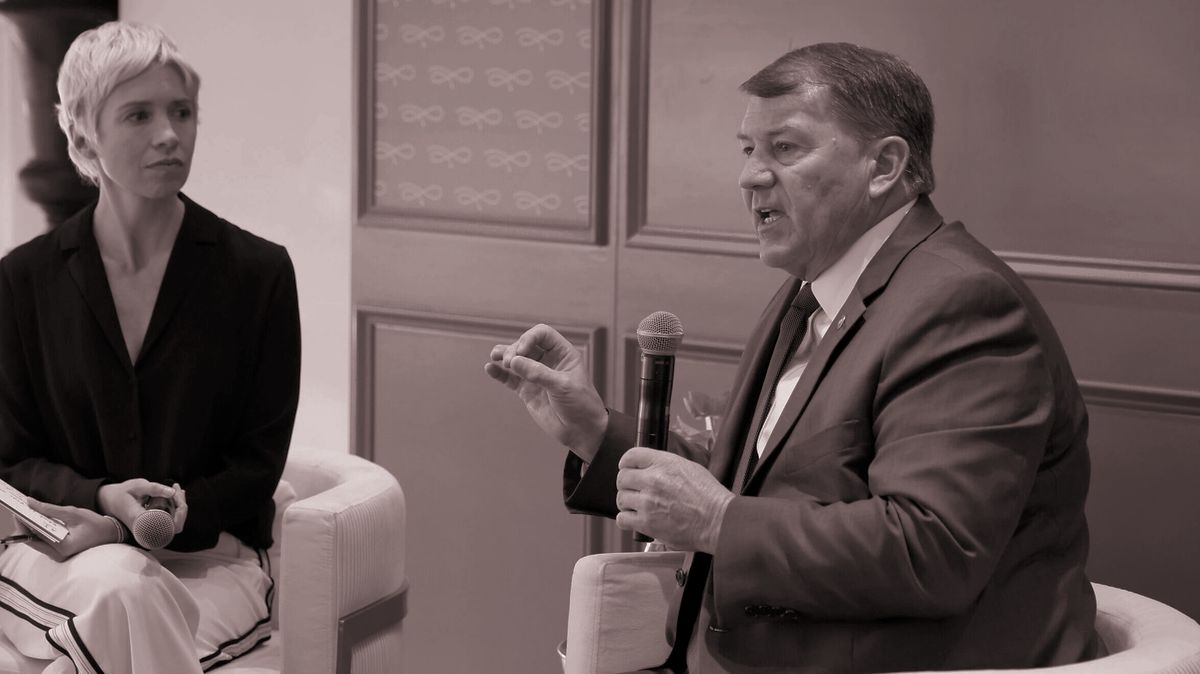
when I interviewed Rounds at the Puck Power Breakfast at the Riggs Hotel this morning, he notably disagreed with the administration in several respects. He thinks Congress—and the states—need to regulate A.I., as well as support wind and solar sources to help meet its surging energy demands. |
“We’re Three Years Behind”
|
Leigh Ann Caldwell: How do you view regulations and A.I, and what do you
think Congress should do? Should they stay out of it or get involved?
Mike Rounds: If Congress is ineffective, then states will take it into their own hands. Congress is ineffective in a lot of cases, and because of that, states look at this and say, We might not be able to protect the rest of the country, but we can sure protect our people. My opinion is, Congress needs to take a leading role laying out standards for everybody in the country. But we have to
respect the fact that if we’re not going to do it, [the states are] going to do it. We need to keep our eyes on what [the states] are doing, but we need to step forward as well.
What does that look like?
You’ve got different committees that all have different points of view, but you’ve got to bring people together. You have a Justice Department that’s going to have one point of view based on what the existing laws are, and a Judiciary Committee that’s going to take
a point of view. Commerce [is] going to be listening to the different business interests and talking about how they should regulate them and create new law. You’ve also got the rest of Congress out here saying, We’re getting feedback from people in lots of different states about privacy concerns, about identifying what’s real and what’s not. Those are the types of things where I think Congress is going to have to get more actively involved—but it’s just the tip of the
iceberg.
So Congress is behind?
Definitely. The last time we actually did an appropriations bill was probably December 2023. How the hell are you supposed to make changes when you’re doing continuing resolutions and you don’t pass bills? You’ve got to have a working, operational, functional decisionmaking body. And it’s why I come back and tell folks we have a lot of work to do up here.
Three years ago, I got a briefing that was at a Special Access level,
and it dealt with what the military had to do to integrate artificial intelligence into the defense of our country. As I listened, all I kept thinking was, My gosh, this is stuff we got to get started on right now. It’s been three years, and we haven’t had an appropriations process in place since then to actually put the money into places so that we could develop the A.I. that will impact people’s lives forever. We’re three years behind from where we should be, just because we’re not
doing appropriations.
Absent congressional regulation, should companies who are developing this [technology] put in their own safeguards?
For them, it’s better to have the safeguards built in rather than be liable for something going south on them. For those that don’t, they’re probably not going to be around very long, because the cost of fixing the problems could be significant. On the other hand, you’re going to have companies out there saying, We got some
real whack jobs out there that aren’t taking care of their stuff. They're moving forward and breaking things. I got a system that will help fix it, and I can make a lot of money doing that. We can’t stop the innovation that’s going on, but we can help it by laying out the framework in which we’re going to develop artificial intelligence, and how it’s going to be applied in the future.
The limiting factor is energy. We have about 1,300 gigawatts of energy right now that we use in the
United States. Between now and 2028, we’re going to need between 75 and 100 gigawatts of additional power just for A.I. development in the United States. China is developing a third of what we’re doing right now, every single year; so they’re doing 400 gigawatts a year in new development. Our supply chains can’t compete with that today.
The administration doesn’t believe in an all-of-the-above strategy, shutting down wind and solar projects around the country. Is that a
mistake?
If they’re actually shutting them down, the answer is yes, because we need all of the above. We can’t build without turbines until we literally go to space-based power—which, by the way, is not that far away—where you actually capture energy in space. Eventually, we will produce, some people say, anywhere between 30 to 50 percent of all the energy needs of our country in space.
How far away is that?
China is doing it now; China has been
working on it for three years. Let’s just say it hasn’t gone unnoticed by our folks. You’ve got commercial interests that are looking at different ways of doing it today. Easily within the next five years, you’re going to have space-based energy collection systems.
Is it necessary that the U.S. takes a posture that China is an adversary in A.I.?
Yes, no question. I would love to say that China is a competitor and not an adversary, but everything we see says that
they’re an adversary. There’s a program right now where they’ve decided that their part of the world belongs to them, and they believe that it should be Chinese standards, and it should be Chinese dominance in the Pacific Rim region. They’re moving in that direction—nothing that we’re seeing in the intel community suggests anything else.
They are trying to put themselves in a position that when they do decide to make advancements in the Pacific Rim region, that we will look at this and
say, Maybe we really don’t want to challenge them. Cybersecurity is where it will start. No matter what happens out there, the early warning for us will be when they start to try to take out our cybersecurity systems in the United States and [those of] our allies. That will be the first warning sign that things are beginning to happen on a kinetic basis elsewhere in the
world.
Read more from the interview here. |
Following a very public bulking phase, wherein Mark Zuckerberg handed out eye-popping
employment offers to A.I. engineers across the ecosystem, Meta has now entered a cutting phase: It’s laying off 600 people within its A.I. division. [Axios]
Reddit has filed a lawsuit against Perplexity and a few others for training its A.I. “answer engine” on Reddit content without permission (or, more importantly, compensation).
[Adweek]
And even as chatbots and language models are positioned as a replacement for traditional search engines, a recent, large-scale study identified a potential impending bump in the road: Such tools misrepresent news content around 45 percent of the time. So… read Puck, not ChatGPT.
[EBU] |
That’s all for today. I’ll see you next week.
Ian |
|
|
A professional-grade rundown on the business of sports from John Ourand, the industry’s preeminent journalist, covering the
leagues, players, agencies, media deals, and the egos fueling it all. |
|
|
Join Puck’s chief political columnist, John Heilemann, as he roams the corridors of power and influence in America on this
twice-weekly interview show, taking you beyond the headlines with the people who shape our culture: icons and up-and-comers, incumbents and insurgents, moguls and machers in the overlapping worlds of politics, entertainment, tech, business, sports, media, and beyond. The conversations are rich and revealing, unrehearsed and unexpected… and reliably impolitic. A Puck-Audacy joint, new episodes drop every Wednesday and Friday. |
|
|
Need help? Review our FAQ page or contact us for assistance. For brand partnerships, email ads@puck.news. You received this email because you signed up to receive emails from Puck, or as part of your Puck account associated with {{customer.email}}. To stop receiving this newsletter and/or manage all your email preferences, click here. |
Puck is published by Heat Media LLC. 107 Greenwich St, New York, NY 10006 |
|
|
|