 |
|
Happy Sunday, and welcome back to Dry Powder.
|
|
Does it matter that Nelson Peltz, the activist investor threatening another proxy battle with Bob Iger, doesn’t actually own the majority of the Disney shares that were attributed to him in that October 8 Journal report? In today’s issue, a reconsideration of Peltz’s leverage, notes on David Zaslav’s latest self-inflicted wounds, and observations on Cathie Wood’s reemergence.
|
|
|
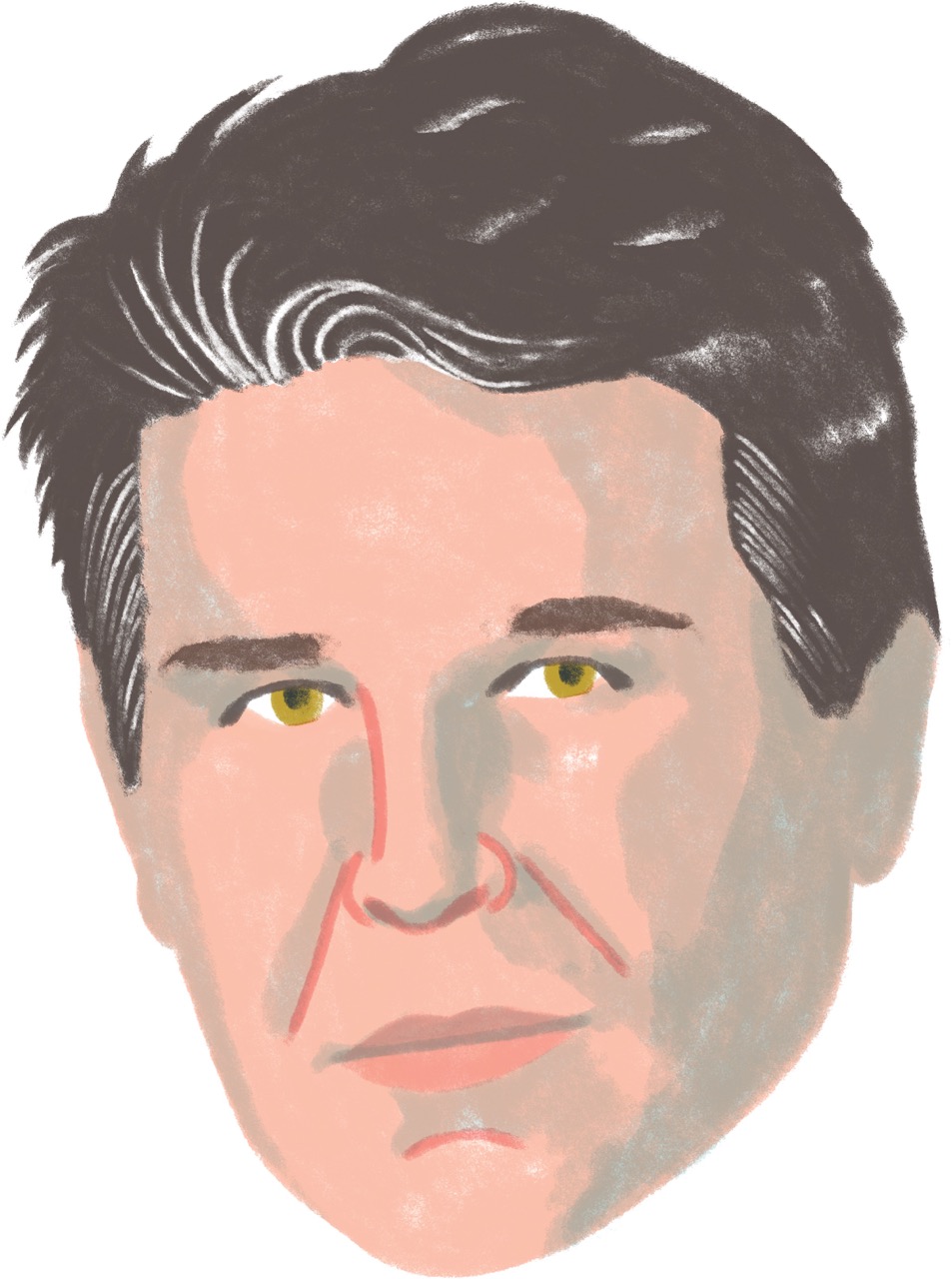
| The Smiling Crocodile, Nelson Peltz, wants you to think he owns 30 million Disney shares, now worth $2.8 billion. That’s what he leaked to The Wall Street Journal on October 8—the day after Hamas attacked Israel. Then, on October 14, the Journal reported that Peltz, who controls the activist hedge fund Trian Fund Management, had upped his shares in Disney to 32.9 million shares, worth nearly $3.1 billion. If it were true, that would make Peltz and Trian one of Disney’s largest shareholders, with the power to exert substantial pressure on Bob Iger and the Disney board. (Though he would still own far fewer shares than the company’s two largest shareholders, State Street and BlackRock, which each owned more than 100 million shares, according to Disney’s 2023 proxy statement.)
But it’s not true. According to Trian’s latest 13F, as filed with the S.E.C. on November 14, Peltz and Trian only own 7.3 million Disney shares, worth $686 million, an increase of 900,000 or so shares from the 6.4 million shares he owned at the end of the second quarter of 2023. Peltz also lists another 25.6 million shares, worth $2.4 billion, on the third-quarter 13F, but these shares are listed as “OTR,” or “other,” shares—meaning shares that Peltz has “investment discretion” over but doesn’t own.
Well, it turns out that these shares are owned by Peltz buddy and fellow octogenarian Ike Perlmutter, the crafty former Marvel executive who made a fortune in the sale of the company to Disney in December 2009. Part of Perlmutter’s compensation in the sale was Disney stock. It’s usually reported that Perlmutter owns “around 30 million” Disney shares, but the true number is likely the 25.6 million over which Nelson claimed he has investment discretion. (Anne Tarbell, a Trian spokeswoman, confirmed that this is the correct reading of the 13F.)
In the first proxy battle with Disney earlier this year, Perlmutter joined forces with Peltz in opposing Disney’s management—first Bob Chapek and then Bob Iger upon his return as C.E.O.—but didn’t give Peltz voting control of his shares. According to Peltz’s proxy statement, Perlmutter called Disney’s directors and lobbied for Peltz to get the board seat he was seeking. In the end, however, Nelson dropped his request for a board seat and the proxy threat. In March, a peeved Iger fired Perlmutter as the chairman of Disney’s Marvel Entertainment, claiming the defenestration was part of the company’s overall cost-cutting effort.
Now, Perlmutter has given Peltz voting control over his 25.6 million Disney shares, and having voting control over the 32.9 million Disney shares is a material improvement for Peltz, although it’s not the same as if he owned the shares himself, as his leak to the Journal implied. I had thought, courtesy of that leak, that Peltz/Trian had stepped up and invested some $1.8 billion more of the fund’s money, giving Peltz much more skin in the Disney game. But, alas, it was really just a clever head fake.
It is not surprising that Perlmutter has decided to more formally join forces with Peltz. What’s still not clear, however, is whether Nelson is going to continue to lobby privately for the board seats he wants or whether he’ll go the public route again, and file a proxy statement with his slate of candidates. Or will Value Act, yet another hedge fund with a big stake in Disney, get the board seat that Nelson wants?
You can’t make this stuff up: Two 80-plus-year-old billionaires are trying to put the wood to a 72-year-old C.E.O. Only in Hollywood, I guess. “It’s just ego,” explained one source who has been following the action in Burbank closely. But I’m glad we’ve cleared up how much Disney stock Nelson actually owns, not what he wants you to think he owns. |
|
|
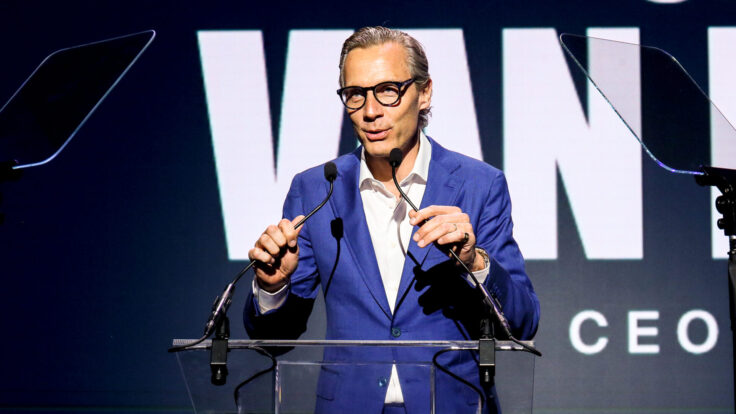
| My Puck partner Dylan Byers and I were chatting the other day, trying to gauge the fallout from yet another tough week for David Zaslav and his WBD creation. As I noted last week, WBD stock cratered 19 percent after Zaz and his C.F.O. Gunnar Wiedenfels announced third-quarter earnings that disappointed the market. Zaz, after all, once promised $14 billion in EBITDA for 2023, and then revised that expectation down considerably, to somewhere in the $10.5 billion to $11 billion range. On the other hand, this past week, the WBD stock recovered nearly 7 percent, suggesting that the big fall was an overreaction.
Zaz still has a boatload of problems. He’s got $43 billion of net debt to grapple with—down $12 billion from the $55 billion when the frankendeal was sealed in April 2022—and the still anemic Zaz-Adjusted EBITDA, as well as an investor base likely losing patience with the fact that the stock is down 56 percent during Zaz’s WBD reign. He also has to continue grappling with the plague facing the whole industry: the ongoing decline of linear TV viewership and the corresponding decline of advertising dollars that flow in that direction. On the bright side, WBD did produce the Barbie blockbuster, and its streaming business, apparently, turned a profit for the first time in the third quarter of 2023. As Dylan wrote the other day, Zaz “has become a convenient caricature for the various pitfalls of legacy media businesses.” And he did himself no favors thinking The New York Times’ recent 8,500-word profile would change the narrative. In fact, it did not, as both Dylan and Matt Belloni explored.
Zaz’s problems in Hollywood are both macro and micro. On the macro side, streaming isn’t yet a profitable business for most of its major players, excepting Netflix. That used to be okay, back when equity investors were high on the industry and its seemingly exponential growth and disruptor status. Alas, thanks in part to the Fed, those days are over, just like the days when Amazon and Tesla could reap huge stock market rewards for their big losses.
At some point, investors get tired of absorbing and subsidizing losses and want to see profits. That’s the inflection point we’re at now with the streaming business. That’s why the profitable Netflix gets rewarded—its stock is up 36 percent since April 2022 and 65 percent in the last year (Bill Ackman, have you taken note?)—while WBD’s stock is down the aforementioned 56 percent since April 2022 and flat in the last year. (The stock of another money-losing streamer, Paramount Global, is down 29 percent in the last year.) There is also the not-insignificant matter of the just resolved writers and actors strike that may seem like a bit of a cash-flow gusher in the short run, due to avoided costs, but that will likely be costly in the longer term, given the new deals the studios had to cut and the fact that the domestic content pipeline is looking anemic, at best. These are facts that affect nearly every big player in Hollywood, and there’s not much Zaz and Gunnar can do about them, at least at the moment.
Then there are self-inflicted wounds that are unique to Zaz and his ambitions. The original sin of Warner Bros. Discovery was the structure of the deal, itself. In order to pry Time Warner out of AT&T, which never should have owned the entity in the first place, Zaz had to agree to be saddled with $55 billion of debt, most of which AT&T thrust onto Time Warner before spinning it off, in a tax-free reverse Morris trust deal, in April 2022. It didn’t take a rocket scientist to know that $55 billion is a whole lot of debt, especially for a company that is struggling to make, at best, $11 billion of Zaz-adjusted EBITDA per year. That’s not Twitter/X territory, of course, which has $13 billion of debt and who knows how much EBITDA (but not much and getting less each day). But then again, Zaz, as wealthy as he is by normal standards, is not the world’s richest man, with the resources to keep paying the interest on the Twitter debt, even though X probably isn’t generating the EBITDA to make those payments without Musk’s checkbook.
If Zaz were less desirous of owning Time Warner, or of being a player in Hollywood, he might have told John Stankey, the AT&T C.E.O., to stuff it when he suggested the $55 billion number. Or he could have structured the original deal for Time Warner as an all-stock deal, although that likely would have resulted in AT&T, or its shareholders, owning even more of WBD than the 70 percent they already do, or did when the deal was first closed. In any event, the original deal structure has come at a very high price indeed for Zaz and Gunnar. And they have to take sole responsibility that, especially since they could always have walked away from AT&T and the deal, or tried to negotiate harder.
But there was probably no other way for them to slice it and marry up in the media landscape. Discovery Communications likely wouldn’t have been long for this world without a megamerger, and Zaz wouldn’t have been C.E.O. in a combined entity unless he had taken a knee on the debt terms. Ego was baked into the deal. Alas, it’s clear now that, at around $100 billion—the $55 billion in debt and $43 billion of equity—Zaz overpaid for Time Warner. That’s clear enough from the fact that all of Warner Bros. Discovery is valued at around $70 billion these days—$43 billion of net debt and $26 billion of equity value.
Zaz is walking a tightrope here, mostly as a result of the deal’s original structure. If WBD’s real EBITDA were the promised $14 billion instead of Zaz-Adjusted EBITDA of $11 billion, at best, a different narrative would be prevailing. He needs more Barbies. He needs more subscribers at Max, subscribers who are willing to pay more for its content. He needs Mark Thompson to continue to right the ship at CNN. He needs to be firing on all cylinders, virtually 24/7. Debt is a brutal taskmaster. Gunnar has promised Wall Street that WBD’s leverage ratio—debt to EBITDA—will be “comfortably below” four times “at year-end, as previously guided.” I’m not sure what the word “comfortably” means here; it’s certainly doing a lot of work in that promise, that’s for sure.
But assuming for a minute that WBD’s Adjusted EBITDA is $10.5 billion in 2023 (with little over a month to go), then Zaz & Co. are going to have to pay down another $4 billion of debt, or so, in the next six weeks. Woe unto them if they don’t. |
|
|
| Sometimes, you just have to scratch your head in amazement about who is given airtime on CNBC. This past week marked the return engagement of Cathie Wood, the way-out-there-in-left-field hedge fund manager, whose ARK Investment Management once upon a time had some $50 billion under management, in February 2021, but now manages far less, just around $7.6 billion. Her premier fund, ARK Innovation, with some $5.8 billion in assets, is down 24 percent in the last three years. Its three largest holdings are Coinbase, Roku, and Tesla, and 97 percent of its investments are in North American equities. Her ARK Fintech fund, with $735 million invested, is down 21 percent in the last three years. Its three largest holdings are Coinbase, Shopify, and Block.
Needless to say, that’s not great, considering the NASDAQ, which is probably the closest comparison to Wood’s ARK portfolio, is up some 18 percent during the same three-year period. Missing the market performance by some 42 percentage points is not the kind of thing that endears a hedge fund manager to his or her investors, but it’s evidently good enough for CNBC to highlight her in a 17-minute segment. (This is not investment advice.)
On CNBC, Wood was up to her same old nutty predictions and promotions. First, she broke the news that her company was getting ready to serve up five new crypto ETFs. (Just what the world needs at this moment…) One will be centered around Bitcoin futures. Another around Ethereum futures. “Another will be Bitcoin futures and cash,” she explained to Andrew Ross Sorkin. One will be a combo of Bitcoin futures and Ethereum futures. And the fifth new ETF will be “broader Bitcoin”—whatever that means—and companies exposed to digital assets or equities.
Wood characterized her suite of new crypto ETFs as a “dress rehearsal” for when the S.E.C. “lets the cat out of the bag,” as Sorkin put it, and allows people to invest directly in a Bitcoin ETF. That so many investors are anticipating this will happen probably goes a ways toward explaining why the price of Bitcoin has been levitating lately and now trades for around $36,000 per Bitcoin, up 117 percent so far in 2023. She suggested that one of the reasons that Gary Gensler, the S.E.C. chairman, had not yet approved the first Bitcoin ETF is because he wants to be Treasury secretary—the implication being, presumably, that approving a Bitcoin ETF would negatively impact his chances of getting that post should Janet Yellen step down or be replaced. (Is this true, Gary? Call me.)
Wood then waxed poetic about the virtues of Bitcoin, as if it hadn’t experienced a collapse in 2022, or suffered any reputational damage in the wake of FTX’s implosion and the conviction of Sam Bankman-Fried, or the entire crypto ecosystem weren’t on reputational thin ice these days. In fact, in Cathie World, these harrowing events, along with the regional bank crisis experienced earlier this year, are just further evidence of the robustness of Bitcoin and crypto. “You can see the health of the network using our on-chain metrics,” she said, whatever that means. “The health of the network is almost as good as it gets. And it seems like this is a bull market. Sure, we’ll have puts and takes. Nothing goes straight up. But I think this flight to quality—Larry Fink [at BlackRock] used that expression—we call it a flight to safety. And look at what happened during the regional bank crisis: Bitcoin went from $19,000 to nearly $30,000, as the regional bank stock index was imploding. If you look at the bank stock index today, it is back down close to where it was in March. So where Larry might say ‘flight to quality’—which is good, it’s true—we would say ‘flight to safety’ because there’s no counterparty risk in Bitcoin.”
I beg to differ: There may be no “counterparty” risk to Bitcoin, but there is also nothing more to Bitcoin, at least at the moment, than a sophisticated way to speculate on whether someone will buy Bitcoin from you for more than you paid for it. It’s still just a way for people to gamble with their money. And that’s fine if that’s what they want to do.
But Wood doesn’t see it that way, no surprise. She said she thinks “most people” understand that Bitcoin “is the money revolution.” She then launched into her usual spiel: “This is the first global, private—so, no government oversight—digital, very important, rules-based monetary system in history,” she said. She even name-dropped Art Laffer, “my professor, mentor, and friend” who told her when they took their “first position” in Bitcoin, in 2015, “I’ve been waiting for this since they closed the gold window in 1970.”
Sorkin reminded Wood that in 2021, when Bitcoin was trading at around $50,000, she said that by 2026, in five years, that Bitcoin would be trading for 10 times more, or $500,000 per Bitcoin. Did she still believe Bitcoin would trade at $500,000 per Bitcoin sometime in the next two years? Why of course she did, chalking it up to the coming regulatory “breakthrough,” which she said would bring big pools of money, or “institutions,” as she called them, “online” into Bitcoin.
She also said the proposed partnership between BlackRock and Coinbase—for the expected creation of a Bitcoin ETF—was “very important.” But Wood did not stop at $500,000 by 2026. She has also predicted that Bitcoin would trade between $1 million and $1.5 million per Bitcoin by 2030.
Personally, I find Wood’s relentless hyping of her investment book terribly offensive. She was a flash in the pan during the risk-off days, when the Federal Reserve made borrowing money nearly cost-less and asset bubbles were inflating across the investment spectrum. But those days are all long gone. And yet, Cathie Wood isn’t. She’s still luring suckers into her web of ETFs and rolling out even more. She’s good TV, I guess. But she’s bad for investors who think she’s onto something. And, frankly, CNBC makes it all the worse by giving her a big time platform on which to continue to sling her hash. I don’t get it. |
|
|
|
| FOUR STORIES WE’RE TALKING ABOUT |
 |
| Gap Year |
| Presaging a C-suite massacre. |
| LAUREN SHERMAN |
|
 |
|
 |
| Zaz Lit 101 |
| News and notes from around the media industry. |
| DYLAN BYERS |
|
 |
|
|
|
|
|
 |
|
|
|
Need help? Review our FAQs
page or contact
us for assistance. For brand partnerships, email ads@puck.news.
|
|
You received this email because you signed up to receive emails from Puck, or as part of your Puck account associated with . To stop receiving this newsletter and/or manage all your email preferences, click here.
|
|
Puck is published by Heat Media LLC. 227 W 17th St New York, NY 10011.
|
|
|
|