{{ 'now' | timezone: 'America/New_York' | date: '%b %d, %Y' }} |
|
|
|
Welcome back to Wall Power’s Inner Circle. I’m Marion
Maneker.
In today’s issue, we meet artist Emma Webster, who, despite having a strong run of secondary auction sales in 2023, is only now having her first solo show in New York, at Petzel. Although her otherworldly landscapes are unlike anything her contemporaries are making, the key talking point around Webster is her method: She makes virtual models of the landscapes before she paints. I’ll get into that with her below. Up top, I got tipped off to Christie’s
secret private-selling exhibition in Venice; and I take you on some gallery rounds with me.
Also mentioned in this issue: François Pinault, Richard Bonington, J.M.W. Turner, Édouard Manet, Louise Bourgeois, Titian, Mark Bradford, Guercino, Andy Warhol, Tom Sachs, Lynette
Yiadom-Boakye, Jeanne Greenberg Rohatyn, Shoko Suzuki, Eli Sterngass, Douglas Gold, André Emmerich, Walt Whitman, Théodore Géricault, and more… |
-
Ghosts of Venice: The Venice Biennale officially opens on May 9, but the action begins days earlier—smart visitors will arrive in time to take in private events as early as May 4. These include a Christie’s private-sales pop-up at Ca’Dario, the palazzo one door away from the Guggenheim collection, on the Grand Canal, not far from Punta della Dogana, one of François Pinault’s two private museums in the city. Invited guests will see a selection of works
that feature views of Venice by Richard Bonington, J.M.W. Turner, and Édouard Manet. Works by Louise Bourgeois, Titian, and Mark Bradford will also be on view. Leaning into the palazzo’s recently acquired reputation as a place that curses its owners and renters to an untimely death, Christie’s has also gathered a number of macabre works, including a still life with a skull by Guercino alongside a not dissimilar Andy Warhol Skull painting from 1976. Prices for the works range from $500,000 to $50 million, according to the auction house.
- Goings-on about town: Late last week,
galleries started to unveil their presentations for the all-important May season. My tour began uptown: I ran into Salon 94’s Jeanne Greenberg Rohatyn on the narrow stairs of her multistory and very Instagrammable 89th Street gallery. She had given over the whole building to Tom Sachs’s art and design, most of which is one-off furniture sets made from found materials like striped traffic barriers, though some of Sachs’s paintings are on display, too. At the top
of the building, where I met Tom’s very fit and with-it father, there’s a room with the Sachs production “Shop Chair,” which I recently saw Kaws post on Instagram in front of a Keith Haring tarp. Greenberg Rohatyn also paired Sachs’s design with the rare and exquisite
pottery of Shoko Suzuki, who moved to Brazil when she was denied her own kiln as a master potter in Japan.
Back downtown, I stopped by Lincoln Glenn, on 24th, where Eli Sterngass and Douglas Gold are building a program in American art. They’re younger than their peers by decades, but are showing respect to the history of their field
by mounting a show of artists who had solo shows with André Emmerich, the influential midcentury dealer in color-field art.
Finally, Lynette Yiadom-Boakye, one of the most successful artists to emerge in the last decade, is debuting new works in a show split between Jack Shainman’s two galleries, in Tribeca and Chelsea. They’re a mix of intense charcoal drawings and figure studies on uncharacteristically light backgrounds. When I stopped
by Shainman in Tribeca, Yiadom-Boakye’s skills as a draftsman were on full display. If you go, make sure to see the stunning painting of a woman as a bullfighter in vivid color, which manages to be both deeply familiar and entirely different from her past work.
|
|
|
|
On the eve of her first real New York show, the L.A.-based artist explains her
futuristic process, in which she uses 3D sculpting software, a V.R. headset, and the glitches of the natural world to create landscapes like no other. |
|
|
|
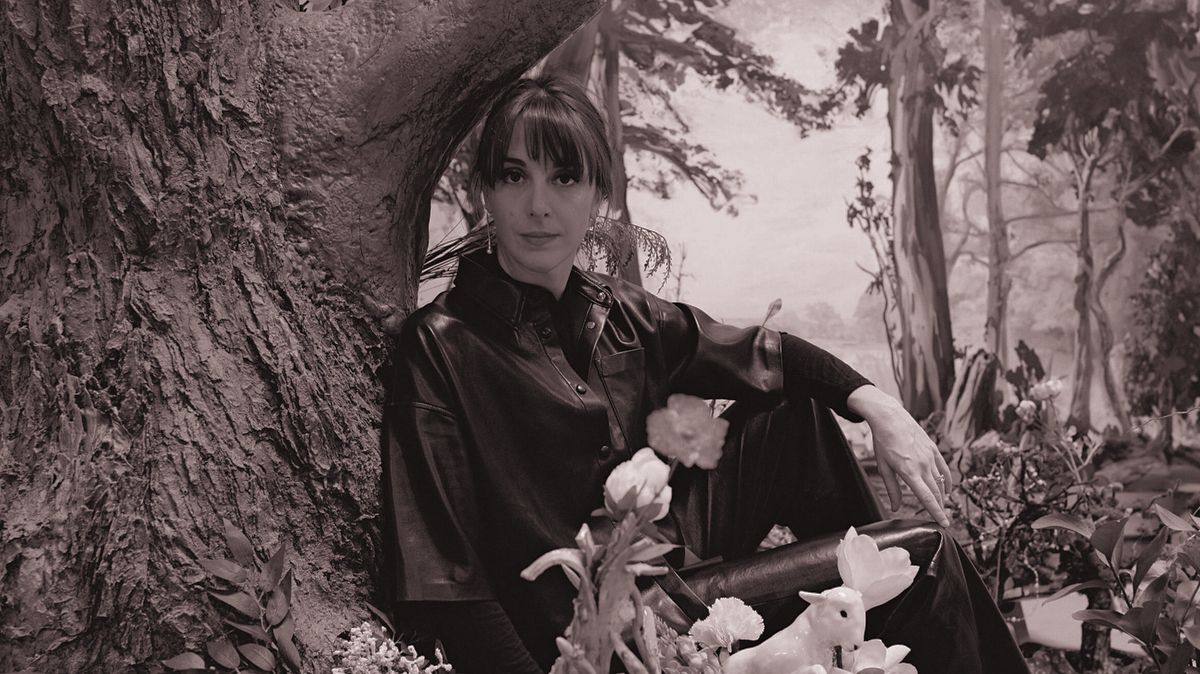
Emma Webster was one of the most heavily sought-after painters to emerge in the
post-pandemic boom. So I was surprised to learn, when I spoke to her recently, that her show at Petzel, opening this week, was her first major solo exhibition in New York. The demand, it turns out, mostly generated from showing in Seoul, Korea. As she told me, her career “really blossomed first through the Asian market,” Europe followed gradually, and America is still “coming
on board.”
The new show, she says, is a “moody” one, with a lot of “unexpected conflict” in the paintings. The 37-year-old artist makes these via a complex system involving virtual studies, built with such tech tools as 3D scanners and V.R. headsets, though she does not describe herself as a tech person. “It needs to come back to painting,” she says. In the conversation that follows, Webster describes how her process works, why she’s excited to face what she calls a “cutthroat” New York
audience, and the “psychological warfare” of Yale’s M.F.A. program, where she developed her technique. As always, the conversation has been lightly edited for length and clarity. |
Marion Maneker: Let’s start with the new show at
Petzel. Can you give a little background about what’s in the show, and what inspired it?
Emma Webster: The title, Rues and Leaves Themselves Alone, comes from a Walt Whitman poem. The show opens April 30, and while I had a small show with Petzel last March, this is really my big New York debut in a lot of ways. It’s an interesting show to use as an introduction to the New York art world because there’s a lot of
unexpected conflict in the paintings—something I think is new for me. I’m known for landscape paintings in which I treat landscape like still life, but this show brings in an almost American Splendor quality. I’m looking not just at the natural world but at the animals we tend to look past, and using these living creatures as a proxy for a larger conversation about why we don’t see, respect, or acknowledge nature as a whole. It’s a moody show, and I’m really excited to see how it’s
received.
But you’re not working from nature directly, are you?
It’s predicated on artifice. Highlighting the artifice of landscape became really important to me because I’m not going out into nature—I’m painting avatars of nature. And it’s through that process that I think there’s real insight to be gleaned—about what we expect from nature, and what an avatar actually is versus something purely fantastical.
So
instead of using the classical tools—sketches of various landscape elements assembled into a composition—you create a full digital world to work from. Is that simply because the technology exists now, or is there a genuine affinity for the digital?
It’s an evolution of what artists and their ateliers have always done. When Géricault painted The Raft of the Medusa, he brought in models to pose for individual sections,
made small sculptural studies, thought through the bodies. I’m doing that, just with digital means. I start with a rough compositional sketch, break it into parts, almost like Legos, and sculpt the various elements—some in real life, which I then 3D-scan, and some using a V.R. headset, which is like working with digital clay.
But above all, you’re building a still life, a scene to work from. Once you have the subject in that finite, concrete way, you can light it properly, and it brings a
realism that’s impossible to achieve by cobbling together 2D sketches. It’s too hard to intuit how light moves around forms, how atmosphere works between elements, without that spatial solidity.
If the digital world were more easily distributable—if people could experience what you’ve built—would you just stop there, or would you still want to make a painting?
I still want to make a painting. I’m actually not a tech person. All the
software I use is free, the kind you can learn from YouTube tutorials. I talk about the tech a lot because I want to show people it’s not some scary A.I. challenge; anyone can use it, and eventually 3D sculpting and rendering software will be as innocuous as Microsoft Word or Photoshop.
But it needs to come back to painting. It works because painting is this original language of the virtual. The first virtual experiences were the murals in Pompeii, where people painted rooms to look like
forests and were meant to feel transported. Paint is an inherently deceptive medium—it transmutes its own chemical character to appear as something else, whether that’s light, an object, or an emotion. The idea that painting is an attempt to re-create reality is at the root of this. |
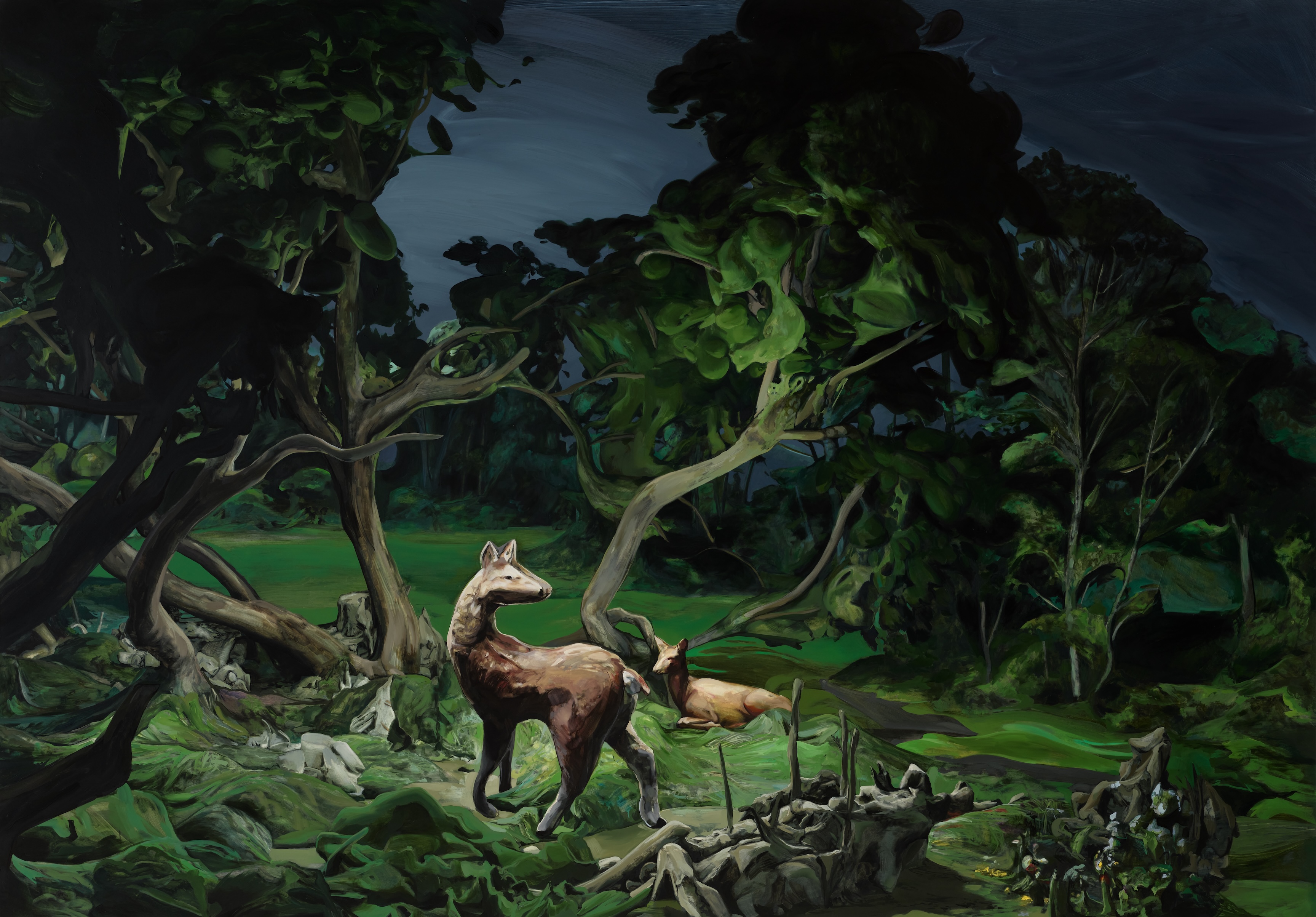
Emma Webster, A Shying Hart (2026). Photo: Marten Elder/Courtesy of DADA
Goldberg
|
When you’re working with flora and fauna as subject matter, are you sketching from life, or
do you work entirely within the virtual tools?
Whenever I bring something into the digital world, I try to make sure a certain level of artifice is embedded in it. There’s already so much technology trying to convince you of its seamless realism. So when I sketch a deer or scan a tree, it needs to carry some degree of error, glitch, and manipulation that shows you can have this realistic scene with these unrealistic characters or components. It’s
like the lie embedded in the object itself, which is so important because there are all sorts of lies and presuppositions we have when we look at the natural world that are not true. We don’t see those lies anymore. Trees, for example, are not static objects. They’re actually creatures. They talk; they move. They’re not that far off from the tree in Lord of the Rings. |
“I
Love Failure in a Certain Way”
|
I’m a little surprised that you haven’t had a show in New York. That certainly hasn’t
stopped people from creating demand for your work.
I had an interesting way into the art world. Perrotin generously brought me in when they were opening their bigger Seoul space, and the reception there was amazing. My career really blossomed first through the Asian market, then gradually the European market. The American market is still coming on board, and I’m not entirely sure why—whether it’s where the work has been shown, or whether there’s
something about the tech dimension that resonated with Asian audiences first.
My stereotype of New York is that it’s very discerning, very intellectual and academic. I’m excited to see if my work resonates. That audience is a bit more cutthroat. A big part of the transition from emerging to more established artist involves people betting on whether you’re going to fail, and it doesn’t feel good to subtly sense someone thinking, I don’t believe Emma Webster has any more good paintings
in her.
Does that get in your head?
No, because I’ve been bet against a lot, and I’m used to it. I also love failure in a certain way, and I’m close to it—I’m not afraid of it. I don’t feel like my best work is behind me or that I’ve run out of things to say. I’m just hungry and curious. They might not believe in it, but I do.
Yale probably helped with that—it’s fairly renowned for its psychological
rigors.
That program is such psychological warfare. You get out of that program and you are mentally strong. It’s very hard to rattle a Yale M.F.A. graduate after what they’ve been through. You go in and have to defend ideas before you even know what the ideas are—being asked to develop something radical and new that you haven’t figured out yet, and being taken to task for it anyway. After enough crits, they stop being about the work and start
being about your thinking: How could you have thought that was a good idea? Where were you going? It’s a little like that movie Whiplash.
And that’s the whole point of going to school—to be in an environment like that, and to be challenged and pushed in a place where you can fail.
Totally. But I will say, not everyone comes out of it tenacious. I graduated with people whose spirits were so thoroughly crushed that
they gave up. That, to me, suggests the program is maybe not helpful. You could argue those people just weren’t cut out for it—but I think it’s also an indicator that the school is doing something wrong.
It’s a very old-fashioned model of education—the rigorous exams, sink or swim, your failure is your problem. The argument for the other approach is that more competent people in the world is better, and if there are many learning styles, maybe we shouldn’t weed out the people who
are only three-quarters competent.
There is one thing the American art system does better than other places: We don’t have the atelier sort of learning you find in Europe or Asia, where the focus is on producing technically proficient artists. What we do well, I think, is insist that art is concept-first—that there has to be a motive, a thought, some value in the thinking before you figure out the medium or the fabrication. Art that prioritizes
technical mastery above thinking is the worst kind, in my opinion.
When you prioritize technical skill, it becomes a conversation about labor—look what I can do—rather than what this is building toward. Modernism fundamentally recrafted our sense of art, from picture portal to art being a reflection of an artist’s journey or psychological state: art as a mirror of the artist’s inner life that’s transferable to whoever encounters the object. We have so many other means at our disposal to
relay accuracy that art shouldn’t be about the technical precision. It should be about the thinking. |
Thanks to Curtis Rowser, who always does a great job wrestling these conversations
into readable form. I’ll be back on Friday with a big announcement for June and more on the luxury business.
Until then,
M |
|
|
|
Puck founding partner Matt Belloni takes you inside the business of Hollywood, using exclusive reporting and insight
to explain the backstories on everything from Marvel movies to the streaming wars. |
|
|
|
Unique and privileged insight into the private conversations taking place inside boardrooms and corner offices up and
down Wall Street, relayed by best-selling author, journalist, and former M&A senior banker William D. Cohan. |
|
|
|
Need help? Review our
FAQ page or contact us for assistance. For brand partnerships, email ads@puck.news.
You received this email because you signed up to receive emails from Puck, or as part of your Puck account associated with {{customer.email}}. To stop receiving this newsletter and/or manage all your email preferences, click here. |
Puck is published by Heat Media LLC. 107 Greenwich St., New York, NY 10006 |
|
|
|
|