|
Hello, and welcome back to The Best & The Brightest. I’m Leigh Ann Caldwell. The Senate is back in town tonight, and they’ll spend the next month working on their version of the tax and spending cuts bill that already passed the House. As one Senate aide told me, this is their first, second, third, fourth, and fifth priority. I’ll have more on that below.
Tonight, my partner Abby Livingston takes you on a tour of Democrats’ candidate-recruitment efforts ahead of the 2026 midterms. The ideal archetype of young(ish) military veterans is straight out of the Rahm Emanuel playbook circa 2006. One archetype that’s not high on the recruitment target list? Biden alums.
|
|
|
|
A MESSAGE FROM OUR SPONSOR
|
In America, farming isn't just a profession; it's a purpose. With 880 million acres of farmland and more than 2 million people dedicated to producing our food in America, farmers are the backbone of our economy. In communities nationwide, Bayer employees work alongside farmers to bring cutting-edge innovations in breeding, crop protection, and technology to their fields. American farmers trust our tools because we have a purpose, too: helping farmers thrive.
Learn more at Go.Bayer.com/Purpose.
|
|
|
- The Senate’s turn: The Senate wants to pass their version of the so-called Big, Beautiful Bill on tax and spending before July Fourth, and President Donald Trump is already getting involved—even though senators don’t yet have legislative text. Sen. Josh Hawley, who has been a vocal opponent of cutting Medicaid and spoken out against aspects of the House bill, posted on social media that he talked to Trump today about the legislation. “He said again, NO MEDICAID BENEFIT CUTS,” Hawley posted on X. (His caps.)
Hawley, who some Republicans have complained is a better agitator than Democrats, will be a critical vote. He also hopes to be an influential shaper of the final product, and advertising his conversation with Trump seems more like a message to his colleagues that the president is on his side. Paralyzing the provider tax, which helps states pay for Medicaid, would cut benefits, Hawley argues. Trump has repeatedly come out against benefit cuts, but he’s not much of a details guy: It’s unclear if he’s spoken with Hawley about the provider tax or even knows what it is. Most Republican senators support it, as it raises about $90 billion in revenue, according to KFF Health News.
It’s a bit earlier than expected, but this is just the beginning of Trump’s involvement with the Senate. The upper chamber’s Republicans can afford to lose three votes.
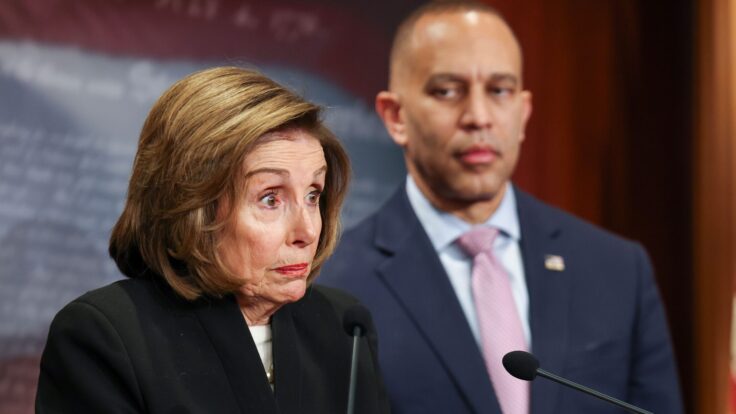
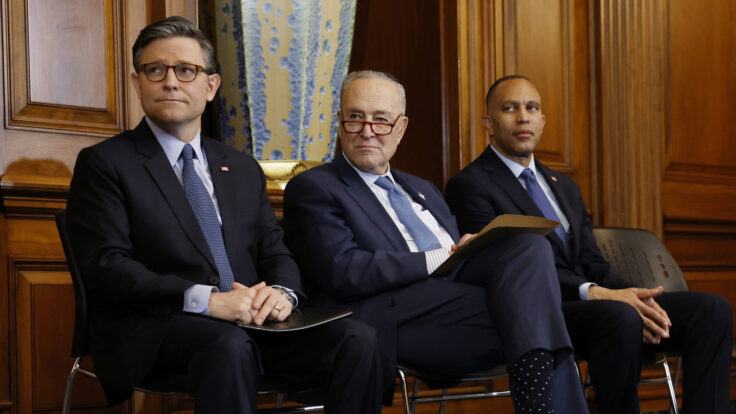
- Demoralized Democrats: House Democratic Leader Hakeem Jeffries inspired eye rolls today with exactly the kind of opaque non-message his caucus has been complaining about, as I reported last week. CNN host Dana Bash asked Jeffries about the Democratic aide who was handcuffed by Department of Homeland Security agents inside Rep. Jerry Nadler’s district office last week. Rather than express outrage, Jeffries offered a ChatGPT word salad: “We will make that decision in a time, place, and manner of our choosing, but the response will be continuous, and it will meet the moment that is required.”
One Democratic aide texted me to say they were beside themselves over this (lack of) response. Jeffries’ tepid reaction, combined with the Justice Department’s pressing charges against Democratic Rep. LaMonica McIver for assault at a protest outside a detention center, has House Democrats worried their leader is missing opportunities to go on offense against Trump and their Republican colleagues.
|
|
|
|
As Trump’s grip weakens, Democrats are recruiting candidates straight from the Rahm Emanuel 2006 playbook: military vets, small-business owners, health care workers, etcetera. Career politicians and Biden insiders need not apply.
|
|
|
|
In retrospect, April 2 was the unofficial kickoff of the Democratic midterm recruiting season. Before Liberation Day, the party was in shambles, still reeling and deeply demoralized from their November defeat—and, naturally, facing a furious donor class. But as markets recoiled from Trump’s global trade war, and his approval ratings began to tumble, potential Democratic candidates sensed an opening. “That was the first big crack in the facade,” a strategist involved in midterm recruiting told me.
Democratic strategists anticipate that the biggest wave of House contenders will start announcing in mid-July, the traditional peak of campaign-launch season. And already, an ideal archetype is emerging, straight out of the Rahm Emanuel 2006 playbook: military veterans. But there are also small-business leaders, and healthcare workers—Democratic but not overtly progressive, more Pat Ryan than Rashida Tlaib. Of course, nearly all of the Democrats who I’ve spoken with say they want candidates who are young—which on the Hill means “under 60”—a vital attribute amid the party’s great gerontocracy debate.
|
|
|
|
A MESSAGE FROM OUR SPONSOR
|
The heartbeat of American agriculture can be heard at every farmer's market and dinner table, spanning 880 million acres, supported by over 2 million people, and contributing $1.5 trillion to our economy.
Thousands of Bayer employees work alongside American farmers, providing access to innovations and support to implement them effectively. Bayer's advanced breeding, crop protection, and digital technology tools are reshaping the future of farming, and we're invested in every field, acre, and harvest. We share the same purpose as American farmers: helping agriculture thrive so we can bring high-quality, abundant, and diverse food to millions. Learn more at Go.Bayer.com/Purpose.
|
|
|
Sure, you don’t need James Carville to tell you that Americans like voting for veterans. But sometimes you have to go back to basics when you’re on the back foot. Democratic strategists note that a military record projects “strength” at a time when the party’s brand is synonymous with “weak.” It also helps to inoculate candidates to take stands that might otherwise get them attacked from the right. For the 2006 midterms, for example, Rahm aggressively recruited Iraq War veterans who could criticize the war—and George W. Bush’s decision to launch it—with the credibility of having served. The conventional is wisdom because it works.
Strategists are also recruiting candidates whose experience speaks to this particular moment: scientists, small-business owners, and healthcare workers who can articulate in personal, vivid terms the administration’s reckless cuts to medical research and slapdash approach to tariff policies. Colorado Rep. Jason Crow, who is a leader of the D.C.C.C.’s recruitment arm this cycle, is particularly interested in sympathetic former federal workers who got DOGE’d by Trump and Elon Musk. (The hitch, according to operatives working on recruiting, is their finances. Mounting a congressional bid often means going 16 months without income, and fired federal workers have just had “a ton of financial instability dropped on top of them,” as the strategist involved in recruiting put it.)
Not surprisingly, there’s some wariness about encouraging current elected officials to run for higher office, given the potential baggage they may have generated with their voting records. “The flip side,” as one strategist put it, “is if they’ve got a voting record, they’ve run for office before, they have some familiarity with what it means to do call time and to manage your politics.”
And strategists are particularly wary about recruiting candidates with ties to the Biden administration. In 2017, so many former Obama staffers ran for office that people joked that the midterms were essentially a jobs-placement program for Obamaworld expats. Alas, in a post– Original Sin world, those attack ads practically write themselves. “I think what voters are looking for is a newer type of Democratic Party, and I think the association of Biden and Bidenworld can maybe cause a little bit of nausea,” said a Dem strategist working on House races. Yes, there are a handful of former administration officials hoping to run, but as one Democratic source put it, “They’re not West Wingers.” And if they decide to throw their hats in the ring, they’re unlikely to lead with that part of their résumé.
|
Dark Clouds & Silver Linings
|
|
The good news, Democrats say, is that they’re more fired up than they’ve been in months, and officials say promising candidates are popping up like weeds. “The enthusiasm has been larger, and has been earlier, than I’ve seen in cycles past, even when I first ran in 2017,” said Crow. “People are stepping up far earlier and in greater numbers than certainly I’ve ever seen in my time in politics.”
|
|
|
The bad news—and yes, Democrats can always be counted on to find it—is that all this enthusiasm can lead to too many candidates crowding into the primaries, making them more expensive and depleting party funds before the general. Indeed, this might already be happening in New York’s 17th district, where the line of Democrats angling to challenge Republican Mike Lawler is a mile long, with a primary likely to run through next June. California is also a perpetual concern, where the top-two primary system means that if too many candidates from one party run, they can split the vote and lock themselves out of a winnable seat.
Democrats groups have been known to take drastic measures to prevent the nomination of candidates they perceive as unelectable. In the past, that meant a progressive who could win a nomination fight, but who party leaders believed was out of step with the district’s general electorate. This tends to infuriate local and national activists—I still hear complaints about the D.C.C.C.’s effective intervention in a 2018, Houston-area primary, wherein the party nuked lefty candidate Laura Moser by dropping oppo research on her campaign. And anyway, there’s an argument that challenging, crowded primaries are a good thing. “I think they’re healthy,” Crow said. “I had a really tough primary, and it made me a better candidate. It tested me, and I was ready for a bruiser of a general because I’d been through that primary.”
With so much turnover at the top of the party in recent years, the rewards for joining the class of 2026 are also more promising than ever. “The ideological spectrum of these candidates is broad, and to a person, I think they are over this shit,” the Democratic recruiter told me, referring to the current administration. “They are motivated, aggressive go-getters that are just not gonna wait around.” This, the recruiter noted, could spell doom for the caucus’s traditional seniority system, which “might not make it another term.”
|
|
|
|
Join Emmy Award-winning journalist Peter Hamby, along with the team of expert journalists at Puck, as they let you in on the conversations insiders are having across the four corners of power in America: Wall Street, Washington, Silicon Valley, and Hollywood. Presented in partnership with Audacy, new episodes publish daily, Monday through Friday.
|
|
|
|
Unique and privileged insight into the private conversations taking place inside boardrooms and corner offices up and down Wall Street, relayed by best-selling author, journalist, and former M&A senior banker William D. Cohan.
|
|
|
Need help? Review our FAQ page or contact us for assistance. For brand partnerships, email ads@puck.news.
You received this email because you signed up to receive emails from Puck, or as part of your Puck account associated with . To stop receiving this newsletter and/or manage all your email preferences,
click here.
|
|
Puck is published by Heat Media LLC. 107 Greenwich St, New York, NY 10006
|
|
|
|